wayground logo

Free Printable Worksheets

Font size

S
M
L
XL
Worksheets

5th Science Milestone Review

Total questions: 100

Worksheet time: 1hrs 29mins

Name
Class
Date
1.
Joel finds an animal in a small pond in his backyard. He sees that it laid its eggs, but the parents live on land. What type of animal could this be classified as?
a)
fish
b)
mammal
c)
reptile
d)
amphibian
2.
When creating an experiment, Talen says that if you put baking soda and vinegar together that will create a gas which is a chemical change. Is he right or wrong and why?
a)
He is wrong. It is a physical change.
b)
He is wrong. It makes no changes.
c)
He is right. It will form bubbles, showing its a chemical change. 
d)
He is right. It is a chemical change because nothing will happen when mixed together. 
3.
 Jack says that if you light a match on fire, it is a physical change because it looks different which would be a physical change. Ellen says that it is a chemical change because a new substance is formed and the match cannot be reversed. Who is correct?
a)
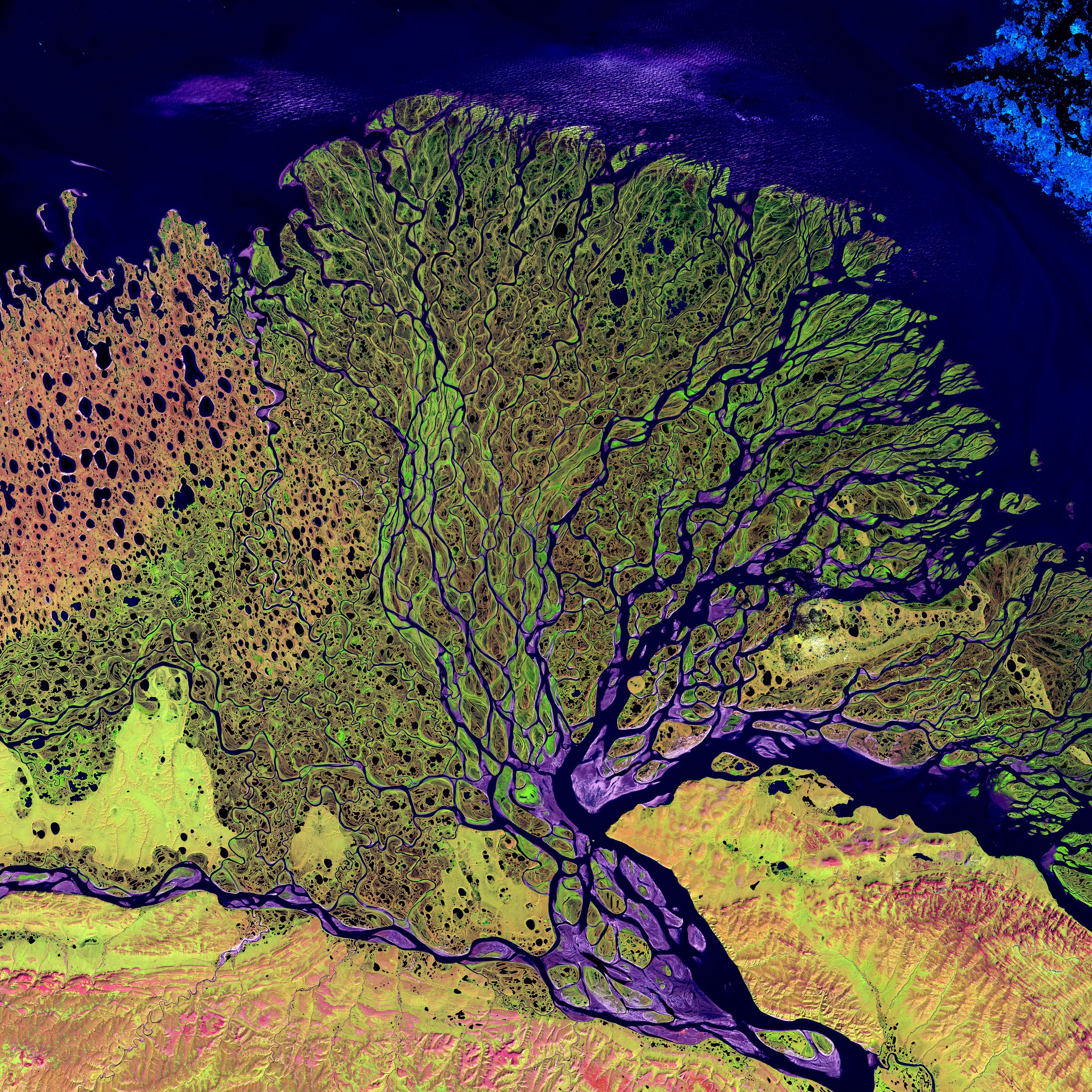
Jack is correct because a physical change is when it changes color.
b)
Jack is correct because it is still a match.
c)
Ellen is correct because the match is still a match even after burning it.
d)
Ellen is correct because it changes temperature and cannot be reversed.
4.
Two students mix together salt, sand and water. Which of these actions would be a physical change to the mixture?
a)
Boiling the water to leave the sand and salt.
b)
Straining the water through a strainer to leave the sand behind. 
c)
Cook the mixture until all the water evaporates. 
d)
Put more chemicals in it to allow the salt and water to evaporate. 
5.
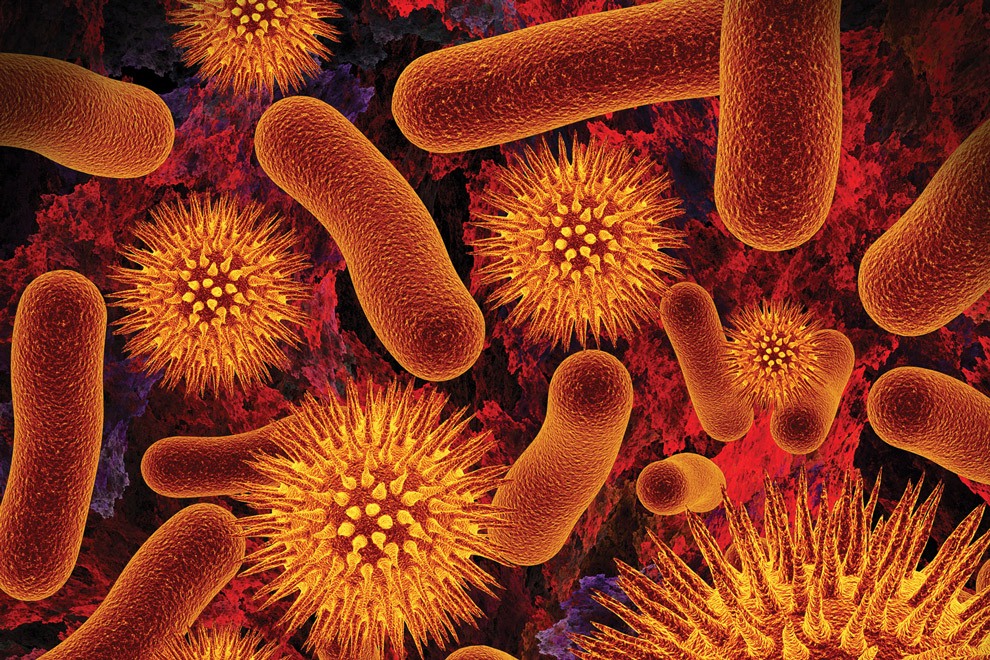
How can harmful microorganisms such as chicken pox be used tor beneficial purposes?
a)
Harmful microorganisms help the bacteria in your body stay balanced.
b)
Harmful microorganisms can be used to make yogurt.
c)
Scientists can take small amounts of the virus and use it to make a vaccine.
d)
Harmful microorganisms have no beneficial uses.
6.
Microorganisms have many different purposes.  What is one beneficial use of yeast?
a)
to fight off bad microorganisms
b)
to make yogurt
c)
to cure chicken pox
d)
to make bread rise
7.
Abraham leaves a peach on the counter as part of an experiment.  After four weeks he notices that a bluish green mold is on the peach.  Which conclusion is true about this experiment?
a)
Microorganisms grew bigger and bigger as they ate the peach.
b)
The mold is not a microorganism.
c)
Microorganisms on the peach multiplied many times making them visible without a microscope.
d)
Peaches naturally turn bluish green as they ripen.
8.
Both Cara and Blake got sick. What might have been the cause of their sickness?
a)
You can conclude they got sick because they swallowed protists while in the lake. 
b)
You can conclude they got sick because they got wet during the hike.
c)
You can conclude they got sick because there might have been e.coli in the undercooked hamburger. 
d)
You can conclude they got sick because there was harmful bacteria in the cave. 
9.
Botox (Clostridium botulinum) comes from a bacteria that causes a very dangerous food poisoning called botulism. This bacteria can cause severe illness and even death.  Doctors have found that this microorganism can paralyze muscle spasms. This ability allowed it to be used with migraine headaches to reduce pain. Some doctors use its properties to temporarily smooth out wrinkles. Which conclusion is best supported by the evidence in the paragraph? 
a)
People should stay away from Botox. It is a very harmful microorganism that can cause death. 
b)
Humans should try to take as much botox as they can to avoid headaches and looking wrinkled. 
c)
Botox is a microorganism that is neither helpful nor harmful. It is commonly found on every surface. 
d)
Doctors have learned to use botox in a safe way so that its benefits outweigh that dangers of the microorganism. 
10.
a)
The puppies will have thick fur.
b)
The puppies will easily respond to a whistle. 
c)
They will not have a long tail. 
d)
The puppies will herd sheep easily with training. 
11.
Michael was talking with his mom about what makes a mammal different from the other vertebrates. Michael says it is because they give live birth. What is another reason he could give his mom to show how mammals differ from other vertebrates? 
a)
They breathe with lungs.
b)
They can have either rough or smooth skin.
c)
They have mammary glands to give milk to their young.
d)
They swim in water sometimes. 
12.
Controls what enters and leaves the cell
a)
Mitochondria
b)
Cell Membrane
c)
Cell Wall
d)
Nucleus
13.
What would happen to the plant cell without the chloroplasts?
a)
There wouldn't be an organelle that performs photosynthesis
b)
There wouldn't be an organelle that serves as the resevoir for water and waste
c)
There wouldn't be an organelle that regulates what comes in and out of the cell
d)
They wouldn't be an organelle that makes necesary proteins
14.
Which organism produces seeds but not flowers?
a)
Lilies and orchids
b)
Horsetails and ferns
c)
Pines and ginkgoes
d)
Ferns and orchids
15.
Jassmine was looking through a microscope at a cell. She sees that is circular and has a dot in the middle of it. Which Sample cell could she be looking at?
a)
Sample A
b)
Sample B
c)
Sample C
d)
Both Sample A and C
16.
What is the difference between organism A and organism B?
a)
Organism A is an animal and Organism B is not.
b)
Organism A has smooth skin and is an amphibian. Organism B is an invertebrate. 
c)
Organism A and B are both vertebrates, but A lives on land for part of it's life. 
d)
Organism A and B both don't have a backbone, but Organism A is an amphibian. 
17.
What tool do you use to view the cells?
a)
metric ruler
b)
centrifuge
c)
microscope
d)
telescope
18.
What part is labeled W and what is it's function?
a)
It is the nucleus, which holds all the information to tell the other organelles how to function. 
b)
It is the cytoplasm, which holds the organelles in place. 
c)
It is the cell wall, which holds the plant cell's shape and protects it. 
19.
What is the function of a cell wall?
a)
to protect and support the cell
b)
to perform different functions in each cell
c)
to prevent water from passing through it
d)
to prevent oxygen from entering the cell
20.
Vascular plants have to transport food and water through their cells, and not through a tube transportation system. 
a)
True
b)
False
21.
How could you tell that a plant is a seed producer?
a)
It will have fruit, pollen or spores on it. 
b)
It will be low to the ground.
c)
It will only have flowers on it. 
d)
It will be very tall. 
22.
Redwood trees can grow to be very tall because they are __________.
a)
Vascular
b)
Deciduous
c)
Nonvascular
d)
Flowering
23.
The first animal does not live in the water and has rough scaly skin. The second animal has fur and does not lay eggs. What are examples of these two animals?
a)
frog and penguin
b)
ladybug and moose
c)
snake and pig
d)
toad and human
24.
DJ was so frustrated with his test grade that he started ripping up his paper. He didn't think that was enough so then he set it on fire. What kinds of changes are these?
a)
Ripping the paper and burning it are both physical changes. 
b)
Ripping the paper is a physical change and burning the paper is a chemical change. 
c)
Ripping the paper is a chemical change, and burning it is a physical change. 
d)
Both of them are chemical changes. 
25.
You are looking at a living organism. It has what looks like smooth skin and is standing near the small pond in your backyard. What can you conclude from this information?
a)
It is an amphibian because it has smooth skin and lives in water for the first 80 days of it's life. 
b)
It is a fish because it is near water. 
c)
It is a mammal because mammals need water and nutrients. 
d)
It is a bird because bird's need water to live. 
26.
Heredity is the passing of traits from _____________________ to _____________________
a)
predators to prey
b)
water to rain
c)
parents to offspring
d)
fungi to protists
27.
What is weathering?
a)
destructive process of moving sediment by wind, water, or ice
b)
destructive process of breaking down rock into smaller pieces
28.
a copper penny turning greenish after a few years.
a)
Chemical Change
b)
Physical Change
29.
A pathway for electricity to travel is called___________
a)
current
b)
static electrcity
c)
circuit
d)
circle
30.
Is burning wood a chemical or physical change?
a)
chemical
b)
physical
31.
Negatively charged particles move easily through certain materials called
a)
conductors
b)
insulators
32.

Which process most likely formed this landform? Select TWO.

a)

erosion by water

b)

weathering by water

c)

volcanic eruption

d)

deposition by wind

33.

A scientist studies volcanic eruptions. How are volcanoes constructive?

a)

hot gases escape from volcanoes

b)

lava flows out of volcanoes and piles up

c)

plants and animals die during eruptions

d)

the top of a volcano blows off during an eruption

34.

A state builds a dam across a river. How will the dam MOST LIKELY affect the region?

a)

It will prevent flooding by blocking high waves

b)

It will rebuild an eroded floodplain by trapping sediment

c)

It will prevent flooding by controlling the flow of the river

d)

It will reduce erosion

35.
Which of these is an example of erosion
a)
Light Shinning onto a mountain
b)
Rain breaking down rock 
c)
Wind blowing away sediment
d)
All of the above
36.
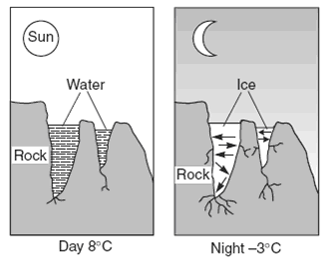
The diagrams  shows a natural process that weathers rock.
 Which statement best explains why this process results in weathering?
a)
frozen water acts as a solute
b)
water expands when it freezes
c)
the mass of water increases when it freezes
d)
frozen water dissolves most types of rock
37.

Deltas are mainly created by the process of -

a)

deposition

b)

weathering

c)

waves

d)

erosion

38.
What is an instrument that detects and records waves produced by earthquakes? (This piece of equipment can measure the magnitude of an earthquake.)
a)
Epicenter
b)
Fault
c)
Seismogram
d)
Seismograph
39.
This famous transform fault is located in the western United States creates significant earthquake activity for California
a)
New Madrid
b)
Denali Fault
c)
Ramapo Seismic Zone
d)
San Andreas
40.
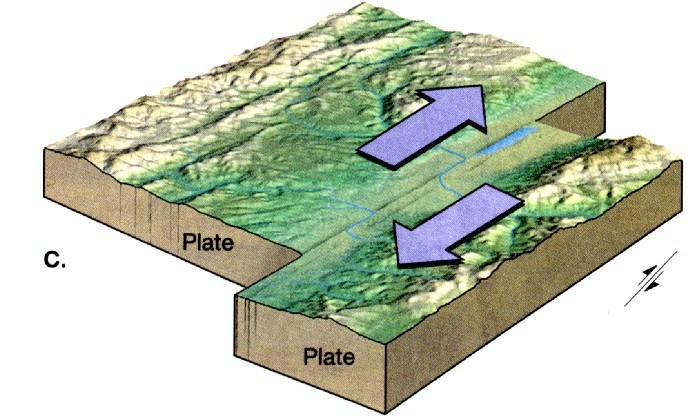
What type of plate boundary is this?
a)
Transform
b)
Convergent
c)
Divergent
d)
Plate
41.
How is mechanical weathering different from chemical weathering?
a)
Chemical weathering happens over much shorter time frame than mechanical weathering.
b)
Chemical weathering changes the chemical composition of rocks; mechanical weathering does not.
c)
Chemical weathering occurs only in tropical climates; mechanical weathering occurs only in cool climates.
d)
Chemical weathering occurs only in the mountains; mechanical weathering occurs only on flat land.
42.
Is hair color an inherited trait or a learned trait?
a)
inherited trait
b)
learned trait
43.
Is talking an inherited trait or a learned trait?
a)
inherited trait
b)
learned trait
44.
Mixtures are made of substances that are __________.
a)
chemically changed and can be physically separated
b)
chemically changed and cannot be physically separated
c)
not chemically changed and can be physically separated
d)
not chemically changed and cannot be physically separated
45.
If sugar and sand are mixed, which of the following methods would separate the sugar and sand?
a)
melt the mixture in a pot
b)
pour the mixture through a sieve
c)
pour the mixture into water to dissolve the sugar
d)
They cannot be separated.
46.
How can you change matter from one state to another?
a)
by changing its container
b)
by adding or removing heat
c)
by dividing it in half
d)
by changing its volume
47.

Malcolm left a cube of ice in a glass on a windowsill. In about an hour, the ice changed into a clear substance that took on the shape of the lower part of the glass. Finally, after three days, there appeared to be nothing in the glass at all. What states of matter did the ice cube pass through?

a)

liquid then gas then solid

b)

solid then liquid then gas

c)

gas then liquid then solid

d)

solid then gas then liquid

48.
Which of these would NOT make a good insulator?
a)
an eraser
b)
a piece of paper
c)
a paper clip
d)
a plastic comb
49.
What creates the magnetic field in an electromagnet?
a)
a bar magnet
b)
an electric current
c)
a compass
d)
an insulator
50.
Which of the following is needed to complete the electric circuit in the picture?
a)
another lightblub connected to the battery
b)
another battery connected to the lightbulb
c)
another wire connecting the battery to the lightbulb
d)
nothing is needed
51.
Most young animals inherit similar appearances, such as shape and color, from their parent animals. Which best describes why a baby deer (fawn) has spots when the adult deer do not?
a)
The spots help camouflage the fawn for protection.
b)
The spots help a fawn to be seen when crossing roads.
c)
The adult deer lose their spots by rubbing against trees.
52.
What kind of circuit is this?
a)
Series
b)
Parallel
53.
When a balloon is rubbed on the hair ...
a)
negative charges are transferred from the hair to the balloon.
b)
positive charges are transferred from the hair to the balloon.
c)
negative charges are transferred from the balloon to the hair.
d)
positive charges are transferred from the balloon to the hair.
54.
This instrument can be used to see if materials conduct electricity.  Which of these groups contains items that could all conduct electricity to complete the circuit?
a)
rubber ball, plastic comb, nail
b)
paper clip, penny, screw
c)
cork, dollar bill, tweezers
d)
pencil, eraser, spoon
55.
A dog sitting on command is an example of what type of trait?
a)
acquired trait
b)
inherited trait
56.
Which of the following is a sign that a chemical reaction has occurred?
a)
change in shape
b)
melting
c)
formation of a gas
d)
dissolving
57.
Is hammering wood together to build a house a chemical or physical change?
a)
chemical
b)
physical
58.
What is an example of a Chemical change?
a)
Ripped paper 
b)
boiled egg
c)
cracked egg
d)
sugar in water
59.
Adding baking soda and vinegar together and it fizzes and creates carbon dioxide.
a)
Chemical
b)
Physical
60.
Fish, amphibians, reptiles, birds and mammals all belong to which group?
a)
Vascular
b)
Vertebrates
c)
Invertebrates
d)
Nonvascular
61.
Scientists classify organisms to ____________.
a)
Count the organisms quicker
b)
Catch the organisms in the wild
c)
Train the organisms to behave
d)
See how organisms are alike and different from each other
62.
Why are plants and animals different?
a)
Plants are unicellular and animals are multicellular. 
b)
Animals have a backbone, but plants do not.
c)
Plants are producers, and animals are consumers.
d)
Plants have cell membranes and animals do not. 
63.
A student watched a plant grow taller and taller in their yard. They decided to water the plant with red water. What will happen to the roots and stems of the flower?
a)
The roots and stems will stay the same color. 
b)
The roots and stems will turn red because it is vascular. 
c)
The roots and stems will change red because they are NONvascular. 
64.
What do all of these organisms have in common?
a)
They all have uniform offspring
b)
They are all made of cells
c)
They possess the same features
d)
They have the same internal and external structures
65.
Name that landform
a)
canyon
b)
delta
c)
sand dune
d)
valley
66.
What was the most likely cause of this canyon's formation?
a)
Floods eroded the sandstone away from the canyon walls
b)
Glaciers eroded the canyon rock as they melted and moved
c)
Ice wedged into cracks in the rock and weathered the canyon walls
d)
Wind blew large rocks that smashed against the canyon walls
67.

Click the box that says something that is true

a)

Miss. Mo is the coolest person around

b)

not this one

c)

not this one

68.
What is the function of the cell nucleus found in both plant and animal cells?
a)
to produce energy
b)
to control cell activity
c)
to remove waste products
d)
to allow molecules to enter the cell
69.
The basic unit of structure and function in a living things.
a)
chloroplast
b)
nucleus
c)
cell
d)
cell membrane
70.
Are microorganisms helpful or harmful?
a)
Helpful
b)
Harmful
c)
Both
d)
Neither
71.
Salmonella and E. Coli can be found on ________________ and ________________ so it is important to cook all meat to kill bacteria.
a)
Waffles and scrambled eggs
b)
Broccoli and steamed corn
c)
Eggs and raw chicken
d)
Sushi and Toaster Strudel 
72.
a)

a

b)

b

c)

c

d)

d

73.
a)

a

b)

b

c)

c

d)

d

74.
a)

a

b)

b

c)

c

d)

d

75.
a)

a

b)

b

c)

c

d)

d

76.
This state of matter has a definite volume and a definite shape
a)
solid
b)
liquid
c)
gas
77.
If you spilled nails in a sandbox, what separation tool/method could you use to clean out the sandbox so it would be safe for children to play in?
a)
Filter
b)
Screen
c)
Magnet
d)
Evaporation
78.
What are the two poles of a magnet called?
a)
North and South
b)
East and West
c)
Up and Down
d)
Red and Blue
79.
What is the difference between a fish and amphibian?
a)
Amphibians only live underwater for part of their lives
b)
Fish have lungs
c)
Amphibians have gills and scales
80.
Which best explains why a tiger is a mammal?
a)
Because it has stripes that blend with its environment
b)
because its got fur
c)
because it eats meat
d)
because it has a backbone
81.
What is the difference and similarity between a cat and slug?
a)
The cat is a mammal and is an invertebrate
b)
The slug is a invertebrate and is a mollusk
c)
The cat is an invertebrate and a mollusk
d)
The slug is a vertebrate and is a mammal
82.
How are mosses and ferns alike?
a)
They both have fronds
b)
They both reproduce without seeds
c)
They both grow only at night
d)
They both grow in the oceans
83.
What is the function of the cell nucleus found in both plant and animal cells?
a)
to produce energy
b)
to control cell activity
c)
to remove waste products
d)
to allow molecules to enter the cell
84.
Consists of a jellylike substance that contains many organelles.
a)
ribosomes
b)
cytoplasm
c)
chloroplasts
d)
cell wall
85.
Conductors 
a)
generate power
b)
generate electricity 
c)
generate light 
d)
generate sound
86.
Which characteristic did Malek most likely inherit from his parents?
a)
his ability to read fast
b)
his need to wear glasses
c)
his ability to speak English
d)
his need to count using his fingers
87.
When a river flows over the Earth and carves out a hole in the surface it makes a: 
a)
hill
b)
mountain
c)
canyon
88.
Ms Jo Jo rubbed two balloons with a piece of wool. What will happen when the balloons are brought near each other?
a)
The balloons will repel each other.
b)
The balloons will attract each other.
c)
The balloons will become positively (+) charged.
d)
The balloons will pop.
89.
What is the major difference between static electricity and current electricity?
a)
 Current electricity involves a continuous flow of neutrons; static electricity is a sudden transfer of protons 
b)
Current electricity can be deadly; static electricity is almost always safe
c)
In current electricity, there's a single transfer of electrons; in static electricity, there's a steady flow of electrons
d)
Current electricity involves a flow of electrons; static electricity involves a single transfer of electrons
90.
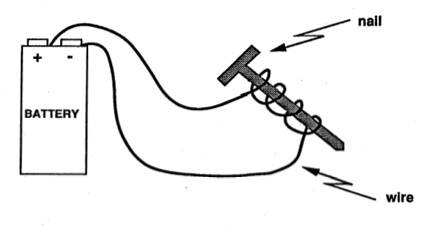
This is a picture of a simple electromagnet. How can the electromagnet be made stronger?
a)
Add more coils of wire to the nail.
b)
Use a smaller battery.
c)
Reverse the poles of the magnet.
d)
Remove all the coils and the nail.
91.
Barrier islands are created by deposition along the coastline of continents. They can be a dangerous place to build houses and businesses because of the fast rate of weathering, erosion, and deposition that occurs there. If you were to build a business there, which of the following questions would be the biggest concern that you would have?
a)
Where would be the best place to build the business so that it is protected from storms which cause the winds and waves to erode and deposit sand?
b)
Before construction begins, should large amounts of sand be removed from the islands in order to stop erosion on the beach?
c)
Since barrier islands are always changing, what location would offer the best access to sand resources to help build the business?
d)
If an earthquake were to happen, would the barrier island sink into the ocean?
92.
A chemical change is easy to reverse.
a)
True
b)
False
c)
What's a Chemical change?
93.

Which physical characteristic of a dog help it walk and run?

a)

Arms

b)

Legs

c)

Head

d)

Tail

94.
What structure is in  plant cells but not animal cells. 
a)
cell membrane
b)
mitochondria
c)
cell wall
d)
vacuole
95.
What is chemical weathering?
a)
How rocks breakdown
b)
The breakdown of rocks by chemical reactions that change the rocks makeup/composition
c)
When rocks rust
d)
Mechanical Weathering
96.
The diagram represents a cell of a green plant.
Solar energy is used to produce energy-rich compounds in which structure?
a)
A
b)
B
c)
C
d)
D
97.
This cell part is in ALL cells. It is the gel-like substance that provides cell shape.
a)
Chloroplasts
b)
Chromosomes
c)
Cytoplasm
d)
Mitochondria
98.
My body is warm and covered in feathers.  I lay eggs which hatch into chickens.  What am I?
a)
Reptile
b)
Amphibian
c)
Mammal
d)
Bird
99.
Which of the following has an exoskeleton?
a)
Foxes
b)
Birds
c)
Lobsters
d)
Fish
100.

click on the one that says "ME".

a)

me

b)

not this one

c)

you're being ridiculous

d)

are you serious???