
 Worksheets
8th Grade FSA Review vs. 2
Total questions: 100
Worksheet time: 2hrs 33mins
Name
Class
Date
1.

What is the range of the data shown in the stem and leaf plot?
a)
40
b)
56
c)
136
d)
96
2.

How many students scored more than 80%?
a)
10
b)
13
c)
7
d)
15
3.
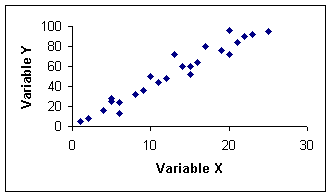
What type of association does this graph have?
a)
positive
b)
negative
c)
none
d)
all of the above
4.

The following scatter plot shows Pam's training as she prepares to run a 6 mile race at the end of the month. Which of the following would be a reasonable approximation for the length of time it would take for her to run 6 miles?
a)
A. 50 min
b)
B. 80 min
c)
C. 45 min
d)
D. 60 min
5.

Describe the bus’s motion from A-B
a)
A)The bus is speeding up
b)
B)The bus's speed is remaining constant
c)
C)The Bus is stopped
d)
D)The bus is beginning to slow down
6.
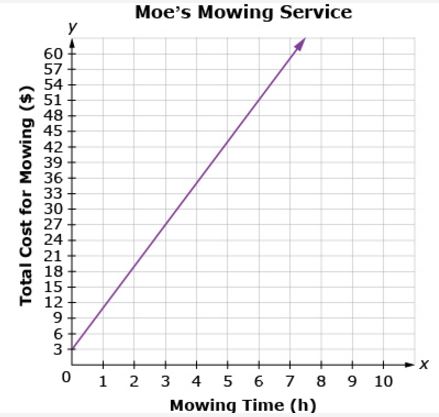
How much does it cost to have your lawn mowed for 2 hours?
a)
$16
b)
$17
c)
$18
d)
$19
7.

Explain why this graph may be misleading?
a)
the x-axis does not have equal intervals
b)
San Fransisco is not a real city
c)
you cannot have percents in a line graph
d)
the y-axis does not have equal intervals
8.

How many people have two or less books in their desk?
a)
4
b)
5
c)
6
d)
7
9.

In how many games did the team score fewer than 10 points?
a)
3
b)
5
c)
4
d)
6
10.

About how many male math teachers were there in 2006?
a)
15
b)
30
c)
35
d)
45
11.
A prediction written in an if,then statement is a:
a)
hypothesis
b)
conclusion
c)
experiment
d)
question
12.

This dart board represents
a)
both accuracy and precision
b)
neither accuracy nor precision
c)
only accuracy
d)
only precision
13.
The way we test our hypothesis is by:
a)
doing background research
b)
drawing a conclusion
c)
performing an experiment
d)
stating the question
14.
A variable that we could change but don't is:
a)
dependent variable
b)
constant variable
c)
independent variable
d)
scientific variable
15.
The variable that is usually measured is:
a)
Dependent variable
b)
independent variable
c)
constant variable
d)
scientific variable
16.
The variable that is changed by the experimenter is:
a)
Independent variable
b)
dependent variable
c)
constant variable
d)
scientific variable
17.
Which of these are equal intervals?
a)
0, 5, 15, 25, 35, 45
b)
0, 10, 20, 25, 30, 35
c)
0, 5, 10, 15, 20, 25
d)
0, 5, 10, 20, 25, 30
18.
The very first step in the scientific method is:
a)
Ask a question
b)
form a hypothesis
c)
draw conclusions
d)
do background research
19.
You want to see if watering your plant makes it grow faster.
What is a constant variable?
What is a constant variable?
a)
plant height
b)
watering amount
c)
Type of plant
20.
Suzan usually walks to school. She wants to see if running to school will help her do better on quizzes in first period. (What is her Control?)
a)
How far she walks
b)
Running to school
c)
Walking to school
d)
Her quiz scores in first period
21.
Suzan usually walks to school. She wants to see if running to school will help her do better on quizzes in first period. (What is her Independent Variable?)
a)
How far she walks
b)
Running to school
c)
Walking to school
d)
How well she does on quizzes
22.

Which statement is an inference about this picture?
a)
The van is tan.
b)
The van ran into KFC.
c)
The driver was hungry.
d)
An ambulance may be on the way.
23.
The summary at the end of an experiment that explains the results.
a)
conclusion
b)
procedures
c)
materials
d)
responding variable
24.
When experimenting with the growth of a plant, a scientist uses three (of the same type of) plants, two different fertalizers, equal light, and equal water. What type of variable is the water?
a)
Dependent
b)
Independent
c)
Control
25.
A series of steps used by scientists to solve a problem or answer a question.
a)
scientific method
b)
recipe
c)
data collection
d)
metric system
26.
Which type of rock results from melting and cooling of magma?
a)
Igneous
b)
Metamorphic
c)
Sedimentary
d)
Extrusive
27.
Which type of rock forms from extreme heat and pressure?
a)
Igneous
b)
Sedimentary
c)
Organic
d)
Metamorphic
28.
Which type of igneous rock forms above ground?
a)
Intrusive
b)
Organic
c)
Extrusive
d)
Foliated
29.
Coal is an example of a _______ sedimentary rock.
a)
Chemical
b)
Organic
c)
Clastic
d)
Intrusive
30.
A metamorphic rock changes into an igneous rock by what two processes?
a)
Melting and cooling
b)
Extreme heat and pressure
c)
Compaction and cementation
d)
Weathering and erosion
31.
Which type of metamorphic rock has minerals in bands or stripes?
a)
Nonfoliated
b)
Coarse grained
c)
Fine grained
d)
Foliated
32.
Wind, water, and ice breaking down rock is called
a)
Erosion
b)
Deposition
c)
Compaction
d)
Weathering
33.
Lava which cools on Earth's surface forms an
a)
metamorphic rock
b)
intrusive igneous rock
c)
extrusive igneous rock
d)
foliated metamorphic rock
34.
Magma cooling and hardening below Earth's surface forms an
a)
Intrusive igneous rock
b)
Extrusive igneous rock
c)
Foliated metamorphic rock
d)
Organic sedimentary rock
35.
Scientists classify rocks by their composition and
a)
chemicals
b)
size
c)
color
d)
texture
36.
What is the MAIN way rocks are classified?
a)
Their color and shapes
b)
How they form
c)
Mineral bands
d)
Where they form
37.
True/False: Igneous rocks can only turn into metamorphic rocks.
a)
True
b)
False
38.
Sediment being moved from one area to another is called
a)
erosion
b)
deposition
c)
weathering
d)
compaction
39.
A naturally occurring solid mixture of minerals and organic matter is a
a)
mineral
b)
rock
c)
composition
d)
pebble
40.
The chemical makeup of a rock
a)
Composition
b)
Texture
c)
Minerals
d)
Organic matter
41.
Texture is determined by
a)
the chemicals in a rock
b)
the color of a rock
c)
the bumpiness of a rock
d)
the size and shape of the rock's mineral grains
42.
Regional and contact metamorphism create what type of rock?
a)
Igneous
b)
Sedimentary
c)
Foliated
d)
Metamorphic
43.
True/False: A decrease in temperature would cause magma to form.
a)
True
b)
False
44.
Which of the following are nonrenewable resources?
a)
Plants and animals
b)
Wind and water
c)
Sunlight and water
d)
Coal and petroleum
45.
What causes magma to form?
a)
A rise in temperature
b)
A change in the rock's composition
c)
A decrease of pressure
d)
All of the above
46.

This rock was formed by smaller pieces of rock that settled at the bottom of a lake millions of years ago. What type of rock is this?
a)
Sedimentary
b)
Igneous
c)
Metamorphic
47.

This rock was molten lava that cooled quickly as it came out of a volcano. What type of rock is this?
a)
Sedimentary
b)
Igneous
c)
Metamorphic
48.
Process when sediments settle out of wind or water
a)
erosion
b)
deposition
c)
compaction
d)
cementation
49.
In order for a metamorphic rock to form, _______ is needed.
a)
Pressure
b)
Heat
c)
Heat and Pressure
d)
Weathering
50.
Scientists learn about the temperature and pressure near the Earth’s core by studying __________ rock.A) compacted B) igneous C) metamorphicD) sedimentary
a)
A) compacted
b)
B) igneous
c)
C) metamorphic
d)
D) sedimentary
51.
What is a PUSH or PULL of an object?
a)
Motion
b)
Force
c)
Friction
d)
Gravity
52.
What is MOVEMENT?
a)
Inertia
b)
Force
c)
Work
d)
Motion
53.
What happens when one force PULLS an object toward another?
a)
Friction
b)
Motion
c)
Gravity
d)
Magnetism
54.
What is a force that works AGAINST MOTION?
a)
Force
b)
Motion
c)
Gravity
d)
Friction
55.
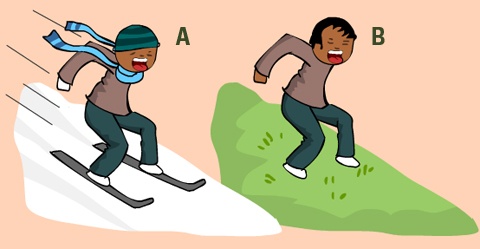
Why is it harder for the boy in Image B to get down the hill?
a)
Motion
b)
Friction
c)
Work
d)
Displacement
56.
What is the standard unit force is measured in?
a)
Newtons
b)
pounds
c)
grams
d)
meters
57.

Choose the correct answer for the image
a)
It is not related to force
b)
It is unbalanced
c)
Not enough information
d)
Balanced force
58.
What is the net force?
130 N 150 N
<------ --------->
130 N 150 N
<------ --------->
a)
20 N
b)
30 N
c)
20 N to the right
d)
30 N to the left
59.
Is this a balanced or unbalanced force?
30 N 30 N
---------> <---------
30 N 30 N
---------> <---------
a)
Balanced
b)
Unbalanced
60.

What is the force present on Earth, but not in space, that makes it difficult for the heart to move blood throughout the body?
a)
energy
b)
friction
c)
gravity
d)
inertia
61.

I discovered the ELECTRON! My Berry Muffin atomic theory had both negative and positive particles all in the same place.
a)
Dalton
b)
Bohr
c)
Thomson
d)
Rutherford
62.

Don't let my "crazy" eyes fool you. I discovered the neutron. And I know neutrons live in the nucleus. Who am I?
a)
Dalton
b)
Bohr
c)
Thomson
d)
Chadwick
63.
Where can electrons be found in an atom?
a)
nucleus
b)
electron orbit
c)
electron cloud
d)
electron galaxy
64.
The # of protons = ___?
a)
atomic mass
b)
atomic number
c)
atomic temperature
d)
isotope
65.
Atoms with the SAME # of PROTONS, but with DIFFERENT # of NEUTRONS are called ____.
a)
clouds
b)
isotopes
c)
neutrons
d)
molecules
66.
Protons + Neutrons
a)
atomic number
b)
electron cloud
c)
atomic mass
d)
isotopes
67.

Who created the first PERIODIC TABLE?
a)
Dalton
b)
Thomson
c)
Mendeleev
d)
Einstein
68.
What does the Periodic TAble do?
a)
organizes molecules
b)
Organizes elements according to Atomic #
c)
is a list of important scientists
69.
EVery ROW in the periodic table is called a ____.
a)
Period
b)
group
c)
family
d)
cloud
70.

My gold foil experiment proved once and for all that every atom has a nucleus!
a)
Dalton
b)
Rutherford
c)
Chadwick
d)
Bohr
71.
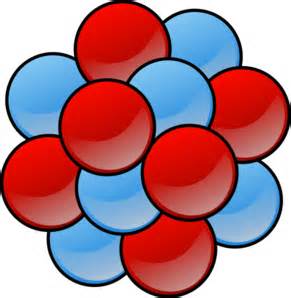
What does the nucleus of an atom contain?
a)
Electrons and neutrons
b)
Protons and neutrons
c)
Neutrinos and positrons
d)
DNA and RN
72.
True or False: The majority of an atom is made up of empty space
a)
True
b)
False
73.
"Everything is composed of atoms" was stated by:
a)
Democritis
b)
Dalton
c)
Moseley
d)
Einstein
74.
Electrons are not factored into atomic mass because:
a)
They are so small their mass is negligible
b)
They're not in the nucleus
c)
They're too big
d)
They move so quickly their mass is zero
75.
The word "atom" comes from a Greek word that means
a)
Invisible
b)
Indivisible
c)
Undivided
76.
What is a producer?
a)
an organism that gets energy from EATING other organisms
b)
an organisms that uses sunlight to MAKE its own food
c)
an organism that gets energy from eating DEAD organisms
77.
What is a herbivore?
a)
an animal that gets energy from eating other ANIMALS
b)
an organism that gets energy from eating only PLANTS
c)
an animal that gets energy by eating BOTH plants and other animals
78.
An organism that gets energy from eating other organisms is a ______________
a)
producer
b)
consumer
c)
decomposer
79.
An organism that gets energy from eating dead organisms, non-living material or waste
a)
producer
b)
consumer
c)
decomposer
80.
What is a carnivore?
a)
an animal that gets energy by eating other ANIMALS
b)
An animal that gets energy by eating only PLANTS
c)
an animal that gets energy by eating BOTH plants and animals
81.
Which of the following is NOT a consumer
a)
grass
b)
dog
c)
shark
d)
fish
82.
An animal that gets energy from eating BOTH plants and animals is a
a)
herbivore
b)
carnivore
c)
omnivore
83.

This is an example of a
a)
food chain
b)
water cycle
c)
food cycle
d)
food web
84.

what is a food web?
a)
A food web is a web with intercepting and crossing lines showing what the animals eat.
b)
I don't know!!
c)
A food web is a web that has organized lines leading to other animals.
85.

Which organism do the owl and the weasel compete for in the food web?
a)
Hawk
b)
Spider
c)
Grasshopper
d)
Shrew
86.

Which of the following would be the most likely effect, if there were a sudden increase in the cricket population?
a)
There would be a decrease in the small bird population.
b)
There would be a decrease in the grass/flowers population.
c)
There would be a decrease in the mice population.
d)
There would be an increase in the grass/flowers population.
87.
A consumer that hunts is called:
a)
a producer.
b)
an omnivore.
c)
a predator.
d)
a herbivore.
88.

Which best describes what happens when an owl attacks and kills a fish for food?
a)
an interconnection between aquatic and terrestrial food webs.
b)
an interconnection between terrestrial organisms and predators
c)
an interconnection between aquatic food webs and decomposers
89.
By which process is water taken from the ocean to form clouds?
a)
condensation
b)
evaporation
c)
transpiration
90.
When animals break down glucose to create energy, they release water and carbon dioxide (CO2.) How can carbon dioxide (CO2) be reused within the food web?
a)
It can be used by animals as a source of oxygen.
b)
It can be used by both plants and animals to produce energy.
c)
It can be used by plants during photosynthesis to create glucose.
91.
Which best describes the role plants serve in the oxygen cycle?
a)
They absorb oxygen during photosynthesis.
b)
They absorb oxygen during decomposition reactions.
c)
They release oxygen as a waste product of photosynthesis.
d)
They release oxygen as a waste product in cellular respiration.
92.
Which organisms recycle carbon in decaying matter back into atmospheric carbon dioxide?
a)
fish
b)
fungi
c)
plants
d)
mammals
93.

In the energy pyramid here, which organisms have the most energy available?
a)
Producers
b)
Carnivores
c)
Herbivores
d)
Top Predator
94.

In the energy pyramid here, how much of the energy in the producers gets passed to the herbivores?
a)
10%
b)
20%
c)
80%
d)
90%
95.
Decomposers affect all levels of the food web.
a)
True
b)
False
96.

What part of the water cycle does this picture show?
a)
condensation
b)
precipitation
c)
evaporation
97.

What does groundwater do?
a)
It sends water to our buildings, houses, and water transplant places
b)
to the sky
c)
to the sun
d)
To the Earth's surfaces
98.

After the rain falls down onto Earth's surface, what most likely happens? What is it called?
a)
1. The remains of the water is soaked into the ground.
2.Groundwater
2.Groundwater
b)
1. Groundwater
2. The remains of the water is soaked into the ground.
2. The remains of the water is soaked into the ground.
c)
1. Groundwater
2. Transpiration happens to the plants.
2. Transpiration happens to the plants.
d)
1. The liquid turns into an gas or an water vapor
2. Evaporation
2. Evaporation
99.
What happens after groundwater at the very end/beginning of the water cycle?
a)
Evaporation
b)
Transpiration
c)
Condensation
d)
Groundwater
100.
What is the water cycle?
a)
the 3 forms of water
b)
the movement of water on, above, or below the surface of the Earth
c)
when water melts
d)
when clouds form
100 %

