wayground logo

Free Printable Worksheets

Font size

S
M
L
XL
Worksheets

Earth

Total questions: 105

Worksheet time: 1hrs 13mins
Name
Class
Date
1.
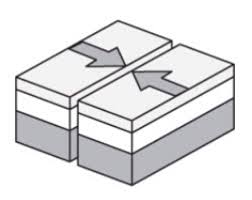
What kind of plate boundary is shown here?
a)
divergent
b)
convergent
c)
transform
d)
subducting
2.
What kind of plate boundary is shown here?
a)
divergent
b)
convergent
c)
transform
d)
submergent
3.
What kind of plate boundary is shown here?
a)
divergent
b)
convergent
c)
transform
d)
strike slip
4.
What geologic feature/event you be most likely to find at a transform boundary?
a)
Earthquakes
b)
Volcanoes
c)
Mountains
d)
Rift Valleys
5.
What geologic feature/event would you most likely to find at a divergent boundary between two pieces of oceanic crust?
a)
Rift Valley
b)
Mid-Ocean Ridge
c)
Island Arc
d)
Flat land
6.
What geologic feature/event would you most likely to find at a divergent boundary between two pieces of continental crust?
a)
Mid-Ocean Ridge
b)
Mountain
c)
Rift Valley
d)
Island Arc
7.
What geologic feature/event would you most likely to find at a convergent boundary between two pieces of continental crust?
a)
Volcano
b)
Mountain
c)
Rift
d)
Island Arc
8.
A subduction zone is formed...
a)
when one tectonic plate sinks below another
b)
at every type of convergent plate boundary
c)
at every type of divergent plate boundary
d)
at transform boundaries
9.
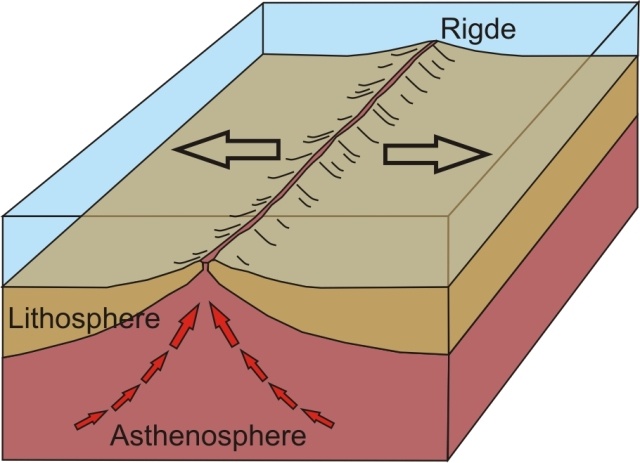
Name the boundary
a)
convergent boundary
b)
divergent boundary
c)
transform boundary
d)
sergent boundary
10.
Name the boundary
a)
convergent boundary
b)
divergent boundary
c)
transform boundary
d)
sergent boundary
11.
In which type of boundary do the plates move away from each other?
a)
convergent
b)
normal
c)
divergent
d)
transform
12.
The area where two or more plates meet is called a __________________.
a)
fault
b)
plate boundary
c)
plate edge
d)
ring of fire
13.
Plates slide past one another at ____________ boundaries.
a)
divergent
b)
convergent
c)
transform
d)
submergent
14.
Plates move towards one another at ______________ boundaries.
a)
divergent
b)
convergent
c)
transform
d)
detergent
15.
When two tectonic plates are moving away from each other, the boundary between them is called...
a)
Divergent boundary
b)
Convergent boundary
c)
Transform boundary
d)
Subduction
16.
When two tectonic plates are moving toward each other, the boundary between them is called...
a)
Divergent boundary
b)
Convergent boundary
c)
Transform boundary
d)
Subduction
17.
In the image, which type of boundary is shown? Hint: its located in the state of California. 
a)
divergent
b)
convergent
c)
transform fault
18.
What was the name given to all the continents when they were joined as one super continent?
a)
Supreme Continent
b)
Eurasia
c)
Plate tectonics
d)
Pangea
19.

all continents were once connected in a single landmass that broke apart about 200 million years ago and drifted slowly to their current positions

a)

continental drift

b)

seafloor spreading

c)

converge

d)

Pangaea

20.

Hess' theory that new seafloor is formed when magma is forced upward toward the surface at mid-ocean ridge

a)

seafloor spreading

b)

continental drift

c)

diverge

d)

Pangaea

21.
The Theory of Continental Drift states that Pangaea broke apart and the continents "drifted" away from each other
a)
True
b)
False
22.
Which piece of evidence did Wegener use to prove continental drift?
a)
The shape of the continents
b)
Similar fossils found on separate continents
c)
Tree fossils found in odd places
d)
All of the above
23.
Who suggested the Continental Drift theory?
a)
Aldrin Weiner
b)
Alfred Wegener
c)
George Williams
d)
IDK 😭
24.
What is this a picture of?
a)
plate tectonics
b)
continental drift
c)
pangea
d)
glacier scaring
25.
What does the theory of continental drift state?
a)
The continents were once joined in a super-continent and have moved over time
b)
Continents are stationary and do not move
c)
The Earth is broken into lithospheric plates that move due to convection currents
d)
none of the above
26.
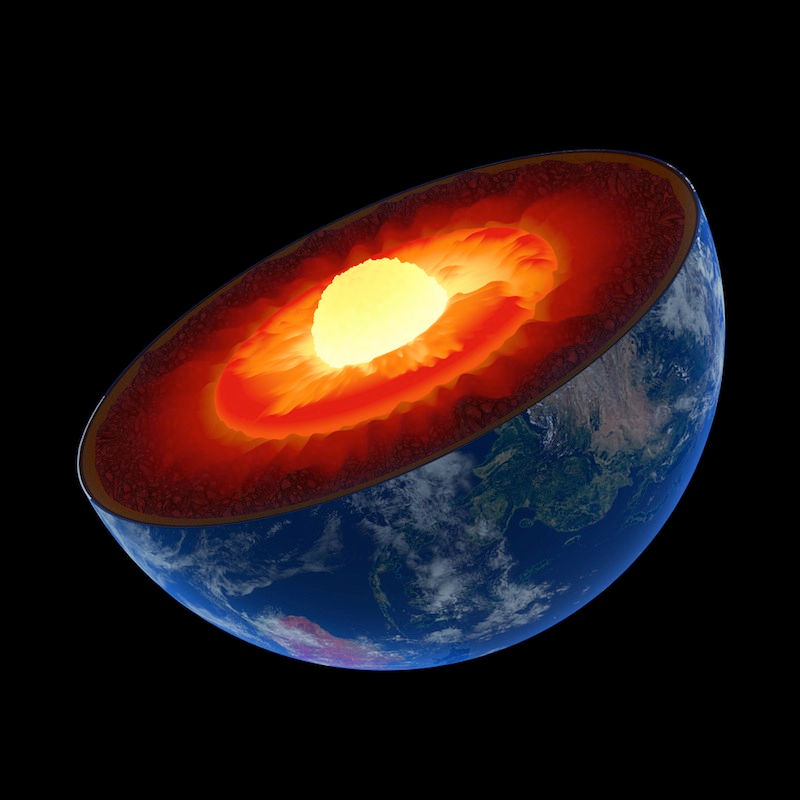
As you travel from the inner core to the crust, how would temperature, pressure and density of the material change?
a)
The would all increase
b)
The would all decrease.
c)
Nothing, the layers are made of the same material throughout
d)
Temperature would decrease, but pressure and density would increase
27.
This layer contains the upper mantle and the crust.
a)
Mesosphere
b)
Asthenosphere
c)
Lithosphere
d)
Core
28.
This layer contains most of Earth's mass.
a)
Inner Core
b)
Mantle
c)
Outer Core
d)
Crust
29.
You live, breathe, and eat on this layer.
a)
Outer Core
b)
Inner Core
c)
Mantle
d)
Crust
30.
The core is mostly made up mostly of which elements?
a)
Oxygen and Silicon
b)
Silicon and Magnesium
c)
Nickel and Iron
d)
Iron and Magnesium
31.
Which layer of the Earth is the only liquid layer?
a)
Outer Core
b)
Inner Core
c)
Mantle
d)
Lithosphere
32.
What are the two type of crust?
a)
Continental and Landforms
b)
Oceanic and Mountains
c)
Mountains and Landforms
d)
Oceanic and Continental
33.
Which layer(s) of the Earth make up the asthenosphere?
a)
Part of the upper mantle
b)
Crust, mantle, Core
c)
Crust and upper mantle
d)
Only the crust
34.
How are scientist able to estimate the thickness of each layer of the Earth?By studying __________
a)
 radio waves
b)
sonar waves
c)
laser waves
d)
seismic waves
35.
Why is the inner core made of solid metal?
a)
Because it is so hot it turns from liquid to solid
b)
Because of the weight of the crust
c)
Because of it's temperature
d)
Because of the pressure of the other layers beating down on it
36.
Which layer is considered the thinnest layer?
a)
Mesosphere
b)
Core
c)
Mantle
d)
Crust
37.
Which Layer is considered the coolest layer?
a)
Crust
b)
Mantle
c)
Inner Core
d)
Outer Core
38.
This layer is divided into pieces called tectonic plates.
a)
Mesosphere
b)
Asthenosphere
c)
Mantle
d)
Lithosphere
39.
Where is the Earth's crust the thickest?
a)
Oceans
b)
Equator
c)
Mountains
d)
North and South Poles
40.
This is the plastic layer of the mantle on which pieces of the lithosphere move.
a)
Lithosphere
b)
Asthenosphere
c)
Mesosphere
d)
Crust
41.
Approximately how deep would you have to drill to reach the center of the Earth?
a)
600 Kilometers
b)
6,000 Kilometers
c)
60,000 Kilometers
d)
600,000 Kilometers
42.
What is the hottest layer?
a)
Crust
b)
Mantle
c)
Core
43.
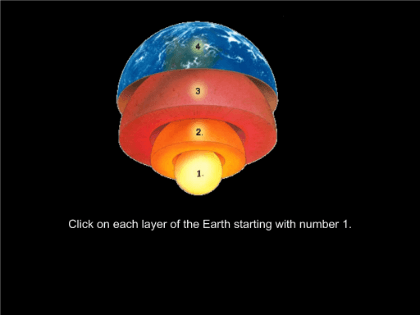
Which layer is the OUTER CORE?
a)
1
b)
2
c)
3
d)
4
44.
Which layer is the INNER CORE?
a)
1
b)
2
c)
3
d)
4
45.
Which layer is the MANTLE?
a)
1
b)
2
c)
3
d)
4
46.
Which layer is the INNER CORE?
a)
1
b)
2
c)
3
d)
4
47.

Plate #1

a)

Scotia plate

b)

Antarctic plate

c)

Southern plate

d)

South Atlantic plate

48.

Plate #2

a)

Japanese plate

b)

Phillipine plate

c)

Asian plate

d)

Pacific plate

49.

Plate #3

a)

Asian plate

b)

Indian plate

c)

Arabian plate

d)

Australian plate

50.

Plate #4

a)

Northern plate

b)

Arctic plate

c)

Atlantic plate

d)

North American plate

51.

Plate #5

a)

Atlantic plate

b)

Pacific plate

c)

Hawaiian plate

d)

Nazca plate

52.

Plate #6

a)

Island plate

b)

Australian plate

c)

Pacific plate

d)

Phillipine plate

53.

Plate #7

a)

Middle East plate

b)

European plate

c)

African plate

d)

Arabian plate

54.

Plate #8

a)

Atlantic plate

b)

Southern plate

c)

South American plate

d)

Antarctic plate

55.

Plate #9

a)

African plate

b)

Atlantic plate

c)

Eurasian plate

d)

Australian plate

56.

Plate #10

a)

European plate

b)

Eurasian plate

c)

Asian plate

d)

Big plate

57.

Plate #11

a)

Cocos plate

b)

Nazca plate

c)

Scotia plate

d)

Juan de Fuca plate

58.

Plate #12

a)

Cocos plate

b)

Nazca plate

c)

Caribbean plate

d)

Scotia plate

59.

Plate #13

a)

Cocos plate

b)

Nazca plate

c)

Caribbean plate

d)

Juan de Fuca plate

60.

Plate #14

a)

Cocos plate

b)

Nazca plate

c)

Caribbean plate

d)

Juan de Fuca plate

61.

Plate #15

a)

Southern plate

b)

Arctic plate

c)

Antarctic plate

d)

Penguin plate

62.
Use the diagram below to answer the following question:
What type of motion would you expect to observe between plates A and B?
a)
Plates A and B will move toward each other.
b)
Plates A and B will move away from each other.
c)
Plates A and B will not move.
d)
Plates A and B will slide horizontally past each other.
63.
Lystrosaurus was a slow-moving, plant eating reptile that lived over 250 million years ago.  Fossils of Lystrosaurus have been found in the brown areas shown above.  
How is this explained by the existence of Pangea?
a)
Lystrosaurus swam across the oceans from one continent to another
b)
Lystrosaurus drifted on rafts of vegetation from one continent to another
c)
Land bridges once crossed oceans to connect Africa, Antarctica and India
d)
Africa, Antarctica and India used to be joined together into a single landmass
64.

This now-extinct small, crocodile-like, freshwater reptile was a good swimmer, but could also walk on land is called _____.

a)

Glossopteris

b)

Lystrosaurus

c)

Mesosaurus

d)

Cynognathus

65.

This now-extinct, plant-eating, pig-sized reptile mostly stayed on land and was called _____.

a)

Glossopteris

b)

Mesosaurus

c)

Lystrosaurus

d)

Cynognathus

66.

This now-extinct, meat-eating, dog-like reptile mostly stayed on land and is called _____.

a)

Glossopteris

b)

Mesosaurus

c)

Lystrosaurus

d)

Cynognathus

67.

(Choose all correct answers!) According to the fossil map, on which ancient landmasses were Glossopteris fossils found?

a)

South America

b)

India

c)

Africa

d)

Antarctica

e)

Australia

68.

(Choose all correct answers!) According to the fossil map, on which ancient landmasses were fossils of Cynognathus found?

a)

South America

b)

Africa

c)

India

d)

Antarctica

e)

Australia

69.

(Choose all correct answers!) According to the fossil map, on which ancient landmasses were the fossils of Mesosaurus found?

a)

South America

b)

Africa

c)

India

d)

Antarctica

e)

Australia

70.

(Choose all correct answers!) According to the fossil map, on which ancient landmasses were the fossils of Lystrosaurus found?

a)

South America

b)

Africa

c)

India

d)

Antarctica

e)

Australia

71.
What is the shaking of the Earth’s crust caused by a release of energy?
a)
Earthquake
b)
Epicenter
c)
Fault
d)
Plate
72.
Which of the following is NOT a cause of an earthquake?
a)
Collapse of Cavern
b)
Eruption of Volcano
c)
Lightning Strikes
d)
Moving Tectonic Plates
73.
What is a break in the lithosphere along which movement in an earthquake has first occurred?
a)
Earthquake
b)
Epicenter
c)
Fault
d)
Focus
74.
Where is the point at which the first movement occurs during an earthquake?
a)
Epicenter
b)
Focus
c)
Fault
d)
Plate
75.
Where is the point on the Earth’s surface directly above the focus of an earthquake?
a)
Epicenter
b)
Fault
c)
Hypocenter
d)
Tremor
76.
Waves move out through the ground from the ..........
a)
rift
b)
hypocenter
c)
epicenter
d)
fault line
77.
The epicenter of an earthquake is
a)
The point below the surface where rock begins to break and the first motion occurs
b)
The seismic station closest to the earthquake
c)
The place where the greatest damage occurs
d)
The point on the surface directly above the focus
78.
This famous transform fault is located in the western United States creates significant earthquake activity for California
a)
New Madrid
b)
Denali Fault
c)
Ramapo Seismic Zone
d)
San Andreas
79.
Which type of wave is the first to arrive after an earthquake occurs?
a)
P Wave
b)
Rayleigh Wave
c)
S Wave
d)
Shear Wave
80.
Which body wave squeezes and stretches rock materials as they pass through the Earth?
a)
Body Waves
b)
P Waves
c)
S Waves
d)
Surface Waves
81.
Which body waves cause particles of rock material to move at right angles to the direction in which the waves are traveling?
a)
Body Waves
b)
P Waves
c)
S Waves
d)
Surface Waves
82.
What is another term for P Wave?
a)
Compression Wave
b)
Principal Wave
c)
Shear Wave
d)
Secondary Wave
83.
P Waves can move through which of the following?
a)
Gas
b)
Liquid
c)
Solid
d)
All of these
84.
S Waves can move through which of the following?
a)
Gas
b)
Liquid
c)
Solid
d)
All of these
85.
What is an instrument that detects and records waves produced by earthquakes? (This piece of equipment can measure the magnitude of an earthquake.)
a)
Epicenter
b)
Fault
c)
Seismogram
d)
Seismograph
86.
What is the measure of the amount of energy released in an earthquake?
a)
Earthquake
b)
Epicenter
c)
Magnitude
d)
Seismogram
87.
Which scale measures the intensity of the ground movement?
a)
Mercalli Scale
b)
Richter Scale
c)
Seismogram Scale
d)
Bernoulli Scale
88.
What is a smaller earthquake that follows a larger earthquake?
a)
Aftershock
b)
Liquefaction
c)
Seismic Gap
d)
Tsunami
89.
What is a large ocean wave that results from an underwater earthquake, landslide, or volcanic eruption?
a)
Aftershock
b)
Liquefaction
c)
Seismic Gap
d)
Tsunami
90.
What is a dent or depression called on a volcano?
a)
side vent
b)
bump
c)
dent
d)
crater
91.
What is the spread of lava as it pours out of a vent?
a)
magma chamber
b)
pipe
c)
lava flow
d)
crater
92.
A dead volcano is called what?
a)
active
b)
dormant
c)
extinct
93.
A high silica volcano makes what type of an explosive?
a)
quiet eruption
b)
explosive eruption
94.
This volcano is most likely which type of volcano?
a)
Felsic
b)
Composite
c)
Shield
d)
Cinder cone
95.
Once magma reaches the earth's surface it is called.....
a)
Silica
b)
Rock
c)
lava
96.
Volcanoes can be found...
a)
on land
b)
under water
c)
on islands
d)
all of the above
97.
A volcano made from alternating layers of ash and lava is called a(n) _________________ volcano
a)
composite
b)
cinder cone
c)
shield
d)
fissure
98.
Most volcanoes occur at which 2 types of plate boundaries? 
a)
convergent w/ subduction and divergent
b)
divergent and transform
c)
divergent and hot spots
d)
convergent w/ subduction and hot spots
99.
A volcano with a broad base and gently sloping sides is called a _________ volcano. 
a)
shield 
b)
cinder cone
c)
composite
d)
fissure
100.
Smaller volcanoes that typically throw ash into the air during eruption
a)
cinder cone
b)
shield
c)
composite
d)
fissure
101.
Approximately 70% of the world's composite volcanoes are located around the Pacific Ocean in a region called the ____________. 
a)
Ring of Fire
b)
Volcano Ring
c)
Nucleus of Volcanoes
d)
Center of Fire
102.

This type of volcano is the most violent, it has both lava flows and pyroclasitc material that can be alternating between eruptions?

a)

dome

b)

cinder cone

c)

composite

d)

shiled

103.

This type of volcano is taller then it is wide and the explosive pyroclastic material falls close to the volcano vent?

a)

dome

b)

cinder cone

c)

composite

d)

shield

104.
This is most likely a _______________ volcano because it is made up of only pyroclastic debris.
a)
shield
b)
cinder cone
c)
composite
105.
A pyroclastic flow typically occurs during a(n) _________ eruption. 
a)
quiet
b)
dormant
c)
explosive
d)
extinct