
 Worksheets
Exploring Life
Total questions: 100
Worksheet time: 1hrs 17mins
Name
Class
Date
1.
All living things must maintain ___, which is the balance of all their internal conditions.
a)
homeostasis
b)
stimuli
c)
space
d)
reproduction
2.
An organism being sorted according to its evolutionary history is an example of ___.
a)
domain
b)
species
c)
binomial nomenclature
d)
phylogeny
3.
In plant cells, organelles called ___ make food.
a)
chlorophyll
b)
chloroplasts
c)
endoplasmic reticulum
d)
ribosome
4.
Many field guides have ____ to help you identify organisms.
a)
dichotomous key
b)
domain charts
c)
nomenclature descriptions
d)
kindom classification
5.
The invention of the microscope by ___ made it possible for scientists to look at cells.
a)
van Leeuwenhoek
b)
Hooke
c)
Virchow
d)
Jenner
6.
All ___ cells have membrane-bound organelles to carry out life processes.
a)
prokaryotic
b)
eukaryotic
c)
virus
d)
bacteria
7.
Using ___, scientists hope to use viruses to spread new genetic material to cells.
a)
antiviral medications
b)
vaccinations
c)
interferon injections
d)
gene therapy
8.
Yellow fever, rabies, chicken pox, and HIV are all ___.
a)
bacterial infections
b)
yeast infections
c)
viruses
d)
curable
9.
____ is the chemical that contains the code for the cell's structure and activities.
a)
Mitochondrion
b)
Gogli body
c)
DNA
d)
Ribosome
10.
Directs all cellular activites.
a)
cell wall
b)
cytoplasm
c)
nucleus
d)
organelle
11.
Performs various functions, including manufacturing, processing, and transporting.
a)
cell wall
b)
cytoplasm
c)
nucleus
d)
organelle
12.
Tough, rigid, outer coverings on plant cells and give them shape.
a)
cell wall
b)
cytoplasm
c)
nucleus
d)
organelle
13.
Gelatin-like substance where most of the cell's processes occur.
a)
cell wall
b)
cytoplasm
c)
nucleus
d)
organelle
14.
Processes and moves materials around inside of the cell.
a)
ribosomes
b)
mitochondrion
c)
endoplasmic reticulum
d)
Gogli body
15.
Cells that make their own proteins on small structures.
a)
ribosomes
b)
mitochondrion
c)
endoplasmic reticulum
d)
Golgi body
16.
Organelles where energy is released when food is broken down.
a)
ribosomes
b)
mitochondrion
c)
endoplasmic reticulum
d)
Golgi body
17.
Stacked, flattened membranes that sort proteins and package them into membrane-bound structures.
a)
ribosomes
b)
mitochondrion
c)
endoplasmic reticulum
d)
Golgi body
18.
A(n) ___ is the smallest unit of an organism that carries out the function of life.
a)
atom
b)
molecule
c)
cell
d)
tissue
19.

What is the order of succession shown in this figure?
a)
A, B, C, D
b)
B, A, D, C
c)
C, D, A, B
d)
D, A, B, C
20.
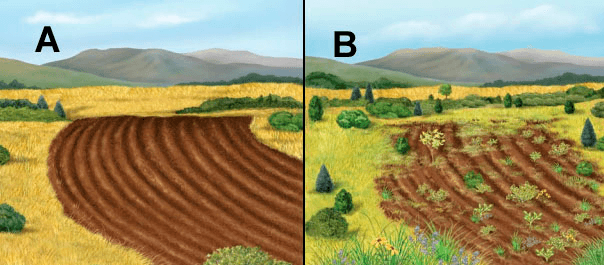
What type of succession is shown going from figure A to figure B?
a)
primary succession
b)
ecological succession
c)
secondary succession
d)
intermediate
21.
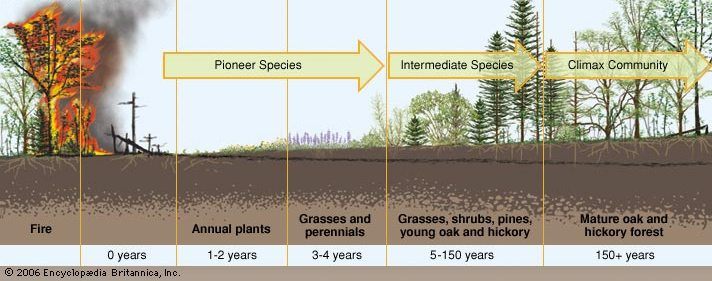
The picture shows what type of succession?
a)
primary
b)
secondary
22.
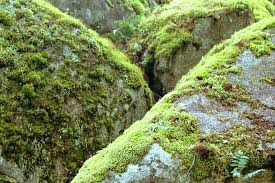
What are examples of pioneer species in a primary succession?
a)
Bushes and Shrubs
b)
Oak trees
c)
Mosses and Lichens
d)
A rose Bush
23.

After a volcanic eruption, lava covers the land. What is the order that plants grow to repopulate the area?
a)
Lichens → Shrubs → Grasses → Trees
b)
Lichens → tree → shrubs→Grasses
c)
Grasses → Lichens → Shrubs → Trees
d)
Lichens → Grasses → Shrubs → Trees
24.
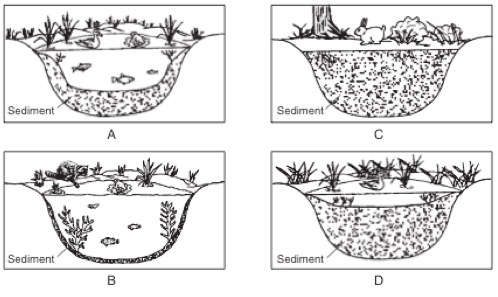
What is the correct order from oldest (happened first) to youngest (happened last) in this pond succession?
a)
A, B, C, D
b)
D, C, B, A
c)
B, A, D, C
d)
C, D, A, B
25.
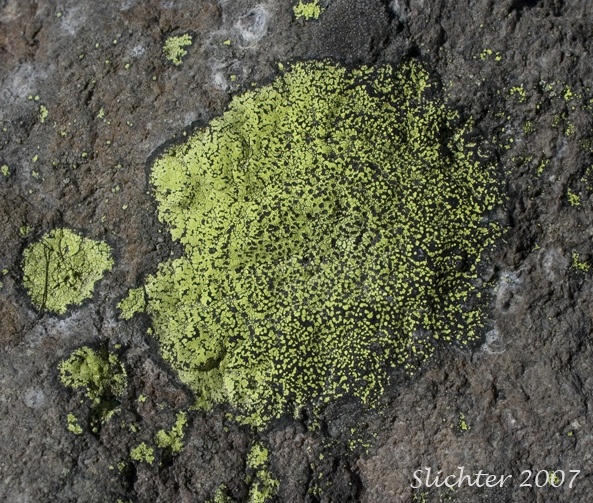
What is the first species you will see after a primary succession?
a)
lichens
b)
grasses
c)
small plants
26.

The great barrier reef of Australia is the largest coral reef in the world and known to have brutal hot summers. Some species of turtles stay well below the surface during the summer months. This behavior is most likely to help the turtle by
a)
avoiding sharks
b)
getting better oxygenated water
c)
keeping their body temp low
d)
be close to the plants they eat
27.

Chameleons eyelids are fused, and cover almost the entire eyeball, except for a small hole to let the pupil see through; each eye can be moved independently from the other. As a prey species, chameleons have eyes have adapted like this to
a)
give better focus to catch moving prey
b)
see a long distance
c)
allow them to see over a wider area allow them to detect predators
d)
spot humans
28.

Most foxes of the desert have a reddish brown coat but the artic fox has a white coat. How has this adaptation allowed the arctic fox to survive over many years?
a)
it gives it warmth during the summer
b)
it makes the fox look meaner
c)
it keeps it warm
d)
its protects it from prey using camoflauge
29.

Flashy tails on many animals is an example of coloration. Why might flashy tailed animals display their colors to another of the same species?
a)
make friends
b)
help build a nest
c)
attract a mate
d)
scare predators
30.

Charles Darwin noticed that birds of the Galapagos Islands were very similar in size and shape but their beaks were very different. What is the explanation for birds having different beaks?
a)
gathering food
b)
building nest
c)
fighting
d)
scaring predators
31.

An environment has a type of bug where some are red and some are blue. The red bugs always have red offspring and the blue bugs always have blue offspring. The birds in the environment always eat the blue bugs first. Over a long period of time, there will be
a)
more blue bugs than red bugs
b)
only red bugs in the environment
c)
only blue bugs in the environment
d)
changes in the red bugs so the birds will want them
32.
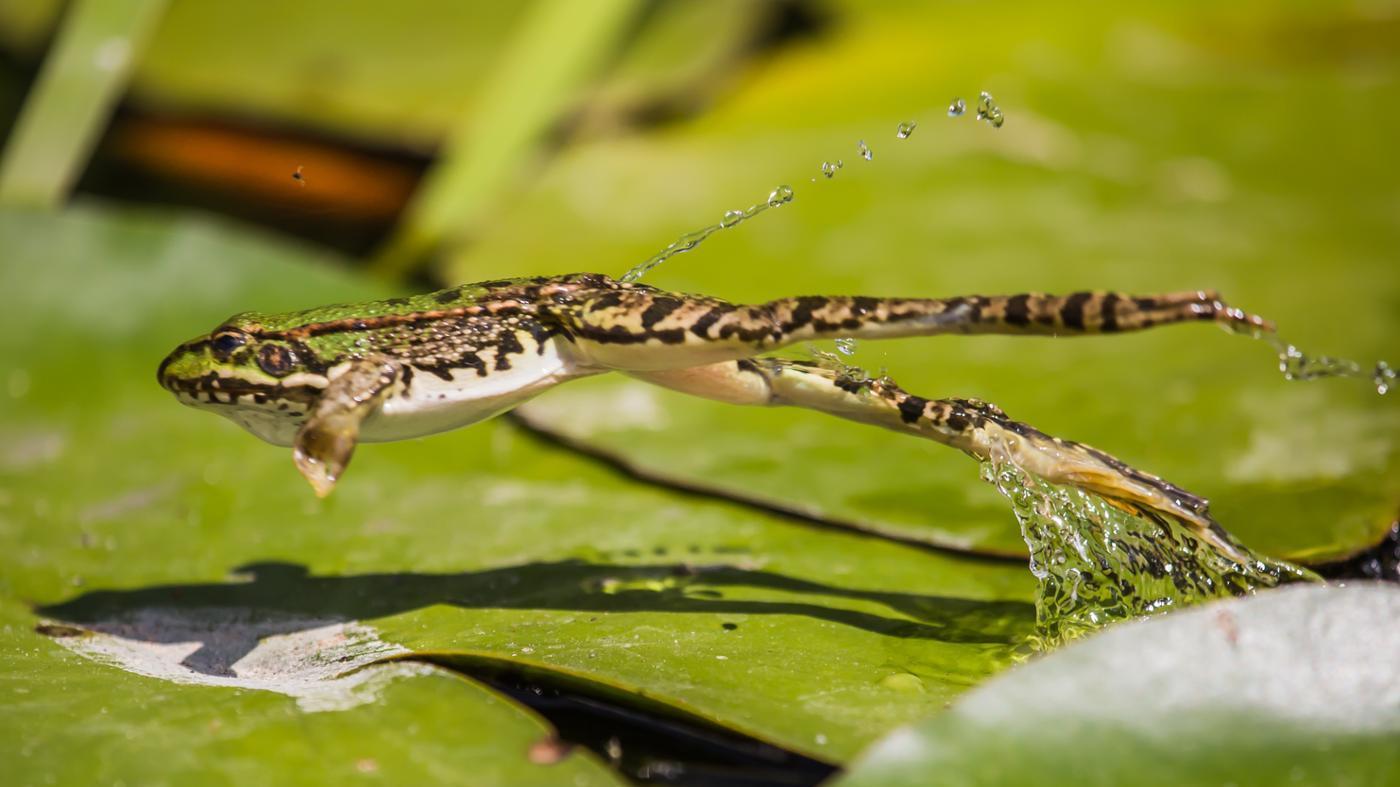
Frogs have webbed feet that help them to swim in water. Webbed feet in frogs are an example of a
a)
niche
b)
variation
c)
adaptation
d)
learned behavior
33.
A gene is a segment of _______
a)
a cell
b)
a trait
c)
DNA
d)
a model
34.
A strand of DNA is found in what part of the cell?
a)
cytoplasm
b)
cell wall
c)
ribosomes
d)
nucleus
35.
All of these influence an organism's phenotype of physical characteristic except ______.
a)
genotype
b)
mutation
c)
envrionment
d)
behavior
36.
The genetic transmission (passing on) of characteristics from parents to offspring.
a)
Inheritance
b)
Genotype
c)
Phenotype
d)
Genetics
37.
The possible variations of alleles (in chromosomes) for a particular trait within an individual.
a)
Inheritance
b)
Genotype
c)
Phenotype
d)
Genetics
38.
Expression of the genotype which depends on both your genotype and environment
a)
Inheritance
b)
Genotype
c)
Phenotype
d)
Genetics
39.
A trait that requires only ONE allele to be present for its expression in a heterozygote
a)
Dominant
b)
Recessive
c)
Pure Breeding
d)
Hybrid
40.
A person who is heterozygous for a trait but does not display the recessive trait.
a)
Carrier
b)
Complete dominance
c)
Hybrid
d)
Homozygous
41.
An individual who has two different alleles for a characteristic
a)
Carrier
b)
Complete dominance
c)
Heterozygous
d)
Homozygous
42.
Neither allele is dominant over the other and each is equally expressed in a heterozygote
a)
Complete dominance
b)
Incomplete dominance
c)
Co-Dominance
d)
Homozygous advantage
43.
Number of chromosomes in a body cell (somatic cell)
a)
23
b)
44
c)
46
d)
2
44.
Number of chromosomes in a sex cell (gamete)
a)
23
b)
44
c)
46
d)
2
45.
A factor that triggers a mutation
a)
Mutagen
b)
Point Mutation
c)
Cancer
d)
Mutagenic impact
46.
Possible causes due to Point Mutation
a)
deletion, insertion and substitution
b)
adenine, thymine, cytosine, guanine
c)
deletion, insertion and amino acid synthesis
d)
proteins, amino acids, DNA
47.
Mutation of red-blood cells that provides resistance to malaria
a)
Sickle cell
b)
Vector
c)
Anemia
d)
Pathogen
48.
A trait that is only found on "X" sex chromosomes.
a)
X-Linked
b)
Y-Linked
c)
ABO Linked
d)
Mutagen
49.
Purpose of a root.
a)
Gather water and nutrients from the ground
b)
Transport materials to all parts of the plant
c)
Absorb sunlight in order to do photosynthesis
d)
Allows the plant to release extra Carbon Monoxide
50.
Purpose of a stem.
a)
Gather water and nutrients from the ground
b)
Transport materials to all parts of the plant
c)
Absorb sunlight in order to do photosynthesis
d)
Allows the plant to release extra Carbon Monoxide
51.
Purpose of a leaf.
a)
Gather water and nutrients from the ground
b)
Transport materials to all parts of the plant
c)
Absorb sunlight in order to do photosynthesis
d)
Allows the plant to release extra Carbon Monoxide
52.
Purpose of a stamen.
a)
Male reproductive part; it is where pollen is produced
b)
Female reproductive part; it is where seeds are produced after pollination
c)
Attracts pollinators to the flower
d)
Protects the other flower parts when the flower is still a bud
53.
Purpose of a pistil.
a)
Male reproductive part; it is where pollen is produced
b)
Female reproductive part; it is where seeds are produced after pollination
c)
Attracts pollinators to the flower
d)
Protects the other flower parts when the flower is still a bud
54.
Purpose of a petal.
a)
Male reproductive part; it is where pollen is produced
b)
Female reproductive part; it is where seeds are produced after pollination
c)
Attracts pollinators to the flower
d)
Protects the other flower parts when the flower is still a bud
55.
Purpose of a sepal.
a)
Male reproductive part; it is where pollen is produced
b)
Female reproductive part; it is where seeds are produced after pollination
c)
Attracts pollinators to the flower
d)
Protects the other flower parts when the flower is still a bud
56.

The largest group of animals are the ...
a)
vertebrates
b)
invertebrates
57.
When an organism reproduces by breaking off and develops into an identical individual ?
a)
budding
b)
fragmentation
c)
sexual
58.
An animal digetsts its food in its
a)
respitory system
b)
nervouse system
c)
digestive system
d)
circulatory system
59.

Squid have a(n) -- body plan
a)
asymetrical
b)
radial
c)
bilateral
60.

Earthworms have a(n) -- body plan
a)
assymetrical
b)
radial
c)
bilateral
61.
All invertebrates
a)
have a backbone
b)
lack a backbone
c)
don't have a circulatory system
d)
use gills
62.
Parenting skills of birds and mammals differfrom those of fish and reptiles in that
a)
fish and reptiles parent until their offspringare adults
b)
birds & mammals have fewer offspring, so theyparent longer.
c)
fish & reptiles havefewer offspring, so they parent longer.
d)
only birds and mammals abandon their offspring at birth.
63.
An example of an ectotherm is a
a)
human
b)
bird
c)
whale
d)
lizard
64.
An animal that maintains its own bodytemperature is called a(n)
a)
endotemp
b)
ectotemp
c)
endotherm
d)
ectotherm
65.
Two types of asexualreproduction are
a)
budding and fragmentation.
b)
egg and differentiation.
c)
differentiation and fertilization.
d)
sperm and embryo.
66.
The type of reproduction that results inoffspring genetically identical to the parent is called
a)
fertilization.
b)
differentiation.
c)
sexual reproduction
d)
asexual reproduction
67.
Most reptiles live on land because
a)
they cannot swim
b)
they do not need water to lay their eggs
c)
their skin must be kept dry.
d)
they eat other vertebrates.
68.
Which of the following are NOT echinoderms?
a)
crabs
b)
sea urchins
c)
sea stars
d)
sand dollars
69.
Most amphibians live near freshwaterbecause
a)
their eggs and larvae need water to survive
b)
they breathe through gills throughout their life cycle.
c)
they are dry skinned and need water.
d)
. it is the only place to find food.
70.
An animal whose bodytemperature changes with the environment is called a(n)
a)
endotherm
b)
ectotherm
c)
endotemp
d)
exotemp
71.
9.The blood vessels that carry blood to and from the heart are
a)
veins and capillaries.
b)
capillaries and veins.
c)
arteries and capillaries.
d)
arteries and veins.
72.

An organism that creates or produces its own food is called?
a)
A producer
b)
A consumer
c)
A scavenger
d)
A decomposer
73.

Example of a decomposer?
a)
mushroom
b)
bumble bee
c)
fly
d)
bear
74.
The process in which plants make their food
a)
Photocholor
b)
Photography
c)
Photosynthesis
d)
Photo of me
75.

The largest number of individuals in a species that an environment can support long term
a)
carrying capacity
b)
emigration
c)
immigration
d)
population density
76.
What is population density?
a)
The number of people living across Europe.
b)
The number of plants occupying an area.
c)
The number of organisms or species living in an area.
d)
The number of insects in an ecosystem.
77.

When a population grows past the ecosystem's carrying capacity, what happens to the population?
a)
Continues to grow
b)
The population starts to die off because of lack of space
c)
The population will go extinct due to lack of resources
d)
The population grows then finds a new carrying capacity
78.
A frog eats a fly. The frog and fly are demonstrating ________.
a)
mutualism
b)
competition
c)
predator/prey
d)
parasitism
79.
A snake is eaten by a hawk. The hawk is the _______.
a)
prey
b)
parasite
c)
predator
d)
all of these
80.

A tapeworm and a cat have this type of relationship.
a)
mutualism
b)
parasitism
c)
commensalism
d)
competition
81.

Barnacles create home sites by attaching themselves to whales. Since the barnacle is a filter feeder, it also gets access to more water (and food) due to the relationship. The whale is unaffected.
This is an example of which type of symbiosis?
This is an example of which type of symbiosis?
a)
Commensalism
b)
Mutualism
c)
Parasitism
d)
Competition
82.

Clown fish live among anemones, acting as a lure for the sea anemone's prey. The clown fish gets protection and shelter from the anemone.
This is an example of which type of symbiosis?
This is an example of which type of symbiosis?
a)
Commensalism
b)
Mutualism
c)
Parasitism
d)
IDK
83.
In a parasitic relationship, one organism is ___________ and one organism is benefiting.
a)
helped
b)
harmed
c)
not effected
d)
happy
84.
In a mutual relationship, both organisms are ________________.
a)
hurt
b)
not effected
c)
harmed
d)
benefiting
85.
Commensalism is where one organism is benefiting and the other organism is _____________________.
a)
not effected
b)
helped
c)
harmed
d)
hurt
86.
A relationship where both organisms benefit is called?
a)
Commensalism
b)
Mutualism
c)
Preditation
d)
Parasitism
87.
A relationship where one organism benefits but does not harm or benefit the other is called?
a)
Commensalism
b)
Mutualism
c)
Preditation
d)
Parasitism
88.
A relationship where one organism benefits from the other and the other organism is harmed is called?
a)
Commensalism
b)
Mutualism
c)
Preditation
d)
Parasitism
89.
Plants and animals are often referred to as?
a)
Organisms
b)
Things
c)
Werid
d)
Ugly
90.
The place where an organism lives is called its?
a)
Home
b)
Ecosystem
c)
Area
d)
Shelter
91.
A producer?
a)
Eats other plants and animals
b)
Makes its own food
c)
Eats dead plants or animals
d)
Makes toys for kids
92.
A consumer?
a)
Makes its own food
b)
Eats dead plants and animals
c)
Eats plants and other animals for energy
d)
Buys toys for kids
93.
A decomposer?
a)
Eats dead plants or animals and breaks down to put nutrients in the soil
b)
Eats plants or other animals for food
c)
Makes its own food
d)
Machine that gathers trash
94.
A relationship between two organisms of different species that benefits one or both of the organisms
a)
Symbiosis
b)
Paratism
c)
Muatilism
d)
Prey
95.
Animals that eat PLANTS AND ANIMALS
a)
Carnivore
b)
Omnivore
c)
Herbivore
d)
Prey
96.
Animals that eat ONLY MEAT are
a)
Carnivore
b)
Herbivore
c)
Omnivore
d)
Predator
97.
Animals that eat ONLY plants.
a)
Autotroph
b)
Omnivore
c)
Producer
d)
Herbivore
98.
The way energy is passed from one organism to another
a)
food chain
b)
energy
c)
extinct
d)
habitat
99.

What is Ecosystem?
a)
The natural home or environment of an animal, plant, or other organism.
b)
A formation of plants and animals that have common characteristics due to similar climates
c)
Environment with organism interact with both biotic and abiotic things
d)
A population of a animal or place
100.
To calculate the magnifying power of a microscope multiply the eyepiece by the objective you are using. Suppose an eyepiece of 10x and Objective of 50X. Total Power????
a)
60X
b)
500X
c)
1,000X
d)
5,000X
100 %

