
 Worksheets
Semester 2 Learning Goals Review-Combined
Total questions: 101
Worksheet time: 6hrs 20mins
Name
Class
Date
1.
The site of photosynthesis
a)
ribosome
b)
mitochondria
c)
chloroplast
d)
4nucleus
2.
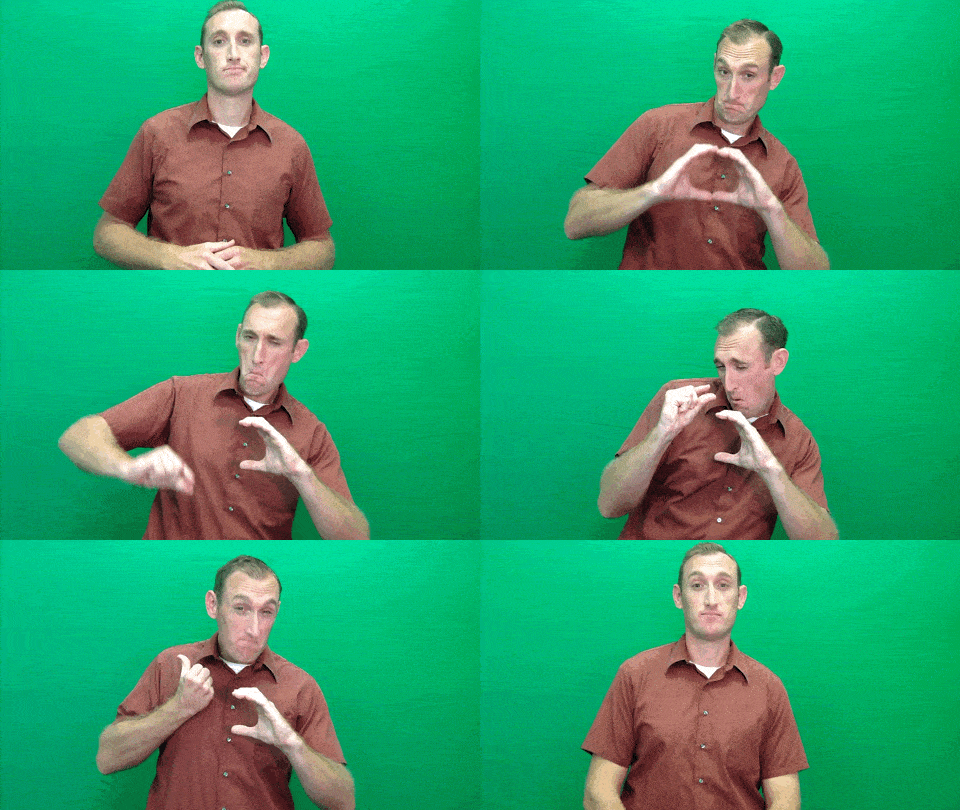
The ___________ is the basic unit of life
a)
organ
b)
cell
c)
atom
d)
tissue
3.
Which organelle is only found in a plant cell?
a)
nucleus
b)
chloroplast
c)
mitochondria
d)
cell membrane
4.

Directs all cell activities through the DNA located there.
a)
Lysosomes
b)
Nucleus
c)
ribosomes
d)
Mitochondria
5.
Which of the following is directly involved in the transportation of materials inside/within the cell?
a)
Endoplasmic Reticulum
b)
Vacuole
c)
Lysosome
d)
Mitochondria
6.
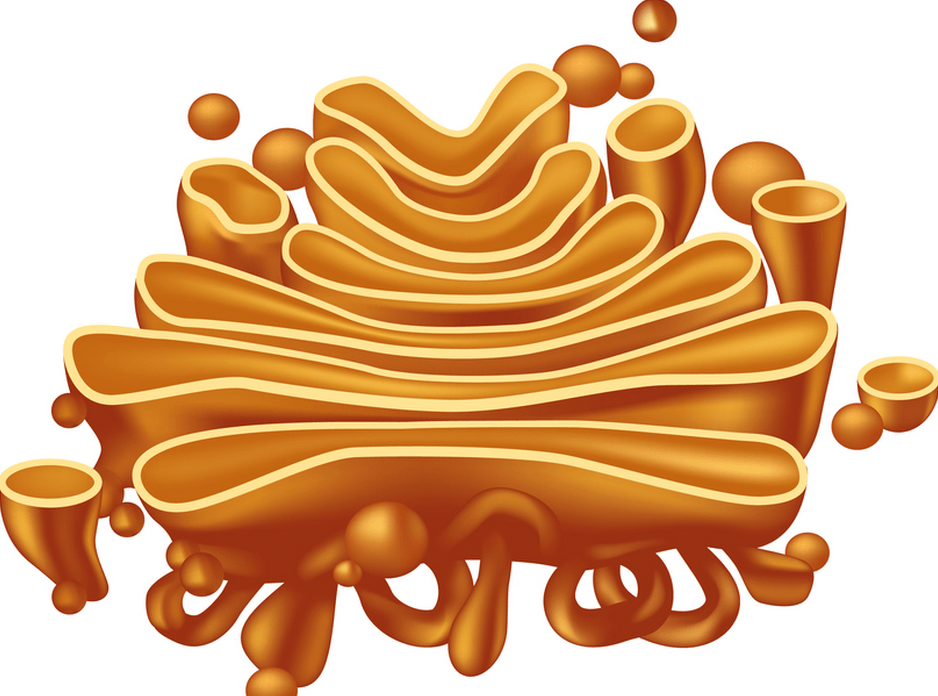
I am a protein packaging and shipping machine! Who am I?
a)
vacuole
b)
ribosome
c)
mitochondrion
d)
golgi apparatus
7.
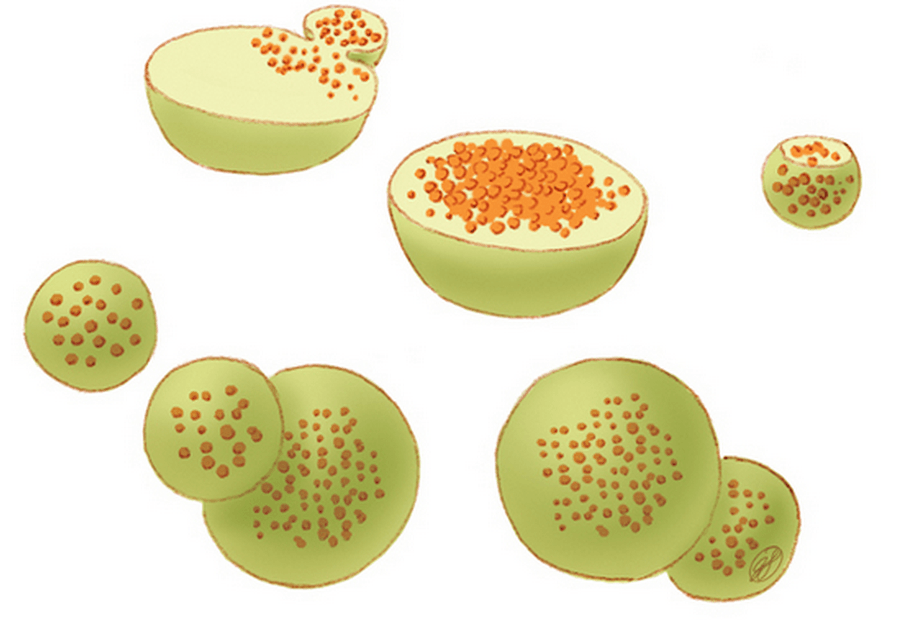
You might think of me as the trash collector, but recycler is maybe more accurate. What am I?
a)
mitochondria
b)
lysosome
c)
vacuole
d)
ribosome
8.

Which part of the cell is often called "the brain of the cell"?
a)
nuclear membrane
b)
endoplasmic reticulum
c)
nucleus
d)
mitochondria
9.
What is found in both plant and animal cells but is much larger in plant cells?
a)
Nucleus
b)
Mitochondria
c)
Chloroplast
d)
Vacuole
10.
Where are proteins made?
a)
Golgi body
b)
Mitoichondria
c)
Chromosomes
d)
Ribosomes
11.

I am the outer most layer of an animal cell. What am I?
a)
cell wall
b)
nucleus
c)
cell membrane
d)
cell skin
12.
A rigid layer that lies outside the cell's membrane is...
a)
Cytoskeleton
b)
Cilia
c)
Cell Wall
d)
Flagella
13.
What organelle is called the "powerhouse" of a cell?
a)
Endoplasmic Reticulum
b)
Nucleus
c)
Mitochondria
d)
Nucleolus
14.
What is the gel-like substance inside of cells called?
a)
photoplasm
b)
photosynthesis
c)
cytoskeleton
d)
cytoplasm
15.
Which organelle controls what enters and leaves the cell?
a)
Mitochondria
b)
Cell Membrane
c)
Cell Wall
d)
Nucleus
16.

According to cell theory, where did this cell come from?
a)
another living cell
b)
energy from sun
c)
a multicellular organism
d)
the nonliving environment
17.
What tool do you use to view the cells?
a)
metric ruler
b)
centrifuge
c)
microscope
d)
pipette
18.
Which of the following is NOT a cell theory.
a)
All non-living things are made of cells
b)
All cells come from pre-existing cells
c)
Cells are the basic unit of structure and function of all living things
19.
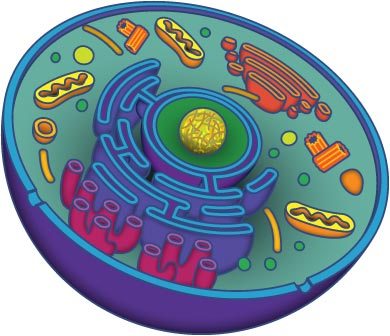
All living things are made up of...
a)
cells
b)
cell tissues
c)
organ
d)
organ systems
20.
Rocks are not living because
a)
they never move
b)
they aren't needed for humans
c)
they are not made of cells
d)
they don't break down
21.
What is the basic structural and functional unit of all living things?
a)
atom
b)
cell
c)
molecule
d)
human
22.
An organism made of one cell is called
a)
unicellular
b)
multicellular
23.
Which type of cell has a cell wall?
a)
Plant
b)
Animal
c)
Brain
d)
Fish
24.
The major outcome of Mitosis is:
a)
all cells disappearing
b)
cell division
c)
making cells that look weird
d)
cell multiplying
25.
Mitosis is needed for...
a)
Growth
b)
Development
c)
Repair
d)
all of the above
26.
This organelle breaks down food to release energy
a)
cytoplasm
b)
chloroplasts
c)
mitochondria
d)
golgi body
27.
The system of channels that transport materials throughout the cell
a)
nucleous
b)
golgi body
c)
vacuoles
d)
endoplasmic reticulum
28.
What organelle breaks down food molecules, cell wastes, and worn-out cell parts?
a)
mitochondria
b)
lysosomes
c)
cytoplasm
d)
golgi bodies
29.
Cell theory states that...
a)
all living things are made of cells
b)
cells are the basic unit of life
c)
living things come from other living cells
d)
All of the above
30.
The ____________________ are structures in the nucleus that contain genetic information.
a)
chromosomes
b)
nucleolus
c)
lysosomes
d)
golgi body
31.
Why might the powerhouse of cells be a good description for mitochondria?
a)
Mitochondria make food for the cell to use
b)
Mitochondria make energy from sunlight for the cell to use
c)
Mitochondria convert energy from food into a form the cell can use
d)
all the answers are correct
32.
If an organism does not have a nucleus it is defined as a/an ________
a)
eukaryote
b)
prokaryote
c)
unicellular organism
d)
multicellular organism
33.
What organelle breaks down food molecules, cell wastes, and worn-out cell parts?
a)
mitochondria
b)
lysosomes
c)
cytoplasm
d)
golgi bodies
34.
Which cell is round in shape?
a)
Animal Cell
b)
Pl
35.
The mitochondria of a cell can best be compared to the __________ of the school?
a)
Lunch Ladies
b)
Boiler room/ Electrical Panel
c)
Hallways
d)
Custodians
36.
Which item is not made of cells?
a)
Dog
b)
Rose
c)
Book
d)
Bacteria
37.
Which is more round in shape?
a)
Animal Cell
b)
Plant Cell
c)
Both Animal and Plant Cell
38.
Which do animal cells not have?
a)
Vacuole
b)
Cell Wall
c)
Well Membrane
d)
Lysosomes
39.
Which organelle is compared to custodians of the school?
a)
Endoplasmic Reticulum
b)
Cytoplasm
c)
Nucleus
d)
Lysosomes
40.
Which organelle is best compared to the air that fills the school?
a)
Cytoplasm
b)
Chloroplast
c)
Vacuole
d)
Cell Membrane
41.
Which organelle is best compared to the principal of the school?
a)
Nucleolus
b)
Golgi body
c)
Nucleus
d)
Cytoplasm
42.
Which organelle stores food, water, and waste?
a)
lysosomes
b)
vacuole
c)
mitochondria
d)
chloroplasts
43.
Which organelle is responsible for transporting things around the cell and much like the hallways of a school?
a)
Endoplasmic Reticulum
b)
Golgi Body
c)
Lysosomes
d)
Chloroplasts
44.
Which organelle makes food for the plant, like the lunch ladies at school?
a)
Chromatin
b)
Vacuole
c)
Chloroplasts
d)
Golgi Body
45.
Which organelle prepares or packages proteins for use and distributes them to other parts of the cell?
a)
Endoplasmic Reticulum
b)
Golgi Body
c)
Vacuole
d)
Mitochondria
46.

I am #9. What am I?
a)
Vacuole
b)
Chloroplast
c)
Mitochondria
d)
Golgi Body
47.

I am #6. What am i?
a)
Golgi Body
b)
Edoplasmic Reticulum
c)
Cell Membrane
d)
Vacuole
48.

I am #1. What am I?
a)
Cell Membrane
b)
Nucleolus
c)
Nucleus
d)
Lysosome
49.

I am #5. What am I?
a)
Chloroplast
b)
Vacuole
c)
Mitochondria
d)
Endoplasmic Reticulum
50.

What am I?
a)
Chloroplast
b)
Vacuole
c)
Ribosome
d)
Lysosome
51.

I am #3. (one of the many little purple dot-like organelles). What am I?
a)
Vacuoles
b)
Ribosomes
c)
Lysosomes
d)
Cytoplasms
52.
I fill all the empty space in the cell, much like the air in a school building. What am I?
a)
Chromatin
b)
Golgi Body
c)
Chloroplast
d)
Cytoplasm
53.
Which is in a plant cell, but not in an animal cell?
a)
Cell Wall
b)
Cell Membrane
c)
Vacuole
d)
Nucleolus
54.

I am #5. What am I?
a)
Lysosome
b)
Golgi Body
c)
Vacuole
d)
Endoplasmic Reticulum
55.

I am the big light blue organelle in the top right corner of this plant cell. What am I?
a)
Vacuole
b)
Ribosome
c)
Mitochondria
d)
Golgi Body
56.

Getting rid of waste in the cell, what am I?
a)
Chromosome
b)
Lysosome
c)
Vacuole
d)
Golgi Body
57.
The tendency to resist a change in an onject's motion is ________.
a)
inertia
b)
an unbalanced force
c)
a balanced force
d)
work
58.
If there are two forces going in the same direction how would you find the net force?
a)
Subtract
b)
Add
c)
Neither
d)
Multiply
59.
With unbalanced forces, the object will move in the direction of the _______ force.
a)
larger
b)
smaller
c)
equal
60.

The force that pulls things toward earth.
a)
Speed
b)
Gravity
c)
Friction
d)
Velocity
61.
You and your dad are moving the couch from one side to another. Your dad pushes with a force of 35 N to the right and you push with a force of 25 N right. What is the net force on the couch?
a)
60 N right
b)
10 N left
c)
60 n right
d)
50 N left
62.
What famous scientist was the SI units of Force named after?
a)
Isaac Newton
b)
Galileo Galilei
c)
Albert Einstein
d)
Charles Darwin
63.

Is this and example of a balanced or unbalanced force?
a)
balanced
b)
KITTIES!
c)
unbalanced
d)
pshhh
64.

What is the net force?
a)
5000 N right
b)
4000 N right
c)
40 N left
d)
4000 N left
65.

What is the net force?
a)
17 N Right
b)
3 N Right
c)
3 N Left
d)
17 N Left
66.
What is Newton's First Law known as? The Law of
a)
Friction
b)
Mass
c)
Inertia
d)
Gravity
67.
What is Newton's First Law
a)
F=ma
b)
Every action has an equal and opposite reaction
c)
An object at rest stays at rest, an object in motion stays in motion.
d)
Friction
68.
A person is pushed forward into their seatbelt when a car stops. Which of Newton's laws explains this motion?
a)
1st law
b)
2nd law
c)
2 and 3 law
d)
3rd law
69.

Friction and gravity are both examples of a force.
a)
True
b)
False
70.
Friction and gravity are both examples of a force.
a)
True
b)
False
71.

__________ is the sum of all forces acting on an object. It is capable of accelerating a mass.
a)
velocity
b)
gravity
c)
net force
d)
distance
72.
How are velocity and force similar?
a)
both are described by the grams they act in.
b)
both are described by the distance they act in.
c)
both are described by the speed they act in.
d)
both are described by the direction they act in.
73.
Calculate the average speed (in miles per hour) of Cassandra who runs an 18 mile marathon in 6 hours.
a)
24 m/hr
b)
3 m/hr
c)
0.333 m/hr
d)
12 m/hr
74.
Calculate the distance (in miles) that Daniel bikes if he maintains an average speed of 26 miles/hr for 7 hours
a)
33 miles
b)
3.71 miles
c)
182 miles
d)
676 miles
75.
Forrest Gump ran 720 miles in 120 hours. How fast was Forrest Gump running?
a)
72 mph
b)
600 mph
c)
88 miles
d)
6 mph
76.
If a man runs at a speed of 70 m/s, and has a time of 30 s. What is the distance he ran?
a)
2100 m
b)
0.233 m
c)
2.33 m
d)
300m
77.
What is the equation to calculate speed?
a)
speed = distance/time
b)
speed = time/distance
c)
speed = time x distance
d)
speed = speed/time
78.
What is the equation to calculate distance?
a)
distance = speed/time
b)
distance = time/speed
c)
distance = speed/distance
d)
distance = speed x time
79.
If an object starts to accelerate, _______.
a)
A balanced force is acting on it
b)
gravity is acting on it
c)
velocity is acting on it
d)
an unbalanced force is acting on it
80.
When forces are balanced, the total force is ______.
a)
greater than the sum of the forces
b)
zero
c)
negative
d)
equal to the largest force
81.
The motion of an object depends on both how strong the forces are and the direction of the forces
a)
True
b)
False
82.
Forces can affect motion by _______.
a)
making objects start to move
b)
making objects stop moving
c)
making objects change direction
d)
all of the above
83.
_____________ cause a change in motion; speed and/or direction.
a)
Net forces
b)
Balanced forces
c)
Frictions
d)
Unbalanced forces
84.
28N−−> ⊟ <−−50N
What is the net force?
What is the net force?
a)
78N, Left
b)
22N, Right
c)
22N, Left
d)
78N, Left
85.
98N−−>⊟<−−48N
What is the net force?
What is the net force?
a)
50N, Right
b)
146N, Right
c)
98N, Right
d)
50N, Left
86.
What is the term used for the place or object used for comparison to determine if an object is in motion?
a)
Starting Point
b)
Motion Point
c)
Reference Point
d)
Objection Point
87.
What is the formula for Velocity?
a)
D/T
b)
D x T and the direction
c)
T/D
d)
D/T and the direction
88.
A helicopter's speed increases from 25mph to 60mph in 5 seconds. What is the acceleration of this helicopter?
A=(Vf - Vi)/Δt
Acceleration= Speedfinal - Speedinitial
̅ ̅ ̅ ̅ ̅ ̅ ̅ ̅ ̅ ̅ ̅ ̅ ̅ ̅ ̅ ̅ ̅ ̅ ̅ ̅ ̅ ̅ ̅ ̅ ̅ ̅ ̅ ̅ ̅ ̅ ̅ ̅ ̅ ̅ ̅
Time
A=(Vf - Vi)/Δt
Acceleration= Speedfinal - Speedinitial
̅ ̅ ̅ ̅ ̅ ̅ ̅ ̅ ̅ ̅ ̅ ̅ ̅ ̅ ̅ ̅ ̅ ̅ ̅ ̅ ̅ ̅ ̅ ̅ ̅ ̅ ̅ ̅ ̅ ̅ ̅ ̅ ̅ ̅ ̅
Time
a)
12 mph/s
b)
175 mph/s
c)
17 mph/s
d)
7 mph/s
89.
Which is not a kind type of friction?
a)
Sliding Friction
b)
Floating Friction
c)
Rolling Friction
d)
Static Friction
90.
This acts in a direction opposite of motion and slows down an objects motion.
a)
Acceleration
b)
Friction
c)
Velocity
d)
Fussion
91.
The pilot slowed down his plane from 200mph to 20mph. This was done in 10 seconds. What was his acceleration?
Acceleration= Speedfinal - Speedinitial
̅ ̅ ̅ ̅ ̅ ̅ ̅ ̅ ̅ ̅ ̅ ̅ ̅ ̅ ̅ ̅ ̅ ̅ ̅ ̅ ̅ ̅ ̅ ̅ ̅ ̅ ̅ ̅ ̅ ̅ ̅ ̅ ̅ ̅ ̅
Time
Acceleration= Speedfinal - Speedinitial
̅ ̅ ̅ ̅ ̅ ̅ ̅ ̅ ̅ ̅ ̅ ̅ ̅ ̅ ̅ ̅ ̅ ̅ ̅ ̅ ̅ ̅ ̅ ̅ ̅ ̅ ̅ ̅ ̅ ̅ ̅ ̅ ̅ ̅ ̅
Time
a)
-22mph/s
b)
18mph/s
c)
22mph/s
d)
-18 mph/s
92.
What is Newton's Second Law?
a)
F= M*A
Acceleration depends on the mass and net force acting on it
Acceleration depends on the mass and net force acting on it
b)
An object in motion/at rest will stay in motion/at rest unless acted upon by an outside force
c)
For every action there is an equal and opposite reaction
d)
An object acted on by friction will reverse and move in the opposite direction
93.
What is Newton's 3rd Law?
a)
F= M*A
Acceleration depends on the mass and net force acting on it
Acceleration depends on the mass and net force acting on it
b)
An object in motion/at rest will stay in motion/at rest unless acted upon by an outside force
c)
For every action there is an equal and opposite reaction
d)
An object acted on by friction will reverse and move in the opposite direction
94.
Jake dropped the pudding cup from his hands. The pudding splattered back up, all over everything. Which of Newton's Laws is at play here?
a)
Newton's 1st Law
b)
Newtons 2nd Law
c)
Newton's 3rd Law
95.
Bella was riding her bike down the hill. She hit a rock with her front wheel and launched herself over the front handle bars into cow manure. Which of Newton's laws is at play here?
a)
Newton's 1st Law
b)
Newton's 2nd Law
c)
Newton's 3rd Law
96.
Emily noticed that her nephew was much more difficult to push up hill in his stroller now that he was a toddler. It was easier when he was an infant. Which of Newton's Laws is described here?
a)
Newton's 1st Law
b)
Newton's 2nd & 3rd Law
c)
Newton's 2nd Law
d)
Newton's 3rd Law
97.

At which point is potential energy greatest
a)
W
b)
X
c)
Y
d)
Z
98.
What is kinetic energy?
a)
energy of work
b)
energy of motion
c)
energy of gravity
d)
energy of power
99.
Speed that does not change is referred to as ____________________ speed.
a)
Slow
b)
Fast
c)
constant
d)
No
100.
__________ is stored energy.
a)
Potential
b)
Kinetic
c)
None of the above
d)
All of the above
101.
What factors affect the force of gravity?
a)
Weight & Distance
b)
Mass & Weight
c)
Distance & Height
d)
Mass & Distance
100 %

