
 Worksheets
Earth Science, Second Semester Review 2018
Total questions: 100
Worksheet time: 1hrs 9mins
Name
Class
Date
1.
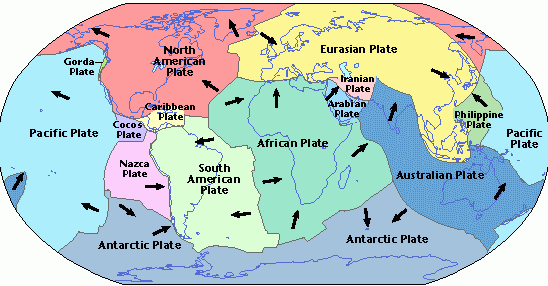
Many earthquakes happen along the borders of...
a)
Countries
b)
Tectonic Plates
c)
Climate Zones
d)
None of the above.
2.
The Richter scale measures:
a)
the amount of radon gas released
b)
the movement of plates
c)
the strength of an earthquake
d)
the weight of tectonic plates
3.

The first wave of an earthquake is . . . .
a)
tsunami
b)
surface wave
c)
p wave
d)
s wave
4.

The epicenter of an earthquake shows up where?
a)
Below the surface of the earth.
b)
On the surface of the earth.
c)
Next to the P Wave.
d)
At the end of a Surface Wave
5.
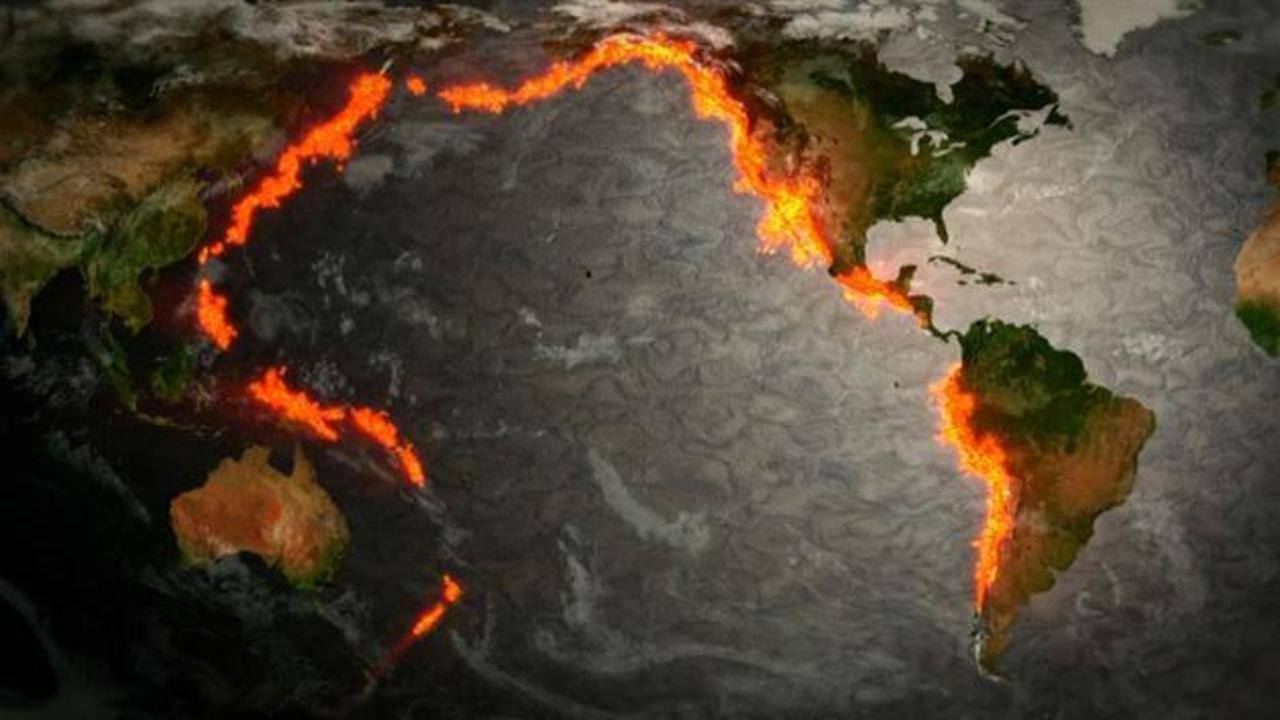
Which ocean in the world is also known as the "Ring of Fire"
a)
Atlantic
b)
Indian
c)
Arctic
d)
Pacific
6.
Which of these seismic waves creates the most damage during an earthquake?
a)
primary
b)
secondary
c)
surface
7.
Liquefaction is when...
a)
the soil behaves like liquid
b)
the ground becomes liquid
c)
magma rises to the surface
d)
buildings are damaged, crumbling like liquid
8.
What is the epicenter of an earthquake
a)
the location along a fault where the first motion of an earthquake occurs
b)
a seismic wave tht travels along the surface of Earth
c)
the point on Earth's surface directly above the earthquake's focus
d)
the last place that motion in an earthquake is detected
9.
An instrument that detects and measures earthquakes is a
a)
seismogram
b)
focus seismic map
c)
focus
d)
seismograph
10.
How much bigger is a magnitude 8 earthquake compared to magnitude 7 one on the Richter Scale?
a)
1 time bigger
b)
10 times bigger
c)
100 times bigger
d)
1000 times bigger
11.
Earthquakes under the water can cause _________________________________.
a)
tornadoes
b)
tsunamis
c)
lightening
d)
hailstorms
12.
The focus of an earthquake is
a)
The point below Earth's surface where rock first breaks
b)
The closest seismic station
c)
The place where the greatest damage occurs
d)
A fault
13.
A break in the lithosphere along which movement has occurred is called a(n)
a)
fault
b)
earthquake
c)
epicenter
d)
volcano
14.
At what location does the first motion of an earthquake occur
a)
the focus
b)
the seismic gap
c)
the mantle
d)
the epicenter
15.

Earthquakes happen every day. Most are too small for humans to notice.
a)
True
b)
False
16.

This is the area beneath the Earth's surface where the earthquake begins
a)
epicenter
b)
hypocenter
c)
fault line
d)
tectonic plate
17.
The record of a seismic wave is the
a)
Seismogram
b)
Seismograph
c)
Seismometer
d)
Richter scale
18.

The outside layer of the earth is called ______________________.
a)
core
b)
crust
c)
mantle
d)
outer core
19.
The epicenter of an earthquake is
a)
The point below the surface where rock begins to break and the first motion occurs
b)
The seismic station closest to the earthquake
c)
The place where the greatest damage occurs
d)
The point on the surface directly above the focus
20.
What is the minimum number of seismograph stations needed to locate an earthquake epicenter?
a)
1
b)
2
c)
3
d)
1 billion
21.
Seismographs detect and record_______ waves
a)
sound
b)
light
c)
seismic
d)
radio
22.

What does the arrows point to?
a)
Triangulation
b)
Seismograph
c)
Seismic waves
d)
epicenter
23.
The earth's ________ is broken up into pieces just like a jigsaw puzzle.
a)
Inner Core
b)
Lithosphere
c)
Mantle
d)
Outer Core
24.
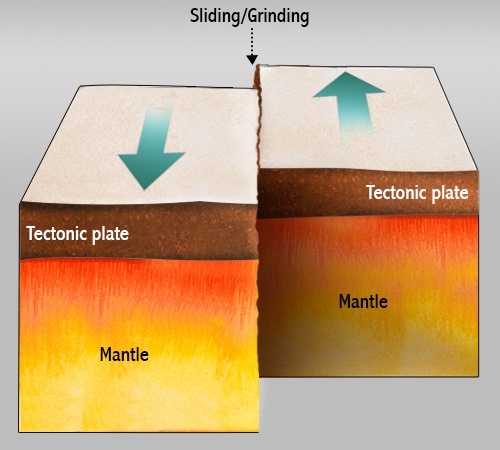
Which Plate Boundary does the picture illustrate?
a)
Spreading Boundary
b)
Fault Boundary
c)
Colliding Boundary
d)
Seismic Boundary
25.

This picture shows which kind of Plate Boundary?
a)
Colliding Boundary
b)
Fault Boundary
c)
Spreading Boundary
d)
Seismic Boundary
26.

Which Plate Boundary does the picture illustrate?
a)
Spreading Boundary
b)
Fault Boundary
c)
Colliding Boundary
d)
Volcanic Boundary
27.
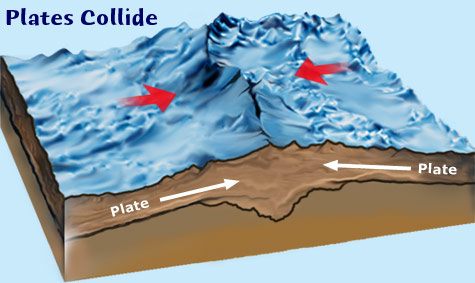
What Geologic Activity is occurring in this picture?
a)
Sea-floor Spreading
b)
Volcano forming
c)
Earthquake
d)
Mountain building
28.

What is the name of the geologic process when one plate slips underneath another plate?
a)
Subduction
b)
Subway
c)
Convergence
d)
Slip
29.
The fastest Seismic waves that can go through any of Earth's layers are...
a)
Secondary Waves
b)
Surface Waves
c)
Primary Waves
30.
The area around the Pacific Ocean where lots of earthquakes and volcanoes happen is called the ____________.
a)
Ring of Earth
b)
Ring of Fire
c)
Ring of Stone
d)
Ring of Diamond
31.
Volcanic belts form along
a)
islands in the Pacific Ocean
b)
North American mountain ranges
c)
the boundaries of Earth's plates
d)
the coast of Antarctica
32.
The formation of the Hawaiian Islands is one example of
a)
volcanoes forming over a hot spot
b)
volcanoes forming along a plate boundary
c)
the Ring of Fire
d)
continental drift
33.
Liquid magma flows upward through cracks in rock because it is
a)
highly fluid
b)
less dense than the surrounding solid material
c)
highly magnetic
d)
more dense than the surrounding solid material
34.
The long tube in the ground that connects the magma chamber to Earth's surface is called the
a)
vent
b)
side vent
c)
pipe
d)
crater
35.
If a volcano's magma is high in silicia, the volcano will probably
a)
erupt quietly
b)
remain dormant
c)
erupt explosively
d)
produce dark color lava
36.
Pahoehoe is
a)
cooler, slower moving lava
b)
fast moving lava
c)
volcanic ash
d)
lava with a rough, chunky surface
37.
When groundwater heated by magma rises to the surface and collects in a natural pond, it is called a
a)
hot spring
b)
geyser
c)
vent
d)
pyroclastic flows
38.
In volcanic areas, groundwater heated by magma is a source of
a)
lava flows
b)
silicia
c)
geothermal energy
d)
pyroclastic flows
39.
Which of the following volcano hazards is made up of rocky particles about the size of a grain of sand?
a)
volcanic bombs
b)
pahoehoe
c)
volcanic cinders
d)
volcanic ash
40.
Tall, cone-shaped mountains in which layers of lava alternate with layers of ash are called
a)
shield volcanoes
b)
cinder cone volcanoes
c)
composite volcanoes
d)
lava plateaus
41.
The main hazard from a quiet volcanic eruption is
a)
volcanic bombs
b)
lava flows
c)
volcanic cinders
d)
volcanic ash
42.
When magma squeezes between layers of rock, it forms a
a)
neck
b)
dike
c)
lava plateau
d)
dome mountain
43.
When many layers of thin, runny lava build up a high, level area, the result is a
a)
lava plateau
b)
shield volcano
c)
cinder cone volcano
d)
composite volcano
44.
Because Mercury and Mars are smaller than Earth and their cores have cooled, scientists think that
a)
the volcanic activtiy on these planets has just begun
b)
the volcanic activity on these planets has ended
c)
there never was volcanic activity on these planets
d)
the volcanoes on these planets are smaller and cooler than those on Earth
45.
What is the landform that forms when rising magma, blocked by layers of rock, forces the layers of rock to bend upward?
a)
volcanic neck
b)
dike
c)
lava plateau
d)
dome mountain
46.
Which planet has shield volcanoes and lava flows similiar to those on Earth?
a)
Jupiter
b)
Venus
c)
Mercury
d)
Neptune
47.
Besides Earth, what are two other bodies in the solar system where volcanic eruptions have been observed?
a)
Io, a moon of Jupiter, and Triton , a moon of Neptune
b)
Mars and Venus
c)
Earth's moon and Venus
d)
Saturn and Uranus
48.
The eruptions on Neptune's moon Triton involve
a)
molten lava similar to Earth's volcanoes
b)
sulfur
c)
liquid nitrogen
d)
salt water
49.
Before lava reaches the surface it is called
a)
rock
b)
magma
c)
volcanic ash
d)
liquid fire
50.
The volcanoes along converging oceanic plate boundaries may form
a)
a hot spot
b)
a part of the mid-ocean ridge
c)
an island arc
d)
a subducting plate
51.
A mass of rock formed when a large body of magma cools inside the crust is called a
a)
neck
b)
dike
c)
lava plateau
d)
batholith
52.
A volcano that may erupt again at some time in the distant future is
a)
active
b)
dormant
c)
explosive
d)
extinct
53.
The huge hole left by the collapse of a volcanic mountain is called a
a)
lava plateau
b)
caldera
c)
cinder cone
d)
shield volcano
54.
If geologists detect many small earthquakes in the area near a volcano, what can they infer about the volcano?
a)
It is dormant
b)
It is probably about to erupt
c)
It is extinct
d)
It is a good source of geothermal energy
55.
The smooth surfaces on Earth's moon that are visible from Earth are
a)
oceans
b)
craters where meteors smashed into the moon
c)
areas where lava flowed more than three billion years ago
d)
mountain ranges
56.
The ________ measures how hard a mineral is.
a)
Miller Scale
b)
Dishong Scale
c)
Curly Scale
d)
Mohs Scale
57.
___________ is the color of powdered mineral.
a)
Luster
b)
Streak
c)
Fracture
58.
_________ is how easily something can be scratched.
a)
specific gravity
b)
luster
c)
hardness
59.
___________ describes how the mineral reflects light.
a)
cleavage
b)
magnetic
c)
luster
60.

_____ is if something breaks into smooth flat layers.
a)
fracture
b)
cleavage
c)
streak
61.

__________ is if a mineral breaks apart in a jagged or rough layer.
a)
cleavage
b)
luster
c)
fracture
62.
Minerals are identified by observing their ___________.
a)
physical properties
b)
name
c)
location
63.

A mineral breaks into pieces like are shown in the picture. How would you describe its breakage?
a)
Fracture
b)
Cleavage
c)
Glassy
d)
Waxy
64.

A mineral breaks into pieces like are shown in the picture. How would you describe its breakage?
a)
Fracture
b)
Cleavage
c)
Glassy
d)
Waxy
65.
What does inorganic mean?
a)
Something that is living
b)
Something that is dead, but was once living
c)
Something that was never living
66.
Which of the following is NOT a way to identify a mineral?
a)
Luster
b)
Hardness
c)
Heaviness
d)
Density
67.
Dull, silky, waxy, pearly, and earthy are terms that best describe which property of minerals?
a)
luster
b)
color
c)
streak
d)
cleavage
68.
Physical properties of minerals include all of the following EXCEPT
a)
hardness
b)
color
c)
streak
d)
specific gravity
69.
Which of the following properties does the Mohs scale measure?
a)
Luster
b)
Hardness
c)
Density
d)
Streak
70.
The definition of a mineral does NOT include:
a)
crystalline structure
b)
solid
c)
organic
d)
natural
71.
The special property that causes some minerals to glow is:
a)
Density
b)
Reclamation
c)
Fluorescence
d)
Specific Gravity
72.
Which of the following is NOT true of minerals?
a)
They are liquids
b)
They are formed in nature
c)
They are inorganic
d)
They have crystalline structure
73.
The ratio of an objects mass to its volume is called
a)
Fluorescence
b)
Streak
c)
Ore
d)
Density
74.
Fluorescence is
a)
an uneven, jagged, or irregular break of a mineral
b)
a special property of minerals that causes some of them to glow
c)
color of the powder of a mineral
d)
a mineral that contains oxygen
75.
What mineral is known as "fools gold"?
a)
graphite
b)
quartz
c)
galena
d)
pyrite
76.
What mineral can pick up a paperclip because of it's magnetic properties?
a)
galena
b)
graphite
c)
magnetite
d)
hematite
77.
Which mineral smells like rotten eggs?
a)
talc
b)
sulfer
c)
mica
d)
pyrite
78.
A mineral's resistance to being scratched is called?
a)
streak
b)
luster
c)
hardness
d)
heft
79.

By definition, a mineral has which of the following characteristic(s)?
a)
chemical composition
b)
crystalline structure
c)
natural
d)
all of the above
80.
A mineral is a living object
a)
True
b)
False
81.
How did the humans use rocks in the past?
a)
to play sports
b)
to tell time
c)
to write
d)
to make tools
82.
Sedimentary rock is formed through the process of
a)
Cementation
b)
Stratification
c)
Erosion
d)
Foliation
83.
What has to increase for metamorphism to occur?
a)
weathering and erosion
b)
temperature and pressure
c)
melting and cooling
d)
compaction ad cementation
84.
What is process in which water, wind, and heat break down rock?
a)
weathering
b)
exfoliation
c)
cementation
d)
composition
85.
When magma cools quickly, what kind of texture does rock have?
a)
coarse grained
b)
large grained
c)
medium grained
d)
fine grained
86.
What are the main categories of sedimentary rock?
a)
extrusive and intrusive
b)
clastic, chemical, & organic
c)
felsic and mafic
d)
foliated and non-foliated
87.
When temperature and pressure change, what can happen to the minerals in rocks?
a)
they stay the same
b)
they change into coal
c)
they change into minerals that are less stable
d)
they change into minerals that are more stable
88.
During the rock cycle, what forms when the magma cools?
a)
igneous rocks
b)
sedimentary rock
c)
metamorphic rock
d)
foliated rock
89.
During the rock cycle, what forms when the magma cools?
a)
igneous rocks
b)
sedimentary rock
c)
metamorphic rock
d)
foliated rock
90.
What do scientists call the rock that is formed when magma cools below the surface
a)
extrustive igneous rock
b)
intrustive igneous rock
c)
erupitve rock
d)
volcanic
91.
Besides clastic and chemical, what is the other kind of sedimentary rock?
a)
extrusive
b)
foliated
c)
organic
d)
intrusive
92.
What kind of metamorphic rock has its minerals grains arranged in planes or bands?
a)
extrustive
b)
foliated
c)
non-foliated
d)
intrusive
93.
Besides texture, how else are rocks classified?
a)
by the amount of foliation
b)
by their grain size
c)
by grain shape
d)
by their composition
94.
The process in which rocks change shape is called...
a)
deformation
b)
deposition
c)
composition
d)
foliation
95.
Metamorphic rock in which minerals are NOT arranged in bands
a)
stratification
b)
non-foliated
c)
extrusive igneous rock
d)
strata
96.
Granite is an igneous rock with large crystals. What does the size of the crystals tell you about granite?
a)
It turned solid immediately.
b)
It turned solid very slowly.
c)
It started out as a sedimentary rock.
d)
It is about to transform into a metamorphic rock
97.
Fossils are found only in _____ rock.
a)
sedimentary
b)
metamorphic
c)
igneous
d)
intrusive
98.
A geologist found a rock whose minerals have been aligned or arranged into parallel bands by high pressure. The geologist probably found _____.
a)
a sedimentary rock
b)
a metamorphic rock
c)
an igneous rock
d)
a meteorite
99.
Which are sources of heat that help metamorphic rock to form?
a)
being near pockets of magma rising through the crust
b)
friction of plate movement
c)
the heat from the mantle
d)
all of these
100.
Extrusive rocks have a _____ texture because the mineral crystals that comprise them have only a short time in which to grow.
a)
large, course grained
b)
colorful
c)
small, fine-grained
d)
blended
100 %

