
 Worksheets
Post Test 2 - Science
Total questions: 102
Worksheet time: 2hrs 35mins
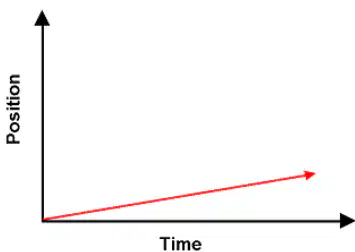
The graph below describes the motion of an object. Which of the following statements is true?
The object is moving with a negative acceleration.
The object has a constant velocity.
The object is moving with a positive acceleration.
The object has a constant position.
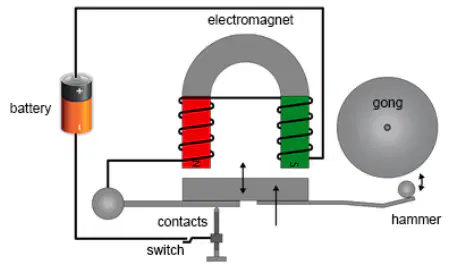
Denver constructs an electric bell as shown in the diagram below. He then turns the switch on to test the bell. Denver notices that the hammer moves a bit toward the gong, but does not quite reach the gong. Which of the following should Denver do to best increase the chances of making the bell ring?
increase the length of the arm supporting the hammer and use a heavier hammer
decrease the size of the gong and use a larger hammer
decrease the size of the gong and the number of coils around the electromagnet
increase the current produced by the battery and the number of coils around the electromagnet
What caused this gas to come together and form the Sun?
The atoms of gas were pulled together by the force of gravity.
The atoms of gas were attracted to the center of a black hole.
The magnetic forces from stars moved the atoms of gas together.
The planets pushed the atoms of gas toward each other.
Which of the following is true about the Earth's natural resources?
The natural resources on Earth can never be used up because humans can always make more resources to replace them.
The same natural resources are available in all areas of the Earth because the geologic processes that formed them occurred the same way in every location.
Natural resources are unevenly distributed on Earth because the geologic processes that formed them occurred in different locations over time.
Natural resources were once formed by geologic processes inside the Earth, but they are now created only by human-made processes.
Which of the following is a force that acts at a distance?
gravity
static electricity
magnetism
all of these
Which of the following is true about the locations of earthquakes, volcanoes, and tectonic plate boundaries?
Neither earthquakes nor volcanoes are located near plate boundaries.
Earthquakes and volcanoes are both commonly located near plate boundaries.
Volcanoes are commonly located near plate boundaries, but earthquakes are not.
Earthquakes are commonly located near plate boundaries, but volcanoes are not.
Which statement best describes how data from a spectroscope can be used to provide information about the Solar System?
A spectroscope records sounds produced by the movement of planets, and this data can be used to determine the movement of the planets in relation to Earth.
A spectroscope records sounds produced by the movement of planets, and this data can be used to find the distance between two planets.
A spectroscope measures properties of light reflected by planets, and this data can be used to calculate the age of each planet compared to the age of Earth.
A spectroscope measures properties of light reflected by planets, and this data can be used to identify the rate at which each planet rotates
To determine the location of an earthquake's epicenter, scientists measure the arrival times of _______ waves, which arrive first, and _______, which arrive second.
S; surface
P; S
S; P
surface; P
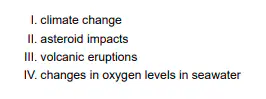
Which of following are natural factors that can cause extinctions?
I, II, and III only
I, II, III, and IV
I and IV only
II and III only
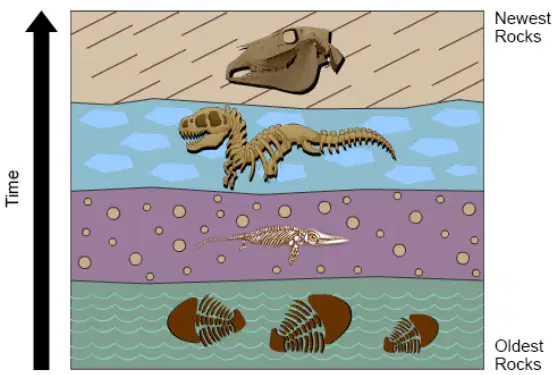
Rock layers are formed over the course of many years. The image below shows the types of fossils that have been found in different layers of rock. Based on this information, what does the fossil record show?
Newer rock layers contain fossils of more complex organisms than the oldest rock layers.
Newer rock layers contain fossils of every organism that ever lived on Earth.
Older rock layers contain fossils of every organism that ever lived on Earth.
The oldest rock layers contain fossils of more complex organisms than newer rock layers.
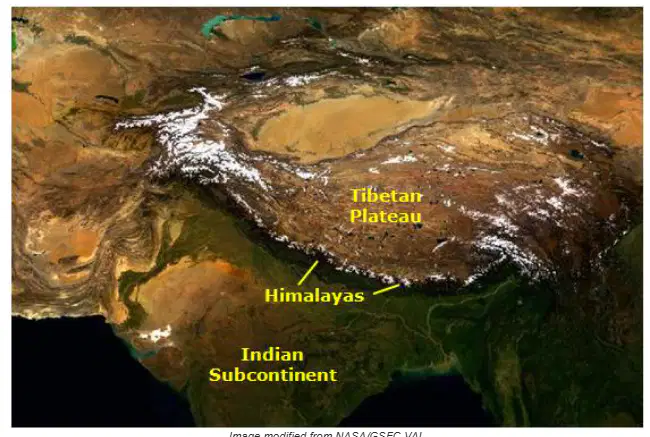
The image above shows a view of South Asia from space. Over millions of years, the Indian subcontinent, which is part of the Indian tectonic plate, has been interacting with the Eurasian tectonic plate. This interaction has produced both the uplifted Tibetan Plateau and the Himalaya Mountains on the Eurasian plate. Which of the following best describes this interaction?
The Indian continent has been pushing into the Eurasian plate.
The Indian subcontinent and the Eurasian plate have been pulling away from each other.
The Indian subcontinent has been moving in circles around the Eurasian Plate.
The Indian subcontinent has been pulling away from the Eurasian plate.
According to the big bang theory, all matter in the Universe started at the same point in space (and time) and has been expanding ever since. The big bang theory replaced the static model—that the Universe always had existed, was neither expanding nor contracting, and has no beginning and no end. Which of the following observations supports the big bang theory and contradicts the static model?
Stars are continuously being created and burning out or exploding.
Most galaxies are moving away from each other.
Galaxies move as though they have far more mass than can be seen.
Different kinds of radiation are produced and absorbed by different things
Which of the following is true regarding the frequency and wavelength of electromagnetic radiation?
Frequency and wavelength are always equal.
Frequency decreases with increasing wavelength.
Frequency increases with increasing wavelength.
There is no relationship between frequency and wavelength.
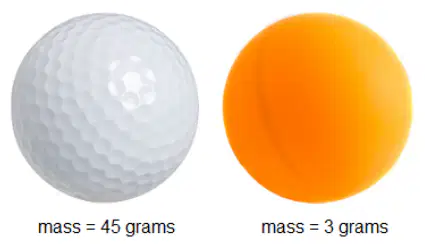
Cameron and Noah are studying force and motion. Cameron has a golf ball with a mass of 45 grams and Noah has a table tennis ball with a mass of 3 grams. The picture below shows the two balls. They both use the same ruler, and bend it back 5 centimeters to strike their ball with the same force. Why will the table tennis ball have a greater acceleration?
It has more inertia than the golf ball.
It has a lower mass than the golf ball.
It has a greater force of gravity acting on it.
It has a lower velocity than the golf ball.

The image below shows two students communicating with a telephone made from cups and string. How does the information transfer between two people using a cup and string phone compare to the information transfer between two people using cell phones?
The cup and string phone transfers information using electromagnetic waves, but a cell phone transfers information using sound waves.
Both the cup and string phone and a cell phone transfer information using electromagnetic waves, but they each travel through different mediums.
The cup and string phone transfers information using sound waves, but a cell phone transfers information using electromagnetic waves.
Both the cup and string phone and a cell phone transfer information using sound waves, but they each travel through different mediums.
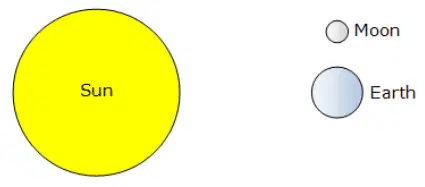
When the Earth, Sun, and Moon are in the positions shown above,
low tide occurs, but high tide does not.
the height difference between high tide and low tide is at its least.
the height difference between high tide and low tide will be greatest.
high tide occurs, but low tide does not.
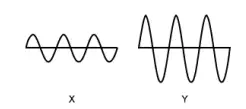
The image below represents two waves, X and Y, traveling through the same medium at the same speed. How are the two waves different?
Wave Y has a greater frequency than wave X.
Wave Y has a greater energy than wave X.
Wave Y has a greater period than wave X.
Wave Y has a greater wavelength than wave X.

Based on the students' results, which of the following wire, battery, and magnet combinations would likely create the fastest spinning motor?
insulated wire, 3.0 V battery, and a small magnet
copper wire, 3.0 V battery, and a large magnet
copper wire, 1.5 V battery, and a small magnet
insulated wire, 1.5 V battery, and a large magnet
Adrian filled a toy dump truck with rocks. Then he pushed the dump truck, and it accelerated forward. Adrian wants to push the dump truck again and have it accelerate more. In what two ways can Adrian double the dump truck's acceleration?
cut its mass in half or cut the net force in half
double its mass or cut the net force in half
double its mass or double the net force
cut its mass in half or double the net force
Volcanoes form most commonly in regions where one tectonic plate plunges beneath another tectonic plate. How does this process lead to volcano formation?
It causes part of the overriding plate to melt into magma, which rises up to form volcanoes at the surface.
It causes strong earthquakes, which shake the ground upward into the shapes of volcanoes.
The plate plunging downward knocks loose part of the Earth's core, which rises up to form volcanoes at the surface.
The plate plunging downward suddenly turns upward, breaking through the surface to form volcanoes.
Which statement best describes artificial selection?
when humans raise organisms in captivity to help prevent population declines
when humans selectively breed organisms to produce offspring with desirable traits
when organisms with disadvantageous traits are selected against by environmental conditions
when organisms with favorable traits are better able to survive and reproduce in their environment
Tectonic plates are pieces of the lithosphere that move around on top of the asthenosphere. Which of the following is a driving force behind the movement of tectonic plates?
gravitational pulls from the Moon and the Sun
centrifugal forces on Earth's surface due to Earth's rotation on its axis
the circular flow of molten iron in the outer core
convection currents in the mantle
Caleb is playing baseball outside. When he hits the ball with the bat, the bat applies a force to the ball. At the same time, the ball
does not apply any reaction force to the bat.
applies an equal but opposite force to the bat.
applies an equal force in the same direction as the bat's force.
applies a much weaker force in the opposite direction of the bat's force.
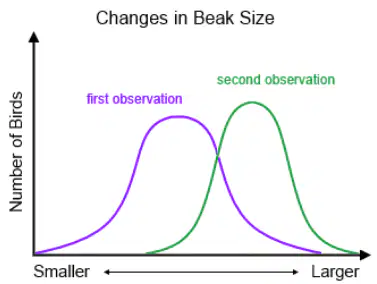
Scientists observed a species of bird in one location and collected data on the beak size of the individual birds. Many years later, the scientists again collected data on the beak size of the same species in the same location. They noticed a change in the beak size of the birds, as shown in the graph. What change could explain the change in the beak size over time?
The color of the bird's habitat changed.
The bird's food source changed.
A new type of predator was introduced.
The population of the bird decreased.
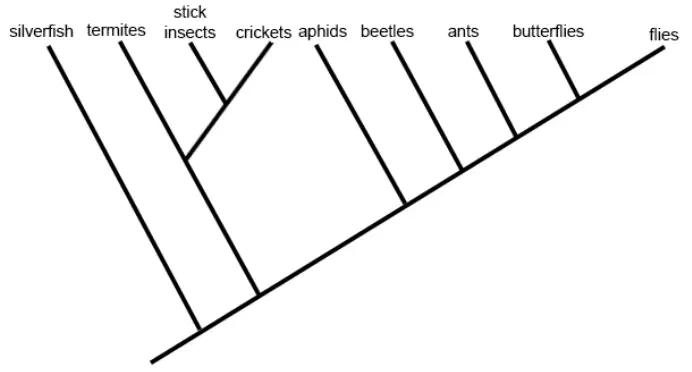
The cladogram shows the relationships among some groups of insects. Which statement about the insects in the cladogram is true?
Silverfish and crickets are more closely related than are termites and crickets.
Crickets are more closely related to stick insects than to aphids.
Butterflies are more closely related to aphids than to ants.
Beetles and flies are more closely related than are ants and flies.
A class was studying birds and reptiles. They looked at pictures of an adult crow, a type of bird, and an adult turtle, a type of reptile. Then, they looked at diagrams of a bird embryo and a reptile embryo. Based on the images, what conclusion can Mariam make about birds and reptiles?
Birds and reptiles are not related because their embryos share many similarities.
Birds and reptiles are not related because adult birds and adult reptiles do not look alike.
Birds and reptiles are related, even though adult birds and adult reptiles do not look alike.
Birds and reptiles are related, even though their embryos do not share any similarities
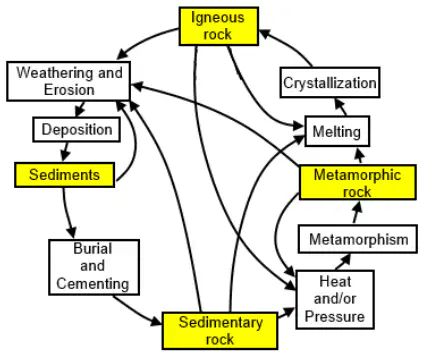
The diagram below shows the rock cycle. Which two processes result in the formation of igneous rocks?
pressure and deposition
crystallization and cementing
melting and crystallization
weathering and heat
A population of green-colored grasshoppers lives in a valley. Because of their body color, the grasshoppers can hide in the green grass of the valley to avoid predators. Due to changes in average precipitation, the grass in the valley starts to turn brown. This continues for several years. The green-colored grasshoppers are now easily visible to predators. Which characteristic would best allow the grasshopper population to adapt to this change?
higher ratio of females to males in the population
ability for the population to migrate
genetic variation within the population
ability to reproduce asexually
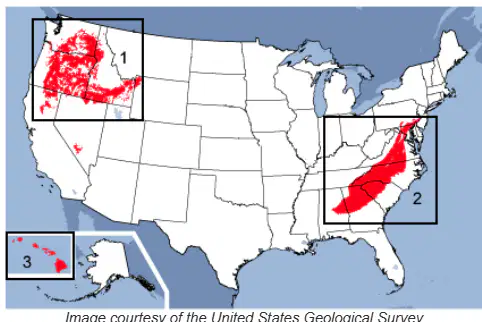
The map below shows the locations of three major groundwater sources in the United States. On the map, the groundwater sources are shown in red, and the regions containing them are numbered. Which statement could best explain why groundwater sources are located in these regions?
Unlike most of the United States, these regions receive a high amount of precipitation and contain non-porous soil.
These regions once experienced volcanic activity that deposited a layer of permeable rock near the Earth's surface.
These regions once experienced volcanic activity that contributed a thick layer of impermeable rock to the Earth's surface.
Unlike most of the United States, these regions receive a low amount of precipitation and contain moderately porous soil.
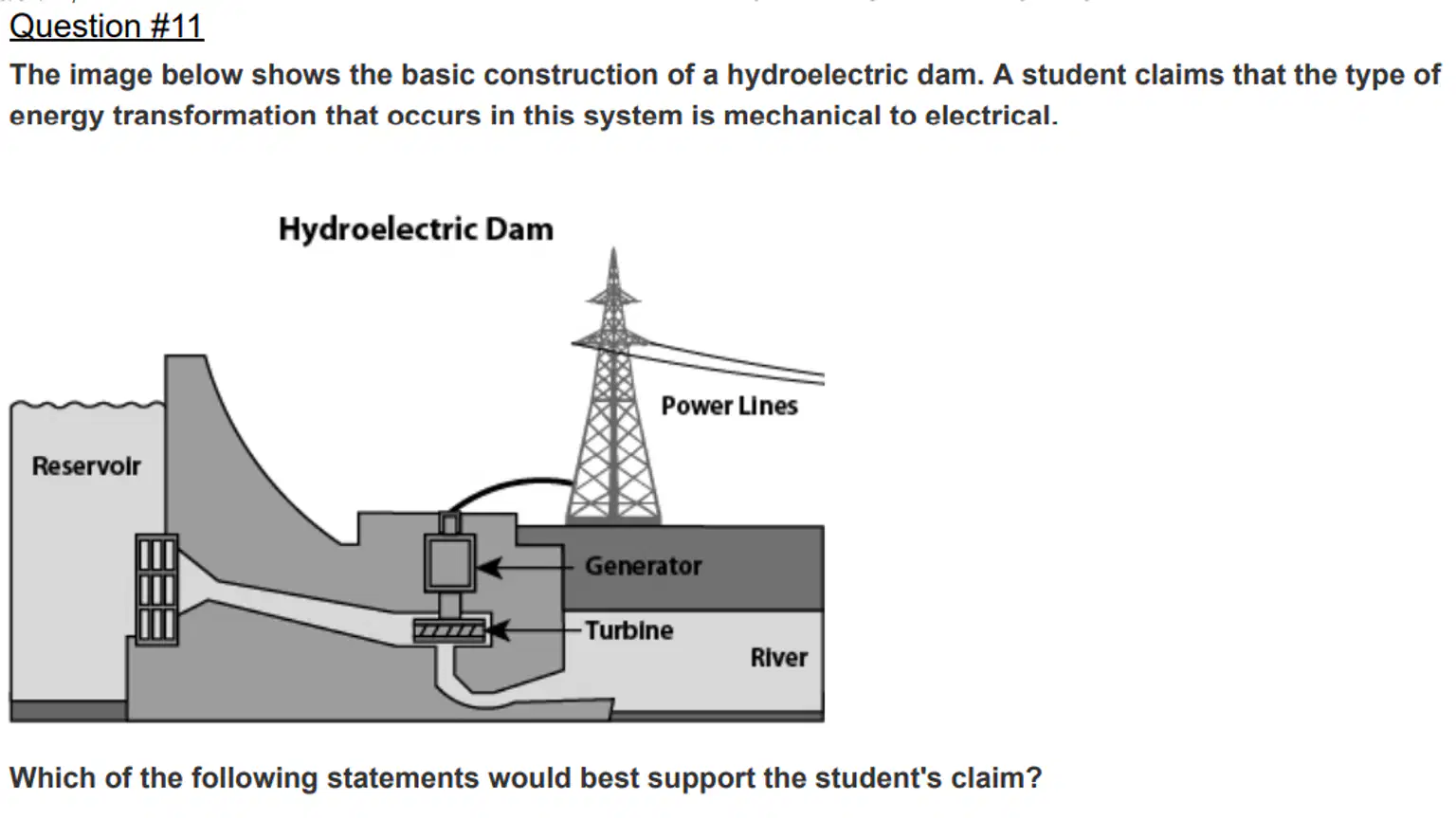
Which of the following statements would best support the student's claim?
Electricity must move to travel through the power liens and reach people's homes.
The turbine must turn for electricity to flow from the generator to the power lines.
Water must flow from a higher place to a lower one for electricity to be created.
The electricity flowing through the power lines has enough energy to move objects.
What is a Longitudinal Wave?
A wave that vibrates the medium in the same direction in which the wave travels
A wave that vibrates the medium at right angles, or perpendicular to the direction that the wave travels.


What is the saying that can help you remember the order of the visible spectrum?
ROYGBIV
RYOBIVG
ROYBVIG
RIBYOVG

What does the picture below illustrate?
Visible Light Spectrum
Electromagnetic Spectrum
Frequency Indicator
Color Line
How are we able to see the color white?
All colors except red are absorbed
All colors are absorbed
All colors are reflected
All colors except red are reflected
Of the visible spectrum, what color has the longest wavelength?
Blue
Green
Yellow
Red
Violet
What type of wave does a light wave resemble?
Transverse wave
Compressional wave
Light is a type of energy that travels as an ______________ ____________.
Longitudinal Wave
Electric Current
Electromagnetic Wave
Magnetic Wave
What happens when light transitions into a new medium?
Reflection
Absorbing
Refraction
Mirror
A blue dish appears blue because it
absorbs blue light
absorbs white light
reflects white light
reflects blue light

What is this a picture of?
Reflection
Refraction
___________ is a form of energy that we can see with our eyes.
Radio Waves
Visible Light
Ultraviolet
Reflection
What is the Electromagnetic Spectrum?
A Group of Energy Waves That are Visible to the human Eye.
The name Given to a Group of Waves that mostly are Invisible and can travel through empty Or outer Space.
How can the strength of an electromagnet be increased? (mark all that apply)
increase the current flowing through the coil
increase the number of coils
add an amplifier to it
put iron core inside the coil

Which of these waves has the highest frequency?
1
2
3

These waves differ in their ___.
amplitude
wavelength
wave type
If more energy is added to a wave, what characteristic changes?
wavelength
wave speed
amplitude
wave type


What are the TWO main types of waves?
Ocean
Electromagnetic
Sound
Mechanical
What term is described: when a wave goes around something that is in the way?
reflection
diffraction
refraction
absorption

Wha type of tide would this arrangement of earth-moon-sun create?
full moon tide
new moon tide
neap tide
spring tide


What tides happen when the moon and Sun are at a 90 degree angle?
Spring
Neap
These tides happen when the Earth, moon, and Sun are in a straight line.
Spring
Neap
What causes tides?
Differences in gravitational force between the Sun and moon.
The solar energy generated by the Sun.
The rotation of Earth.

Which area on the diagram represents the white dwarfs?
Area M
Area X
Area P
Area Z

Barnard's Star is about 5.9 light-years from the Sun. The star has a temperature of 2,800 K. What spectral class does it belong to?
Spectral class O
Spectral class B
Spectral class A
Spectral class M

A star that is several thousand times brighter than the Sun with a temperature lower than 4,000 K would be classified as
a main sequence star in spectral class B
a supergiant in spectral class K
a main sequence star in spectral class K or M
a white dwarf in spectral class B


Another word for "a push" or "a pull".
Inertia
Gravity
Friction
Force
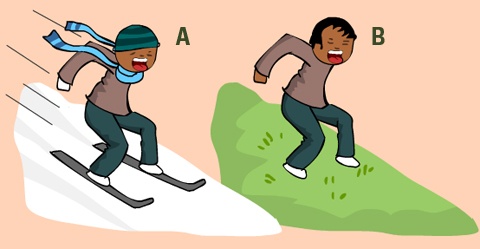
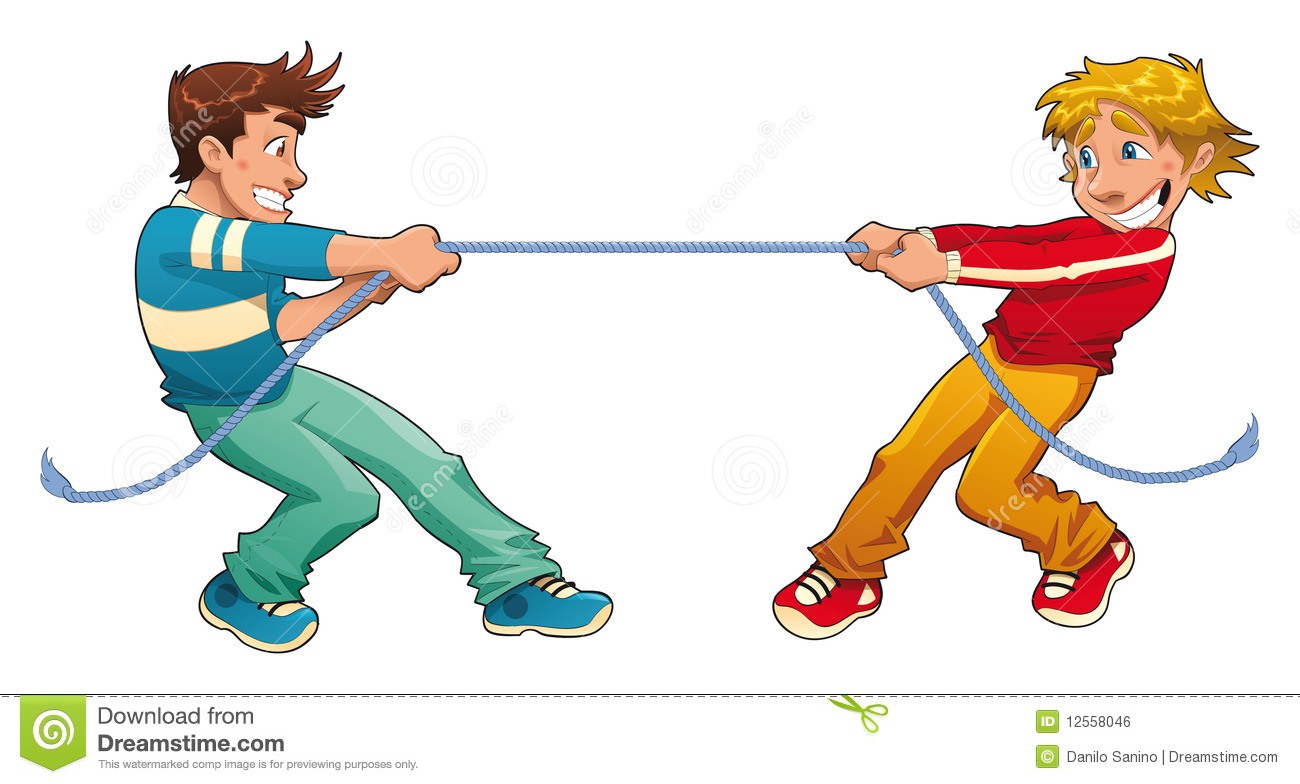

The image represents what
Free Body Diagram
Four Fundamental Forces
Force Diagram
Force = mass times acceleration
Magnetism is what type of force?
Contact
Non-contact
The image represents what
Free Body Diagram
Four Fundamental Forces
Force Diagram
Force = mass times acceleration
In which direction and with how much force will an object move if you push to the left with 15N of force and your friend pushes to the right with 5N of force?
up with 10N of force
down with 5N of force
left with 10N of force
right with 10N of force
What does absolute age tell us about a rock layer or fossil?
The 'exact' age of a fossil determined by radiometric dating
The relative age of a fossil determined by radiometric dating
Younger rock layers sit on top of older rock layers
Older rock layers sit on top of younger rock layers
What two methods are used for determining the age of rocks and fossils?
Relative and Absolute Dating
Carbon and Water Dating
Sedimentary and Igneous Rocks
Spatial and Layered Dating
What does relative age tell us about a rock layer or fossil?
The age of one rock layer or fossil compared to another.
The relative age of a fossil determined by radiometric dating
The exact age of a fossil
Older rock layers sit on top of younger rock layers

