
 Worksheets
Earth's Layers &Plate Tectonics
Total questions: 99
Worksheet time: 1hrs 8mins
Name
Class
Date
1.
Mountains form from ...
a)
plates sliding past one another
b)
collision of plates
c)
plates moving away from each other
2.
The area around the pacific plate where boundaries form is called...
a)
death ring
b)
fire zone
c)
ring of fire
d)
zone of fire
3.
Associated with transform boundaries.
a)
Volcanoes
b)
mountains
c)
trenches
d)
earthquakes
68.
Which is true about hotter material in the mantle?
a)
more dense, sinks
b)
less dense, sinks
c)
less dense, rises
d)
more dense, rises
5.
During sea floor spreading, molten material rises up from the mantle...
a)
along the continents
b)
at the mid ocean ridges
c)
deep ocean trenches
d)
at north and south poles
6.
Which ocean is expanding due to a mid-ocean ridge?
a)
Indian
b)
Dead Sea
c)
Atlantic
d)
Artic
7.
Which of the following is where one plate slides under another plate?
a)
submarine zone
b)
divergence zone
c)
subduction zone
d)
lower zone
8.
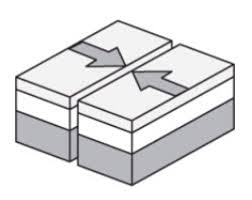
Name the boundary
a)
convergent boundary
b)
divergent boundary
c)
transform boundary
d)
sergent boundary
9.

Name the boundary
a)
convergent boundary
b)
divergent boundary
c)
transform boundary
d)
sergent boundary
10.
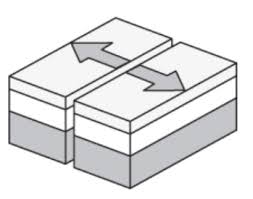
Name the boundary
a)
convergent boundary
b)
divergent boundary
c)
transform boundary
d)
sergent boundary
11.
A subduction zone is formed...
a)
when one tectonic plate sinks below another
b)
at every type of convergent plate boundary
c)
at every type of divergent plate boundary
d)
at transform boundaries
12.
Whenever a subduction zone is formed a ______ is formed.
a)
Mountain
b)
Island Arc
c)
Rift
d)
Volcano
13.
Plate movement is caused by ______________.
a)
the rotation of the Earth
b)
ocean tides
c)
convection currents in the mantle
d)
the moon's gravity
14.
What are mid-ocean ridges?
a)
A chain of underwater waterfalls
b)
A chain of underwater volcanos
c)
A chain of underwater mountains
d)
A chain of underwater rocks
15.
What does the theory of continental drift state?
a)
The continents were once joined in a super-continent and have moved over time
b)
Continents are stationary and do not move
c)
The Earth is broken into lithospheric plates that move due to convection currents
d)
none of the above
16.

Who is the person credited with developing the theory of continental drift?
a)
Harry Hess
b)
Galileo
c)
Alfred Wegener
d)
Newton
17.
Created by a divergent boundary.
a)
Rocky Mountains
b)
Mariana Trench
c)
Mid Atlantic ridge
18.
Geologists obtain indirect evidence about Earth's interior by...
a)
measuring pressure at the surface
b)
studying seismic waves
c)
drilling through each layer
d)
estimation of temperature in the layers
70.
Which of the following did not support continental drift?
a)
magnetic striping on the ocean floor
b)
identical fossils on continents
c)
mountain ranges
d)
coastlines fit like a puzzle
33.
What was the name given to all the continents when they were joined as one super continent?
a)
Supreme Continent
b)
Eurasia
c)
Plate tectonics
d)
Pangea
36.
Which of the following occurs because of convection currents?
a)
Tectonic plates on the crust move.
b)
The mantle increases in size.
c)
Pressure in the crust increases.
d)
Pressure in the crust decreases.
22.

Scientists think that convection currents that move the plates flow in Earth's
a)
Continental crust
b)
Oceanic crust
c)
Asthenosphere
d)
Lithosphere
38.
Where does the heat come from that drives this convection current in the mantle?
a)
The sun
b)
The crust
c)
the mantle
d)
the core
39.
What does the theory of continental drift state?
a)
The continents were once joined in a super-continent and have moved over time
b)
Continents are stationary and do not move
c)
The Earth is broken into lithospheric plates that move due to convection currents
d)
none of the above
46.
This land formation occurs at a divergent continental/ continental boundary.
a)
mid ocean ridge
b)
deep ocean trench
c)
pacific hot spot
d)
rift valley
47.
Mountains form from ...
a)
plates sliding past one another
b)
collision of plates
c)
plates moving away from each other
48.
Oceanic crust is
a)
Younger and less dense than continental crust
b)
Thinner, younger and more dense than continental crust
c)
Older, thicker and less dense that continental crust
d)
Bigger and younger than continental crust
49.
Earth's plates are...
a)
constantly moving and changing the face of the earth
b)
Never moves
c)
Moves seldom and very fast
d)
Moves when it feels like it
82.

What type of boundary creates a volcano?
a)
convergent ocean ocean
b)
convergent ocean continental
c)
convergent continental continental
d)
divergent
83.

What type of boundary creates an island arc?
a)
convergent ocean ocean
b)
convergent ocean continental
c)
convergent continental continental
d)
divergent
84.
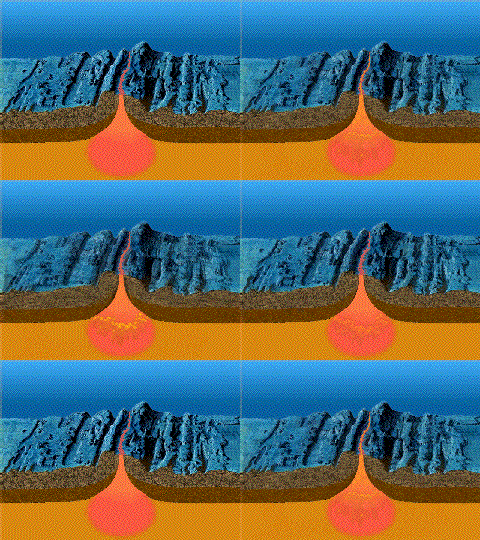
What type of boundary creates new seafloor?
a)
convergent ocean ocean
b)
convergent ocean continental
c)
convergent continental continental
d)
divergent
32.
What is Pangaea?
a)
The name of a German Scientist
b)
the name of the supercontinent that existed millions of years ago
c)
another name for continental drift
d)
the name of an ancient fossil
33.
What was the name given to all the continents when they were joined as one super continent?
a)
Supreme Continent
b)
Eurasia
c)
Plate tectonics
d)
Pangea
34.
Which of these layers is ALL solid iron and nickle?
a)
inner core
b)
outer core
c)
lithosphere
d)
mesosphere
35.
The layer that makes up most of the earth's mass and volume is the
a)
crust
b)
mantle
c)
core
d)
asthenosphere
36.
Which of the following occurs because of convection currents?
a)
Tectonic plates on the crust move.
b)
The mantle increases in size.
c)
Pressure in the crust increases.
d)
Pressure in the crust decreases.
37.
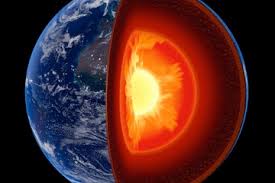
As you travel from the inner core to the crust, how would temperature, pressure and density of the material change?
a)
The would all increase
b)
The would all decrease.
c)
They would stay the same.
d)
Temperature would decrease, but pressure and density would increase.
38.
Where does the heat come from that drives this convection current in the mantle?
a)
The sun
b)
The crust
c)
the mantle
d)
the core
39.
What does the theory of continental drift state?
a)
The continents were once joined in a super-continent and have moved over time
b)
Continents are stationary and do not move
c)
The Earth is broken into lithospheric plates that move due to convection currents
d)
none of the above
40.

Name the boundary
a)
convergent boundary
b)
divergent boundary
c)
transform boundary
d)
sergent boundary
41.

Name the boundary
a)
convergent boundary
b)
divergent boundary
c)
transform boundary
d)
sergent boundary
42.

Name the boundary
a)
convergent boundary
b)
divergent boundary
c)
transform boundary
d)
sergent boundary
43.
During sea floor spreading, molten material rises up from the mantle...
a)
along the continents
b)
at the mid ocean ridges
c)
deep ocean trenches
d)
at north and south poles
44.
Which of the following is where one plate slides under another plate?
a)
submarine zone
b)
divergence zone
c)
subduction zone
d)
lower zone
45.
Associated with transform boundaries.
a)
Volcanoes
b)
mountains
c)
trenches
d)
earthquakes
46.
This land formation occurs at a divergent continental/ continental boundary.
a)
mid ocean ridge
b)
deep ocean trench
c)
pacific hot spot
d)
rift valley
47.
Mountains form from ...
a)
plates sliding past one another
b)
collision of plates
c)
plates moving away from each other
48.
Oceanic crust is
a)
Younger and less dense than continental crust
b)
Thinner, younger and more dense than continental crust
c)
Older, thicker and less dense that continental crust
d)
Bigger and younger than continental crust
49.
Earth's plates are...
a)
constantly moving and changing the face of the earth
b)
Never moves
c)
Moves seldom and very fast
d)
Moves when it feels like it
50.
This layer of Earth is the thickest part
a)
crust
b)
outer core
c)
mantle
d)
inner core
51.
The oceanic floor is made of?
a)
Granite
b)
Basalt
c)
Cookies
d)
Water
52.
The thinnest layer of the Earth is?
a)
Mantle
b)
Lithosphere
c)
Athenosphere
d)
Crust
53.
The lithosphere combines what two layers?
a)
Athenosphere & Crust
b)
Crust & Upper Mantel
c)
Mantel & Athenosphere
54.
The asthenosphere makes up the?
a)
Upper portion of the mantel
b)
The lower portion of the crust
c)
Just the Athenosphere
55.
What happens to pressure as we move from the crust to the inner core?
a)
Pressure Decreases
b)
Pressure Increases
c)
Nothing
56.
What happens to temperature as we move from the crust to the inner core?
a)
Decreases
b)
Increases
57.
What is the name of the layer that contains the uppermost mantle and crust
a)
Asthenosphere
b)
Mesosphere
c)
Lithosphere
d)
Transosphere
58.

Identify layer #20.
a)
mantle
b)
asthenosphere
c)
inner core
d)
outer core
59.
Scientists determine what Earth’s interior looks like by using:
a)
Volcanoes
b)
Seismic Waves
c)
Continental Drift
d)
Convection Currents
60.
Less dense materials rise to the top.
a)
True
b)
False
61.
What is the correct order (starting from the surface) of Earth's layers?
a)
crust, outer core, inner core, mantle
b)
mantle, outer core, inner core, crust
c)
crust, mantle, outer core, inner core
d)
outer core, inner core, crust, mantle
62.
Heat transfer within a fluid takes place by...
a)
convection currents
b)
radiation
c)
conduction
d)
density
63.
Using data from seismic waves, geologists have learned that Earth's interior is made up of several
a)
continents
b)
layers
c)
ridges
d)
trenches
64.
Earth's magnetic field results from movements in the
a)
mantle
b)
outer core
c)
inner core
d)
crust
65.
A deep well or mine shaft goes through which layer or layers of Earth?
a)
crust only
b)
mantle only
c)
crust and mantle
d)
mantle and core
66.
Geologists' main evidence about the structure of Earth's interior comes from
a)
temperature measurements in deep mines
b)
observations of other planets
c)
exploration of caves
d)
rock samples and seismic waves
67.
Mountains form from ...
a)
plates sliding past one another
b)
collision of plates
c)
plates moving away from each other
68.
Which is true about hotter material in the mantle?
a)
more dense, sinks
b)
less dense, sinks
c)
less dense, rises
d)
more dense, rises
69.
This land formation occurs at a divergent continental/ continental boundary.
a)
mid ocean ridge
b)
deep ocean trench
c)
pacific hot spot
d)
rift valley
70.
Which of the following did not support continental drift?
a)
magnetic striping on the ocean floor
b)
identical fossils on continents
c)
mountain ranges
d)
coastlines fit like a puzzle
71.
The type of plate boundary where two plates come together is a .....
a)
Convergent Boundary
b)
Divergent Boundary
c)
Transform Boundary
d)
Plate Boundary
72.
Which of the following causes Earth's tectonic plates to move?
a)
Energy from the Sun
b)
Magnetic Pole Reversal
c)
Convection currents in the mantle
d)
Faults in Mountain Ranges
73.
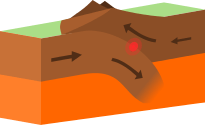
What type of plate boundary is this?
a)
Plate
b)
Divergent
c)
Convergent
d)
Transform
74.

What type of event will occur at this boundary?
a)
Earthquake
b)
Volcano Eruption
c)
Tornado
d)
Mountain Building
75.
Which of the following is the name of the ancient supercontinent formed 28 Million Years ago.
a)
Pangea
b)
Gondwanda
c)
Laurasia
d)
Neverland
76.
Which of the following is NOT evidence to support the theory of plate tectonics?
a)
Fossils
b)
Mountains
c)
Glaciers
d)
Sand Erosion
77.
The theory that says Earth's continents once made up an ancient supercontinent, and have been drifting apart ever since, is called the theory of...
a)
Pangea
b)
Plate Tectonics
c)
Natural Selection
d)
Gravity
78.
How is it possible for new crust to be formed without increasing the surface area of the Earth?
a)
Crust is destroyed at the same time it is created
b)
New crust is underwater where it sinks
c)
New crust breaks more easily than old crust
79.
Mountains are created when....
a)
Two continental plates collide
b)
Two oceanic plates pull apart
c)
An Oceanic plate subducts under a Continental Plate
d)
Two continental plates pull apart
80.
The thin and solid outermost layer of the Earth above the mantle?
a)
Crust
b)
Mantle
c)
Core
d)
Pangea
81.
The soft layer of the mantle on which the tectonic plates move;
a)
Asthenosphere
b)
Lithosphere
c)
Mesosphere
d)
Atmosphere
82.
What type of boundary creates a volcano?
a)
convergent ocean ocean
b)
convergent ocean continental
c)
convergent continental continental
d)
divergent
83.
What type of boundary creates an island arc?
a)
convergent ocean ocean
b)
convergent ocean continental
c)
convergent continental continental
d)
divergent
84.
What type of boundary creates new seafloor?
a)
convergent ocean ocean
b)
convergent ocean continental
c)
convergent continental continental
d)
divergent
85.

What type of boundary creates a mountain chain?
a)
convergent ocean ocean
b)
convergent ocean continental
c)
convergent continental continental
d)
divergent
86.
Plates of the lithosphere float on the ____.
a)
crust
b)
asthenosphere
c)
core
d)
atmosphere
87.
The hypothesis that continents have slowly moved to their current locations is called ____.
a)
continental drift
b)
continental slope
c)
magnetic reversal
d)
convection
88.

Earthquakes and volcanoes are most likely found in which locations?
a)
at plate boundaries
b)
in oceans
c)
in the middle of continents
d)
in the middle of plates
89.
In the early 1900's Alfred Wegener found evidence of identical rock types, identical fossils, and matching mountain ranges on different continents that are on opposite sides of an ocean. What could be the explanation for these observations?
a)
All animals can swim extremely long distances
b)
These observations have no significant meaning.
c)
In the past, continents were not located where they are today but were joined together
d)
mountains are made through the same processes therefore they are very similar in their structure throughout the entire world.
90.
Most geologists think that the movement of Earth's plates is caused by
a)
conduction
b)
earthquakes
c)
convection currents in the mantle
d)
Earth's magnetic field.
91.
Why does cooler material sink while warmer material rises?
a)
Cooler material is more dense.
b)
Hot material is more dense.
92.
The Richter scale measures:
a)
the amount of radon gas released
b)
the movement of plates
c)
the strength of an earthquake
d)
the weight of tectonic plates
93.

Earth's crust is broken up into several large rocky pieces called ...
a)
plates
b)
faults
c)
fossils
d)
puzzle pieces
94.

When Earth's plates rub or scrape against one another, the release of energy causes ...
a)
a volcano
b)
an earthquake
c)
a tornado
d)
continental drift
95.
If, after an eruption, the top of a volcano collapses down, a _________ forms.
a)
caldera
b)
vent
c)
hot spot
d)
volcanic neck
96.
Where can volcanoes form?
a)
convergent plate boundaries
b)
divergent plate boundaries
c)
over hotspots in the middle of plates
d)
all of these
97.
The magnitude of an earthquake is measured by the ____________.
a)
Richter scale
b)
moho discontinuity
c)
modified Mercalli scale
d)
elastic limit
98.
Scientists discovered changes in Earth's interior by studying__________
a)
tsunamis
b)
tides
c)
changes in seismic waves
d)
eclipses
99.
Volcanoes and earthquakes happen along...
a)
islands in the Pacific Ocean
b)
North American mountain ranges
c)
the boundaries of Earth's plates
d)
the coast of Antarctica
100 %

