
 Worksheets
Waves Test #1 Review
Total questions: 102
Worksheet time: 1hrs 2mins
Name
Class
Date
1.

A string is attached to two fixed points & is compressed on one end and released. The resulting wave travels back & forth b/w until it comes to a stop. This is an example of...
a)
transverse wave
b)
longitudinal
c)
superpositional
d)
refracted
2.
A sound wave can be transmitted through all of the following except...
a)
a gas
b)
a liquid
c)
a solid
d)
a vacuum
3.
The distance between Earth and the Moon was determined by measuring the time it took for light from Earth to travel to the Moon and back. Why wasn't sound waves used?
a)
Sound must move through a medium.
b)
Sound would change frequency.
c)
Sound would move too slowly to be accurate.
d)
Sound moves more slowly in Earth's atmosphere than in space.
4.
What type of wave is illustrated in the spring?
a)
electromagnetic
b)
mechanical
5.
The squished part of this wave is called...
a)
compression
b)
rarefraction
6.
The stretched part of this wave is called...
a)
compression
b)
rarefraction
7.

What do waves carry?
a)
particles
b)
matter
c)
energy
d)
objects
8.

Which color of light has more energy?
a)
orange
b)
green
9.
Which of these two light waves would appear dimmer?
a)
orange
b)
green
10.

Greatest amplitude?
a)
Black
b)
Orange
c)
Green
d)
Blue
11.
Greatest frequency?
a)
Black
b)
Orange
c)
Green
d)
Blue
12.
Shortest wavelength?
a)
Black
b)
Orange
c)
Green
d)
Blue
13.
Three waves per period
a)
Black
b)
none
c)
Green
d)
Blue
14.
Fastest Wave?
a)
Black
b)
Orange
c)
Green
d)
Blue
15.
Val needs a wave with low energy. Which wave has the lowest energy.
a)
Wavelength 700 nm Amplitude 10 cm
b)
Wavelength 650 nm Amplitude 10 cm
c)
Wavelength 700 nm Amplitude 5 cm
d)
Wavelength 750 nm Amplitude 5 cm
16.
The number of waves per period
a)
amplitude
b)
wavelength
c)
frequency
d)
speed
17.
the length of a compression and a rarefraction
a)
amplitude
b)
wavelength
c)
frequency
d)
speed
18.
the length from crest to crest of a transverse wave
a)
amplitude
b)
wavelength
c)
frequency
d)
speed
19.
What part of a wave needs to be changed in order to vary volume?
a)
amplitude
b)
wavelength
c)
frequency
d)
speed
20.
Why do waves move slower in water than in air?
a)
water is more dense
b)
air is more dense
c)
waves reflect off of the water molecules
d)
waves refract off of the water molecules
21.
Val counts 17 total waves pass down the rope in 5 minutes. What wave property is Val investigating?
a)
frequency
b)
speed
c)
amplitude
d)
wavelength
22.
All waves in space have the same...
a)
wavelength
b)
frequency
c)
amplitude
d)
speed
23.

Why does the tube appear broken?
a)
As light moves from air to water it slows and bends
b)
The light hits the water and bounces off its surface causing the tube to look broken.
c)
The tube is indeed broken because the fish have damaged it.
d)
It is an optical illusion due to a change in the wave's amplitude.
24.

The process that creates the bend in the tube is called...
a)
reflection
b)
refraction
c)
absorption
d)
transmission
25.

The glasses above block out all wavelengths of light but red. What happens to all the other wavelengths of light?
a)
They are reflected.
b)
They are absorbed.
c)
They are transmitted.
d)
They are refracted.
26.
The glasses above block out all wavelengths of light but red. What word best describes these glasses?
a)
transparent
b)
translucent
c)
opaque
27.
Val notices that the glasses start to get warm. Why does this occur?
a)
The light is absorbed and converted to infrared radiation.
b)
The heat comes from the sun.
c)
The heat is transferred from her body to the glasses.
d)
The glasses really aren't getting hot, they just appear to get hot.
28.

a)
Reflection
b)
Refraction
c)
Transmisson
d)
Refraction & Transmisson
29.

a)
Reflection
b)
Refraction
c)
Transmission
d)
Absorption
30.

a)
Reflection
b)
Refraction
c)
Reflection and Refraction
d)
Absorption
31.
Uses the principle of refraction to magnify images
a)
prisms
b)
convex lens
c)
diffraction grating
d)
plane mirror
32.
Breaks white light into component colors
a)
prisms
b)
convex lens
c)
diffraction grating
d)
prisms and diffraction gratings
33.

Val tries on sleep mask A and it completely blocks out all light.
a)
Transparent
b)
Translucent
c)
Opaque
34.
Val tries on sleep mask B & while it makes the room dark, she can still see light through it.
a)
Transparent
b)
Translucent
c)
Opaque
35.

Val ordered clear cups to serve her special layered dessert. She was disappointed when these cups arrived. What could she have said that would have gotten her the correct cup?
a)
Transparent
b)
Translucent
c)
Opaque
36.
The variable that you, as the scientist, controls
a)
IV
b)
DV
37.
The variable that you, as the scientist, looks for and measures to find
a)
IV
b)
DV
38.

What is the independent variable in this data?
a)
Number of Frogs
b)
Depth of Pond
c)
Temperature
d)
Number of Croaks
39.

Use the graph to determine how many croaks per minute occur if the temperature is 24 °C.
a)
12
b)
15
c)
16
d)
32
40.

What's the dependent variable?
a)
Temperature
b)
Depth of Pond
c)
Number of Frogs
d)
Number of Croaks
41.
Which of the following is a testable scientific question?
a)
Where do apples grow best?
b)
Why is there water on the ground in front of the school?
c)
How long does it take to drive from Ohio to Iowa on a motorcycle?
d)
Does the type of shoe worn during a 20 yard dash affect the speed in which you can run?
42.
Mr. Patterson gave his class a tool to use in studying the visible spectrum. He told the class that this tool will break light into the colors of the spectrum. Which tool did he most likely give to his students?
a)
Prism
b)
Convex Lens
c)
Color Filter
d)
Plane Mirror
43.
A quantitative observation you could make while in your science classroom might be ____.
a)
The butterflies have fallen off the wall.
b)
The soccer ball in the corner of the room is small.
c)
There are three computers in the back of the room.
d)
The water in the large beaker is slowly evaporating.
44.
The process by which organisms that are best suited to an environment survive and reproduce is ___.
a)
extinction
b)
fossilization
c)
preservation
d)
natural selection
45.
Determining the manner in which a mineral breaks is helpful when ___.
a)
mining the mineral
b)
making the mineral
c)
identifying the mineral
d)
changing the mineral's composition
46.
Why is color not a reliable clue to the identity of a mineral?
a)
Several minerals have the same color
b)
A single minerals can be different colors
c)
Minerals change colors
d)
Minerals can be different colors AND different minerals can have the same color.
47.
What rock forms as heat and/or pressure are applied to an existing rock?
a)
rock cycle
b)
igneous rock
c)
sedimentary rock
d)
metamorphic rock
48.
The rock cycle shows how rocks continually...
a)
increase in size
b)
change over time
c)
increase in number
d)
become more complex
49.
Tension forces occur at...
a)
Divergent boundaries
b)
Convergent boundaries
c)
Transform boundaries
50.

Which layer from the diagram is the oldest?
a)
A
b)
B
c)
C
d)
D
51.
Fossils give clues to ____.
a)
Diversity of living things over the history of Earth
b)
Past climate and surface changes on Earth
c)
Changes that have occurred with organsims over time
d)
All of the above
52.
A trait or behavior that helps an organism survive and reproduce in its particular environment is ___.
a)
adaption
b)
specuation
c)
natural selection
d)
unicellular multiplication
53.
During which geologic time or era were dinosaurs the dominant kind of animal?
a)
Precambrian
b)
Paleozoic
c)
Mesozoic
d)
Cenozoic
54.
Independent variable= amount of exercise
Dependent variable= how fast they run a mile.
Which would go on the x-axis?
Dependent variable= how fast they run a mile.
Which would go on the x-axis?
a)
Independent variable
b)
Dependent variable
c)
Controlled variable
d)
How fast they run a mile
55.
When the Northern Hemisphere is pointing towards the sun, what season is the Southern Hemisphere?
a)
Winter
b)
Spring
c)
Fall
d)
Summer
56.
What are the reasons for the seasons?
a)
Earth's tilt and rotation.
b)
Earth's rotation and revolution.
c)
Earth's tilt and revolution.
d)
Earth's tilt and resolution
57.
Tides are caused by ___________
a)
wind
b)
gravitational pull of moon
c)
waves gravitation toward land
d)
rain
58.
Waxing means...
a)
Growing
b)
Dying
c)
Losing light
d)
Moving
59.
When the moon is in between the earth and the sun it is a
a)
New Moon
b)
Full Moon
c)
First Quarter
d)
Third Quarter
60.
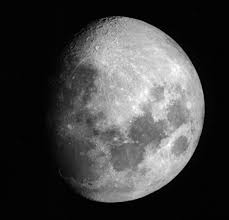
Name the moon phase
a)
waning crescent
b)
waxing crescent
c)
waning gibbous
d)
waxing gibbous
61.
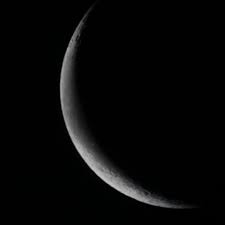
Name the moon phase
a)
waning crescent
b)
waxing crescent
c)
waning gibbous
d)
waxing gibbous
62.
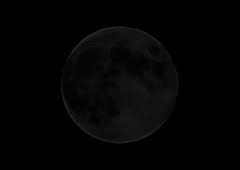
Name the moon phase
a)
First Quarter
b)
Last Quarter
c)
New Moon
d)
Full Moon
63.
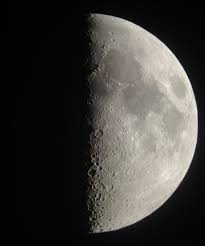
Name the moon phase
a)
First Quarter
b)
Last Quarter
c)
New Moon
d)
Full Moon
64.
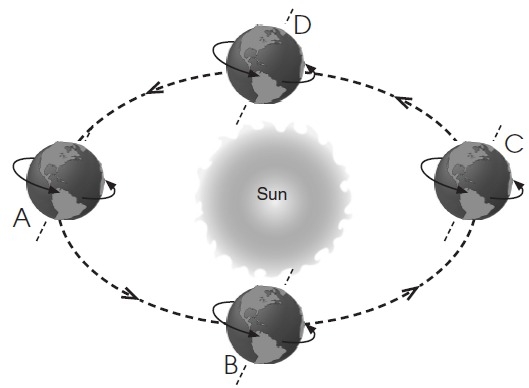
What season is letter A?
a)
Winter
b)
Summer
c)
Spring
d)
Fall
65.
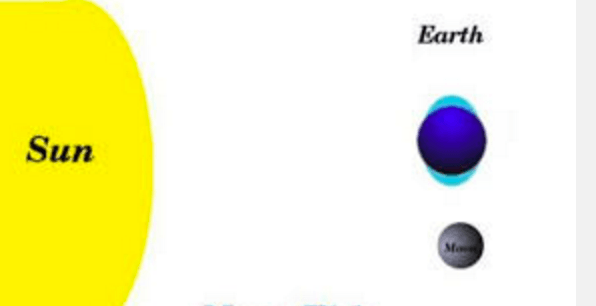
Which moon phase is shown in this diagram?
a)
new moon
b)
1st quarter
c)
full moon
d)
last quarter/3rd quarter
66.

What phase is this?
a)
Waning Gibbous Moon
b)
Waxing Gibbous Moon
c)
Waning Crescent Moon
d)
Waxing Crescent Moon
67.

What would be the result if the Earth's axis was not tilted but straight up and down?
a)
Nothing would change
b)
There would be no seasons
c)
Days would get longer
d)
The Equator would burn up and the poles would freeze
68.

Name the phase of the moon for letter a
a)
First Quarter
b)
Last Quarter
c)
Waxing Gibbous
d)
Waning Gibbous
69.
What is illuminating the Moon?
a)
Nuclear Fusion
b)
Sunlight
c)
Mirrors
d)
Flood Lights
70.
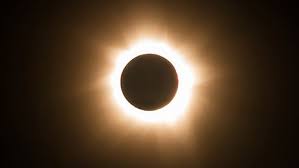
During a solar eclipse...
a)
The sun is blocked by the moon
b)
The Earth is blocked moon
c)
The moon is blocked by the sun
d)
You are blocked
71.
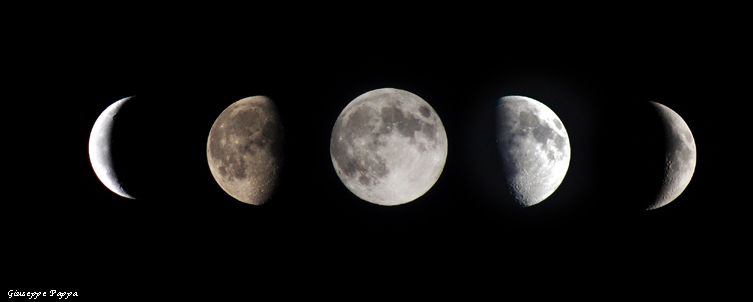
A solar eclipse only occurs during which moon phase?
a)
1st Quarter
b)
New Moon
c)
Full Moon
d)
3rd Quarter
72.

What must occur for an solar eclipse to occur?
a)
Sun-Earth-Moon in line
b)
Sun-Moon-Earth in line
73.
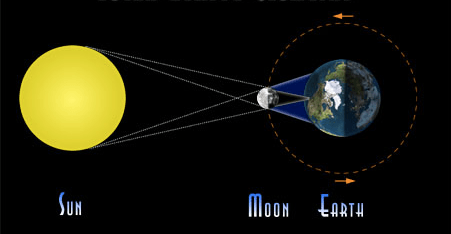
Which type of eclipse is shown in this picture?
a)
Solar Eclipse
b)
Orbit
c)
Lunar Eclipse
d)
Total Eclipse
74.
What do all waves have in common?
a)
nothing
b)
they carry energy
c)
they absorb light
d)
you can see them
75.
Identify the Era:
called the "Age of Mammals"
called the "Age of Mammals"
a)
Precambrian
b)
Paleozoic
c)
Mesozoic
d)
Cenozoic
76.
The direction of a transverse waves is ____ to the disturbance/vibration.
a)
equal
b)
less than
c)
at an acute angle
d)
at a right angle
77.

Line A represents...
a)
amplitude
b)
wavelenght
c)
frequency
d)
trough
78.
A repeating disturbance or vibration
a)
medium
b)
particle
c)
wave
d)
energy
79.
A convex lens curves ____________.
a)
outward
b)
inward
c)
opaque
d)
refracts
80.
If you wanted a gift to be a surprise, what kind of container would you put it in?
a)
transparent
b)
thick
c)
opaque
d)
translucent
81.
Which is transparent?
a)
a wooden fence
b)
clean water
c)
aluminum foil
d)
a purple balloon
82.
What is most likely to happen to light that hits an opaque object?
a)
All of the light passes through the object.
b)
None of the light passes through the object.
c)
Most of the light disappears.
d)
Some of the light passes through the object.
83.
Which is translucent?
a)
tissue paper
b)
air
c)
wood
d)
clear plastic
84.
Our galaxy is called the
a)
Earth Nebula
b)
The Hubble Galaxy
c)
The Milky Way
d)
The Snickers
85.
What are in galaxies?
a)
ice and rock
b)
dust, gas, and star
c)
stars and ice
d)
water and dust
86.
A comet is best described as:
a)
a frozen ball of dust and organic debris
b)
a ball of dirt and maple syrup
c)
a snowball
d)
a snowball that moves at a high velocity
87.
An asteroid is best described as:
a)
a star
b)
a burning ball of gas
c)
a small rocky body orbiting the sun
d)
a large rocky ball surrounded by gas
88.

The proper set up of the planets:
a)
Mercury, Venus, Earth, Mars, Jupiter, Saturn, Uranus, Neptune
b)
Mercury, Venus, Earth, Mars, Jupiter, Saturn, Uranus, Neptune, Pluto
c)
Mars, Venus, Mercury, Earth, Saturn, Jupiter, Uranus, Neptune
d)
Mars, Earth, Venus, Mercury, Earth, Jupiter, Pluto
89.
The Earth's axis is angled at _______ degrees.
a)
180
b)
90
c)
45
d)
23.5
90.
These are telescopes or other instruments that have been launched in space to gather information about celestial bodies while orbiting Earth
a)
Satellites
b)
Space Observatories
c)
Space Probes
d)
Radio Telescopes
91.
How long does the Earth take to revolve around the Sun?
a)
360
b)
365
c)
365.25
d)
366
92.
1. What is the orbiting of an object in space?
a)
Reflection
b)
Refraction
c)
Revolution
d)
Rotation
93.
1. What is the spinning of an object in space?
a)
Reflection
b)
Refraction
c)
Revolution
d)
Rotation
94.
the squeezing force at a convergent boundary that causes reverse faults
a)
tension
b)
compression
c)
shearing
95.
the forces acting in opposite directions at a transform boundary that causes strike-slip faults
a)
tension
b)
compression
c)
shearing
96.

Which direction are the plates moving at a divergent boundary?
a)
moving away from each other
b)
moving towards each other
c)
sliding past each other
d)
they don't move
97.
What forms at a divergent boundary?
a)
mid-ocean ridges
b)
mountains
c)
earthquakes
d)
only volcanoes
98.
What is a subduction zone?
a)
where plates move into each other
b)
where plates are moving away form each other
c)
where plates move past each other
d)
area where plate slips under another plate
99.
Paleozoic, Mesozoic & Cenozoic are all
a)
Epochs
b)
Eras
c)
Periods
d)
Eons
100.
Identify the Era:
when INVERTEBRATES first appeared
when INVERTEBRATES first appeared
a)
Precambrian
b)
Paleozoic
c)
Mesozoic
d)
Cenozoic
101.

Bob is spear fishing but keeps missing. What wave behavior could be causing this?
a)
transmission
b)
reflection
c)
refraction
d)
absorption
102.
What can change a waves speed?
a)
type of wave
b)
type of medium
c)
height of crest
d)
amount of energy
100 %

