wayground logo

Free Printable Worksheets

Font size

S
M
L
XL
Worksheets

Physical Science Spring Final Review

Total questions: 103

Worksheet time: 2hrs 4mins

Name
Class
Date
1.

What is the charge of a proton?

a)

Positive

b)

Negative

c)

Neutral

d)

It depends

2.

What is the charge of a neutron?

a)

positive

b)

negative

c)

neutral

d)

Impossible to tell

3.

What is the charge of an electron?

a)

positive

b)

negative

c)

neutral

d)

Impossible to tell

4.

Where is a neutron found?

a)

nucleus

b)

electron cloud

5.

Where is a proton found?

a)

nucleus

b)

electron cloud

6.

Where is an electron found?

a)

nucleus

b)

electron cloud

7.

How many atmospheres in 1520 torr?

a)

0.5

b)

15

c)

2

d)

1520

8.

How many atmospheres in 50 kPa?

a)

0.5

b)

15

c)

2

d)

1520

9.

How many mmHg in 50 kPa?

a)

0.5

b)

380

c)

760

d)

1520

10.

How many kPa in 2 atm?

a)

51

b)

202.6

c)

1520

d)

760

11.

What is 27 degrees C in Kelvin

a)

27

b)

0

c)

-27

d)

300

12.

Which is not standard pressure?

a)

760 torr

b)

101.3 kPa

c)

790 mmHg

d)

1 atm

13.

What is the unit of temperature in chemistry?

a)

Kelvin

b)

celsius

c)

centigrade

d)

fahrenheight

14.

What is the scientific unit for volume?

a)

grams

b)

pounds

c)

newtons

d)

liters

15.

A mL = ___ cm3

a)

2.54

b)

1

c)

.5

d)

3

16.

20 L=

a)

0.020 ml

b)

.20 ml

c)

2 ml

d)

20,000 ml

17.

20,000 m=

a)

20 km

b)

2 km

c)

200,000 km

d)

20,000,000 km

18.

1 cm =

a)

10 mm

b)

.01 m

c)

.00001 km

d)

all of the above

19.

5.5 km=

a)

.55 m

b)

.055 m

c)

5,500 m

d)

5,500 cm

20.

If 22.5 L of N at 748 mmHg are compressed to 725 mmHg at constant temp., what is the new volume?

a)

23.2 L

b)

760 L

c)

700 L

d)

20.7 L

21.

What pressure is required to compress 196 L of air at 1 atm into a volume of 26.0 L?

a)

7.54 atm

b)

5096 atm

c)

0.13 atm

d)

76 atm

22.

What is the decrease in temperature when 6 L at 20 degrees C is compressed to 4 L?

a)

195.3 K

b)

425.2 K

c)

97.7 K

d)

11.3 K

23.

5 L of gas at 100 K expands to 20 L. What is the new temperature if the pressure is unchanged?

a)

400 K

b)

10,000 K

c)

25 K

d)

1 K

24.

A scuba tank is at 900 mmHg at 27 degrees C. It's temperature is decreased to -183 C. What's the new pressure?

a)

3,000 mmHg

b)

2700 mmHg

c)

270 mmHg

d)

300 mmHg

25.

What is the formula for magnesium chloride?

a)

Mg2Cl

b)

MgCl

c)

MgCl2

d)

Mg2Cl2

26.

What is the formula for Magnesium Phosphide?

a)

MgPh

b)

MgP

c)

Mg2P

d)

Mg3P2

27.

What is the formula for Calcium Iodide?

a)

CaI

b)

Ca2I

c)

Ca3I

d)

CaI2

28.
How many valence electrons does selenium have?
a)
16
b)
6
c)
34
d)
-2
29.
Group  15 elements form what type of charge?
a)
-1
b)
-3
c)
+3
d)
15
30.
Ionic Formula
Sodium fluoride
a)
Na2F
b)
NaF2
c)
NaF
d)
SF
31.
Ionic Formula - 
strontium iodide
a)
SrI
b)
SrI2
c)
Sr2I
d)
StI2
32.
N2 +  3H2 −->  2NH3 
How many moles of ammonia are produced when 3 moles of nitrogen react with hydrogen?
a)
6 moles ammonia
b)
1.5 moles ammonia
c)
9 moles ammonia
d)
9 moles hydrogen
33.
The chemical formula for tin (IV) oxide is written
a)
Sn2O4
b)
Ti2O4
c)
SnO2
d)
TiO2
34.
Name the following ionic compound: BeCl2
a)
beryllium chlorine
b)
beryllium II chloride
c)
beryllium chloride
d)
beryllium dichloride
35.
What is the correct formula for the compound, lithium oxide?
a)
LiO
b)
Li2O
c)
LiO2
d)
Li2O2
36.
What is the formula for manganese(III) oxide?
a)
MgO
b)
Mg2O3
c)
MnO
d)
Mn2O3
37.
Which of the following combinations would need roman numerals in the name?
a)
potassium + fluorine
b)
beryllium + oxygen
c)
boron + iodine
d)
silver + oxygen
38.
When naming ionic compounds with transition metals you need to include roman numerals to show the _____ of the metal..
a)
atomic number
b)
mass number
c)
charge
d)
ionization energy
39.
The chemical formula of Iron (III)bromide is
a)
FeBr
b)
Fe(III)Br
c)
FeBr₃
d)
Fe₂Br₃
40.

How many grams are there in 4 moles of H2O?

a)

64

b)

38

c)

72

41.

How many mole are there in 51 grams of NH3?

a)

1 mole

b)

2 moles

c)

3 moles

42.

How many moles are there in 80 grams of CH4

a)

4 moles

b)

3 moles

c)

5 moles

d)

6 moles

43.

How many grams are there in 2 moles of NH3?

a)

17 grams

b)

28 grams

c)

34 grams

d)

51 grams

44.

How many grams are there in 2 moles of CH4

a)

12 grams

b)

16 grams

c)

24 grams

d)

32 grams

45.
Using the balanced equation in question 1,
Mg(s)   +   HCl(aq)  -->   MgCl₂(aq)   + H₂(g)
How many moles of HCl are consumed in the production of 7.5 moles of MgCl₂?
a)
3.8 moles
b)
15 moles
c)
7.5 moles
d)
23 moles
46.
N2 +  3H2 −->  2NH3 
How many moles of ammonium are produced when 3 moles of nitrogen react with hydrogen?
a)
6 moles Ammonium
b)
1.5 moles ammonium
c)
9 moles ammonium
d)
9 moles hydrogen
47.
4 Al + 3 O2 –> 2 Al2O How much aluminum would be needed to completely react with 45 grams of O2?
a)
1.05 moles
b)
3.75 moles
c)
1.875 grams
d)
1.875 moles
48.
Mole ratios are obtained from the
a)
balanced chemical equation
b)
periodic table
c)
molar mass
49.
What can be determined from a balanced chemical equation?
a)
Mole ratio of any two substances in the reaction
b)
Energy released in the reaction.
c)
Electron configuration of all elements in the reaction. 
d)
Mechanism involved in the reaction. 
50.
In the equation 2 Al2O3 --> 4 Al + 3 O2, what is the mole ratio of aluminum to oxygen?
a)
10:6 
b)
3:4
c)
4:3
d)
2:3
51.
Reactants are on the ____ side of the arrow in a chemical equation.
a)
left
b)
right
52.
Products are on the ____ side of the arrow in a chemical equation.
a)
right
b)
left
53.

What are the units for molar mass?

a)

grams

b)

amu

c)

molecules

d)

grams/mole

54.

What is the molar mass of Carbon?

a)

6

b)

14

c)

12.0

d)

4

55.

Fluorine is diatomic. What is the molar mass of Fluorine gas?

a)

19.0 g/mol

b)

9 g/mol

c)

38.0 g/mol

d)

18.0 g/mol

56.

What is the molar mass of NaOH?

a)

20.0 g/mol

b)

39.0 g/mol

c)

368.0 g/mol

d)

40.0 g/mol

57.

What is the mass of 4.5moles of CH4?

a)

72.0 g

b)

72.0 g/mol

c)

72.0 mol

d)

0.3 mol

58.
How many neutrons in C-14?
a)
6
b)
7
c)
14
d)
8
59.
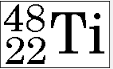
How many protons does this isotope of titanium have?
a)
48
b)
22
c)
26
d)
70
60.
How many neutrons does the isotope of lithium have?
a)
8
b)
3
c)
4
d)
5
61.
How many neutrons does uranium-235 have?
a)
238
b)
92
c)
146
d)
143
62.
What quantities vary between isotopes of an element?
a)
protons, electrons, and atomic mass
b)
protons, electrons, and atomic number
c)
neutrons and electrons
d)
neutrons and atomic mass
63.
which explanation of this notation is correct?
a)
 12 is proton #
b)
6 tells you there are 6 neutrons
c)
6 tells you there are 6 protons
d)
12 is not a mass # here
64.
Which particle has a positive charge?
a)
electron
b)
orbital
c)
proton
d)
neutron
65.
Choose the particle that has no charge.
a)
nucleus
b)
neutron
c)
proton
d)
electron
66.
This particle determines what element you have - the elements identity.
a)
electron
b)
proton
c)
neutron
d)
valence shell
67.
Why is water NOT on the periodic table?
a)
It is naturally occuring
b)
It is a compound, not an element
c)
It exists as a solid, a liquid, and a gas
d)
Its chemical formula doesn't fit
68.
_______ are the ROWS on the periodic table.
a)
Families
b)
Groups
c)
Periods
d)
Elements
69.
________ are the COLUMNS on the periodic table and are organized by similar properties.
a)
Classifications
b)
Groups
c)
Periods
d)
Elements
70.
Atoms with similar properties are most likely located...
a)
in the same period.
b)
in the same group.
c)
in different periods.
d)
to the right and left of each other.
71.
What is an ion?
a)
A Charged Atom
b)
A Large Atom
c)
A Small Atom
d)
A Cute Atom
72.
Barium atoms want to form...
a)
an anion
b)
a cation
c)
an onion
d)
a cuddly kitten friend
73.
Why are ions formed?
a)
To make our lives difficult
b)
Because atoms want 8 valence electrons
c)
Because atoms have the same number of protons and electrons
d)
Because atoms gained neutrons
74.
Cations are...
a)
Positive
b)
Negative
c)
Neutral
d)
Purring
75.
Anions are...
a)
Positive
b)
Negative
c)
Neutral
d)
Crying
76.
An atom becomes _________ when it gains electrons.
a)
Positive
b)
Negative
c)
Neutral
d)
Invinsible
77.
An atom becomes _______ when it loses electrons.
a)
Positive
b)
Negative
c)
Neutral
d)
Invinsible
78.
What will nitrogen's charge be as an ion?
a)
+3
b)
-3
c)
0
d)
-1
79.
Valence electrons are: 
a)
Electrons farthest away from the nucleus
b)
Electrons closest to the nucleus
c)
Electrons that just come and go - they don't stay with the atom
80.
What is the charge does a sodium ion have?
a)
+2
b)
+1
c)
-1
d)
-2
81.
When an atom loses a valence electron, it becomes a(n) _____________ ion.
a)
positive
b)
negative
c)
neutral
d)
polyatomic
82.
What charge will an Oxygen ion have? 
a)
+1
b)
-1
c)
+2
d)
-2
83.
Nitrogen will ____ valence electrons when forming an ionic bond.
a)
gain 1
b)
lose 1
c)
gain 3
d)
lose 3
84.
Magnesium's ion
a)
Mg+
b)
Mg2+
c)
Mg-
d)
Mg2-
85.
Convert from meters to cm:  9 meters
a)
900 cm
b)
90 cm
c)
0.9 cm
d)
0.09 cm
86.
Convert 17 m to cm:
a)
0.17 cm
b)
0.017 cm
c)
1,700 cm
d)
170 cm
87.
Convert 300 meters to centimeters:
a)
3000 cm
b)
0.3 cm
c)
30,000 cm
d)
3 cn
88.
Convert 8 kilometers to meters
a)
800 m
b)
80,000 m
c)
8,000 m
d)
.008 m
89.
Convert 300 cm to m:
a)
3 m
b)
30 m
c)
0.3 m
d)
0.03 m
90.
1000 grams = _____ kilograms
a)
0.0001
b)
1,000,000
c)
10
d)
1
91.
7,000 g = ____ kg
a)
70
b)
700
c)
7
d)
0.07
92.
490,000 g =____ kg
a)
490
b)
49
c)
4,900
d)
0.49
93.
Is 20 g greater than, less than, or equal to 2 kg?
a)
greater than
b)
less than
c)
equal to
94.
648 g = ____ mg
a)
6,480
b)
64,800
c)
648,000
d)
64.8
95.
IV
a)
6
b)
9
c)
4
d)
3
96.
V
a)
1
b)
3
c)
5
d)
7
97.
III
a)
12
b)
9
c)
3
d)
6
98.

Which of the following is neutral?

a)

7

b)

10

c)

7.2

d)

4

e)

More than one is neutral

99.
The pH scale is a range from:
a)
1-7
b)
0-14
c)
1-14
d)
1-20
100.
A(n) ______ is a substance with a pH less than 7
a)
Acid
b)
Alkaline
c)
Base
d)
Buffer
101.
A(n) _______ is a substance with a pH greater than 7.
a)
Base
b)
Acid
c)
Buffer
d)
Water
102.

Which is not a diatomic?

a)

Nitrogen

b)

Oxygen

c)

Carbon

d)

Fluorine

103.

Which of these molecules is incorrect in the gaseous state?

a)

Cl

b)

Sb

c)

Br2

d)

Al2