
 Worksheets
TCAP REVIEW
Total questions: 100
Worksheet time: 3hrs 20mins

A diagram of seven rock layers is shown. The diagram represents a section of Earth that a paleontologist, a scientist who studies fossils, has been working with for years. Which statement correctly describes this diagram?
Layer W contains fossils of organisms that existed on Earth after the organisms found in layers U and R.
Layer U contains fossils of organisms that are older than the organisms found in layer R.
Layers R and W contain fossils that are both types of plant species.
Layers W and U contain fossils that are animal species.

Some scientists compared fossils of the common ancestor of horses with modern horses. The table shows what the scientists found during their analysis.
The scientists claim that modern horses are better adapted for survival in the present-day environment than the common ancestor would have been. Which statement best support this claim?
Organisms with four legs will develop a hoof because of the need to balance on four legs.
Organisms will acquire helpful traits from their surroundings to survive.
Organisms that have hooves are more likely to reproduce.
Organisms with multiple toes are easily seen by predators, so parents choose not to pass the trait on to their offspring.

A canyon wall is shown. The rocks that make up the wall are layered. From the evidence in the picture, which statement is most correct about what the fossil record looks like in this location?
The number of fossils would decrease as the layers accumulate.
The number of fossils would rise and then immediately disappear.
The types of fossils would be similar but would show gradual structural changes.
The types of fossils would stay exactly the same in every layer.

Government agencies study natural disasters such as volcanic eruptions to make decisions about planning for natural disasters. The triangles on the map show the locations of potentially active volcanoes in the western United States. Which statement is correct regarding the dangers of volcanic eruptions in the western United States?
Colorado should have a stricter volcano emergency plan than Washington State has.
here is more danger of a volcanic eruption in the near future in San Diego, California, than there is in Seattle, Washington.
Utah should have a stricter volcano emergency plan than California has.
There is less danger of a volcanic eruption in the near future in Salt Lake City, Utah, than there is in Bend, Oregon.
Gravity is a force that pulls objects down toward Earth’s surface. Which statement explains why a student standing at the top of a step stool does not move downward?
The student’s mass is not large enough to be affected by gravity.
The step stool is a barrier that blocks the gravitational force.
The step stool exerts a force on the student equal to the force gravity exerts on the student.
The student exerts an upward force on the step stool equal to the gravitational force.

A heavy flood washed away over five meters of soil and rock. The layer of rock that was exposed by the flood contained remains of brachiopods, crinoids, and corals that existed in warm, shallow seas 350 million years ago. Some of the fossils that were found are shown.
Which statement is the best explanation for the presence of these marine fossils in an inland area of the United States?
The brachiopods could live in water and on land.
The crinoids and corals grew on terrestrial surfaces.
The fossils were carried to the area by floodwaters.
The area used to be covered by an ocean.

A data table shows a section of a gene from four animals. Based on the partial gene segments, which pair of animals will produce the most similar proteins?
Rat and Chimpanzee
Chimpanzee and Mouse
Rat and Mouse
Gorilla and Chimpanzee
When the solar system was very young, the sun was just being formed and planets had not yet been made. The solar system was mostly gas and dust.
Which statement best explains how planets formed in the early solar system?
Planets formed from magnetism in space that interacted with light from the stars.
Planets formed from large asteroids that had broken apart.
Planets formed from small amounts of debris that were attracted together because of gravity.
Planets formed from molten metal in volcanic eruptions.

The graphic shows the stages in the development of the solar system. Which statement best describes the process of the formation of the solar system?
Gravity pulled the gas and dust together.
A black hole pulled the gas and dust together.
Magnetism attracted the gas and dust together.
An explosion pushed the gas and dust together.

The graph shows the changes in the number of animal faunas living on Earth over time and how the faunas were affected by different extinction events. Which statement is correct about the changes in faunas during one of these five major events?
The event at the end of the Devonian (Dev.) resulted in an increase in the number of Cambrian faunas.
The event at the end of the Cretaceous resulted in an increase in the number of Paleozoic faunas.
The event at the end of the Triassic (Tri.) resulted in the extinction of fewer faunas than in any other period.
The event at the end of the Cretaceous resulted in the extinction of more faunas than in any other period.
Which instrument is used to take an image from outer space that shows the depletion of the ozone layer in Earth’s atmosphere?
microscope
planetarium
satellite
spectroscope
Which statement about the fossil record is correct?
Extinction is a common event but is rarely seen in the fossil record.
Extinction is a rare event and is rarely seen in the fossil record.
Most species that have lived on Earth are still living.
Most species that have lived on Earth are now extinct.

A student sets up a box with a flashlight that shines on a mirror located at position X. Other possible locations for objects in the box are labeled A-E. How can the student place objects in the box to have all the light from the flashlight shine back on the flashlight?
Place a mirror at position E to reflect the light to a prism placed at position C to refract all the light back to the flashlight.
Place a prism at position E to refract the light to mirrors placed at positions C and D to reflect the light back to the flashlight.
Place a mirror at position E to reflect the light to a prism placed at position A to refract all the light to the flashlight.
Place mirrors at positions A and E to reflect the light around the box and back to the flashlight.
Scientists find evidence of a large meteor impact on the coast of the Yucatán Peninsula in Mexico. What can the scientists most likely expect to find in the layers of rock that are about the same age as the impact?
evidence of the mass extinction of many species
evidence of a gradual change of one species over time
evidence of a rapid change in one species
evidence of the stability of many species over time

The image shows four locations (A-D) on the island of Japan, which resides on or near four different tectonic plates. Which location and explanation describes where engineers should design buildings that can withstand earthquakes?
location A; earthquakes occur near plate boundaries
location B; earthquakes occur far away from mountains
location C; earthquakes occur along the coast
location D; earthquakes occur in the middle of continents

The image shows the emission spectrum measured from a star once a year for three years. Based on the shifts of the spectral lines, how is the star moving with respect to Earth?
The star is moving toward Earth.
The star is moving away from Earth.
Initially, the star moves away and then starts moving toward Earth.
Initially, the star moves toward and then starts moving away from Earth.
Which scientific discovery supports the claim that Earth has changed over time?
Plants use sunlight to grow and create sugars.
Oceans cover a majority of the surface of Earth.
Animals can live in different climates on Earth.
Rocks found on different mountains are different ages.
An ocean wave energy device moves up and down with the motion of an ocean wave. The device produces more energy if larger waves move the device.
Which property of waves does the wave energy device use the most?
amplitude
frequency
volume
wavelength

Fossil evidence shows that Archaeopteryx, an ancient bird-like animal, had many reptile-like features including a long tail with many vertebrae and claws. Which conclusion does the fossil evidence support?
Birds and reptiles laid eggs.
Birds and reptiles had similar evolutionary beginnings.
Birds and reptiles had similar behaviors.
Birds and reptiles lived at the same time in the ancient past.

The image shows two ways of transmitting signals for television broadcasting. Historically, in aerial transmissions for television, the analog signals were transmitted from a television station tower and received at homes through an antenna. In current satellite transmissions, the signals are digitized and transmitted from the sender to the receiver through a satellite. Why are satellite transmissions used instead of aerial transmissions?
Only satellite transmissions can work in bad weather.
Satellite transmissions can serve a much larger area.
Unlike aerial transmissions, satellite transmissions are a wireless mode of transmission.
Unlike aerial transmissions, satellite transmissions do not have to pass through the air.

The model shows four different positions (W-Z) of the Moon in its orbit around Earth. Which position(s) of the Moon will cause spring tides on Earth? (remember- straight line, spring tide, springs higher)
X only
X and Z
W and Y
Y only

plants grow better. You divide the
plants into four groups.
Plant Groups Group Music Type
A jazz
B classical
C rock
D none
What is group D called??
A compression of a wave can be described as...
the part of a sound wave where the particles are close together
the part of a sound wave where the particles are spread apart
The resting point of the wave
A rarefaction of a wave can be described as...
the part of a sound wave where the particles are close together
the part of a sound wave where the particles are far apart
the part of a wave where the particles are warm
Which of the following statements about sound waves is true?
Sound is a transverse wave that can only travel in water.
Sound waves cannot typically be easily decoded by animals
A sound wave is a longitudinal wave that needs a medium in order to be transmitted.
In physics, what is a wave?
A friendly way to say hello to another person
A process to transfer electrons
A disturbance that carries energy
A rocket taking off from Earth is an example of...
Newton's idea of a good Friday night
Newton's first law (Law of inertia)
Newton's second law (Law of acceleration)
Newton's third law (action/reaction)
A 80 kg person was running at 2 m/s2. How much force does the person have?
F=ma
40 N
91 N
160 N
82 N

What is the net force acting on this box?
30 N
6030 N
60 N
90 N

What is the net force acting on this box?
18 N
80 N
2 N
108 N

Is the picture showing a balanced or unbalanced force?
balanced
unbalanced
neither

Is this picture showing a balanced or unbalanced force?
balanced
unbalanced
neither
A student is designing an experiment for the science fair. She needs to find a material that conducts an electric current, and her teacher has provided her with samples of the following elements. Which of them should she choose?
argon
fluorine
copper
phosphorous
What is the difference between the velocity and speed of an object?
Velocity is the change in distance over time, while speed is the change in velocity over time.
Velocity has a direction associated with it, while speed has no specific direction.
Velocity is the change in speed over time, while speed is the change in distance over time.
Velocity has no direction associated with it, while speed has a specific direction.
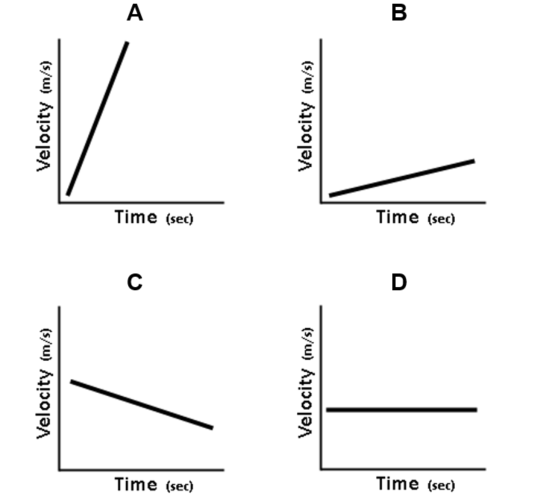
Which graph represents zero acceleration (constant velocity)?
A
B
C
D
Why do peppered moths tend to be the same color as the trees on which they live?
The coloring goes along with tasting like the tree.
It keeps the moth the same temperature as the tree.
It makes the moths faster than the birds
It makes the moths harder to see.

All of these finches have different shaped beaks, they are an adaptation to gain access of
Water
Food
Shelter
Which of the following is an inherited trait?
Eye color
Name
Hairstyle
Birthday

Which ball has a stronger gravitational pull towards Earth?
golf ball
ping pong ball

Jupiter has about 317 times more mass than Earth. What can you infer from this fact?
That Jupiter’s and Earth’s gravitational forces are equal.
That Jupiter’s gravitational force is much stronger than Earth’s gravitational force.
Mass has no effect on the gravitational force between two objects
What is the SI unit of force?
Joules
kilograms
Newtons
Isaac
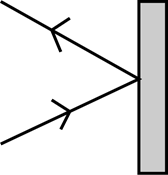
In the illustration, the light ray striking the object is-


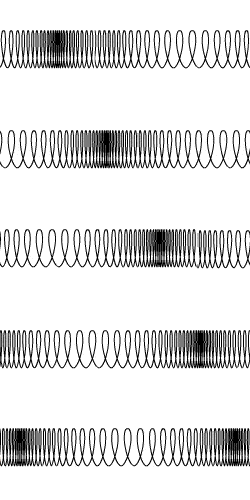
What is the adaptation?
Organisms with the Advantageous traits will
Die and go extinct
survive and reproduce

Do these homologous structures share a common ancestor?
yes
no

What best describes the relationships among the organisms shown?
embryological similarities
superposition similarities

Layer B is __________ layer C.
Older than
Younger than
Same age as
What evidence supports the idea that whales and dolphins have a common ancestor?
They eat the same food.
They have similar anatomies.
They swim the same way.
They live in the same area of the ocean.
If natural selection means "survival of the fittest", what does it mean to be "fit"?
you can migrate to new areas
you have a large territory
you can reproduce and pass on your genes
you have more genetic mutations
How could a series of fossils show how a horse evolved over time?
All the fossils would show varying levels of similar structures compared to modern horses.
All the fossils would be found in the same place.
All the fossils would be completely identical.
All the fossils would be found in the same rock layer.
Which list is organized from SMALLEST to LARGEST?
Planet, Galaxy, Solar System, Universe
Solar System, Planet, Universe, Galaxy
Universe, Solar System, Planet, Galaxy
Planet, Solar System, Galaxy, Universe
What is the shape of planet orbtis
rectangles
squares
ovals (ellipses)
perfect circles
Cosmic background radiation is remnants of the _______.
big bang
solar flare
supernova
none of the above

Which of the following factors influences the strength of an electromagnet?
The number of coils
The amount of current
The iron core (diameter)
All the above
The power source of an electric motor is a _____.
sparkplug
battery
magnet
Electric current can flow through a wire only if it forms a ____
Open Loop
Closed Loop
A closed loop through which current can flow is called an ____
Electric Force
Electric Current
Electric Circuit
How can a magnet be used to produce an electric current?
Hold a magnet next to a piece of wire.
Wrap wire around a magnet.
Spin the magnet around inside a coil of wire.
A _____________ transforms mechanical energy into electrical energy.
generator
electromagnet
circuit
magnetic field
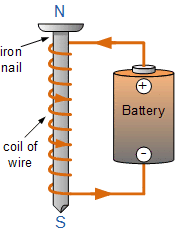
An electric motor
does not involve magnetic fields
does not require a voltage source
takes electrical energy and transfers it into mechanical energy
takes mechanical energy and transfers it into electrical energy.

