wayground logo

Free Printable Worksheets

Font size

S
M
L
XL
Worksheets

8th Grade Science STAAR Review 2022

Total questions: 100

Worksheet time: 4hrs 28mins

Name
Class
Date
1.

How many protons are present in Hafnium (Hf) with a mass number of 178?

a)

72 protons, 178 neutrons, 106 electrons

b)

72 protons, 106 neutrons, 72 electrons

c)

178 protons, 250 neutrons, 72 electrons

d)

106 protons, 72 neutrons, 196 electrons

2.

An atom of an element has 36 protons, 36 electrons, and a mass number of 84? How many neutrons?

a)

36

b)

72

c)

48

d)

8

3.

What types of particles are found in the cloud surrounding the atom's nucleus?

a)

positively and negatively charged particles

b)

negatively charged particles only

c)

neutral and positively charged particles

d)

positively charged particles only

4.

What is the mass number of a potassium (K) atom that has 20 neutrons?

a)

18

b)

19

c)

20

d)

39

5.

Which of the following is the best description of an electron?

a)

No charge and the same mass as a proton

b)

negative charge and much less mass than a proton

c)

positive charge and much more mass than a neutron

d)

negative charge and the same mass of a neutron

6.

An atom has 25 protons, 30 neutrons, and 25 electrons. What is the charge of the nucleus?

a)

+55

b)

-25

c)

+25

d)

-30

7.

Tin (Sn) is a soft, white metal. Which statement accurately describes an atom of tin?

a)

tin atoms have five valence electrons

b)

tin atoms have 68 electrons

c)

tin atoms have 50 protons

d)

tin atoms have 119 neutrons

8.

Atoms of a certain element have 11 protons and 1 valence electron. Which statement is correct?

a)

the element is sodium and it is not reactive

b)

the element is fluorine and it is highly reactive

c)

the element is fluorine and it is not reactive

d)

the element is sodium and it is highly reactive

9.

What characteristic of an atom always determines it's identity?

a)

number of neutrons

b)

number of protons

c)

number of valence electrons

d)

location of valence electrons

10.

Which characteristic of calcium is most closely related to its chemical reactivity?

a)

20 protons in each calcium atom

b)

calcium's density is 1.54 g.cm3

c)

2 valence electrons in each atom of calcium

d)

one calcium atom has an atomic mass of 40.078 amu

11.

Which two elements are in the same period?

a)

F and Cl

b)

Sn and Rb

c)

K and Ba

d)

Se and Te

12.

Which element is similar to phosphorus but has a greater atomic mass?

a)

nitrogen (N)

b)

sulfur (S)

c)

arsenic (As)

d)

silicon (Si)

13.

Which is the organic compound?

a)

silane, SiH4

b)

urea, CH4N2O

c)

ammonium sulfide, (NH4)2S

d)

sodium chloride, NaCl

14.

Which process is the best example of a physical change in the digestive system?

a)

saliva converting starch molecules into simple sugar

b)

digestive enzymes breaking down proteins into smaller parts

c)

intestinal bacteria converting lactose into simple sugars

d)

teeth grinding an almond into smaller pieces in the mouth

15.

6 CO2 + 6 H2O → C6H12O6 + 6 O2

How many oxygen atoms in total are present in the reaction?

a)

10

b)

21

c)

12

d)

18

16.

6 CO2 + 6 H2O → C6H12O6 + 6 O2

How many carbon atoms in total are present in the reaction?

a)

6

b)

18

c)

12

d)

10

17.
A clear liquid from a flask is poured into another clear liquid in a beaker. Which of the following results of this procedure would indicate a new substance was formed?
a)
The level of the substance in the beaker is higher after the other liquid is added.
b)
A yellow solid forms and then settles to the bottom of the beaker.
c)
Small white crystals are left behind in the flask that held the first liquid.
18.

Which liquid is the least dense?

a)

Oil

b)

Water

c)

Syrup

d)

Plastic bottle

19.
What is the acceleration of a 50 kg object pushed with a force of 500 newtons?
a)
100 m/s2
b)
25,000 m/s2
c)
10 m/s2
d)
25 m/s2
20.
Forces that have a net force of zero 
a)
Balanced force
b)
Unbalanced force
21.
The sum of all forces acting on an object.
a)
Contact Force
b)
Balanced Force
c)
Unbalanced Force
d)
Net Force
22.
What will cause an object to move?
a)
Applied forces
b)
Balanced forces
c)
Unbalanced forces
23.

an imaginary line that an object spins or revolves around

a)

equator

b)

hemisphere

c)

axis

d)

latitude

24.

the orbiting of an object around another object

a)

Solstice

b)

Revolution

c)

Rotation

d)

Equinox

25.

When the Northern Hemisphere is tilted toward the sun it is the

a)

Summer Solstice

b)

Vernal Equinox

c)

Winter Solstice

d)

Autumnal Equinox

26.

When the Northern Hemisphere is tilted away from the sun it is the

a)

Summer Solstice

b)

Vernal Equinox

c)

Winter Solstice

d)

Autumnal Equinox

27.
Name the moon phase
a)
First Quarter
b)
Last Quarter
c)
New Moon
d)
Full Moon
28.

The moon phase cycle repeats about every

a)

365 days

b)

20 days

c)

29 days

d)

15 days

29.
CHALLENGE
When the moon is lined up exactly between the sun and Earth, it is called a ______ ______. 
a)
Solar Eclipse
b)
Lunar Eclipse
30.

The luminosity of a star describes its ______________.

a)

brightness

b)

temperature

c)

age

d)

color

31.

As the _________ of a star increases, luminosity increases.

a)

size

b)

distance

c)

age

d)

composition

32.
What feature is formed at B?
a)
river
b)
rift valley
c)
sink hole
d)
mountain
33.

If the amount of food or resources available increases, the carrying capacity for an animal.....

a)

Stays the same

b)

Increases

c)

Decreases

d)

Fluctuates

34.
The living organisms in an ecosystem such as plants and animals
a)
adaptation
b)
biotic
c)
decomposer
d)
abiotic
35.
The non-living factors in an ecosystem such as rocks, water and temperature.
a)
natural selection
b)
biotic
c)
biodiversity
d)
abiotic
36.
Organisms that make their own food. Also called autotrophs.
a)
Producer
b)
Parasite
c)
Scavenger
d)
Decomposer
37.
Organisms that eat other organisms (heterotroph).
a)
Producer
b)
Parasite
c)
Consumer
d)
Scavenger
38.
Organisms that digest dead producers and consumers such as mold, fungus, bacteria and worms.
a)
Producer
b)
Parasite
c)
Decomposer
d)
Consumer
39.
Organisms, such as vultures, that feed on dead animals.
a)
Producer
b)
Scavenger
c)
Consumer
d)
Parasite
40.
Organisms that live in or on another organism and benefit at the host's expense.
a)
Parasite
b)
Producer
c)
Scavenger
d)
Decomposer
41.
Struggle between organisms of the same or different species for food, space, light, water, etc.
a)
Interdependence
b)
Natural Selection
c)
Adaptation
d)
Competition
42.
Process by which an animal or plant species becomes fitted to its environment to help them survive.
a)
Interdependence
b)
Natural Selection
c)
Adaptation
d)
Competition
43.
Variety of life
a)
Natural Selection
b)
Ecological Succession
c)
Interdependence
d)
Biodiversity
44.
Gradual and orderly process of change in an ecosystem until a stable community is established.
a)
Ecological Succession
b)
Biodiversity
c)
Adaptation
d)
Competition
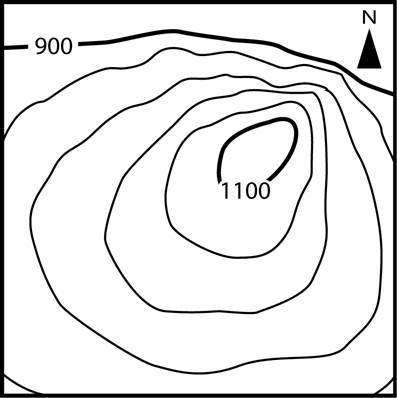
45.

Which side is steeper?

a)

The left side of the hill

b)

The right side of the hill

46.
What is the highest elevation this hill could possibly have? (might not be labeled)
a)
1040
b)
1060
c)
1079
d)
1009
47.
Provided is a topographic map of a hill with contour lines drawn showing elevation in meters.
The steepest slope on this hill can be found on the side that is facing which direction?
a)
Southwest
b)
Northeast
c)
Northwest
d)
Southeast
48.

Which two areas on the map are steepest?

a)

A and C

b)

C and D

c)

A and B

d)

B and D

49.

Which area of this topographic map indicates a mountain peak?

a)

A

b)

B

c)

C

50.

What is the most likely profile of this topographic map?

a)
b)
c)
d)
51.

What causes day & night?

a)

Earth's rotation on the equator

b)

Earth's revolution around the Sun

c)

The Moon's rotation around the Sun

d)

Earth's rotation on its axis

52.
Earth's axis is tilted at - 
a)
23.5 degrees
b)
33.5 degrees
c)
28 degrees
d)
90 degrees
53.
Which answer correctly labels each letter as day and night? 
a)
X = night
Y = day
b)
X = day
Y = night
54.
Which season is taking place in the Northern Hemisphere in Position 3?
a)
Winter
b)
Spring
c)
Summer
d)
Fall
55.
What happens when the area in which you live tilts away from the sun?
a)
It is summer.
b)
It is spring.
c)
It is winter.
d)
It is fall.
56.

In the summer, many people enjoy going to the beach. The photograph shows a beach in Argentina, which is located in the Southern Hemisphere. Which diagram shows the position of Earth when it is summer in Argentina?

a)
b)
c)
d)
57.

In winter, the axis of the earth is pointed away or toward the sun?

a)

towards

b)

up

c)

down

d)

away

58.
What are the reasons for the season?
a)
Earth's tilt & rotation
b)
Earth's tilt & revolution
c)
Earth's rotation & rovolution
d)
Earth's tilt & resolution
59.
At position A, which hemisphere would have summer?
a)
Northern hemisphere
b)
Southern hemisphere
60.
What is Earth's annual motion around the sun called?
a)
Rotation
b)
Revolution
61.
Which movement of Earth causes day and night?
a)
rotation
b)
revolution
62.

Visible part of the moon is on the right side:

a)

Waxing

b)

Waning

63.

Visible part of the moon is on the left side:

a)

waxing

b)

waning

64.

Visible part of the moon is growing larger:

a)

waxing

b)

waning

65.

Visible part of the moon is shrinking.

a)

waxing

b)

waning

66.

At which position would the people on Earth see a full moon?

a)

1

b)

3

c)

5

d)

7

67.

The model shows Earth in several positions relative to the Sun. In which position is it winter in North America?

a)

Position 1, because North America receives the most direct sun.

b)

Position 2, because North America is tilted toward the Sun.

c)

Position 3, because North America is parallel to the Sun.

d)

Position 4, because North America is tilted away from the Sun.

68.
What is the name of this moon phase?
a)
Waning Crescent
b)
Waxing Crescent
c)
Waning Gibbous
d)
Waxing Gibbous
69.
The name of this phase is...?
a)
Waning Crescent
b)
Waxing Crescent
c)
Waning Gibbous
d)
Waxing Gibbous
70.
How long does it take for the lunar cycle to go from position B to position D?
a)
7 days
b)
14 days
c)
21 days
d)
28 days
71.
Approximately how many days after a full moon does the new moon occur?
a)
28 days
b)
14 days
c)
7 days
d)
4 days
72.

Look at the diagram of phases of the Moon. What phase does Day 14 represent?

a)

waxing moon

b)

new moon

c)

full moon

d)

waning moon

73.

What moon phase will be observed after the waning crescent?

a)
b)
c)
d)
74.

What will the phase of the moon be in the diagram?

a)

new moon

b)

waning gibbous

c)

first quarter

d)

full moon

75.

What phase of the moon is shown in the picture?

a)

first quarter

b)

new moon

c)

full moon

d)

last quarter

76.

What moon phase is shown in the picture?

a)

first quarter

b)

new moon

c)

last quarter

d)

full moon

77.

Where would the Sun need to be in this diagram to cause these phases of the moon?

a)

At the Bottom

b)

At the Left

c)

At the Top

d)

At The Right

78.
Based on this diagram which type of stars would belong to spectral class M and have the lowest luminosity?
a)
Main Sequence Stars
b)
Giants
c)
Super Giants
d)
White Dwarfs
79.
Based on this diagram which type of stars would belong to spectral class G and have the highest luminosity?
a)
Main Sequence Stars
b)
Giants
c)
Super Giants
d)
White Dwarfs
80.
Based on this diagram which type of stars would belong to spectral class B and have the lowest luminosity?
a)
Main Sequence Stars
b)
Giants
c)
Super Giants
d)
White Dwarfs
81.
Analyze this HR Diagram. Which group of stars is considered to have lower than average luminosity as well as a higher than average temperature?
a)
Giants
b)
Main Sequence
c)
White Dwarfs
d)
Super Giants
82.
On the H-R diagram, the Sun is a _____.
a)
Main Sequence star
b)
Red Giant
c)
White Dwarf
d)
Blue Giant
83.
Use the Hertzsprung-Russell Diagram to answer the following question.  Red colored stars __________
a)
are stars with cool temperatures
b)
are stars with hot temperatures
c)
are all stars with bright luminosity.
d)
are all stars with dim luminosity
84.
Use the Hertzsprung-Russell Diagram to answer the following question. Blue colored stars __________
a)
are stars with cool temperatures
b)
are stars with hot temperatures
c)
are all stars with bright luminosity.
d)
are all stars with dim luminosity
85.
A large cloud of dust and gas
a)
black hole
b)
nebula
c)
Galaxy
d)
Supercluster
86.
Blue stars are the _____________.
a)
hottest
b)
coolest
c)
smallest
87.
Red stars are the _____________.
a)
hottest
b)
coolest
c)
biggest
d)
brightest
88.
Which star is considered a Main Sequence Star?
a)
A
b)
B
c)
C
d)
D
89.

The San Andreas fault is a transform fault. The map below shows a student's approximation of where the fault line crosses through the United States. Students were asked to make maps predicting which way land would most likely move over thousands of years.

a)
b)
c)
d)
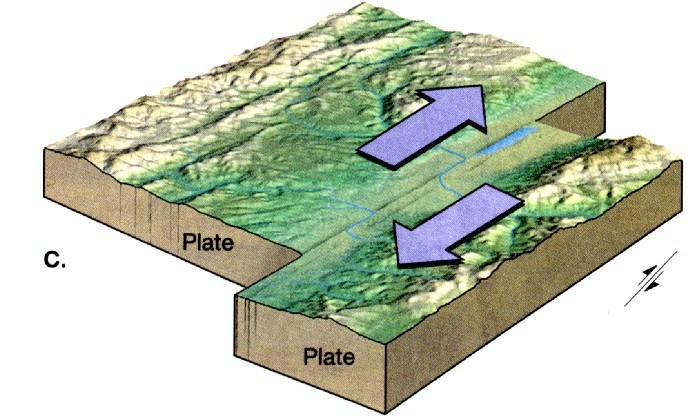
90.
What type of plate boundary is this?
a)
Plate
b)
Divergent
c)
Convergent
d)
Transform
91.
What type of event will occur at this boundary?
a)
Earthquake
b)
Volcano Eruption
c)
Tornado
d)
Mountain Building
92.
What type of plate boundary is this?
a)
Transform
b)
Convergent
c)
Divergent
d)
Plate
93.
Name the boundary
a)
convergent boundary
b)
divergent boundary
c)
transform boundary
d)
sergent boundary
94.
Name this plate boundary.
a)
divergent
b)
convergent 
c)
transform
d)
insurgent
95.
What type of weather usually goes with this symbol?
a)
Clear, sunny skies
b)
Cloudy skies
c)
Hot temperature
d)
Thunderstorms
96.
This is the symbol for a... 
a)
Occluded Front
b)
Stationary Front
c)
Warm Front
d)
Cold Front 
97.
This is the symbol for a... 
a)
Cold Front
b)
Warm Front
c)
Stationary Front
d)
Occluded Front 
98.
This is the symbol for a... 
a)
Stationary Front
b)
Occluded Front
c)
Cold Front
d)
Warm Front
99.
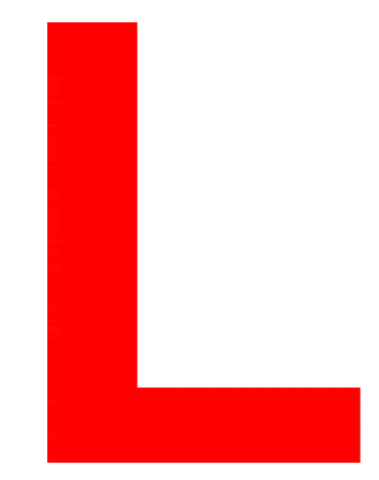
What does this symbol on a weather map indicate? 
a)
High pressure system
b)
Low pressure system
c)
Cold front
d)
Warm front
100.

What would the weather be like in a low-pressure system area?

a)

Hot, sunny and windy

b)

Cloudy with precipitation

c)

Partly cloudy with wind

d)

Bright wind and warm air