wayground logo

Free Printable Worksheets

Font size

S
M
L
XL
Worksheets

The Universe, Gravity, Mass and Tides

Total questions: 99

Worksheet time: 1hrs 10mins

Name
Class
Date
1.

Which statement is true?

a)

The galaxies are moving toward us.

b)

The galaxies are moving away from us.

c)

The universe remains static or unchanged in motion.

d)

None of the above

2.

Most scientists believe the Big Bang Theory explains which of the following questions?

a)

How our planets and moons formed

b)

How our universe began

c)

How the sun turns hydrogen into helium

d)

How fast light travels through space

3.
What forces cause a planet to orbit?
a)
gravity and orbit
b)
gravity and inertia
c)
gravity and mass
d)
gravity and weight
4.

 
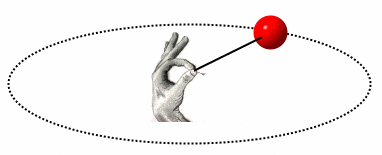
Which force in the Solar System is similar to the tension in the string?
a)
Friction
b)
Inertia
c)
Force
d)
Gravity
5.
What would happen to the planets in the solar system if the sun’s gravitational force were to suddenly disappear?
a)
They will stop moving and become static.
b)
They will stop spinning.
c)
They will fly away in straight lines.
d)
They will start moving toward the Sun
6.
 A bowling ball keeps rolling down the alley because of
a)
inertia
b)
gravity
c)
friction
d)
mass
7.

The initial explosion that resulted in the creation and expansion of the universe is known as the

a)

Big Bang Theory

b)

Milky Way

c)

Great Expansion

8.

Following the Big Bang, the Universe:

a)

expanded and then rapidly stopped expanding

b)

expanded and has not stopped expanding since

c)

rapidly expanded and then shrunk back to its original size

9.

When looking at the night sky, the brighter stars are typically:

a)

farther from Earth than dimmer stars.

b)

closer to Earth than dimmer stars

c)

the same distance from Earth as all other stars

10.

Which term represents a larger area?

a)

universe

b)

galaxy

c)

they are all the same

11.

Which of the following would NOT be an example of the force of gravity?

a)

The moon orbits around Earth

b)

Earth revolves around the Sun

c)

A ball hit in the air comes down into the outfielder's glove

d)

All of the above are examples of gravity

12.

Mass can be best defined as:

a)

The weight of an object

b)

The amount of matter in an object

c)

The volume of an object

13.

Which of the following would have the most gravity between them?

a)

2 ping pong balls 2 meters apart

b)

2 bowling balls 1 meter apart

c)

2 bowling balls 2 meters apart

14.

There is gravity between you and the moon.

a)

True

b)

False

15.

There is gravity between the Milky Way Galaxy and other galaxies

a)

True

b)

False

16.

An idea which has not yet been proven to be true, but has not been disproved is known as:

a)

an idea

b)

an understanding

c)

a theory

17.
Which objects have a STRONG force of gravity?
a)
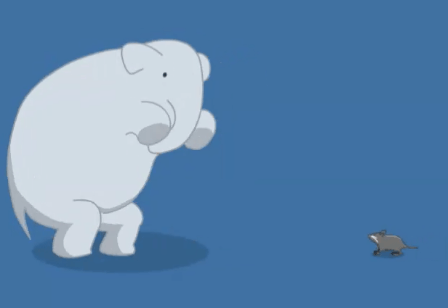
Objects with GREATER mass, like elephants
b)
Objects with LESS mass, like mice
18.
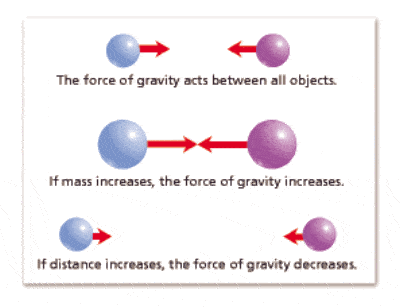
As distance between two objects increase the pull of gravity 
a)
Increases
b)
Decreases
c)
Stays the same
19.
The force of gravity acting on an object is the object's ______.
a)
mass
b)
matter
c)
weight 
d)
friction 
20.
The amount of matter in an object is 
a)
pressure
b)
weight
c)
mass
d)
force
21.
Which of the following never changes no matter where in the universe?
a)
weight
b)
force
c)
mass
d)
pounds
22.
A person would weigh less on on the Moon than on the Earth because . . .
a)
Moon has more mass, and therefore more gravity
b)
Moon has less mass, and therefore more gravity
c)
Moon has more mass, and therefore less gravity
d)
Moon has less mass and therefore less gravity
23.
Two factors effecting the magnitude of the force of gravity between 2 objects are...
a)
mass and distance 
b)
mass and matter
c)
distance and weight 
d)
weight and mass
24.
If Earth's mass was cut in half, what would happen to your mass?
a)
increase because gravitational force increases
b)
decrease because gravitational force decreases
c)
decrease because gravitational force increases
d)
nothing, mass is not affected by gravitational force
25.
As mass increases, what happens to gravitational force?
a)
increases
b)
decreases
c)
stays the same
d)
i don't know
26.
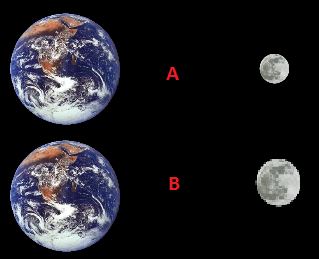
Which system has the greater gravitational attraction between the two objects (if any)?
a)
System A
b)
System B
c)
Same gravitational attraction fro System A and System B
27.
How does changing the distance of the string in the model represent the orbits of the planets?
a)
the longer the string means the larger the planet
b)
the longer the string, the longer the orbit time of a planet
c)
the shorter the string, the longer the orbit time of the planet
d)
the shorter the string, the smaller the planet
28.
When only the force of gravity is acting on an object, we say that the object is in ___________________________.
a)
Terminal Velocity
b)
Free Fall
c)
Projectile motion
d)
Centripetal Force
29.
If a bowling ball and a feather were dropped at the same time, in a room with no air resistance (vacuum), which object will hit the ground first?
a)
Bowling Ball
b)
Feather
c)
Both would hit at the same time
d)
Neither one would hit the ground because air is what pushing things down.
30.
What is gravity?
a)
A force
b)
Energy
c)
A push
d)
All of them
31.
Without gravity we would________. 
a)
Float away
b)
Stay in the ground
c)
Nothing would happen.
d)
I don't know
32.
Which has more mass, Earth or the Moon?
a)
Earth
b)
Moon
c)
The same
33.
The weight of an object _________ as it moves away from the center of Earth.
a)
increases
b)
stays the same
c)
triples
d)
decreases
34.

Why do all of the planets orbit the sun rather than Earth?

a)

the sun has more mass

b)

the sun is a star

c)

the Earth is heavier

d)

the sun is in the middle of the milky way

35.
Use the balance beam to tell whether the statement below is true or false.The orange is heavier than the grapes.
a)
True
b)
False
36.
Use the balance beam to tell whether the statement below is true or false.The banana is heavier than the apple.
a)
True
b)
False
37.
Order these items from lightest to heaviest.
a)
bike, lightbulb, glass of milk
b)
lightbulb, bike, glass of milk
c)
lightbulb, glass of milk, bike
d)
glass of milk, lightbulb, bike
38.
Volume is _________.
a)
how much matter is in an object
b)
how much space an object takes up
c)
how much something weighs
d)
how many atoms
39.
What keeps the planets from flying into space?
a)
Gravity of the Sun
b)
Gravity of the Earth
c)
Weight of the Sun
d)
Weight of the Earth
40.
Planets move around the Sun in a(n) ________.
a)
orbit
b)
circle
c)
path
d)
gravity
41.

What is a high tide?

a)

Sea pulled TOWARD the moon where Earth is CLOSEST to the moon

b)

Sea pulled AWAY from the moon where Earth is FARTHEST to the moon

c)

Sea pulled AWAY from the moon where Earth is CLOSEST to the moon

42.
Which body has the greater effect on Earth's tides?
a)
Sun
b)
Saturn
c)
Moon 
d)
Venus
43.
What type of tides would this arrangement of earth-moon-sun create?
a)
neap tide
b)
spring tide
c)
new moon tide
d)
full moon tide
44.

Wha type of tide would this arrangement of earth-moon-sun create?

a)

full moon tide

b)

new moon tide

c)

neap tide

d)

spring tide

45.
What causes tides?
a)
gravity
b)
wind
c)
spring
d)
neap
46.
If tides alternate from high to low and there are two of each type of tide a day, about how many hours will generally be between each different tide?
a)
2 hours
b)
6 hours
c)
12 hours
d)
24 hours
47.
How many low tides and high tides happen in a day?
a)
1 low tide, 1 high tide
b)
4 low tides, 4 high tides
c)
3 low tides, 3 high tides
d)
2 low tides, 2 high tides
48.
You visited the beach at 12 pm (noon) and it is high tide. If you return 6 hours later what tide will you see? 
a)
high 
b)
low 
c)
none
d)
spring 
49.
What do we call the small tides that happen when the sun and moon are at right angles to each other?
a)
Neap Tide
b)
Spring Tide
c)
Larger Change
d)
Smaller Change
50.
What is a difference between spring and neap tides?
a)
Spring tides occur when the earth and sun are IN LINE with the new or full moon. 
b)
Spring tides occur when moon in 3rd or 1st quarter phases
c)
Spring tides are LOWER than neap tides
d)
Spring tides occur in Spring and neap tides can occur in any season
51.
Tides are caused mainly by the differences in how much gravity from the moon and the sun pulls on different parts of the Earth. 
a)
True
b)
False
52.
Changes in the positions of Earth, the moon, and the sun affect the height of high tides during a month. 
a)
True
b)
False
53.

Spring tides have the largest tidal ranges because...

a)

the earth, moon, and sun are aligned for greater gravitational force.

b)

the moon has the strongest gravitational force.

c)

the sun has the most gravitational force.

d)

none of the above

54.

What planet is closest to the sun?

a)

Mars

b)

Earth

c)

Venus

d)

Mercury

55.

What are the four inner planets?

a)

Earth, Uranus, Mercury, Venus

b)

Mercury Venus Earth Saturn

c)

Mars, Earth , Mercury, Venus

d)

Mars, Earth, Neptune, Mercury

56.

Which planet is farthest from the sun?

a)

Neptune

b)

Jupiter

c)

Mercury

d)

Uranus

57.

What are the outer planets?

a)

Jupiter, Saturn, Earth, Neptune

b)

Saturn, Neptune, Mars, Uranus

c)

Uranus, Saturn, Neptune, Jupiter

d)

Mercury, Venus, Earth, Mars

58.

What is the fourth planet from the sun?

a)

Mars

b)

Earth

c)

Saturn

d)

Venus

59.

What is at the center of our solar system?

a)

asteroid belt

b)

Earth

c)

sun

d)

moon

60.

What is the sixth planet from the sun?

a)

Uranus

b)

Saturn

c)

Earth

d)

Venus

61.

Which planets are made of solid surfaces and rocky cores?

a)

terrestrial

b)

gas giants

c)

outer planets

62.

Which planets are mostly made of gases?

a)

terrestrial

b)

gas giants

c)

inner planets

63.

Which planet is third from the sun?

a)

Mars

b)

Earth

c)

Mercury

d)

Venus

64.

Which planet is a gas giant?

a)

Mercury

b)

Earth

c)

Saturn

d)

Venus

65.

Which planet is a terrestrial planet?

a)

Uranus

b)

Neptune

c)

Jupiter

d)

Venus

66.

Which planets are the gas giants?

a)

Earth, Jupiter, Venus, Neptune

b)

Saturn, Uranus, Jupiter, Neptune

c)

Jupiter, Saturn, Uranus, Mars

d)

Uranus, Jupiter, Earth, Neptune

67.

Which planets are all inner planets?

a)

gas giants

b)

terrestrial planets

68.

Which planets are all outer planets?

a)

gas giants

b)

terrestrial planets

69.

How many planets are in our solar system?

a)

6

b)

7

c)

8

d)

9

70.

Which two facts describe Earth?

a)

inner planet

b)

outer planet

c)

terrestrial planet

d)

gas giant

71.
Mercury 
a)
1st 
b)
2nd 
c)
3rd 
d)
4th 
72.

Venus ( thick atmosphere that traps in heat) ((hottest planet))

a)

1st

b)

2nd

c)

3rd

d)

4th

73.
Earth 
a)
1st 
b)
2nd 
c)
3rd 
d)
4th 
74.

Mars (gets its reddish color from the iron in the dust and sane)

a)

1st

b)

2nd

c)

3rd

d)

4th

75.

Jupiter ( giant red spot is a storm)

a)

5th

b)

6th

c)

7th

d)

8th

76.

Saturn

a)

5th

b)

6th

c)

7th

d)

8th

77.
Uranus 
a)
5th 
b)
6th 
c)
7th 
d)
8th 
78.
Neptune 
a)
5th 
b)
6th 
c)
7th 
d)
8th 
79.
Which planet has the largest continuous hurricane?
a)
Earth
b)
Mars
c)
Jupiter
d)
Saturn
80.
Which planet doesn't have a moon?
a)
Earth
b)
Mars
c)
Mercury
d)
Jupiter
81.
Which of the following is not true?
Planets closer to the sun...
a)
are hotter
b)
revolve slower
c)
have less moons
d)
are smaller
82.
Which planet has very visible rings?
a)
Jupiter
b)
Saturn
c)
Earth
d)
Neptune
83.
The inner and outer planets are divided by...
a)
The asteroid belt
b)
The oort cloud
c)
The kuiper belt
d)
a fraction
84.
What is the correct order of planets from the sun?
a)
Mercury, Venus, Earth, Mars, Jupiter, Saturn, Uranus, Neptune
b)
Mars, Venus, Earth, Mercury, Jupiter, Saturn, Uranus, Neptune
c)
Mercury, Venus, Earth, Mars, Jupiter, Saturn, Neptune, Uranus
d)
Jupiter, Saturn, Venus, Earth, Pluto, Mars, Mercury, Neptune
85.
What does the word terrestrial mean?
a)
Warm planets
b)
planets with moons
c)
planets with ailens
d)
Rocky planets
86.
Compared to the inner planets, the outer planets are...
a)
larger
b)
warmer
c)
denser
d)
better
87.
The difference between a moon and a planet is...
a)
A moon is made of rock, a planet is made of gas
b)
Moons can only be seen with a telescope
c)
Moonss revolve around a planet, planets revolve around a sun
d)
That's no moon... ITS A SPACE STATION!
88.
The greater mass a planet has, 
a)
the greater the gravitational force it has
b)
the less gravitational force it has
c)
gravitational force does not depend on mass
89.
The spinning of an object on its axis is called______
a)
orbit
b)
rotation
c)
revolution
d)
tide
90.
As distance between two objects increase the pull of gravity 
a)
Increases
b)
Decreases
c)
Stays the same
91.
The distance between the planets is all the same. 
a)
True
b)
False
92.
Gravity attracts all objects towards one another.
a)
False
b)
True
c)
It depends
93.
Which planet is the largest?
a)
Jupiter
b)
Saturn
c)
Uranus
d)
Neptune
94.
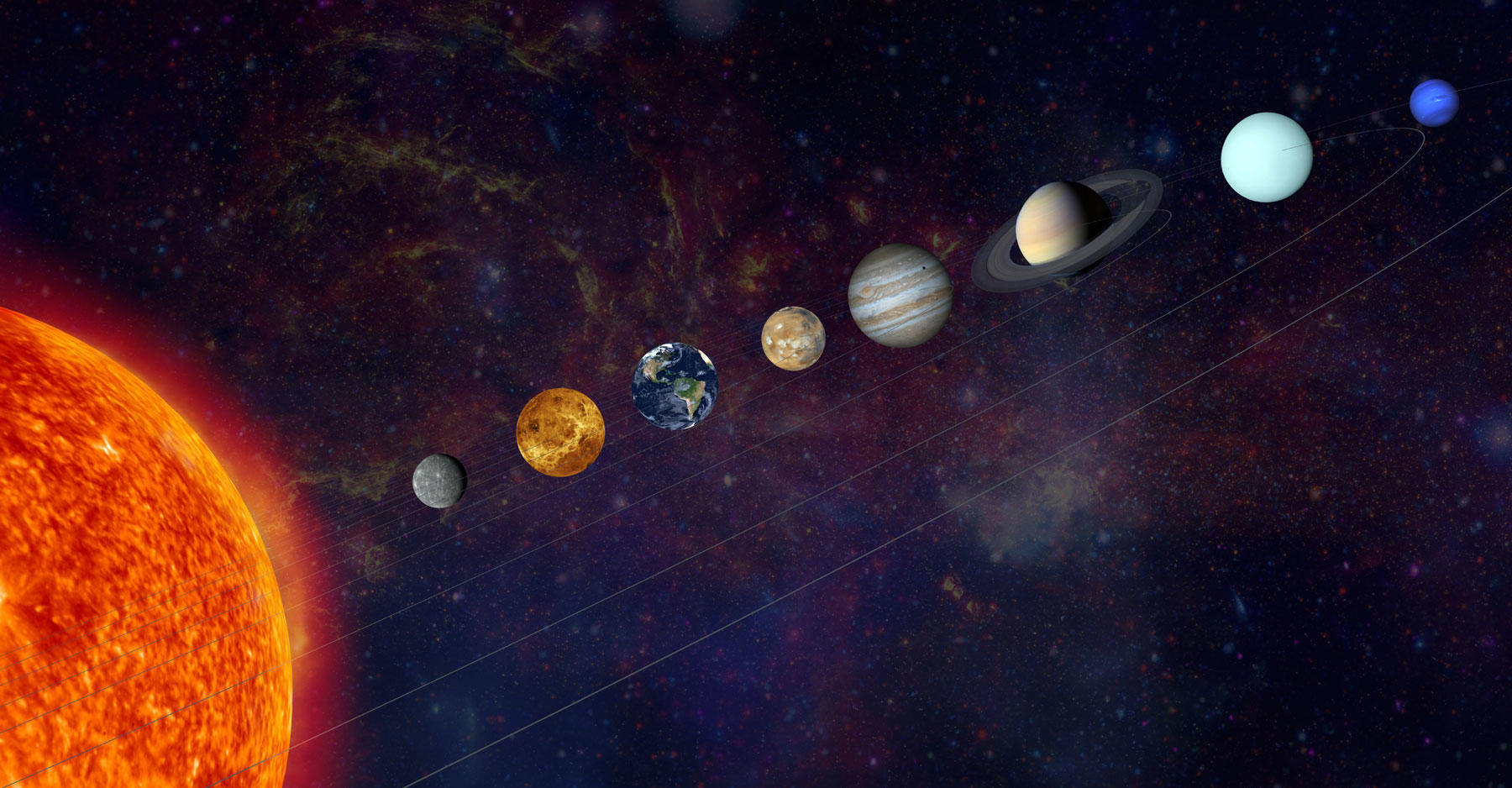
True or False
The Earth is the center of the solar system.
a)
True
b)
False
95.
How long does it take the Earth to make one REVOLUTION around the Sun?
a)
12 hours
b)
24 hours
c)
365 days
d)
29.5 days
96.
The spinning of an object on its axis is called______
a)
orbit
b)
rotation
c)
revolution
d)
tide
97.
True or False
The planets are all equally distanced from each other.
a)
True
b)
False
98.
True or False
The planets are not lined up in a perfectly straight line
a)
True
b)
False
99.
Which planet has the biggest rings?
a)
Jupiter
b)
Saturn
c)
Uranus
d)
Neptune