wayground logo

Free Printable Worksheets

Font size

S
M
L
XL
Worksheets

8th Grade SSA Review

Total questions: 100

Worksheet time: 2hrs 55mins

Name
Class
Date
1.
The natural chemical or physical processes that breaks down rock on Earth's surface.
a)
weathering
b)
erosion
c)
deposition
d)
jackhammering
2.
The process by which water, ice, wind or gravity moves weathered rock and soil from one place to another.
a)
weathering
b)
erosion
c)
deposition
d)
dumptruck
3.
How does freezing water cause the weathering of rocks?  The freezing water—
a)
keeps the rocks in place
b)
makes the rocks last longer
c)
expands cracks and breaks rocks
d)
causes rocks to fall in landslides
4.
How do plants weather rocks?
a)
during photosynthesis
b)
when roots grow into cracks of rocks and expand the rock
c)
when the plant moves water from the roots to the leaves
5.

Erosion ________________________.

a)

breaks down rock

b)

moves rocks

c)

deposits rock

d)

is caused by ice wedging

6.

Weathering is the__________________.

a)

breaking down of rocks

b)

movement of rocks

c)

deposition of rocks

7.

What process most likely formed the Grand Canyon?

a)

weathering by wind

b)

rain pounding the rocks

c)

erosion by a river (water)

8.

_____________________ is the movement of soil and rock by wind, water, ice, and gravity.

a)

Weathering

b)

Erosion

c)

Deposition

9.

______________________ occurs when eroded materials stop moving and begin to build up.

a)

Weathering

b)

Erosion

c)

Deposition

10.

Which process describes rain washing away soil from a hill?

a)

Weathering

b)

Erosion

c)

Deposition

11.

Which process describes layers of sediment forming at the bottom of the ocean?

a)

Weathering

b)

Erosion

c)

Deposition

12.

Which process describes flood water pounding against a canyon wall and wearing it down?

a)

Weathering

b)

Erosion

c)

Deposition

13.

How are metamorphic rocks formed?

a)

Heating and cooling

b)

Deposition

c)

Heating and pressure

d)

Materials gathering and pressing together
14.
Which type of rock results from melting and cooling of magma?
a)
Igneous
b)
Metamorphic
c)
Sedimentary
d)
Extrusive
15.
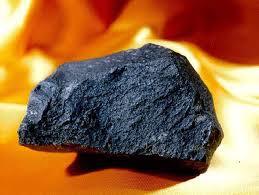
This rock was found near the mouth of a volcano. What type of rock is this?
a)
Sedimentary
b)
Igneous
c)
Metamorphic
16.
This rock was formed by smaller pieces of rock that settled at the bottom of a lake millions of years ago. What type of rock is this?
a)
Sedimentary
b)
Igneous
c)
Metamorphic
17.
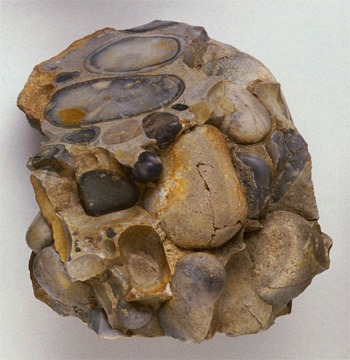
What are the 3 major types of rocks?
a)
Igneous, Metamorphic, Sedimentary
b)
Metamorphic, Igneous, Cementation
c)
Brown, Red, Gray
d)
Streak, Hardness, Breakage
18.
This rock started as molten magma. What type of rock is this?
a)
Sedimentary
b)
Igneous
c)
Metamorphic
19.
This rock is made from tiny pieces of other rocks that settled to the bottom of a valley millions of years ago. What type of rock is this?
a)
Sedimentary
b)
Igneous
c)
Metamorphic
20.
Each rock type can follow only one pathway of the rock cycle.
a)
True
b)
False
21.
According to the law of superposition, the oldest fossils are found 
a)
At the top of the rock layers
b)
Near the bottom of the rock layers
c)
In the middle of the rock layers
d)
Somewhat near the surface
22.
Which rock layer in the diagram seems to be the oldest?
a)
F
b)
E
c)
B
d)
A
23.
According to the law of superposition, which layer is the youngest?
a)
A
b)
B
c)
C
24.
How do geologists use relative dating?
a)
Placing rocks in order from youngest to oldest
b)
Placing rocks in order by minerals they contain
c)
Classifying rocks by different textures
d)
Classifying rocks by different isotopes
25.
Relative dating of rock layers tells us that the deeper we dig, _______.
a)
the younger the rocks get
b)
the smellier the rocks get
c)
the harder the rocks get
d)
the older the rocks get
26.
The length of time required for half of the radioactive atoms in a sample to decay is its...
a)
era
b)
age
c)
half-life
d)
eon
27.
How does absolute age differ from relative age?
a)
only absolute dating indicates which rock is older than another
b)
only absolute dating finds the age in years
c)
only relative dating finds the age in years
28.
Radiometric dating is possible because the rates of decay of radioactive isotopes _____.
a)
change over time
b)
change from place to place
c)
are constant
d)
vary widely
29.
Scientists use radioactive decay to measure...
a)
relative time
b)
absolute time
c)
half-lives
d)
time of day
30.

The transfer of energy through matter by the direct contact of particles is called​ (a)   .

Choose from the below words

conduction

convection

radiation

kinetic energy
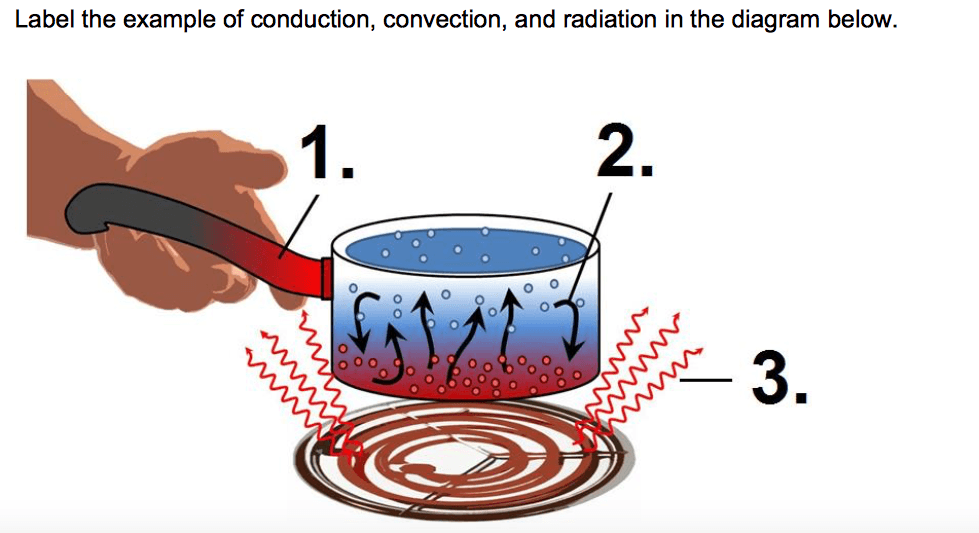
31.

What type of thermal energy transfer is number 1 pointing to?

a)

Convection

b)

Conduction

c)

Radiation

d)

Insulation

32.
The heat from a lamp allows a lizard to remain warm. This is an example of which type of heat transfer?
a)
radiation
b)
conduction
c)
convection
d)
insulation
33.

How does heat move?

a)

In many directions

b)

from warm places to cooler places

c)

from cold places to warm places

d)

Both B and C

34.

What type of thermal energy transfer is number 3 pointing to?

a)

Convection

b)

Conduction

c)

Radiation

d)

Insulation

35.

How does heat energy reach the Earth from the Sun

a)

Convection

b)

Radiation

c)

Conduction

d)

Insulation

36.
a)

Conduction

b)

Convection

c)

Radiation

37.

As you move from the crust to the inner core, the pressure ___________.

a)

Increases

b)

Decreases

38.
a)

Conduction

b)

Convection

c)

Radiation

39.
a)

Conduction

b)

Convection

c)

Radiation

40.

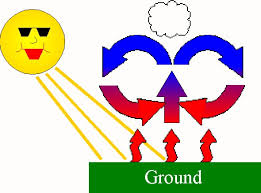
Warm air rises and the cool air sinks

a)
conduction
b)
convection
c)
radiation
41.

Contains chlorophyll (green pigment) and uses the sun to make food

a)

cell membrane

b)

cell wall

c)

chloroplast

d)

cytoplasm

42.

controls movement of materials in and out of the cell, maintains homeostasis

a)

cell membrane

b)

cell wall

c)

chloroplast

d)

cytoplasm

43.

jelly like material that protects cell organelles

a)

cell membrane

b)

cell wall

c)

chloroplast

d)

cytoplasm

44.

the brain of the cell

a)

cytoplasm

b)

mitochondrion

c)

nucleus

d)

vacuoles

45.

What cell part is NOT found in all cells?

a)

Chloroplasts

b)

Cell Membrane

c)

Cytoplasm

d)

Nucleus

46.

This type of cell needs a cell wall and chloroplasts

a)

Animal Cell

b)

Plant Cell

47.

What shape are most plant cells?

a)

round

b)

rectangular

48.

Which organelle contains the cell's DNA, or the genes?

a)

Nucleus

b)

Mitochondria

c)

Chloroplast

d)

Vacuole

49.

This is the brain or control center of the cell.

a)

Cytoplasm

b)

Nucleus

c)

Cell membrane

50.
What do you call the gooey liquid in a cell?
a)
Lysosome
b)
Mitochondria
c)
Chloroplast
d)
Cytoplasm
51.
This organelle is often referred to as the power house of the cell.
a)
Mitochondria
b)
Lysosome
c)
Chloroplast
d)
Vacuole
52.
An object that does not allow light to pass through
a)
transparent 
b)
clear
c)
opaque
d)
translucent
53.
This type of object lets some light through, but not all. It is not easy to see through this type of material.
a)
transparent
b)
translucent
c)
co-parent
d)
opaque
54.
If an object allows most all light to pass through it then it is...
a)
transparent
b)
opaque 
c)
translucent
d)
cold
55.
A stained glass window is
a)
transparent
b)
translucent
c)
opaque
56.
A block of wood is opaque.
a)
true
b)
false
57.
A clear window is opaque
a)
true
b)
false
58.
The windows that you can easily see through is transparent.
a)
true
b)
false
59.
While playing hide and seek I was able to find my friend easily because I could see right through the window into the kitchen where she was hiding. That means the window is ________________. 
a)
Opaque
b)
Transparent
c)
Translucent 
60.
Sometimes in the morning, my car windows are fogged up. This allows me to see some of the road, but it is not very clear. This means my window is now ________________________.
a)
transparent
b)
Translucent
c)
Opaque
61.

Based on Aiyana's results which two materials are opaque?

a)

wood and frosted glass

b)

cardboard and wood

c)

frosted glass and notebook paper

d)

clear glass and glass of water

62.
If you were building a house in Alaska (where it can be daylight for months!), what type of material would be best to cover your windows with that would help keep the Sun out of your room so you can sleep?
a)
transparent material
b)
translucent material
c)
opaque material
d)
glass material
63.
A microscope makes objects under it appear bigger because the lens...
a)
bends the light passing through it.
b)
increases the strength of the light.
c)
decreases the light passing through it.
d)
changes the color of the light passing through it.
64.

A medium/matter that allows ALL light pass through

a)

Transluscent

b)

Opaque

c)

Transparent

d)

Medium

65.

A medium/matter that allows SOME light to pass through, but not all of it

a)

Transparent

b)

Translucent

c)

Opaque

d)

Transmit

66.

A medium/matter that allows NO light to pass through which creates a shadow behind that object

a)

Translucent

b)

Opaque

c)

Transparent

d)

Reflect

67.

The basic unit of living things is called

a)

nucleus

b)

organism

c)

lysosome

d)

cell

68.

What is the function of the nucleus of an animal cell?

a)

It is the place where energy is produced.

b)

It stores the genetic information, the DNA (chromosomes).

c)

It defends the cell from infections.

d)

It captures sunlight to produce food.

69.

Name the outer structure of the plant that provides support that is found only in plant cells.

a)

cell wall

b)

cell membrane

c)

vacuole

d)

nucleus

70.

Storage space for water, wastes, food, and other cellular material

a)

mitochondria

b)

cell membrane

c)

cell wall

d)

vacuoles

71.
What is the correct order (starting from the surface) of Earth's layers?
a)
crust, outer core, inner core, mantle
b)
mantle, outer core, inner core, crust
c)
crust, mantle, outer core, inner core
d)
outer core, inner core, crust, mantle
72.
What happens to temperature as we move from the crust down into the inner core?
a)
Decreases
b)
Increases
73.
Which layer of the earth has the lowest temperature?
a)
Crust
b)
Mantle
c)
Outer Core
d)
Inner Core
74.
Which layer of Earth has the GREATEST density?
a)
crust
b)
mantle
c)
outer core
d)
inner core
75.
What is the thickest layer of the Earth?
a)
the crust
b)
the mantle
c)
the outer core
d)
the inner core
76.

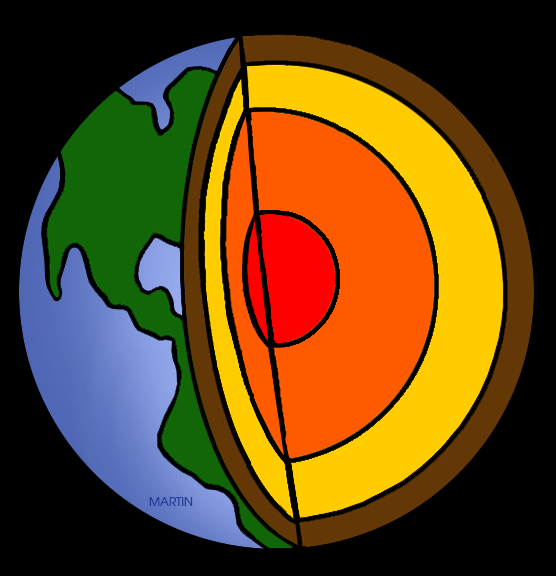
Which layer is shown in red?

a)

crust

b)

mantle

c)

outer core

d)

inner core

77.

Which layer is shown in orange?

a)

crust

b)

mantle

c)

outer core

d)

inner core

78.

Which layer is shown in yellow?

a)

crust

b)

mantle

c)

outer core

d)

inner core

79.

Which layer is shown in brown?

a)

crust

b)

mantle

c)

outer core

d)

inner core

80.

Which layer of the Earth are convection currents found?

a)

Crust

b)

Mantle

c)

Inner Core

d)

Outer Core

81.

The tectonic plates make up the

a)

Crust

b)

Lithosphere

c)

Asthenosphere

d)

Core

82.

Alfred Wegener named his single supercontinent ____________, which means "all Earth" in ancient Greek.

a)

Pandora

b)

Gandowandaland

c)

Pangea

d)

Percia

83.

Most geologists think that the movement of Earth's tectonic plates is caused by

a)

the rotation of the Earth.

b)

the Earth's magnetic field.

c)

subduction.

d)

convection currents.

84.

When plates collide we get ________.

a)

crumbles

b)

volcanos

c)

trenches

d)

mountain ranges

85.
Associated with transform boundaries.
a)
Volcanoes
b)
mountains
c)
trenches
d)
earthquakes
86.
A location where two tectonic plates collide is known as a _________ boundary.
a)
Convergent
b)
Divergent
c)
Transform
d)
Spreading
87.

Subduction means.....

a)

one plate goes under another plate

b)

two plates slide past each other

c)

two plate collide and form folded mountains

88.

Sea-floor spreading explains how.....

a)

new crust is created at a divergent boundary

b)

volcanoes are formed on continents

c)

deep sea trenches are formed

89.
Large pieces of lithosphere that move around on the asthenosphere are called
a)
Crust plates
b)
Tectonic plates
c)
Mantle pieces
d)
Core plates
90.
Tectonic plates are made up of continental crust and ________ crust.
a)
continental
b)
oceanic
c)
plates
d)
mantle
91.
What is the theory that all continents were once joined together in one single large landmass?
a)
Plate Tectonics
b)
Pangaea
c)
Continental Drift
d)
Subduction
92.

The Sun warms your skin on a cold day.

a)

Conduction

b)

Convection

c)

Radiation

93.

Hot chocolate is stirred with a spoon and the spoon gets hot.

a)

Conduction

b)

Convection

c)

Radiation

94.

You burn your hand by touching a hot stove.

a)

Conduction

b)

Convection

c)

Radiation

95.

Warming your feet in front of a fire.

a)

Conduction

b)

Convection

c)

Radiation

96.

The air near the ceiling in a room is warmer than the air near the floor.

a)

Conduction

b)

Convection

c)

Radiation

97.
Snowman melting in the sun.
a)
Conduction
b)
Convection
c)
Radiation
98.
Water boiling in a kettle.
a)
Conduction
b)
Convection
c)
Radiation
99.
An avalanche is an example of which process?
a)
Weathering
b)
Erosion
c)
Deposition
d)
Volcanic Eruption
100.
Over long periods of time, deposition may change the Earth’s surface by _____.
a)
forming new land features.
b)
breaking down large rocks into smaller ones.
c)
washing away beaches.
d)
moving topsoil.