wayground logo

Free Printable Worksheets

Font size

S
M
L
XL
Worksheets

Milestones REVIEW Summative

Total questions: 100

Worksheet time: 2hrs 45mins

Name
Class
Date
1.

All matter is made of _________.

a)
energy 
b)
atoms 
c)
electrons 
d)
compounds 
2.
What is at the center of every atom?
a)
An electron
b)
A compound
c)
A molecule
d)
A nucleus
3.
The positively charged particles of an atom are the ________.
a)
electrons
b)
protons
c)
neutrons
d)
protons & neutrons
4.

What does the number 3 represent in 4NH3?

a)

Subscript

b)

Superscript

c)

Coefficient

5.

What does the number 4 represent in 4NH3?

a)

Subscript

b)

Superscript

c)

Coefficient

6.

How many total molecules is 4NH3?

a)

4

b)

1

c)

3

d)

12

7.

In the equation shown, what are the reactant(s)?

a)

N2 + H2

b)

NH3

8.
What kind of energy is represented in the picture?
a)
Thermal
b)
Chemical
c)
Sound
d)
Nuclear
9.
A battery converts what type of energy to another?
a)
sound to kinetic
b)
light to heat
c)
mechanical to electrical
d)
chemical to electrical
10.
Identify the energy transformation for a windmill that generates electricity.
a)
Mechanical to Electrical
b)
Mechanical to Chemical
c)
Solar to Electrical
d)
Electrical to Mechani
11.

Wavelength measures from

a)

Crest to Crest

b)

Crest the Resting Point

c)

Crest to Trough

d)

Crest to Amplitude

12.
a)
Frequency
b)
Amplitude
c)
Wavelength
d)
Trough
13.
A converging lens is also known as a ____ lens.
a)
convex
b)
concave
c)
double
d)
refracted
14.
___ is when light travels through a material and bends.
a)
Diffraction
b)
Dispersion
c)
Mirage
d)
Refraction
15.
The point where the rays meet is known as....
a)
Fire
b)
the focal point
c)
refraction
d)
Plane of the lens
16.
Is a concave lens thicker or thinner in the middle? 
a)
Thicker 
b)
Thinner 
17.
______ is a lens that is thicker on its edges and makes an object appear smaller? (S8P4g)
a)
mirror
b)
convex lens
c)
concave lens
d)
prism
18.

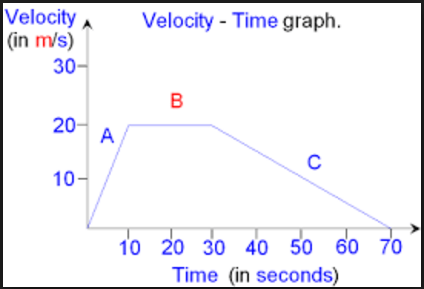
This is a velocity-time graph. What is the object doing in segment A?

a)

Speeding up

b)

Slowing down

c)

Constant Velocity

d)

Not moving

19.

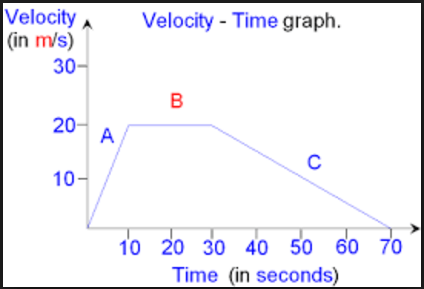
This is a velocity-time graph. What is the object doing in segment C?

a)

Speeding up

b)

Slowing down

c)

Constant Velocity

d)

Not moving

20.

Describe the motion of the object in the graph

a)

Moving with constant speed

b)

Speeding up

c)

Not moving

21.
What is this graph showing?
a)
Constant Speed
b)
Acceleration (speeding up)
c)
Deceleration (slowing down)
d)
No motion
22.
Which graph shows the object standing still?
a)
A
b)
B
c)
C
d)
D
23.
Which graph represents zero acceleration (constant velocity)?
a)
A
b)
B
c)
C
d)
D
24.

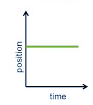
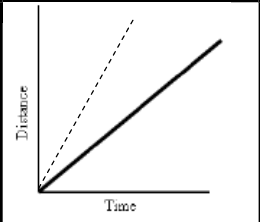
What is occurring on this distance/time graph?

a)

speeding up in the positive direction

b)

moving at a constant speed in the positive direction

c)

not moving

d)

moving at a constant speed in the negative direction

25.

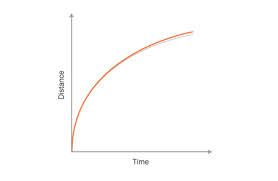
What is occurring on this distance/time graph?

a)

Negative acceleration

b)

moving at a constant speed in the positive direction

c)

positive acceleration

d)

negative net force

26.
Which runner won the race?
a)
Albert
b)
Bob
c)
Charlie
27.
What does this graph represent?
a)
Constant Speed
b)
Acceleration
c)
Not moving
28.
Which of the following is accelerating?
a)
A cannonball sitting on the ground
b)
A boat traveling at a constant speed in a straight line
c)
A can being crushed under a person's foot
d)
A car going around a curve at a constant speed
29.

Which of the following is an example of kinetic energy being converted to potential energy?

a)

At an ice rink, an ice skater gives another ice skater a gentle push.

b)

A bike rider stops pedaling and lets his bicycle coast up a hill.

c)

The cord of a bow-and-arrow is released, propelling the arrow forward.

d)

On a factory assembly line, boxes slide down a ramp.

30.

Danielle has a rubber band. She stretches the rubber band with her fingers. After she releases the rubber band, it flies through the air.


Which of the following is true about the energy of the rubber band?

a)

Both the stretched rubber band and the released rubber band have only kinetic energy.

b)

The stretched rubber band has more potential energy, and the released rubber band has more kinetic energy.

c)

The stretched rubber band has more kinetic energy, and the released rubber band has more potential energy.

d)

Both the stretched rubber band and the released rubber band have only potential energy.

31.
Are forces balanced or unbalanced when a car is moving at a constant speed in a straight line?
a)
Balanced
b)
Unbalanced
32.
Ted is trying to move a fridge through his house, he gets stuck on a carpet and even though he is pushing the fridge, it is not moving. What force is acting against him?
a)
gravity
b)
friction
c)
air
d)
mass
33.
A push or pull exerted on an object
a)
Force
b)
Net force
c)
Momentum
d)
Speed
34.

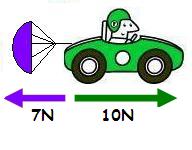
Calculate the net force for the diagram.

(a)  

35.

When two force act in the same direction, how would you calculate the net force?

a)

Subtract the forces

b)

Balance the forces

c)

Add the forces

d)

Divide the forces.

36.
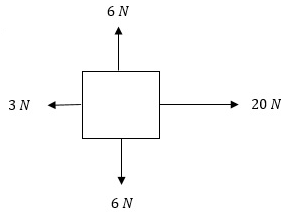
What is the net force?
a)
17 N Right
b)
3 N Right
c)
3 N Left
d)
17 N Left
37.

What is the NET FORCE of this diagram?

a)

17 N, right

b)

17 N, left

c)

23 N, right

d)

12 N, up

38.

All objects have inertia

a)

True

b)

False

39.

More mass = More inertia

a)

True

b)

False

40.

Which of the following options provides evidence of a CHEMICAL change?

a)

Wood is burned releasing ash and smoke

b)

Rocks separate when soil is sifted

c)

Water turns to ice when you put it in the freezer

d)

Salt dissolves in water

41.

Which of the following examples provides evidence of a PHYSICAL change?

a)

Wood is burned and releases ash and smoke

b)

Iron rusts over time

c)

When mixed, baking soda and vinegar form gas bubbles

d)

A piece of paper changes shape when you rip it up

42.

A white tablet is dropped into water. The water becomes cloudy and bubbles are produced. What type of change has occurred?

a)

Physical change

b)

Chemical change

c)

No change

43.

When mixing milk and vinegar, a white, chunky, solid substance is formed. What has occurred?

a)

Physical change: state of matter

b)

Chemical change: production of a solid

c)

Physical change: freezing

d)

Chemical change: rust

44.

What kind of matter is this?

a)

Element

b)

Compound

c)

Mixture

45.

What type of mixture does this diagram represent?

a)

Homogeneous

b)

Heterogeneous

46.
What is the left part of a chemical equation called?
2H2 + O2 --> 2H2O
a)
Reactants
b)
Products 
c)
Yields 
d)
Chemical Equation 
47.
Is this balanced?...
Al + O2 --> 2Al2O3
a)
Yes!
b)
NO!
48.
At the end of chemical reactions, what is the total mass of the reactants compared to the total mass of the products?
a)
the product is doubled
b)
the product is half the mass of the reactants
c)
the mass is the same
d)
the mass changes depending on the reaction
49.
Why is the following chemical equation not balanced?
H2 + O2 --> H2O
a)
each side of the equation has a different number of oxygen atoms
b)
each side of the equation has a different number of hydrogen atoms
c)
each side has the same mass
50.
The blue atoms are called 
a)
metals
b)
nonmetals
c)
metalloids
d)
noble gases
51.

Rubber is not good at allowing heat to flow through, we call these.

a)

conductors

b)

insulators

52.
a)

Conduction

b)

Convection

c)

Radiation

53.
Explain what happens to the potential energy of a rock as it falls off the side of a cliff.
a)
The kinetic energy decreases as the potential energy increases.
b)
The kinetic energy decreases as the potential energy decreases.
c)
The potential energy decreases as the kinetic energy increases.
d)
The potential energy decreases as the kinetic energy decreases. 
54.

The variables _______ and ________ affect the gravitational force between objects.

a)

weight, mass

b)

volume, weight

c)

distance, mass

d)

rotation, distance

55.

What process is the method by which a neutral object obtains an electrical charge?

a)

convection

b)

discharge

c)

induction

d)

radiation

56.

Friction, conduction and induction are three ways of creating a static charge on an object. Which method or methods will produce the same charge on two objects?

a)

Friction Only

b)

Conduction Only

c)

the neutrally charged wall.

d)

another negatively charged balloon.

57.

After turning off the television, you approach it. As you get close, but not touching it, the hairs on your arm start to stand up. This is an excellent example of static charge built up by

a)

conduction

b)

convectin

c)

friction

d)

induction

58.
This is a picture of a simple electromagnet. How can the electromagnet be made stronger?
a)
Add more coils of wire to the nail.
b)
Use a smaller battery.
c)
Reverse the poles of the magnet.
d)
Remove all the coils and the nail.
59.

What do we call a device that converts electricity into mechanical movement?

a)

electric charge

b)

electric motor

c)

electric current

d)

electric plasma

60.
Generators are devices that convert _____ energy into _____ energy.
a)
chemical; mechanical
b)
mechanical; electrical
c)
electrical; mechanical
d)
potential; kinetic
61.

The following material is not a good electrical conductor

a)

Plastic

b)

Copper

c)

Iron

d)

human body

62.
How many nitrogen atoms does NH3 have?
a)
1
b)
2
c)
3
d)
4
63.
What is the reactant in the following equation?
2NaHCO3  -> Na2CO3  +  CO2  + H2O
a)
NaHCO3
b)
Na2CO3
c)
CO2
d)
H2O
64.
Which  of the following is a balanced equation?
a)
Na   +   Cl2   -->  NaCl
b)
H2  +  O2  --> H2O
c)
Ca   +   Br  -->  CaBr2
d)
Na   +  F  -->  NaF
65.
What is the mass number of this atom?
a)
1
b)
3
c)
4
d)
7
66.
What is the atomic number of this atom?
a)
2
b)
4
c)
6
d)
none of the above
67.
What is the name of this element?
a)
Helium
b)
Hydrogen
c)
Argon
d)
Silver
68.

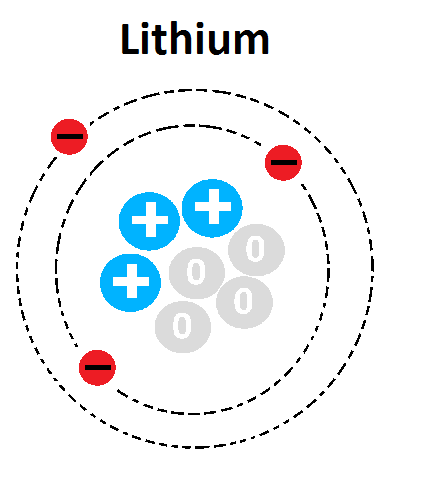
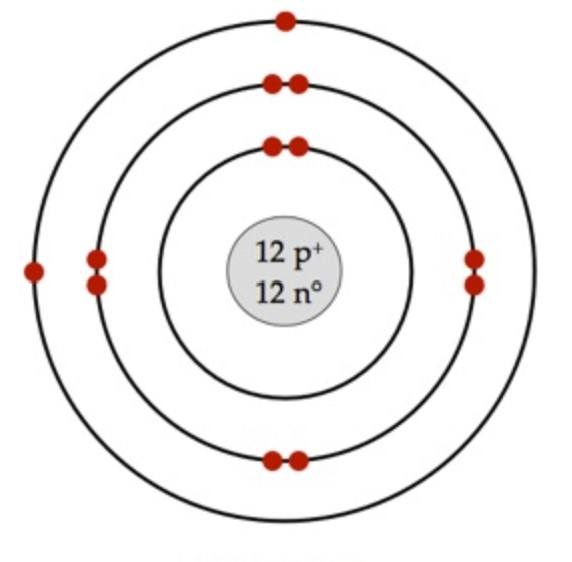
What element is represented in this Bohr Model?

a)

Carbon

b)

Hydrogen

c)

Aluminum

d)

Lithium

69.
What is the name of this element?
a)
Lithium
b)
Boron
c)
Carbon
d)
Neon
70.
What is the mass number of this atom?
a)
1
b)
3
c)
4
d)
7
71.
What is the atomic number of this atom?
a)
2
b)
4
c)
6
d)
none of the above
72.
Isotopes are elements with a different amount of
a)
protons
b)
neutrons
c)
electrons
d)
atoms
73.
an element will always have the same number of 
a)
neutrons
b)
protons
c)
isotopes
d)
atoms
74.
How are electrons arranged in an atom?
a)
In groups of five
b)
In energy levels
c)
By color
d)
By shape
75.

What is the atomic number of this element?

a)

17

b)

18

c)

35

d)

35.453

76.

How many electrons can fit on the 1st energy level (orbital) for any Bohr Model?

a)

2

b)

6

c)

8

d)

10

77.

What is the mass number of this atom of Chlorine?

a)

17

b)

18

c)

35

d)

35.453

78.
What does the nucleus of an atom contain?
a)
Electrons and neutrons
b)
Protons and neutrons
c)
Neutrinos and positrons
d)
Electrons and megatrons
79.

What is a Bohr Model?

a)

a simplified representation of an atom

b)

vertical column in periodic table

c)

horizontal row in periodic table

d)

Only shows the element symbol and it's outer most electron shell

80.

Which element does this Bohr model represent?

a)

Aluminum

b)

Silicon

c)

Magnesium

d)

Cobalt

81.

What is the mass of this atom?

a)

9

b)

10

c)

19

d)

28

82.

What element does this Bohr model represent?

a)

Chromium

b)

Magnesium

c)

Carbon

d)

Krypton

83.
What does the nucleus of an atom contain?
a)
Electrons and neutrons
b)
Protons and neutrons
c)
Neutrinos and positrons
d)
Electrons and megatrons
84.

What is the mass of this atom?

a)

9

b)

10

c)

19

d)

28

85.

What element does this Bohr model represent?

a)

Chromium

b)

Magnesium

c)

Carbon

d)

Krypton

86.

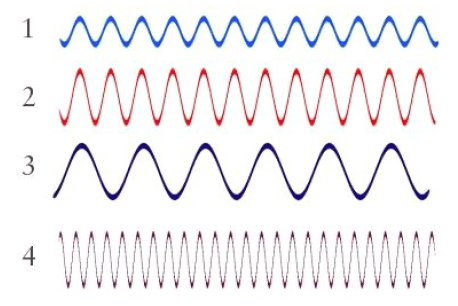
Which transverse wave has the highest frequency?

a)

1

b)

2

c)

3

d)

4

87.
The matter (solid, liquid, or gas) through which waves can travel
a)
Medium
b)
Object
c)
Transverse Wave
d)
Wavelength
88.

Which diagram shows the wavelength of a wave?

a)
b)
c)
89.

What does a wave carry from place to place?

a)

energy

b)

matter

c)

people

90.

The highest point on a transverse wave is the

a)

compression

b)

crest

c)

rest position

d)

trough

91.

A wave that can travel through matter and empty space is a:

a)

electromagnetic wave

b)

longitudinal wavy

c)

transverse wave

d)

mechanical

92.

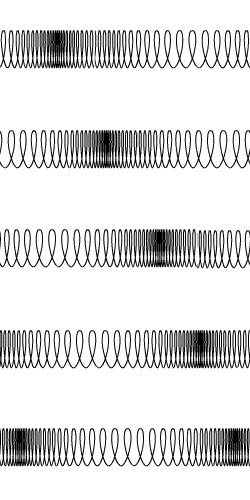
What type of wave is this?

a)

Longitudinal

b)

Transverse

c)

Electromagnetic

d)

x ray

93.

You can't hear sounds in outer space because there is no

a)

medium

b)

light

c)

energy

d)

heat

94.
Which travels faster, light or sound?
a)
light
b)
sound
95.

Sound travels fastest through:

a)

air

b)

water

c)

wood

d)

saltwater

96.
Waves that require a medium are called 
a)
mechanical waves
b)
transverse waves
c)
light waves
d)
gamma rays
97.
What happens when you increase the amplitude of a sound?
a)
it makes the sound louder
b)
it makes the sound travel faster
c)
it increases the wavelength of the sound
d)
it increases the frequency of the sound
98.
Which wave in the diagram has the greatest wavelength?
a)
1
b)
2
c)
3
d)
4
99.
Which of the following can sound travel through?
a)
solid
b)
liquid
c)
gas
d)
all of the above
100.

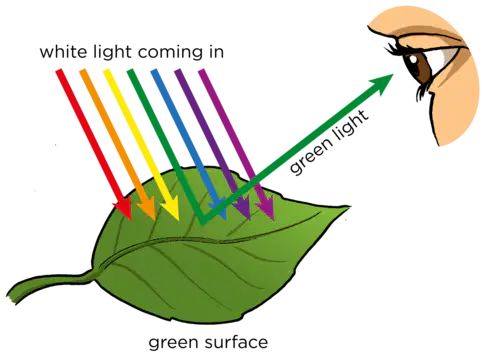
When you see something colored green, which statement is true?

a)

All color wavelengths are being absorbed

b)

Green is being absorbed other colors reflected

c)

Green is being reflected other colors absorbed

d)

All color wavelengths are being reflected