
 Worksheets
Plate Tectonics
Total questions: 95
Worksheet time: 1hrs 11mins
In some areas of the world, like California and Japan, earthquakes are a common occurrence. How can this best be explained?
The strong ocean currents are undermining both areas causing earthquakes.
Both areas are located near the edge of the Pacific Ocean, the unstable sand causes earthquakes.
Both areas are subjected to strong ocean wind and waves that causes earthquakes.
Both areas are on the boundary of active plates, the motion of the plates causes earthquakes.
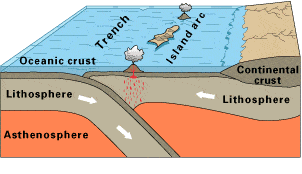
Observe this diagram of a plate boundary. One statement BEST describes what is happening. It is that
the oceanic crust is melting.
the denser ceanic crust is subducting under the less dense oceanic crust
volcanic islands are forming.
the tectonic plates are moving away from each other.
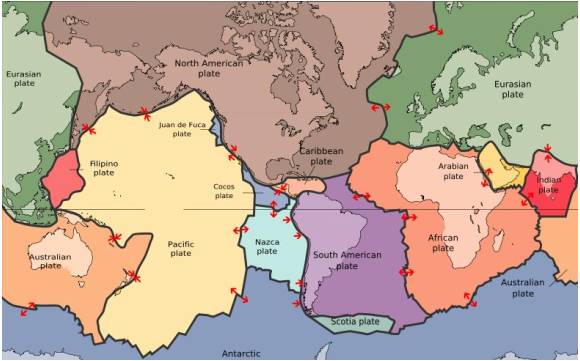
The map in the picture shows tectonic plate boundaries. This map would be useful in predicting the location of future
droughts
hurricanes
earthquakes
tornadoes
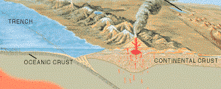
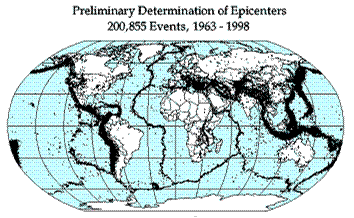
Earthquake epicenters (center of where the earthquakes started) were mapped for a 35 year period in the diagram above. The black dots indicate these epicenters. The black dots appear along what feature on Earth?
hot spots
plate boundaries
rift zones
sea floor spreading
The 2004 Indian Ocean tsunami was caused by a shift in two plates that pushed one section of the sea floor under another section of the sea floor by 5 meters. What type of boundary is this?
divergent
convergent
transform
metamorphic


1. A teacher asks students to make a model of a transform plate boundary. The students use blocks to represent tectonic plates and slide the blocks past each other in the direction of the arrows as shown. Which event can the students best demonstrate with their model?
An earthquake
A volcanic eruption
Formation of a rift valley
Building up of a mountain

How heat energy moves through liquids and gases
conduction
convection
radiation
subduction
The idea that the continents were once joined and then broke apart
seafloor spreading
plate tectonics
continental drift
The idea that the ocean floor moves is called
seafloor spreading
plate tectonics
continental drift
The idea of continental drift is credited to
Howard Hess
Albert Einstein
Charles Lyell
Alfred Wegener
When a substance is heated its density
increases
decreases
stays the same
Plate tectonics are believed to be driven by
meteors
convection currents
waves
wind
What did Earth look like in the past?
The Earth has always looked the same as it does today.
The continents were in different locations than they are today.
There were more continents than there are today
There was less water in the oceans as compared to today.
What makes up Earth's plates?
The plates are made of solid rock on continents only.
The plates are made of solid rock on ocean floors only.
The plates are made of solid rock on ocean floors and continents.
The plates are not made of solid rock.
Where is the youngest rock found in relation to a mid-ocean ridge?
Far from where plates separate, because that is where magma solidifies.
Far form where plates separate, because that is where plates slide beneath other plates.
Close to where plates separate, because that is where magma solidifies.
Close to where plates separate, because that is where plates slide beneath other plates.
What is happening at some places where oceanic trenches form?
A continental plate is sliding beneath an oceanic plate.
A continental plate is moving alongside an oceanic plate.
An oceanic plate is sliding beneath another oceanic plate.
An oceanic plate is moving alongside another oceanic plate.
The age of rock on the ocean floor shows the youngest rock at the center and the oldest rock near the continents. How does this evidence support Continental Drift Theory?
The younger rocks, in a process called seafloor spreading, are pushing the older rocks on the continents away from each other.
The older rocks on the continents used to be the connected but are traveling over the younger rocks as the continents drift apart.
The newer rock is denser and sinks to the bottom of the ocean while the older, less dense rock floats above the water and drifts.
Volcanoes on the bottom of the ocean are constantly erupting and making new rock.

Which location on the world map above is a place where new plate material is being formed?
Point A
Point B
Point C
Point D
Which of the following describes the layer directly beneath Earth’s plates?
It moves very rapidly, and it moves in different directions in different places.
It moves very slowly, and it moves in different directions in different places.
It moves very slowly, and it moves in one direction around the earth.
It does not move.
What is TRUE about the layer directly below Earth’s plates?
It is completely solid rock.
It is mostly liquid rock.
It is mostly solid and liquid rock.
It is mostly slightly softened rock.
Which evidence does NOT support Continental Drift Theory?
Fossils of the same ancient plants and animals are found on different continents.
Coal, which is evidence of tropical plants, is found in Antarctica.
Many of the continents appear to fit together like a puzzle.
Penguins can be found living on Antarctica and in South America.

What type of plate boundary is this?
Divergent
transform
continental/continental convergent
Continental/oceanic convergent

Which feature is evidence that this is a continental-oceanic convergent boundary?
There are volcanoes and a trench
There is an active volcano
The asthenosphere is below the lithosphere
The mountains resulted from earthquakes.
At what type of plate boundary would you expect an earthquake?
Transform boundary
Divergent boundary
Convergent boundary
All of them!
What happens when two relatively thick plates move towards each other?
Only mountains form
Only Earthquakes occur
Both mountains and earthquakes can occur
Neither mountains nor earthquakes can occur

Using the features in this map, can you tell which direction the Nazca plate and the South American plate are moving?
Nazca Plate → S. America Plate →
Nazca Plate ← S. America Plate →
Nazca Plate → S. America Plate ←
Nazca Plate ← S. America Plate →
You are exploring a different planet and find evidence of an active volcano at the end of a chain of ancient volcanoes. Would you expect to find tectonic plates?
Yes, hot spot volcanoes are signs of plate motion because the plate moves over the hot spot.
Yes, this volcano must be on a continental plate because all volcanoes form in subduction zones where oceanic plates are pushed under continental plates.
No, volcanoes are formed by magma coming up through the rock in hot spots. They have nothing to do with tectonic plate motion.
No, for a planet to have plates it must also have oceans, so I would look for signs of oceans first.
What event often occurs where two (2) plates slide alongside each other?
Volcanic eruptions
Earthquakes
Mountain formation
Ocean trench formation
Which of the following are characteristics of the Earth's plates?
The plates are different sizes, and the plates are moving.
The plates are different sizes, and the plates are not moving.
The plates are the same size, and the plates are moving.
The plates are the same size, and the plates are not moving.
How do plates move on the Earth's surface?
Plates move by floating on the moving water of the ocean
Plates move as a result of shaking during earthquakes
Plates move by sliding along the ocean floor
Plates move by floating on the moving rock of the mantle.
Wh do earthquakes and volcanoes occur in similar locations on Earth?
Earthquakes are never in the same places as volcanoes.
Earthquakes and volcanoes occur where plates interact with each other.
Volcanoes erupt after earthquakes occur
Volcanoes erupt when plates slide beneath other plates due to earthquakes.

Which of the following claims can be made from the data and map presented above?
Sinabung is located over a more active region of tectonic plates than Raung
There is more tectonic plate activity near Java compared to Sumatra
Both Sinabung and Raung are located on a divergent plate boundary
There is a greater convection current under Sumatra than under Java
Who first proposed the idea of Continental Drift?
Harry Hess
Alfred Wegener
Albert Einstein
Galileo Galilee
What did Wegener name the large supercontinent where all the continents were joined together?
Wegenerland
Gondwanaland
Laurasia
Pangaea
Most geologists rejected Wegener's idea of Continental Drift because _________.
He didn't have enough evidence to support his idea.
He wanted to know what the Earth looked like millions of years ago, which was impossible.
He didn't have a good explanation of what would cause continents to move around.
They were afraid of the new idea.
Wegener used matching matching fossils of the same organisms on different continents as evidence to support his hypothesis of Continental Drift.
true
false
Wegener used matching rock types and ages across different continents as evidence to support his hypothesis of Continental Drift.
true
false
Which of the following did Wegener use as evidence for continental drift. (Choose all that apply)
Fit of continents
Global warming
Matching rock sequences
Plant fossils
Glaicial evidence
What supports plate movement?
Convection current in the crust
Convection current in the mantle
Convection current in the core
Volcanic Eruptions
What is true about the age of the oceanic crust?
It is youngest by the continents
it is oldest at the ridge
It is oldest by the continents
It's the same age all the way across
What happens to oceanic crust at a convergent boundary?
It becomes the overriding plate
It becomes continental lithosphere
Nothing
It subducts
What causes convection in the mantle?
Heat from the core of the Earth
The sun
Magnetic poles
The moving plates
What is the mantle?
A layer of the Earth just under the tectonic plates
Molten rock below the Earth's crust
Molten rock above the Earth's crust
What is magma?
A layer of the Earth just under the tectonic plates.
Molten rock below the Earth's crust
Molten rock above the Earth's crust
Why does the mantle's heat source cause convection?
It causes hot, less dense rock to rise.
It causes cooled rock to sink
It causes subduction
It causes earthquakes
Which one doesn't belong?
Volcano
Mountain
Subduction
Trench
Which one doesn't belong?
Ridge
Divergent
Himalayas
Young Rock
Which one doesn't belong?
Transform
Convergent
Divergent
Subduction
Which one doesn't belong?
Continental
Oceanic
Older
Less dense
Which one describes continental crust?
Granite
Basalt
Thinner
More dense
True or False: All of the rock on Earth is the same age.
True
False


Which correctly identifies the geologic process that formed the Himalayan mountains (The World's Tallest Mountains, including Mt. Everest)?
Two continental plates converging
An earthquake in a subduction zone
A tectonic plate moving over a hot plate
Movement at a transform fault boundary
In the gelatin and graham cracker model, what did the gelatin represent?
The ocean
buildings
The continental crust
The oceanic crust
What is most likely to happen when plates move alongside each other?
Volcanoes
Earthquakes
Trenches
Mountains
what is causing all of the Ring of Fire volcanoes?
Johnny Cash
Global warming
Continents colliding
Subduction
Where are oceanic plates destroyed?
Trenches
Mid-ocean ridges
Rift valleys
Mountain ranges
A feature that can cause volcanoes in the middle of plates is a
convergent collision boundary
hotspot
convergent subduction boundary
mid-ocean ridge
In a hotspot chain
all volcanoes are active
only one volcano is active
a few random volcanoes are active
there are no volcanoes, only earthquakes
A hotspot creates a volcano chain when
the hotspot moves but the plate stays still
the hotspot stays still but the plate moves
the hotspot and the plate move in opposite directions
convection in the mantle wears a hole in the crust
Geologist can tell the direction of plate movement by looking at hotspot chains.
True
False
What happens to the older volcanoes in a hotspot chain?
The continue to increase in size as the volcanoes erupt.
They give advice about life to the younger volcanoes
They explode when the pressure becomes too great.
They become smaller because of weathering and erosion

In this hotspot chain, which way is the plate moving?
toward the northeast
toward the southeast
toward the northwest
toward the southwest
Hotspots form because...
magma is pushed to the surface at a plate boundary.
a mantle plume weakens Earth's crust.
water is pushed up to Earth's surface
a mantle plume strengthens Earth's crust.
What is a better model of the earth?
picture
globe
map
map or globe, depends on how it will be used
Where are the greatest concentration of volcanoes?
in the oceans
on the edges of continents in higher elevations
in the middle of continents
on tectonic plates
When two continental plates converge (move together), what happens?
bending and folding of hard plate material
plates break and separate forming new plates
islands form from large pieces breaking off
large pieces, the size of large houses break off
What is needed for a scientific explanation?
claim
evidence
reasoning
all are needed

A cliff is part of a continent. What is the relationship between the continent and Earth's plates?
The continent is next to a plate but not part of a plate.
The continent is on top of a layer of water that is above a plate.
The continent is part of a plate.
The continent is on top of a plate.
In a CER, what would not be used as evidence?
scientific principle
observations
data from an activity table
quotes from a text, video or article

Analyze the map to answer the following question.
Where are the places in the world where the earthquake or volcanic activity does not seem to fit the patterns you identified? Select all that apply. MS-ESS2-2 MS-ESS3-2
There are many earthquakes and some volcanoes that occur in the middle of the ocean and in the center of Europe.
There are earthquakes but no volcanoes in Australia.
There are several volcanoes in northern Africa but very few earthquakes.
South America has more volcanoes than earthquakes.

Knowing that earthquake and volcanic activity help us to see where the edges of plates are located, what can we conclude about plates based on the patterns we have seen so far? Select all that apply.
MS-ESS2-2 MS-ESS3-2
There are many plates of different shapes and sizes that make up the Earth’s surface.
The plates are defined by the continents. The continent boundaries are the plate boundaries.
Continents do not define plates - both continent and ocean can be a part of a plate.
There are many wide gaps or spaces between the plates.

What can you conclude based on the patterns you observed across all of the maps you have analyzed? Select all that apply.
MS-ESS2-2 MS-ESS3-2
Plate boundaries (dark black lines) are associated with areas of high volcanic and earthquake activity.
Volcanoes only happen on land.
The areas of high elevations are aligned to plate boundaries in some locations and not in others.
There is very little evidence of a pattern of earthquake and volcanic activity.
Deep within the Earth’s rock layers, the conditions are very hot. Where does the heat come from? MS-ESS2-1
The heat is absorbed into Earth from the sun’s rays.
The heat comes from the friction of the plates moving.
The heat comes from volcanoes.
The heat deep within the Earth comes from the Earth’s core.
What do we know about plates that would be important to include when constructing a model to explain what they are?
Select all that apply.
MS-ESS2-3
No plate is bigger than a mountain range.
plates are different shapes and sizes.
plates are either made of continents or of oceans.
plates cover Earth’s entire surface with no significant gaps.plates are huge, flat, rigid slabs of rock that independently move on the surface of Earth.
plates are huge, flat, rigid slabs of rock that independently move on the surface of Earth.
In your classroom model, the water represented the convecting and fluid mantle of the Earth. What did the pieces of cardboard represent?
MS-PS1-4 MS-ESS2-1
The cardboard pieces were the floating plates.
The cardboard pieces were continents and oceans.
The cardboard pieces were islands that are in the ocean.
The cardboard pieces were Pangaea.
Explain why the hotter material (water) rises.
MS-ESS2-1 MS-PS1-4
Material rises because it is hotter.
Hot material rises because it is less dense than the surrounding material.
Hot material rises because cooler material is pushing it upward.
Hot material does not actually rise but the cool material is sinking so the hot material only appears to rise.

In class you used Silly Putty® as a simulation for how metamorphic rocks are formed. What did the simulation suggest about what happens to metamorphic rock as it is formed?
MS-ESS2-1
Metamorphic rock forms when mountains are crushed and folded.
Metamorphic rock forms when rock is heated (not melted) and slowly deformed, resulting in a curvy appearance.
Metamorphic rock comes from rock that was melted into a liquid before hardening again.
When metamorphic rock forms it changes color and shape.
Which of the following is TRUE about the movement of earth’s plates?
MS-ESS2-1
They do not move because they sit on a layer of solid rock.
They move along with the layer of slightly softened rock below them.
They move by floating on a layer of completely melted rock below them.
They do not move until the solid rock layer beneath them temporarily melts and moves.
What did Earth look like in the past?
The Earth has always looked the same as it does today.
The continents were in different locations than they are today.
There were more continents than there are today
There was less water in the oceans as compared to today.
Which evidence does NOT support Continental Drift Theory?
Fossils of the same ancient plants and animals are found on different continents.
Coal, which is evidence of tropical plants, is found in Antarctica.
Many of the continents appear to fit together like a puzzle.
Penguins can be found living on Antarctica and in South America.

