
 Worksheets
G8 Science Review
Total questions: 100
Worksheet time: 4hrs 55mins


This model is showing us a...
lunar eclipse
solar eclipse
phases of the moon
earth eclipse
True or False: Plants make their own food via Cellular Respiration and use the energy from the food that is made via Photosynthesis.
True
False
What gas do plants give off after conducting photosynthesis?
Oxygen
Carbon
Nitrogen
Hydrogen


What are the reactants (taken into) of cellular respiration? (Mark all of them!)
oxygen
glucose
carbon dioxide
water
energy
to make food for a plant
to break down materials
to make energy
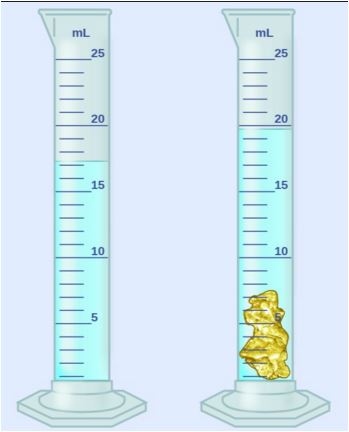

Based off of this table, which statement is true?
Aspirin is more soluble than Sugar
Sugar is less soluble than Salt
Carbon Dioxide is less soluble than Salt
Sugar is the most soluble substance on the planet

Based on this table, what can be concluded?
KNO3 is more soluble at higher temperatures than lower temperatures
KNO3 is most soluble at lower temperatures
KNO3 is insoluble at low temperatures
KNO3 is less soluble at higher temperatures than lower temperatures

Use the Data Table to answer the question:
If the following liquids were stacked together in a jar, where in the jar would a substance with a mass of 14g and a volume of 20mL float?
In the middle
Near the top
At the bottom
On top of everything else


Does 1cup or 6cups of water have a higher density?
1 cup
6 cups
They have the same density
Weight is the amount of matter in an object.
True
False
The parts of a compound can often be separated by physical properties.
True
False

Which substance is least soluble at 0 ºC?
KI
KNO3
KClO3
Ce2(SO4)3

How many grams are soluble in 100 g of water at 100 ºC?
300 grams
250 grams
100 grams
50 grams

Select all that apply: What will allow more solute to be dissolved in a solvent.
Scientific __________ predict WHAT HAPPENS in the natural world
Law
Theory
SELECT ALL THAT APPLY:
Which variable does your data and results come from?
Dependent
Control
Independent
Outcome
Why is it important that scientists modify scientific theories when important new information is discovered?
To confuse people
To keep science interesting and fresh
To ensure theories are as accurate and effective as possible
To make sure non-scientists can't understand theories

What is the independent variable on this graph?
Estimated Population
Population
Year

The independent variable is Day. The dependent variable is Temperature
The independent variable is Temperature. The dependent variable is Day

A biologist is investigating the effects of growth hormone on the rate of metamorphosis in butterflies. Which of the following methods of investigation would work best for the biologist investigating any possible effects?
Models
Controlled experiments
Systematic observations
Random sampling of populations
Ahmya wants to know if fish swim faster to Broadway music or the Blues. She has two fish tanks, with the same kind and number of fish in each. She plays Broadway music for one hour each day for one tank and the Blues for one hour each day for the other. She puts her findings in a scientific journal.
Name two control variables in this experiment.
Length of music exposure
Music type
Type of fish
How fast the fish swim
Why is it important that scientists modify scientific theories when important new information is discovered?
To confuse people
To keep science interesting and fresh
To ensure theories are as accurate and effective as possible
To make sure non-scientists can't understand theories

Newton’s third law of motion states that for every action there is an equal and opposite reaction. How does this law differ from a theory?
A theory explains a set of well tested observations; a law describes a pattern in nature.
A law explains a pattern in nature in more detail than a theory.
Theories are based on more evidence than laws.
Laws can be changed with the addition of new evidence but theories cannot.
Theories are based on more evidence than laws.

Carlos conducted an experiment involving temperature and reaction rate. When the experiment was complete, he used his data to create this graph, fitting a line to his data points.
Based on these results, which statement about Carlos's experiment is most accurate?
As temperature increases, reaction rate remains steady
As reaction rate increases, temperature decreases
As temperature increases, reaction rate increases
As reaction rate decreases, temperature increases
Which is the stronger acid?
pH 1
pH 4
pH 8
pH 13
If the substance is neutral, what would the pH be?
3
5
7
9
11
If an acid is combined with a base of equal strength, the result will most likely be
a neutral solution.
a stronger acid.
impossible to tell without testing the pH.
a stronger base
Bases are usually identified by their sweet taste and
are known to turn blue litmus into red.
TRUE
FALSE
MAYBE
Neutralization occurs when an acid reacts with an equivalent amount of base and forms a neutral solution containing salt and water.
TRUE
FALSE
MAYBE
Turns red litmus paper blue
Acid
Base
Neutral
Pure Air
HOMOGENEOUS
HETEROGENEOUS

Chocolate Chip Ice Cream
HOMOGENEOUS
HETEROGENEOUS

Salad Dressing
HOMOGENEOUS
HETEROGENEOUS

What kind of mixture is shown in the picture?
Homogeneous
Heterogeneous

What kind of mixture is shown in the picture?
Homogeneous
Heterogeneous

Which of the models of a chemical reaction best represents the Law of Conservation of Mass?
A
B
C
D

Which of the models of a chemical reaction best represents the Law of Conservation of Mass?
A
B
C
D

A student pours 5.49 g hydrochloric acid (HCl) into an open beaker that contains a piece of magnesium (Mg). The Total mass of the product is 5.73 g. What was the mass of the magnesium?
5.71 g
11.22 g
0.24 g


MOST OF THE OUTER PLANETS ARE MADE OF
ROCKY CORES
HELIUM AND HYDROGEN ONLY
GAS
ICE
The main force at play during making of our solar system
strong force
weak force
gravity
electrostatic force


T/F: the sun is the biggest star in our galaxy
True, that is why we have the only solar system
False, there are much bigger stars than our sun

Which planet is NOT one of the
"Gas Giants"?
Uranus
Venus
Neptune
Saturn


This table shows the rotation period and revolution period for 6 planets, and Earth’s moon, all relative to Earth’s periods. Which 2 planets have shorter days than Earth?
Jupiter and Saturn
Venus and Mercury
Mars and Jupiter
Saturn and Moon

a small rocky body orbiting the sun, ranging from the size of a small house to dust particles
nebula
terrestrial planets
collision
asteroids
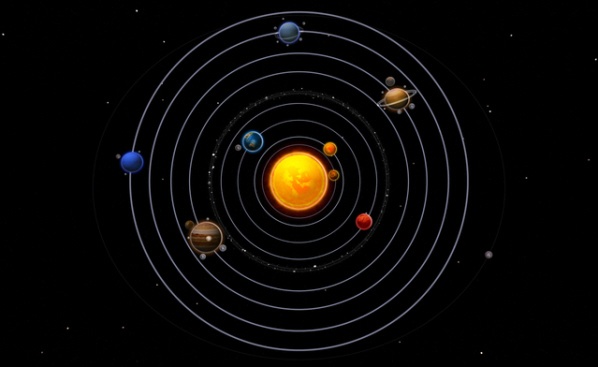
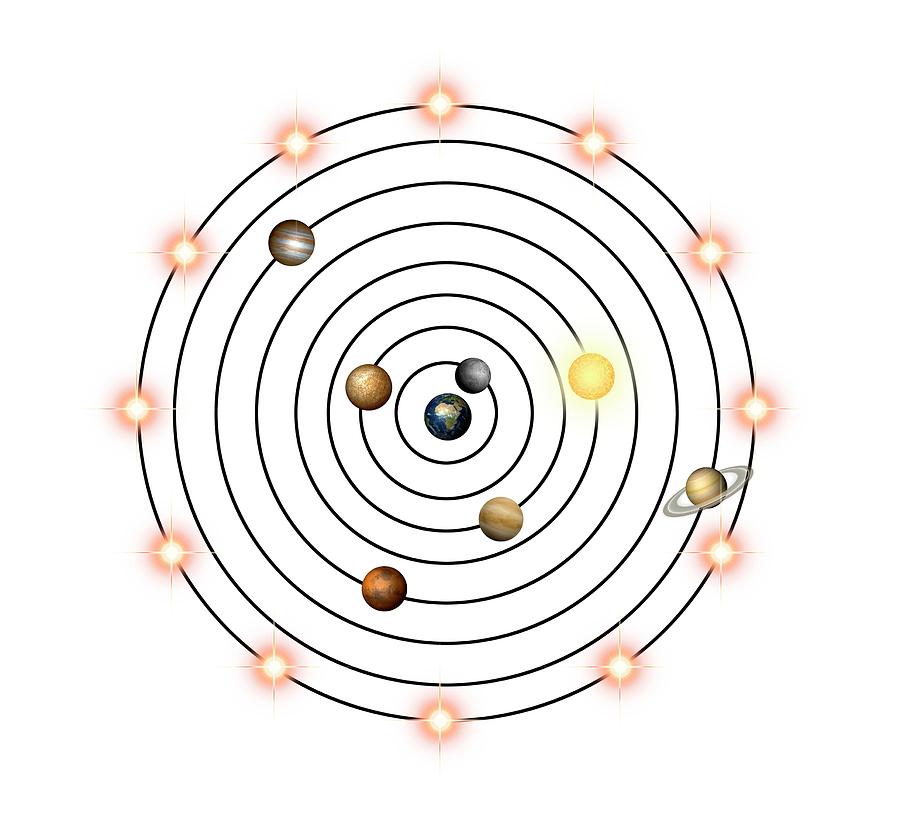
What does the Geocentric system look like?
What does the Heliocentric system look like?


What factors affect gravitational force?
mass, distance
speed, distance
momentum, mass
What is Astronomical Unit?
The average distance between the Sun and the Moon
The average distance between Neptune and the Sun
The average distance between Earth and the Sun
The average distance between Earth and Moon
What is Light Year?
The distance travelled by light in a second
The distance travelled by light in a minute
The distance travelled by light in a year
The distance travelled by light in a decade
Which distance is larger: 1 astronomical unit or 1 light-year?
1 AU
1 LY
If an object is 7.4 light years away from Earth, what does this tell you?
It would take 7.4 minutes for the light to get to Earth.
Traveling at the speed of light it takes 7.4 yrs to get to the earth.
The object is very close to Earth.
It would take 7.4 seconds for the light to get to earth.

As the _________ of a star increases, luminosity increases.
size
distance
age
composition

The table compiles information about the distance of various stars from Earth, their apparent magnitude, and their absolute magnitude. Based on evidence in the table, which of the stars would look the brightest when observed from Earth?
Sirius
Rigel
Arcturus
Aldebaran
Two stars have the same apparent magnitude as seen from Earth’s surface. Star A is 33 ly away. Star B is 346 ly away. Which of the following claims is supported by the evidence?
Star B is larger than Star A
Star B is more luminous than Star A
The stars have the same absolute magnitude
Star A has a smaller absolute magnitude


Which letter represents wavelength?


Compared to a white dwarf, a red supergiant is...
Hotter and brighter
Hotter and not as bright
Colder and brighter
Colder and not as bright
What kind of star has the longest lifespan?
A very massive star, like a blue giant
An average sized star, like our Sun
A star with low mass, like a red dwarf
Check all the following statements that are TRUE
Asteroids are made of rock and metal
Comets are made of ice, rock, and dust
Comets can be found in the Oort Cloud
All the above
A young star that has just started the fusion of hydrogen is called a ____________________.
Black Dwarf
Red Giant
Protostar
Nebula
Our sun is known as a middle-aged, stable star. Also known as a ____________________.
Gas Giant
Nebula
Pulsar
Main Sequence Star

Which mass of star will have the shortest life span?
Low Mass Star
Medium Mass Star
High Mass Star
Very High Mass Star

