wayground logo

Free Printable Worksheets

Font size

S
M
L
XL
Worksheets

Review for Final Exam

Total questions: 100

Worksheet time: 2hrs 30mins

Name
Class
Date
1.
This volcano is an example of something you would find in the:
a)
Atmosphere
b)
Biosphere
c)
Hydrosphere
d)
Geosphere
2.
An example of a connection between ATMOsphere and HYDROsphere is:
a)
rain
b)
rivers
c)
lakes
d)
rocks
3.
What sphere does the picture represent?
a)
Geosphere
b)
Atmosphere
c)
Exosphere
d)
Hydrosphere
4.
A monkey is:
a)
Atmosphere
b)
Biosphere
c)
Geosphere
d)
Hydrosphere
5.
Studies the solid portions of the earth, including volcanoes, earthquakes, and fossils.
a)
Geology
b)
Geography
c)
Cartography
d)
Oceanography
6.
This picture shows
a)
Atmosphere
b)
Biosphere
c)
Hydrosphere
d)
Geosphere
7.
In which layer of the atmosphere is the majority of water vapor found (it is also where our weather occurs)?
a)
Thermosphere
b)
Mesosphere
c)
Stratosphere
d)
Troposphere
8.
The device that measures air pressure is...
a)
Barometer
b)
Thermometer
c)
Anemometer
d)
Zapometer
9.
Humidity is the...
a)
Amount of Water Vapor in the Air
b)
Amount of Wind in the Air
c)
Amount of Precipitation in the Air
d)
Amount of Pressure in the Air
10.

This weather tool measures wind speed.

a)

thermometer

b)

barometer

c)

anemometer

d)

psychrometer

11.
A hygrometer measures - 
a)
Clouds
b)
Wind
c)
Precipitation
d)
Humidity
12.

What measures wind direction?

a)

Hygrometer

b)

Anemometer

c)

Wind vane

d)

rain gauge

13.

Decreasing air pressure means -

a)

storms and rain

b)

clear skys

14.
The actual amount of water vapor in the air is called
a)
air pressure
b)
humidity
c)
relative humidity
d)
dew point
15.
Winds are caused by differences in 
a)
precipitation
b)
humidity
c)
air pressure
d)
turbulance
16.

Which is NOT a major factor of weather?

a)

temperature

b)

humidity

c)

clouds

d)

air pressure

17.
What does this tool measure?
a)
Wind speed
b)
Wind direction
c)
Air pressure
d)
Temperature
18.
A rain gauge measures what?
a)
Air pressure
b)
Wind speed
wind speed
c)
Amount of rain fall
d)
Wind direction
19.
This weather instrument is an...
a)
wind vane
b)
anemometer
c)
barometer
d)
thermometer
20.

78% of the Earth's atmosphere is ___________ and 21% of the Earth's atmosphere is _____________.

a)

Oxygen, Nitrogen

b)

Nitrogen, Oxygen

c)

Nitrogen, Carbon Dioxide

d)

Oxygen, Carbon Dioxide

21.

In what layer of the atmosphere do all weather events occur?

a)

Stratosphere

b)

Thermosphere

c)

Mesosphere

d)

Troposphere

22.

In the troposphere, the temperature _____ as altitude increases.

a)

Increases

b)

Decreases

c)

Stays the same

d)

Goes up and down

23.

As altitude increases, air pressure....

a)

Increases

b)

Decreases

c)

Stays the same

d)

Goes up and down

24.

The ozone layer is a sublayer of the ________ layer.

a)

Troposphere

b)

Stratosphere

c)

Exosphere

d)

Mesosphere

25.

Why is the ozone layer vital to life on Earth?

a)

Planes fly in the ozone layer

b)

It is made up of oxygen (O2)

c)

It shields the Earth from ultraviolet (UV) rays from the sun

d)

It causes clouds to be created

26.

What is the order of the layers of the atmosphere, starting with the layer closest to Earth's surface?

a)

Stratosphere, Troposphere, Exosphere, Mesosphere, Thermosphere

b)

Troposphere, Stratosphere, Mesosphere, Thermosphere, Exosphere

c)

Troposphere, Stratosphere, Mesosphere, Exosphere, Thermosphere

d)

Troposphere, Stratosphere, Thermosphere, Exosphere, Mesosphere

27.

What layer of the atmosphere has the highest air pressure?

a)

Troposphere

b)

Stratosphere

c)

Exosphere

d)

Mesosphere

28.

What layer of the atmosphere has the lowest air pressure?

a)

Troposphere

b)

Stratosphere

c)

Thermosphere

d)

Mesosphere

29.

Which explanation correctly describes the greenhouse effect?

a)

The process of the atmosphere keeping the Earth's surface dense

b)

The process of the atmosphere trapping the sun's radiation, and making the Earth warm and livable for humans

c)

The process of the atmosphere keep us from floating into space

d)

The process of the atmosphere reflecting all of the Sun's heat back into space

30.

Which type of cloud often indicates that a storm is on the way?

a)

cirrus

b)

cumulonimbus

c)

cumulus

d)

stratus

31.

What are the types of precipitation?

a)

rain, humidity, air pressure, sleet

b)

rain, snow, sleet, and hail

c)

rain, snow, sleet, hygrometer

d)

evaporation, condensation, precipitation, run-off

32.

Which type of cloud is described as being high and wispy?

a)

cumulus

b)

cirrus

c)

stratus

d)

cumulonimbus

33.

Which type of cloud is low to the ground and covers the sky like a blanket?

a)

cumulus

b)

cirrus

c)

stratus

d)

cumulonimbus

34.

Which type of cloud is white and puffy?

a)

cumulus

b)

cirrus

c)

stratus

d)

cumulonimbus

35.

Which type of cloud is tall and dark?

a)

cumulus

b)

cirrus

c)

stratus

d)

cumulonimbus

36.

Meterologists classify cloud type using the following characteristics; the ability to produce precipitation,

a)

texture and composition

b)

shape and altitude

c)

temperature and humidity

d)

altitude and color

37.
What causes warm air to rise?
a)
the fact that it's less dense than cold air 
b)
The fact that it weighs more than cold air 
c)
The fact that it has higher pressure than cold
d)
the fact that its more dense than cold air 
38.
The temperature at which water vapor condenses is the 
a)
relative humidity
b)
humidity
c)
freezing point
d)
dew point
39.
Why doesn't cloud formation take place until the dew-point temperature is reached?
a)
because dew-point is the temperature at which water vapor condenses into water droplets
b)
cloud formation can take place at any temperature, and does not depend on the dew-point temerature
c)
because water sublimates at the dew-point temperature
d)
the dew-point temperature only applies on Earth's surface, not in the atmosphere
40.
What causes wind to blow?
a)
Differences in longitude 
b)
Shock waves from clouds 
c)
Differences in air temperature and pressure 
d)
The rotation of the earth
41.
When we discuss greenhouse gases what is the main one we discuss?
a)
Methane (CH4)
b)
Carbon Dioxide (CO2)
c)
Nitrous oxide (N2O)
d)
Flourinated gases
42.

Q6: Anything that has mass or takes up space is known as...

a)

matter

b)

objects

c)

physical properties

d)

science

43.

tendency to crack or split at the weak portions of a mineral in a PATTERN

a)

cleavage

b)

fracture

c)

hardness

d)

streak

44.

when a mineral breaks in an IRREGULAR PATTERN

a)

cleavage

b)

fracture

c)

hardness

d)

streak

45.

a measure of how difficult it is to scratch a mineral (scale of 1 to 10)

a)

cleavage

b)

fracture

c)

hardness

d)

streak

46.

the color of a mineral in powdered form

a)

cleavage

b)

fracture

c)

hardness

d)

streak

47.

a mineral's density compared to water

a)

specific gravity

b)

shape of crystal

c)

ability to transmit light

d)

color

e)

luster

48.

solid shape that can be squares (cubes), triangles (prisms), etc.

a)

specific gravity

b)

shape of crystal

c)

ability to transmit light

d)

color

e)

luster

49.

mineral's outward appearance

a)

specific gravity

b)

shape of crystal

c)

ability to transmit light

d)

color

e)

luster

50.

amount of light an object reflects (metallic vs. nonmetallic)

a)

specific gravity

b)

shape of crystal

c)

ability to transmit light

d)

color

e)

luster

51.

How do you find the streak of a mineral?

a)

Scratch the mineral against a streak plate.

b)

Scratch the mineral against another mineral on the Moh's scale.

c)

Scratch the mineral against the ground.

d)

You cannot find the streak of a mineral.

52.
In order to be called a mineral, a substance must have which of the following?
a)
Definite chemical composition
b)
Cleavage
c)
Streak
d)
Luster
53.
What is the hardest mineral on Earth?
a)
talc
b)
diamond
c)
ruby
d)
topaz
54.
A mineral is
a)
a naturally occurring, inorganic, solid, that has a crystal structure and a definite chemical composition. 
b)
an inorganic, solid, that has a crystal structure and a definite chemical composition. 
c)
a naturally occurring, inorganic, solid, that has a definite chemical composition. 
d)
a naturally occurring, inorganic, solid, that has a crystal structure. 
55.
What is the relationship between a rock and a mineral?
a)
Rocks are made up of minerals.
b)
Minerals are made up of rocks.
c)
Rocks are on the Earth's surface. Minerals are found underground.
d)
Rocks and minerals are different names for the same thing.
56.

The positive particles of an atom are

a)

electrons

b)

positrons

c)

neutrons

d)

protons

57.
the central region of an atom where its neutrons and protons are is its 
a)
nucleus 
b)
electron cloud
c)
core 
d)
center 
58.
What subatomic particle(s) would be found orbiting the nucleus?
a)
Neutrons only
b)
Electrons only
c)
Protons and Neutrons
d)
Protons and Electrons
59.
This rock was formed when heat and pressure changed its minerals around into new minerals. What type of rock is it?
a)
Metamorphic Rock
b)
Igneous Rock
c)
Sedimentary Rock
d)
Boring Rock
60.
This rock was formed when molten rock cooled into a solid. What type of rock is it?
a)
Igneous Rock
b)
Metamorphic Rock
c)
Sedimentary Rock
61.
This rock formed when bits of other rocks became pressed into a solid. What type of rock is it?
a)
Sedimentary Rock
b)
Metamorphic Rock
c)
Igneous Rock
62.
What are the 3 major types of rocks?
a)
Igneous, Metamorphic, Sedimentary
b)
Metamorphic, Igneous, Cementation
c)
Brown, Red, Gray
d)
Streak, Hardness, Breakage
63.

Granite is a speckled rock. The speckles are different crystals that have formed from melted rock which cooled slowly inside the earth. What kind of rock is it?

a)

Sedimentary

b)

Extrusive igneous

c)

Intrusive igneous

d)

Metamorphic

64.

Pumice is a rock that contains air bubbles. It is formed by volcanic rock cooling and trapping air inside. What kind of rock is it?

a)

Sedimentary

b)

Extrusive igneous

c)

Intrusive igneous

d)

Metamorphic

65.

Mafic rocks are

a)

light in color due to high silica content

b)

coarse-grained

c)

dark in color due to their high iron and magnesium content

d)

fine grained

66.
The three groups of rocks are classified by
a)
How they form
b)
Color
c)
Grain size
d)
Chemical Composition
67.

This is the continuous process of rock changing from one type to another.

a)

Igneous rocks

b)

Sedimentary rocks

c)

Metamorphic rocks

d)

Rock Cycle

68.

What are the 4 main agents of erosion?

a)

Ice, Snow, Rocks

b)

Landslides, Erosion, Volcanoes, Flooding

c)

Wind, Water, Ice, Gravity

69.
Which type of climate would cause the greatest rate of weathering?
a)
Cold and dry
b)
Cold and humid (wet)
c)
Warm and humid (wet)
d)
Warm and dry
70.
What is the weathering process in which rocks are broken down into smaller pieces (sediments) and do not change the rock composition?
a)
Acid weathering 
b)
Gravity weathering
c)
Chemical weathering
d)
Mechanical weathering
71.

An example of chemical weathering is -

a)

Ice wedging

b)

Oxidation

c)

Animals burrowing

d)

Crashing waves

72.

Over millions of years, weak carbonic acid can dissolve limestone to form -

a)

Cracks in rocks

b)

Caves and caverns

c)

Mountains and cliffs

73.

Carbonic acid is formed in nature when -

a)

Water dissolves particles of soil to form mud

b)

The oxygen molecules in water bond with minerals in rocks

c)

Water bonds with carbon dioxide in the air and/or soil

74.
These rocks were made smooth by wind blowing smaller rock particles across their surface.  This is an example of:
a)
ice wedging
b)
chemical weathering
c)
acid rain
d)
abrasion
75.
These rocks were broken apart from the continuous freeze/thaw of water in the cracks of the rocks. This is an example of:
a)
ice wedging
b)
acid rain
c)
permeability
d)
abrasion
76.
Humus is.....
a)
the dead parts of plants and animals in soil.
b)
A food we eat with pretzels.
c)
The tiny particles inside of soil
d)
The roots that come off of a plant and live in soil.
77.
What is soil composed of?
a)
weathered rock
b)
minerals
c)
living things
d)
all of the above
78.

In which of the following soil layers is humus mostly found?

a)

A horizon

b)

B horizon

c)

C horizon

d)

D horizon

79.

IDENTIFY 3

a)

Bedrock

b)

c horizon

c)

b horizon

d)

a horizon

80.

Which of the following is included in the composition of typical soil

a)

loam

b)

obsidian

c)

limestone

d)

granite

81.
The force that moves objects downhill is ...
a)
mass movement
b)
gravity
c)
slump
d)
deposition
82.

The diagram shows a form of mass movement. The type most likely represented is

a)

Slumping

b)

Earth creep

c)

Landslide

d)

Soil creep

83.

How do geologists classify mass movements?

a)

by the speed of the mass movement

b)

by the nature of the movement

c)

by the nature of the material

d)

all of the above

84.

Which of the following is the most important factor in causing mass movements?

a)

temperature

b)

bulk compositions

c)

water content

d)

pressure

85.
The most thunderstorms per year occur in which state?
a)
Montana
b)
Florida
c)
Texas
d)
Virginia
86.
When lightening heats the air around it, and the air expands quickly, what does this cause?
a)
Thunder
b)
Wind
c)
Precipitation
d)
Evaporation
87.
What happens during the cumulus stage of a thunderstorm?
a)
The storm begins to break up
b)
The storm creates lightning thunder and heavy rain
c)
The cool air rises and stratus clouds build
d)
The warm air rises and cumulus clouds build
88.
What happens during the mature stage of a thunderstorm?
a)
The storm begins to break up
b)
The storm creates lightning thunder and heavy rain
c)
The cool air rises and stratus clouds build
d)
The warm air rises and cumulus clouds build
89.
What happens during the dissipating stage of a thunderstorm?
a)
The storm begins to break up
b)
The storm creates lightning thunder and heavy rain
c)
The cool air rises and stratus clouds build
d)
The warm air rises and cumulus clouds build
90.

Where do MARITIME air masses form?

a)

Over water

b)

Over land

91.

Where do CONTINENTAL air masses form?

a)

Over water

b)

Over land

92.

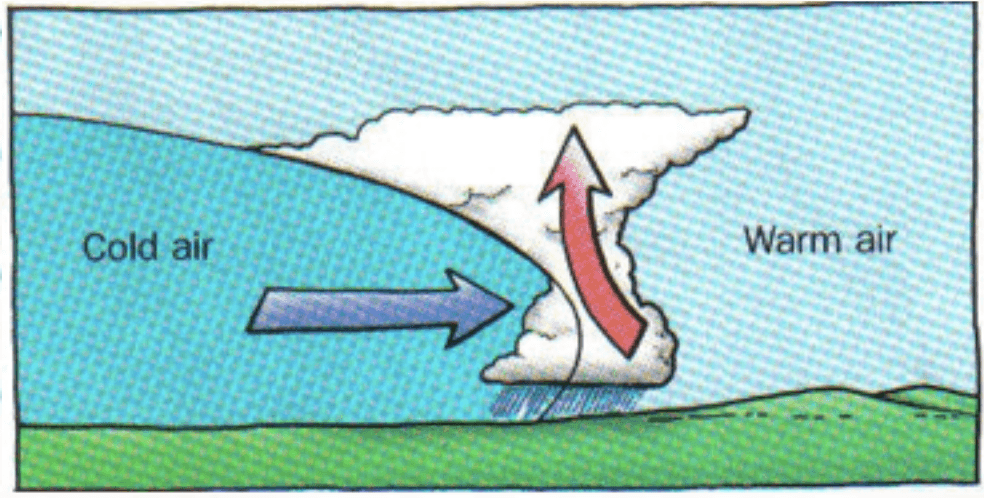
Name that front.

a)

Cold Front

b)

Warm Front

c)

Stationary Front

d)

Occluded Front

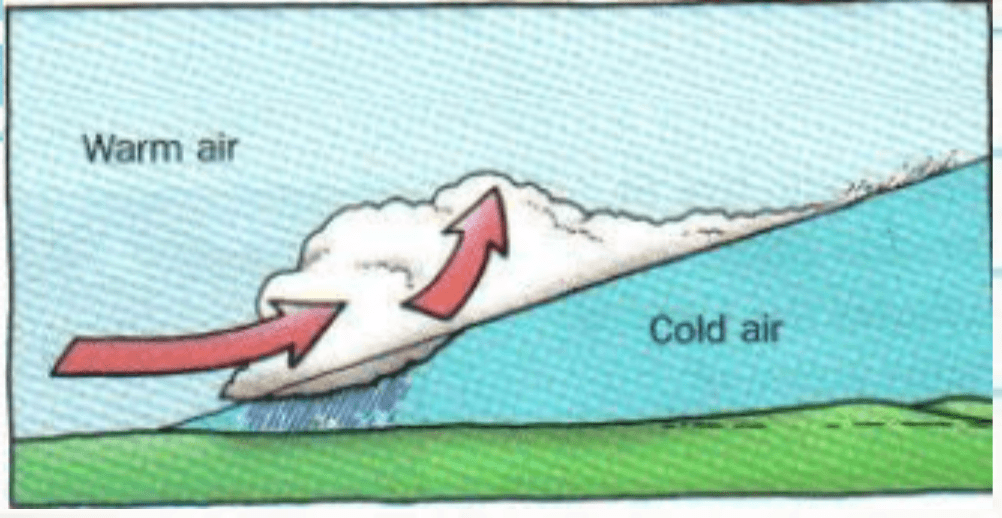
93.

Name that front.

a)

Cold Front

b)

Warm Front

c)

Stationary Front

d)

Occluded Front

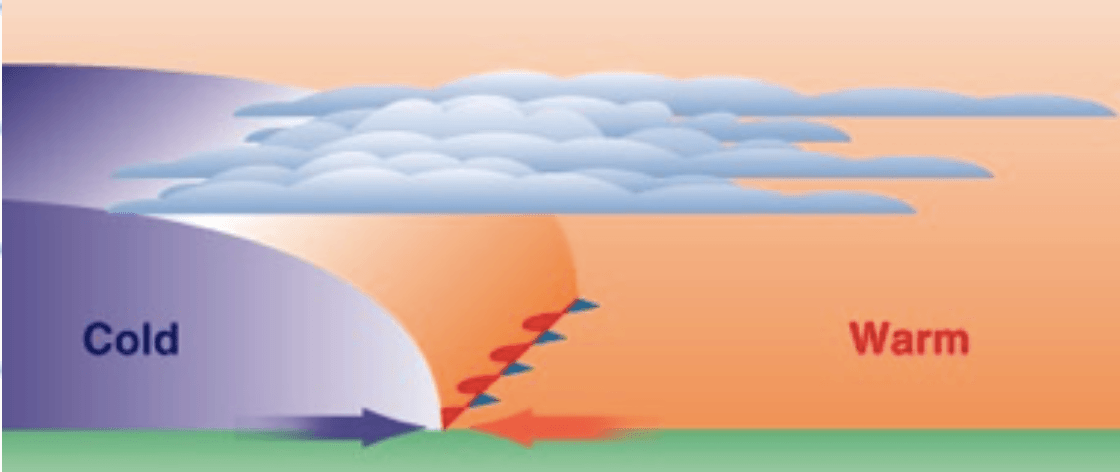
94.

Name that front.

a)

Cold Front

b)

Warm Front

c)

Stationary Front

d)

Occluded Front

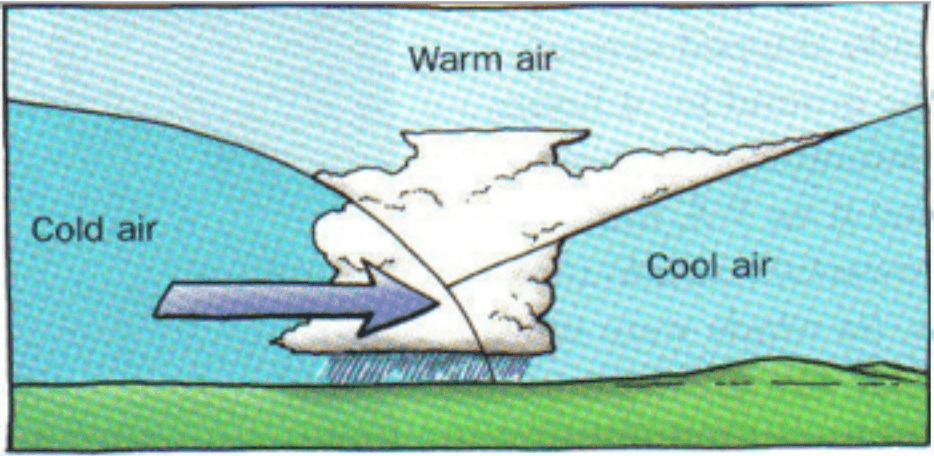
95.

Name that front.

a)

Cold Front

b)

Warm Front

c)

Stationary Front

d)

Occluded Front

96.
This type of front can bring thunderstorms.
a)
cold
b)
warm
c)
stationary
d)
occluded
97.

Can tornadoes also occur during a severe thunderstorm?

a)

Yes

b)

No

98.

What is the first step in the birth of a tornado?

a)

dark sky

b)

thunderstorm

c)

high wind

d)

rain

99.
When is Hurricane Season in the Atlantic Ocean?
a)
December 1st - July 4th
b)
March 21st - October 3rd
c)
May 15th - September 1st
d)
June 1st - November 30th
100.
How do we name air masses?
a)
Water and temperature
b)
Air pressure
c)
Humidity and temperature
d)
Cold and warm