wayground logo

Free Printable Worksheets

Font size

S
M
L
XL
Worksheets

Biology & Space 3rd year Assessment

Total questions: 100

Worksheet time: 3hrs 36mins

Name
Class
Date
1.
Which organelle performs PHOTOSYNTHESIS?
a)
Chloroplast
b)
Mitochondria
2.
Which of the following is the correct equation for PHOTOSYNTHESIS?
a)
CO+ light + H2O --> O+ Sugar
b)
CO+ sugar + H2O --> O+ light
c)
O2 + light + H2O --> CO+ Sugar
d)
CO+ O2 + H2O --> Light+ Sugar
3.
What is the ultimate ORIGINAL source of energy for living things
a)
Sugar
b)
Sun
c)
Moon
d)
Carbon Dioxide
4.

What is the pigment in chloroplasts that performs photosynthesis?

a)

Chlorosynthesis

b)

Chlorophyll

c)

Chloroplast

d)

Green

5.
Which gas is removed from the atmosphere during photosynthesis?
a)
hydrogen
b)
oxygen
c)
nitrogen
d)
carbon dioxide
6.
What is photosynthesis?
a)
The process in which humans eat their food
b)
When a photographer takes a photo.
c)
To get your pictures from the photo lab.
d)
The process in which plants make their food.
7.
A student is collecting the gas given off from a plant in bright sunlight at a temperature of 27°C. The gas being collected is probably ________.
a)
oxygen
b)
carbon dioxide
c)
ATP
d)
glucose
8.
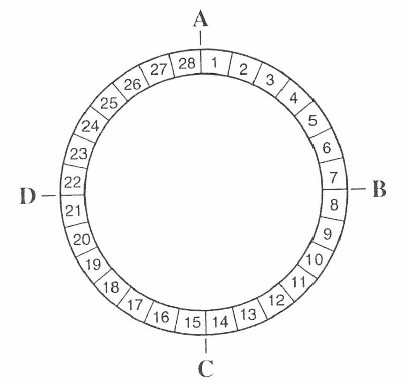
The diagram shows the 28 days of the menstrual cycle. When does the lining of the uterus break down?
a)
A
b)
B
c)
C
d)
D
9.

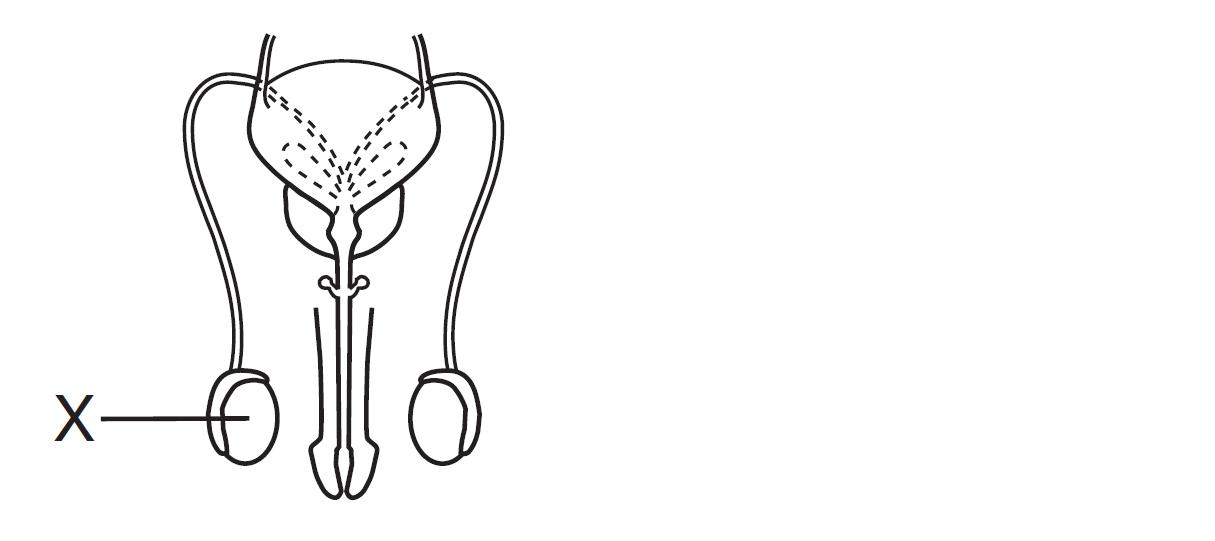
The diagram below represents a system in the human body. The function of structure X is to _____________

a)

produce energy needed for sperm to move

b)

provide food for the sperm to carry to the egg

c)

produce and store urine

d)

produce sperms and male sex hormones

10.

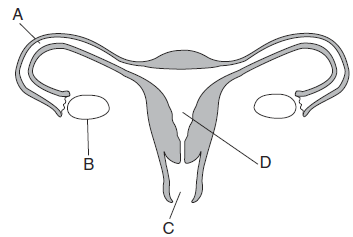
The human female reproductive system is represented below. Where will the embryo attach itself after fertilization?

a)

A

b)

B

c)

C

d)

D

11.

The male reproductive cell is called the (a)   .

12.

The female reproductive cell is called the (a)   .

13.

Tick on the boxes that show the parts of the male reproductive system.

a)

vagina

b)

testes

c)

ovary

d)

penis

e)

womb

14.

Tick on the boxes that show the parts of the female reproductive system.

a)

penis

b)

ovary

c)

womb

d)

testes

e)

vagina

15.

The developing baby receives nutrients from its mother through the __________ ________ .

(a)  

16.

The hormone responsible for regulating the male reproductive system is called

a)

Estrogen

b)

Progesterone

c)

Testosterone

d)

Adrenaline

17.

How many chromosomes contain the gametes of a human being?

a)

22

b)

23

c)

46

d)

44

18.

The site of fertilization is the

a)

vagina

b)

uterus

c)

ovary

d)

fallopian tube

19.

The release of the egg from the ovary is known as

a)

menstruation

b)

ovulation

c)

fertilization

d)

conception

20.

The fetal organ that connects the mother's blood supply and nourishes the fetus while it grows is the:

a)

Stomach

b)

Placenta

c)

Vagina

d)

Uterus

21.
Which structure is correctly paired with its function?
a)
ovary — provides milk for newborns
b)
placenta — storage of released eggs
c)
uterus — produces estrogen
d)
testis — development of sperm
22.
Base your answer on on the picture below which represents systems in a human male and on your knowledge of biology.  Which structure has both reproductive and excretory functions?
a)
A
b)
G
c)
C
d)
D
23.
What number of chromosomes are handed down by a egg cell?
a)
46
b)
12
c)
23
d)
96
24.
Sexual reproduction requires _____ parents and asexual reproduction requires ___ parents
a)
1,1
b)
2,2
c)
2,1
d)
1,2 
25.
Meiosis makes sperm and egg cells. In humans, sperm and egg cells each have _____ chromosomes. Therefore a fertilized human egg cell (sperm and egg cell combined) would create a cell with _____ chromosomes.
a)
23, 46
b)
46, 23
c)
2, 4
d)
50, 100
26.
Which process creates genetically DIFFERENT offspring?
a)
sexual 
b)
asexual
27.

What is the question mark pointing to?

a)

Penis

b)

Vas Deferens

c)

Seminal Vesicles

d)

Testicles

28.
What is the question mark pointing to?
a)
Scrotum
b)
Testicles
c)
Epididymis
d)
Penis
29.

What is the question mark pointing to?

a)

Testicles

b)

Epididymis

c)

Vas deferens

d)

Scrotum

30.

What does the scrotum do?

a)

Carries sperm and urine out of the penis

b)

Stores sperm

c)

Transports the sperm

d)

Protects the testicles

31.

Joining of a sperm and egg cell

a)

Neutralisation

b)

Differentiation

c)

Fertilization

32.

The liquid that carries sperm

a)

Sperm

b)

Erection

c)

Semen

d)

Egg Cell

33.

What is structure #3

a)

Ovary

b)

Fundus

c)

Fallopian Tube

d)

Cervix

34.

Reproductive organs that produce eggs

a)

cervix

b)

vagina

c)

ovaries

d)

fallopian tube

35.

The ... is the opening of the uterus

a)

cervix

b)

vagina

c)

ovulation

d)

uterus

36.

How many ovaries do females have?

a)

1

b)

2

c)

3

d)

4

37.

How many testicles do males have?

a)

1

b)

2

c)

3

d)

4

38.

The drawing represents the ____________reproductive system.

a)

Male

b)

Female

39.

How many sperm cells are needed to fertilise an egg?

a)

1 million

b)

1

c)

10

d)

10,000

40.

Which option correctly lists some of the changes which occur in males during puberty?

a)

Voice breaks, testicles produce sperm, breasts develop

b)

Voice breaks, testicles and penis get bigger, periods start

c)

Pubic hair grows, ovaries start to release eggs, testicle produce sperm

d)

Voice breaks, testicles produce sperm, testicles and penis get bigger, pubic hair grows

41.

Long, thread like structure which contain genetic materials found in nucleus of cell called ….

a)

sperm

b)

chromosome

c)

cytoplasm

d)

gamete

42.
Which characteristic would most likely be inherited by a baby?
a)
brown hair
b)
crying a lot
c)
ability to jump high
d)
his ability to talk
43.
The following are inherited traits of humans EXCEPT...
a)
long hair
b)
blue eyes
c)
long eyelashes
d)
small dimples
44.
Which is an example of a learned characteristic?
a)
color of a dog's fur
b)
color blindness of a person
c)
the ability of a mouse to run a maze
d)
a person's ability to roll their tongue
45.
Which best describes an inherited trait?
a)
a characteristic one chooses to express
b)
a characteristic one receives from the food one eats
c)
a characteristic that is passed on from one's parents
d)
a characteristic that is influenced by one's surroundings
46.
Chromosomes are found in the ____________ of the cell
a)
Chloroplast
b)
Nucleus
c)
Cytoplasm
d)
Mitochondria
47.
Heredity is the passing of traits from _____________________ to _____________________
a)
predators to prey
b)
water to rain
c)
parents to offspring
d)
fungi to protists
48.

What are chromosomes?

a)

Long strands of DNA that contain lots of genes.

b)

Different versions of a gene.

c)

The basic unit of heredity; controls a specific trait.

d)

A characteristic passed from parent to offspring

e)

The differences that occur from a mixture of genes

49.

The offspring of asexually reproducing organisms have genes that are ____________ to that of their parent.

a)

different

b)

same

c)

dominant

d)

recessive

50.

What is the abbreviation for deoxyribonucleic acid?

a)

RNA

b)

DOA

c)

DNA

d)

DBN

51.

The disappearance of a species.

a)

Evolution

b)

Extinction

c)

Migration

d)

Mutation

52.

What term is used to describe the differences that exist between members of the same species?

a)

Chromosomes

b)

Inheritance

c)

Variation

d)

Fertilisation

53.
The process in which organisms with traits well suited to an environment are more likely to survive and to produce offspring is
a)
Natural Selection
b)
Origin of Species
c)
Genetic Principles
d)
Trait Mechanism
54.
Which of the following is a term for a group of similar organisms that can reproduce fertile offspring?
a)
individual
b)
population
c)
species
d)
fossil
55.
This scientist came up with the idea of natural selection.
a)
Jean Baptiste Lamarck
b)
Gregor Mendel
c)
Charles Darwin
d)
Thomas Malthus
56.
This occurs when no more of a species is living.
a)
Fossilization
b)
Adaptation
c)
Extinction
d)
Natural selection
57.
The sky darkens at midday and the Sun seems to disappear. Minutes later, the Sun reappears and the daylight returns. The best explanation for this is...
a)
a partial solar eclipse is occurring
b)
the Moon has created a lunar eclipse
c)
the Sun has created a lunar eclipse
d)
the Moon has created a solar eclipse
58.
When the Earth is closest to the Sun and the northern hemisphere is tilted away from the Sun, we will be experiencing what season?
a)
Summer
b)
Fall (Autumn)
c)
Winter
d)
Spring
59.
Which of the following is true?
a)
Earth is the center of the solar system
b)
The sun orbits the earth
c)
Gravity exists only on Earth
d)
The sun is the center of the solar system
60.
How long is Earth's revolution?
a)
one day
b)
one year
c)
one decade
d)
one hour
61.
What causes seasons?
a)
earth's distance to the sun
b)
earth's tilt and revolution
c)
earth's tilt and rotation
d)
the moon
62.

An object that revolves around another object in space (natural or manmade)

a)

mirror

b)

microscope

c)

oscilloscope

d)

satellite

63.
What is an asteroid?
a)
rocky, metallic tiny planet that orbits the sun
b)
chunk of dirt and ices
c)
a mixture of gases
d)
a smaller chunk of stony matter, also known as a shooting star
64.
The Sun, eight planets, and thousands of stars make up the 
a)
outer planets
b)
inner planets
c)
solar system
d)
light years
65.

The Big Bang Theory explains the formation of the...

a)

Earth

b)

Sun

c)

Universe

d)

Solar System

66.
What does the Big Bang theory suggest?
a)
The universe was just there
b)
The Milky Way is the only solar system
c)
The universe is continually expanding
d)
The universe is collapsing in toward a single point
67.
How long does it take for the Earth to rotate once?
a)
24 hours
b)
365 days
c)
27.3 days
d)
27.3 hours
68.
What does the word "solar" refer to?
a)
Sun
b)
Moon
c)
Earth
d)
Energy
69.
What does the word "lunar" refer to?
a)
Sun
b)
Moon
c)
Earth
d)
Night
70.

In a single day, the

a)

Earth revolves around the Sun

b)

Earth rotates on its axis

c)

Moon revolves around the Earth

d)

Sun rotates on its axis

71.

It takes an entire year for the -

a)

Earth to rotate on its axis

b)

Earth to revolve around the Sun

c)

Moon to revolve around the Earth

d)

Sun to revolve around the Earth

72.

It takes just about a month for the moon to -

a)

completely revolve around the Earth

b)

travel to Earth

c)

leave its orbit

d)

revolve around the Sun

73.
What is a producer?
a)
an organism that gets energy from eating other organisms
b)
an organisms that uses sunlight to make its own food
c)
an organism that gets energy from eating dead organisms, non-living material or waste
d)
an organism that uses chemical energy to make its own food
74.
What is a herbivore?
a)
an animal that gets energy from eating other animals
b)
an organism that gets energy from eating only plants
c)
an animal that gets energy by eating both plants and other animals
d)
an animal that eats only herbs
75.
What is a carnivore?
a)
an animal that gets energy by eating other animals
b)
An animal that gets energy by eating only plants
c)
an animal that gets energy by eating both plants and animals
d)
an animal that makes its own energy through photosynthesis
76.
An animal that gets energy from eating both plants and animals is a 
a)
herbivore
b)
carnivore
c)
omnivore
d)
autotroph
77.
The shrew provides energy for the _______?
a)
cricket
b)
grasshopper
c)
frog
d)
snake
78.
Which of the following is a herbivore?
a)
cricket
b)
frog
c)
hawk
d)
shrew
79.
Where do all life forms get their energy?
a)
Earth's Core
b)
Water
c)
Plants
d)
The Sun
80.
What is this called?
a)
Food Web
b)
Food Chain
c)
Abiotic Factors
81.
What is this called?
a)
Food Web
b)
Food Chain
c)
Abiotic Factors
82.
All food chains begin with a ____________.
a)
primary consumer
b)
secondary consumer
c)
producers
d)
scavengers
83.
Which best describes what a food chain shows you?
a)
Energy flow through an ecosystem
b)
Food flowing through an ecosystem
c)
Consumers going into other consumers
d)
Who eats who
84.
All of the living and nonliving things in an area that interact with each other are called a/an ______.
a)
community
b)
habitat
c)
population
d)
ecosystem
85.
An area where an organism finds food, shelter and water in a specific arrangement
a)
niche
b)
biosphere
c)
biome
d)
habitat
86.
The non-living part of an ecosystem
a)
Ocean
b)
Lava Flow
c)
Birds
d)
Abiotic
87.
The study of how living things interact with one another and with their environment.
a)
Biology
b)
Lithology
c)
Ecology
d)
Farmacology
88.
Organisms that breaks down and absorbs nutrients from dead organisms 
a)
consumer
b)
trophic level
c)
decomposer
d)
species
89.

What is the name of the apparatus shown?

a)

Pooter

b)

Beating tray

c)

Line transect

d)

Pitfall trap

90.
When identifying insects found in a habitat, which one of the following is most useful?
a)
Key
b)
Pooter
c)
Lock
d)
Map
91.
What is the function of the instrument shown?
a)
To measure the frequency of plants
b)
To capture small insects
c)
To capture butterflies
d)
To map out a habitat
92.
A line stretched across an area to be sampled, where plants are identified at regular intervals, is called a
a)
line transect
b)
beating tray
c)
pitfall trap
d)
quadrat
93.

The device shown is to dislodge insects and small animals from bushes and trees.

What is this device called?

a)

Beating tray

b)

Quadrat

c)

Pooter

d)

Line transect

94.
The square frame used to estimate the numbers of plants is called a
a)
quadrat
b)
pitfall trap
c)
pooter
d)
line transect
95.

The photograph shows a pupil and teacher using a quadrat. The quadrat is placed randomly in a number of sites in the habitat being studied.

How is random sampling achieved when using a quadrat?

a)

The student throwing a pencil behind him.

b)

Placing the quadrat next to the nearest stone.

c)

Placing the quadrat at a corner of the habitat.

d)

Throwing the quadrat as far away as possible.

96.

The photograph shows a pupil with a sweep net.

What is the sweep net used to collect?

a)

Butterflies

b)

Large Animals

c)

Birds

d)

Insects

97.

Some students wanted to see what effect people walking in a field had on a number of different plants growing there.

In order to sample the plants, they used a quadrat as shown in the diagram.

Which one of the following would make the investigation as fair as possible?

a)

Placing the quadrats randomly in ten different sample areas.

b)

Placing the quadrats randomly in two different sample areas.

c)

Placing all the quadrats where there had been lots of plants.

d)

Placing all of the quadrats on areas that had been walked on.

98.
Organism's role within its community
a)
Job
b)
Niche
c)
Work
d)
Population
99.

Which is not an organism?

a)

person

b)

rock

c)

tree

d)

lizard

100.

When house sparrows were introduced from Europe into the United States, they stated to take over bluebird nesting sites, causing a decline in the bluebird population. Which term best describes the relationship between house sparrows and bluebirds?

a)

Symbiosis

b)

Competition

c)

Predator-prey

d)

Commensalism