wayground logo

Free Printable Worksheets

Font size

S
M
L
XL
Worksheets

Earth's Internal Processes

Total questions: 95

Worksheet time: 2hrs 53mins

Name
Class
Date
1.

Earthquakes generate compressional waves [P-waves] and shear waves [S-waves]. Compared to the speed of shear waves in a given earth material, the speed of compressional waves is

a)

always faster

b)

always slower

c)

always the same

d)

sometimes faster and sometimes slower

2.

A strong earthquake that occurs on the ocean floor could result in the formation of

a)

an ocean current

b)

El Nino

c)

a delta

d)

a tsunami

3.

The place on the Earth's surface, above the origin of the earthquake.

a)

Epicenter

b)

Focus

c)

Surface

d)

Crust

4.

The place where an earthquake originates inside the Earth's surface is called...

a)

Epicenter

b)

Focus

c)

Underground

d)

Crust

5.

What is the instrument used to measure earthquakes?

a)

Seismograph

b)

Seismologist

c)

Scale

d)

Seismogram

6.

5. Which type of wave travels the fastest?

a)

Primary Wave

b)

Secondary Wave

c)

Long Wave

7.

This is created by earthquakes that occur on the ocean floor.

a)

longshore current

b)

gulf stream

c)

tsunamis

d)

high tide

8.

What scale determines the amount of damage an earthquake causes?

a)

Richter scale

b)

Mercalli scale

c)

Moment magnitude scale

d)

seismographic scale

9.

S-waves can move through which of the following?

a)

Gas

b)

Liquid

c)

Solid

d)

All of these

10.
What type of fault is this?
a)
Normal
b)
Reverse
c)
Strike-slip
11.

Which wave can travel through all materials?

a)

P - primary

b)

S - secondary

c)

L - Long

12.

Which wave can travel through solids only?

a)

P - Primary

b)

S - Secondary

c)

Surface

13.

Measures the magnitude or size, of an Earthquake

a)

epicenter

b)

focus

c)

Richter scale

d)

Mercalli Scale

14.
The huge pieces of the earth's crust are called ____________________________. 
a)
crust
b)
plates
c)
directions
d)
seismos
15.
The epicenter of an earthquake is
a)
The point below the surface where rock begins to break and the first motion occurs
b)
The seismic station closest to the earthquake
c)
The place where the greatest damage occurs
d)
The point on the surface directly above the focus
16.
This famous transform fault is located in the western United States creates significant earthquake activity for California
a)
New Madrid
b)
Denali Fault
c)
Ramapo Seismic Zone
d)
San Andreas
17.
The Richter scale measures:
a)
the amount of radon gas released
b)
the movement of plates
c)
the strength of an earthquake
d)
the weight of tectonic plates
18.
What do S (secondary) waves do during an earthquake?
a)
Shake the ground
b)
Cause eruptions
c)
Open cracks in the earth's surface
d)
Create loud noises
19.
An instrument that detects and measures earthquakes is a 
a)
seismogram
b)
focus seismic map
c)
focus
d)
seismograph 
20.
What is a fault?
a)
A crack in a plate.
b)
Where two plates move toward each other.
21.
Most earthquakes happen along the _________________. 
a)
coast
b)
faults
c)
desert
d)
directions
22.
Earthquakes under the water can cause _________________________________.
a)
tornadoes
b)
tsunamis
c)
lightening
d)
hailstorms
23.
Many earthquakes happen along the borders of...
a)
Countries
b)
Tetonic Plates
c)
Climate Zones
d)
None of the above.
24.
This earthquake is......?
a)
Convergent
b)
Transform
c)
Divergent
d)
Rift Zone
25.
This earthquake is......?
a)
Convergent
b)
Transform
c)
Divergent
d)
Rift Zone
26.
The distribution of earthquakes on Earth’s surface is evidence that Earth’s crust is divided into ____.
a)
dishes
b)
oceans
c)
plates
d)
mantle
27.

In sea-floor spreading, molten material rises from the mantle and erupts

a)

along the edges of all the continents.

b)

along mid-ocean ridges.

c)

in deep-ocean trenches.

d)

at the north and south poles.

28.

The process by which the ocean floor sinks beneath a deep-ocean trench and back into the mantle is known as _______

a)

convection.

b)

continental drift.

c)

subduction.

d)

conduction.

29.

Most geologists think that the movement of Earth’s plates is caused by _______

a)

convection.

b)

continental drift.

c)

subduction.

d)

conduction.

30.

The geological theory of _______ states that pieces of Earth’s lithosphere are in constant, slow motion.

a)

subduction

b)

plate tectonics

c)

deep-ocean trenches

d)

sea-floor spreading

31.

Scientists think that convection currents flow in Earth’s

a)

continents.

b)

mantle.

c)

lithosphere.

d)

inner core.

32.

The place where two plates come together is known as a _______

a)

transform boundary.

b)

divergent boundary.

c)

convergent boundary.

d)

rift valley.

33.

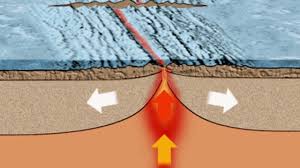
Below is a picture of sea-floor spreading. How are the ocean crusts moving?

a)

Converging

b)

Diverging

c)

Sliding

d)

No movement

34.
How is it possible for new crust to be formed without increasing the surface area of the Earth?
a)
Crust is destroyed at the same time it is created
b)
New crust is underwater where it sinks
c)
New crust breaks more easily than old crust
35.
What are the two types of crust
a)
continental and oceanic
b)
ocean and upper
c)
lower and upper
d)
pizza and subway
36.
What is Pangaea?
a)
the name of a German scientist
b)
the name of the super-continent that existed millions of years ago
c)
another name for continental drift
d)
the name of an ancient fossil
37.
What are the two types of crust?
a)
continental and oceanic
b)
ocean and basin
c)
lower and upper
d)
thick and thin
38.
Mountains form from ...
a)
plates sliding past one another
b)
collision of plates
c)
plates moving away from each other
39.
Who is the German Scientist that came up with the theory of the Continental Drift? 
a)
Albert Einstein 
b)
Ms. Stukel 
c)
Galileo
d)
Alfred Wegener
40.
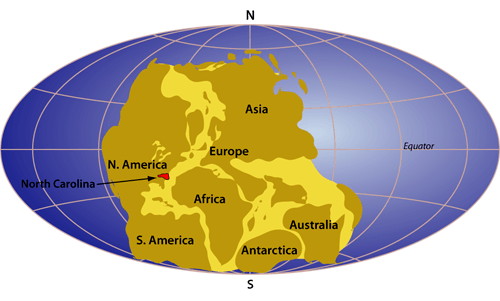
What is this a picture of?
a)
plate tectonics
b)
continental drift
c)
pangea
d)
glacier scaring
41.
Pangaea was an ancient supercontinent made up of...
a)
America, Greenland, and Europe.
b)
Antarctica, India, and America.
c)
all of Earth’s continents.
d)
South Africa, India, Australia, and South America.
42.
The rejection of Mr. Wegener's hypothesis  teaches us that
a)
Indirect evidence is not sufficient to prove a hypothesis
b)
Direct evidence is hard to find 
c)
Hypotheses are hard to prove
d)
Scientists of the early 1900s were not smart enough
43.

Alfred Wegener used __________ to prove that Pangea once existed ?

a)

graham crackers and frosting

b)

math

c)

a metal detector

d)

fossils

44.
The cracks in Earth's crust are called ___________.
a)
tectonic plates
b)
faults
c)
magma
d)
lava
45.

Most Earthquakes and Volcanoes can be found....

a)

around the Pacific Ring of Fire

b)

along the coast of Asia

c)

along plate boundaries

d)

in the Southern Hemisphere

46.
What are the puzzle pieces of the Earth's surface called?
a)
Tectonic plates
b)
Puzzles
c)
Earthquakes
47.

The movement of the tectonic plates is caused by______.

a)

convection currents

b)

rotation of the Earth

c)

movement of materials in the outer core

d)

revolution of the Earth

48.

What is common at convergent boundaries?

a)

valleys

b)

mountains

c)

ridges

d)

rivers

49.

What happens often at transform boundaries?

a)

typhoons

b)

earthquakes

c)

volcanic eruption

d)

tornado

50.

Geologist and Navy Admiral who mapped the seafloor in WWII discovering the Mid Atlantic Ridge and ocean trenches which led to his theory of 'seafloor spreading'

a)

Alfred Wegener

b)

Harry Hess

c)

Wilson

d)

Shackleton

51.
Magma that reaches the surface is called:
a)
Vent
b)
Hot spot
c)
Lava
d)
Cinders
52.
The more silica that magma contains...
a)
the thicker the magma
b)
the thinner the magma
c)
the higher the viscosity
d)
the runnier the magma
53.
The belt of volcanoes around the rim of the Pacific Ocean is called:
a)
Island arc
b)
Ring of Fire
c)
Lava plateau
d)
Hawaii
54.
Shield volcanoes have:
a)
gently sloping sides
b)
a steep cone shape
c)
moderately sized sides
d)
long cracks along plate boundaries
55.
Explosive eruption that hurls ash, gases, cinders, and bombs from the main vent.
a)
Volcano bomb
b)
Geyser
c)
Geothermal energy
d)
Pyroclastic flow
56.
Magma's resistance to flow, or how thick it is, is called:
a)
silica
b)
viscosity
c)
hot spot
d)
caldera
57.
This type of volcano has explosive eruptions that result in massive amounts of tephra (ash).
a)
Shield volcano
b)
Composite / Stratovolcano
c)
Cinder cone
d)
Fissure volcano
58.
What is molten rock that has formed deep within the Earth?
a)
Hot Spot
b)
Magma
c)
Lava
d)
Volcano
59.
What is molten rock that has reached the Earth's surface?
a)
Aa
b)
Lava
c)
Magma
d)
Pahoehoe
60.
Vocanoes are found...
a)
on land
b)
under water
c)
on islands
d)
all of the above
61.
__________ volcanoes are formed from fast flowing, lava which flows easily over the surface, forming larger volcanoes with gentle sides.
a)
Cone
b)
Composite
c)
Angel
d)
Shield
62.
A subduction zone is...
a)
plates pull apart.
b)
the continental plate slides under the oceanic plate.
c)
where the oceanic plate slides under the continental plate.
d)
plates slap each other a high five.
63.

Where is the point on the Earth’s surface directly above the starting point of an earthquake?

a)

Epicenter

b)

Fault

c)

Magma chamber

64.
What is the shaking of the Earth’s crust caused by a release of energy?
a)
Earthquake
b)
Epicenter
c)
Fault
d)
Plate
65.
This famous transform fault is located in the western United States creates significant earthquake activity for California
a)
New Madrid
b)
Denali Fault
c)
Ramapo Seismic Zone
d)
San Andreas
66.
Which travels fastest, always being the first detected by seismic stations?
a)
P waves
b)
S waves
67.

Many earthquakes happen along the borders of...

a)

Countries

b)

Tectonic Plates

c)

Climate Zones

d)

None of the above.

68.

What is the difference between magma and lava?

a)

lava is magma but it is on the surface of the Earth

b)

lava is the chamber that magma flows

c)

lava is the Earth's crust

d)

lava has a different chemical composition than magma

69.

A tool used to measure and record earthquake activity

a)

laser beams

b)

Richter scale

c)

seismograph

d)

tiltmeter

70.

The point on the earth’s surface directly above the origin of the earthquake.

a)

Epicenter

b)

Focus

c)

Foreshock

d)

Caldera

71.

The most destructive seismic waves. They move the earth side to side and up and down.

a)

P waves

b)

L waves

c)

S waves

d)

X waves

72.

A device used to measure the magnitude of an earthquake

a)

Seismograph

b)

Richter scale

c)

Laser beams

d)

none of the above

73.
Where is the largest volcano?
a)
Africa
b)
Indonesia 
c)
Wyoming
d)
Hawaii
74.
Where are most volcanoes found?
a)
Southern Hemisphere
b)
Ring of Fire
c)
Mid-Atlantic Ridge
d)
Hot Spots
75.

A 'pyroclastic flow' may consist of...(more than one choice)

a)

gases

b)

ash

c)

lava

d)

lava blocks

e)

cinder

76.

What happens as a tectonic plate moves over a hot spot?

a)

The plate descends into the mantle.

b)

A chain of volcanoes form.

c)

The pressure of the plate keeps magma below Earth’s surface.

d)

The hot spot is pushed to the edge of the plate.

77.

Volcanoes that form far from plate boundaries are associated with

a)

ocean ridges

b)

divergent boundaries

c)

subduction zones

d)

hot spots

78.

Most volcanoes form ___________.

a)

at hot spots

b)

at plate boundaries

c)

in the center of ocean plates

d)

in the middle of continents

79.

What caused this type of volcanism in the Cascades Mountains (Mt. St. Helen's, Mt. Shasta)?

a)

hot spots

b)

ocean-ocean subduction

c)

ocean-continent subduction

d)

continent-continent collision

80.

Hawaiian volcanoes are caused by what type of volcanism, which does not occur on plate boundary?

a)

hot spots

b)

ocean-ocean subduction

c)

ocean-continent subduction

d)

continent-continent collision

81.

The most explosive volcanoes are _____________.

a)

cinder cones

b)

hot spots

c)

shield volcanoes

d)

composite volcanoes

82.

The most dangerous volcano in the US is Yellowstone National Park. What type of volcanism is Yellowstone?

a)

oceanic hot spot

b)

continental hot spot

c)

ocean-continent subduction

d)

ocean-ocean subduction

83.

What type of volcano is Mt. Saint Helens?

a)

Composite

b)

Cinder Cone

c)

Shield

84.

What type of eruptions do shield volcanoes have?

a)

Quiet/light eruptions

b)

Explosive/heavy eruptions

c)

Varied between explosive and quiet eruptions

85.

True or False: Yellowstone is a portion of Earth's continental crust that overlies a mantle plume

a)

True

b)

False

86.

An area where material from deep within Earth's mantle rises through the crust and melts to form magma.

a)

hot spot

b)

rift zone

c)

hot soup

d)

hot mamma

87.
This city was destroyed in 79 A.D. by the eruption of Mt. Vesuvius.
a)
Rome
b)
Munich
c)
Pompeii
d)
Naples
88.
Where is Mt. St Helens located?
a)
New Jersey
b)
Nebraska
c)
Washington state
d)
I didn't learn this so I give up 
89.
What is / are sign(s) that a volcano may erupt soon?
a)
Earthquake activity in the area
b)
Changes in the shape of the volcano
c)
Different amounts of gas being produced
d)
All of these are signs
90.

TRUE OR FALSE: The higher the temperature of magma is, the higher is its viscosity.

a)

TRUE

b)

FALSE

91.

TRUE OR FALSE: Viscosity is the property of the material’s resistance to flow.

a)

TRUE

b)

FALSE

92.

Which of the following characteristics of a volcano depends on its magma emission?

a)

age

b)

shape

c)

size

d)

location

93.

Which volcano is named the deadliest eruption in US history?

a)

Mt. St. Helens

b)

Yellowstone

c)

Hawaiian Volcanoes

d)

Mount Rainier

94.

Can volcanic eruptions effect climate?

a)

yes

b)

no

95.
Smallest pyroclastics that are ejected from a volcano.
a)
blocks
b)
bombs
c)
AA
d)
ash