wayground logo

Free Printable Worksheets

Font size

S
M
L
XL
Worksheets

APES Unit 1 Topic 1.4-1.11

Total questions: 96

Worksheet time: 2hrs 31mins

Name
Class
Date
1.
What does NOT produce carbon dioxide?
a)
Photosynthesis
b)
Burning Fossil Fuels
c)
Animal respiration
d)
Plants decaying
2.
Combustion is another word for __________.
a)
Transportation
b)
Respiration
c)
Fossil Fuels
d)
Burning
3.
TRUE or FALSE?
All of the carbon in existence is continually recycled in the carbon cycle.
a)
True
b)
False
4.
Organisms that do not decompose can be buried and become what?
a)
water
b)
nutrients
c)
air
d)
fossil fuels
5.
Carbon can be found in...
a)
The atmosphere
b)
Soil
c)
Fossil fuels
d)
All of the above
6.
Which of the following removes carbon from the atmosphere?
a)
Combustion
b)
Respiration
c)
Photosynthesis
d)
Death
7.
What process occurs when coal (fossil fuel) is used for energy?
a)
Decomposition
b)
Combustion
c)
Pressurization 
d)
Respiration 
8.
Respiration is the process by which animals take in _____ and release _____. 
a)
photosynthesis, air
b)
carbon, oxygen
c)
oxygen
d)
oxygen, carbon dioxide
9.
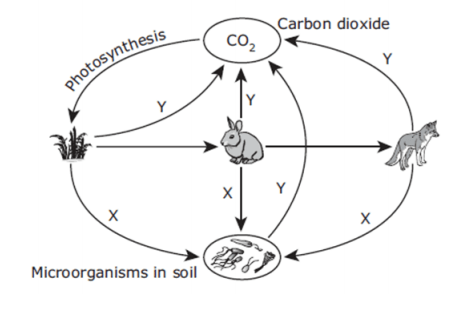
The diagram shows the flow of organic molecules through an ecosystem. What two processes are identified by the labels X and Y?
a)
X : Respiration
Y : Predation
b)
X : Adaptation
Y : Decomposition
c)
X : Fermentation
Y : Nitrogen Fixation
d)
X : Decomposition
Y : Respiration
10.
When humans burn fossil fuels, most of the carbon quickly enters the                       as carbon dioxide.
a)
Water
b)
Atmosphere
c)
Sun
d)
Air
11.
Which one of these does not add CO2 to the atmosphere?
a)
cooking with gas
b)
planting trees
c)
burning wood
d)
riding in a bus
12.
How do living organisms return carbon to the atmosphere in the carbon cycle?
a)
respiration and photosynthesis
b)
 decomposition and respiration
13.
In the carbon cycle, producers take in the gas __
a)
carbon dioxide
b)
oxygen
c)
nitrogen
d)
carbon monoxide
14.
How does the carbon in grass become part of a lion?
a)
The lion eats the grass
b)
Carbon from grass doesn't end up in a lion. 
c)
The carbon ends up in the lion's food chain. 
d)
The lion breathes in carbon given out by the plant
15.
Organisms that do not decompose can be buried and become what?
a)
water
b)
nutrients
c)
air
d)
fossil fuels
16.

Which is a true statement?

a)

Humans depend on oxygen, plants depend on carbon dioxide

b)

Plants produce carbon dioxide

c)

Humans depend on carbon dioxide, plants depend on oxygen

d)

Humans don't depend on plants for the air they need

17.
How nitrogen is "fixed" into useable form for plants...
a)
through action of bacteria only
b)
through lightning only
c)
through action of bacteria & lightning
d)
through photosynthesis
18.
How much of the atmosphere is composed of nitrogen gas?
a)
87%
b)
38%
c)
78%
d)
21%
19.
How do plants get the nitrogen they need?
a)
from the air
b)
from the soil or water in which they live
c)
from the Sun
d)
from broken-down rocks
20.
Animals obtain the nitrogen they need directly from the
a)
soil in their habitat
b)
air they breathe
c)
plants they eat
d)
bacteria living within them
21.

Which of the following describes the role of nitrogen-fixing bacteria in the nitrogen cycle? Nitrogen-fixing bacteria convert....

a)

nitrates intro nitrogen gas

b)

ammonia into proteins

c)

nitrogen gas into ammonium ions

d)

proteins into nitrates

22.

Organisms require nitrogen to make which of the following?

a)

glucose and starch

b)

lipids and nucleic acids

c)

proteins and nucleic acids

d)

carbohydrates and proteins

23.
Nitrogen fixation processes nitrogen from which of the following sources?
a)
lightning
b)
fertilizers
c)
dead plants
d)
atmosphere
24.

What converts nitrogen gas into a usable form for plants and animals?

a)

bacteria

b)

rain

c)

fungi

d)

car exhaust

25.

How is nitrogen "fixed" into a usable form for plants?

a)

Through action of bacteria only

b)

Through lightning only

c)

Through action of bacteria and lightning

d)

Through photosynthesis

26.
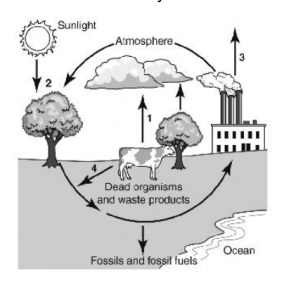
What is happening at 1?
a)
respiration: releasing CO2
b)
decomposing COin the soil
c)
photosynthesis: absorbing CO2
d)
turning CO2 from the atmosphere into organic molecules
27.
When nitrogen gas is turned in to a form that plants and animals can use is called 
a)
Combustion
b)
Photosynthesis
c)
Decomposition
d)
Nitrogen Fixation
28.
Identify the cycle pictured.
a)
The Water cycle
b)
The Carbon cycle
c)
The Nitrogen cycle
d)
The Phosphorus cycle
29.
Identify the cycle pictured.
a)
The Water cycle
b)
The Carbon cycle
c)
The Nitrogen cycle
d)
The Phosphorus cycle
30.
Identify the cycle pictured.
a)
The Water cycle
b)
The Carbon cycle
c)
The Nitrogen cycle
d)
The Phosphorus cycle.
31.
Which nutrient is not cycled through the atmosphere?
a)
carbon
b)
nitrogen
c)
phosphorous
d)
water
32.
What role do decomposers play in the phosphorous cycle?
a)
absorb phosphorous 
b)
release phosphorous into atmosphere
c)
return phosphorous into the soil
d)
combustion
33.
This is released by the weathering of rocks.
a)
Carbon
b)
Oxygen
c)
Phosphorus
d)
Nitrogen
34.

All living organisms are mainly composed of what elements?

a)

Oxygen, Carbon, Hydrogen, Nitrogen

b)

Carbon, Phosphorus, Nitrogen, Oxygen

c)

Sodium, Carbon, Nitrogen, Hydrogen

d)

Calcium, Phosphorus, Nitrogen, Oxygen

35.

This is NOT a part of the phosphorus cycle.

a)

Phosphate is incorporated into sedimentary rocks

b)

Phosphate bound to soil

c)

Atmospheric phosphate

d)

Phosphate is absorbed from the soil by plants

36.
Phosphorous is passed from plants to ____ who eat them
a)
plants
b)
animals
c)
scavengers
37.
Nitrogen in the soil has been fixed by bacteria. It is now available for use by ___. 
a)
humans
b)
plants
c)
fungi
d)
the water cycle
38.
_____ brings phosphorous into our waterways. .
a)
precipitation
b)
runoff
c)
transpiration
d)
condensation
39.
What two states does water exist in on Earth?
a)
Ice and Tea
b)
Liquid and Solid
c)
Gas and Light
d)
Air and Dust
40.
Two thirds of the Earth's fresh water  is stored where?
a)
Oceans
b)
Seas
c)
Lakes
d)
Ice
41.
Any type of liquid or solid water that falls to earth's surface
a)
evaporation
b)
condensation
c)
precipitation
d)
runoff 
42.
Process of water vapor changing into a liquid
a)
evaporation
b)
condensation
c)
precipitation
d)
transpiration 
43.
Process of liquid water changing into a gas
a)
evaporation
b)
condenstaion
c)
precipitation
d)
transpiration 
44.
Liquid precipitation that is not absorbed into the ground 
a)
groundwater
b)
condenstaion
c)
infiltration 
d)
runoff 
45.
The energy source that allows the water cycle to occur
a)
batteries
b)
the sun
c)
solar panels 
d)
gasoline 
46.
What is it called when plants give off water vapor as a waste product?
a)
condensation
b)
evaporation
c)
sublimation
d)
transpiration
47.
What do we call water that flows over the ground surface rather than soaking in?
a)
runoff
b)
discharge
c)
recharge
d)
tributary
48.
What is C?
a)
Evaporation
b)
Condensation
c)
Precipitation
d)
Runoff
49.
What is B?
a)
Evaporation
b)
Condensation
c)
Precipitation
d)
Runoff
50.
What is      D?
a)
Evaporation
b)
Condensation
c)
Precipitation
d)
Runoff
51.
The hydrologic cycle continuously recycles _______ through Earth's systems.
a)
rocks
b)
water
c)
oxygen
d)
carbon dioxide 
52.
What follows evaporation during the water cycle? How does this occur?
a)
Water evaporates into water vapor
b)
Water vapor condenses and forms a  cloud
c)
Water precipitates to the ground
d)
Water runs down into the hydrosphere
53.
A model of the water cycle was made using an aquarium with a glass cover, a container of ice cubes, water, and a lamp.
Which part of the water cycle causes the water droplets to form on the glass cover?
a)
condensation
b)
evaporation
c)
precipitation
d)
runoff
54.
Most of the water on Earth is located in the oceans and has a salinity of about 3.5%. Which statement best explains why rain is fresh water and has a very low salinity?
a)
When water precipitates from oceans, most of the salt remains in the oceans.
b)
When water evaporates from oceans, most of the salt remains in the oceans.
c)
When water precipitates from clouds, most of the salt remains in the clouds.
d)
When water evaporates from clouds, most of the salt remains in the clouds,
55.
Base your answers to the following questions on the diagram of the water cycle below. Letter A represents a process in the water cycle. Points X and Y represent locations on Earth's surface.
 The process represented by A is
a)
precipitation
b)
transpiration
c)
condensation
d)
saturation
56.
The arrows in the diagram below represent the movement of water in the water cycle.

Which arrow represents the process of transpiration?
a)
A
b)
B
c)
C
d)
D
57.
__________ primary productivity is the total amount of energy that producers convert to chemical energy in organic molecules per unit of time.   
a)
Net
b)
Total
c)
Gross
d)
None of the above
58.
About ___ percent of the planet is covered in ocean
a)
25
b)
50
c)
85
d)
70
59.
Oxygen is essential to _______________.
a)
photosynthesis
b)
glycolysis
c)
cellular respiration
d)
fermentation
60.
To measure primary productivity, you can measure carbon dioxide consumption, total carbohydrates produced or ________________.
a)
dissolved oxygen
b)
total proteins produced
c)
light energy entering system
61.
Would salt water or fresh water be expected to have a greater concentration of dissolved oxygen?
a)
salt water
b)
fresh water
c)
they would be equal
62.
Which environment would have a greater amount of dissolved oxygen, warm water (31degrees C) or cool water (18 degrees C)?
a)
warm
b)
cool
c)
they would be the same
63.
__________productivity = the organic materials that remain after photosynthetic organisms in the ecosystem have used some of these compounds for their cellular energy needs (cellular respiration).
a)
Gross
b)
Primary
c)
Net
d)
Secondary
64.
An output of photosynthesis is
a)
carbon dioxide
b)
Oxygen
c)
light
d)
water
65.
An input of photosynthesis is
a)
carbon dioxide
b)
oxygen
c)
oxygen 2
d)
glucose
66.
All of the production by photosynthetic organisms in a defined area over a specified time period is known as
a)
Gross Productivity
b)
Net Productivity
c)
Photosynthesis + Respiration
d)
Photosynthesis - Respiration
67.
NPP can be determined
a)
from the dark bottle reading
b)
from the light bottle reading
c)
using GPP + R
d)
All of the above
68.
Which of the following is an appropriate unit of primary productivity
a)
kg/m2
b)
kg/m/day
c)
kJ/m2
d)
kg/m2/yr
69.
The efficiency of energy transfer from a lower trophic level to the next highest level is roughly
a)
1%
b)
10%
c)
100%
d)
1000%
70.
Trophic levels are represented by 
a)
squares
b)
circles
c)
pyramids
d)
lines
71.
Which animal is the apex predator?
a)
hawk
b)
lizard
c)
snake
d)
grass
72.
Which animal is not the apex predator but, a predator to a mouse?
a)
hawk
b)
rabbit
c)
snake
d)
grass
73.
Why is a shark a carnivore.
a)
because it eats seaweed
b)
because it eats dead animals
c)
because it eats sand 
d)
because it eats other animals
74.
In the energy pyramid here, how much of the energy in each level gets lost as heat or used by the organism for survival?
a)
80%
b)
90%
c)
10%
d)
20%
75.
The arrows in a food chain or web represents what?
a)
They point to the organism that is being eaten.
b)
It shows how sunlight flows within an ecosystem.
c)
They show what direction the energy is flowing between organisms. 
d)
They represent how water is transferred within a habitat.
76.
Which of the following is a herbivore?
a)
cricket
b)
frog
c)
hawk
d)
shrew
77.
Organisms that create their own energy from sunlight or chemicals
a)
Herbivore
b)
Omnivore
c)
Autotroph
d)
Heterotroph 
78.
Biomass refers to
a)
Chemical Energy
b)
Light Energy
c)
Rank in the feeding heirarchy
d)
Amount of living tissue in an ecosystem
79.
Why do we sometimes use a food pyramid to illustrate feeding relationships?
a)
To change things up a bit
b)
Pyramids show you need a lot more producers than consumers
c)
To show you need more consumers than decomposers
d)
Pyramids are neat
80.
All of the living and nonliving things in an area that interact with each other are called a/an ______.
a)
community
b)
habitat
c)
population
d)
ecosystem
81.
What does a food web represent?
a)
All connections of energy flow throughout all organisms in a habitat.
b)
The specific ways that mutualism is carried out.
c)
A single pathway or energy flow between organisms. 
d)
How carnivores get their food. 
82.
Which of the following would be the definition of a scavenger/detritivore?
a)
Animals that eat insects.
b)
Organisms that feed on rocks, recycling the nutrients back into the ground.
c)
Organisms that eat only pants
d)
Things that feed on dead, rotting organisms (roadkill)
83.
The image provided is an example of a(n):
a)
Producer
b)
Autotroph
c)
Consumer
d)
Insect
84.
The image provided is an example of a(n):
a)
Carnivore
b)
Herbivore
c)
Producer
d)
Autotroph
85.
Which of the following would provide the most energy in an ecosystem?
a)
Producers
b)
Herbivore
c)
Omnivore
d)
Carnivore
86.
A wolf eats a rabbit, that just ate some berries.  What would you call the rabbit?
a)
Producer
b)
Omnivore
c)
Primary Consumer
d)
2nd order Heterotrph
87.
Why are decomposers located to the side of the pyramid?
a)
They recycle dead material from all levels
b)
The eat living things from all levels
c)
They are not a living organisms
d)
They are too large to fit on the pyramid
88.
Which of the following illustrates the correct ordering of trophic levels?
a)
decomposers-carnivores-autotrophs-herbivores
b)
herbivores-autotrophs-carnivores-decomposers
c)
autotrophs-herbivores-carnivores-decomposers
d)
carnivores-producers-omnivores
89.
All energy on Earth ultimately comes from what source?
a)
Water
b)
Sun
c)
Consumers
d)
Oxygen
90.
How much energy is available to be passed on to the next trophic level in an ecosystem?
a)
100%
b)
10%
c)
50%
d)
75%
91.
The diagram represents a model of a food pyramid.  Which statement best describes what happens in this food pyramid?
a)
More organisms die at higher levels than at lower levels, resulting in less mass at higher levels.
b)
Energy is lost to the environment at each level, so less mass can be supported at each higher level.
c)
When organisms die at higher levels, their remains sink to lower levels, increasing the mass of lower levels.
d)
Organisms decay at each level, and thus less mass can be supported at higher levels
92.
What is the ultimate ORIGINAL source of energy for living things?
a)
Sugar
b)
Sun
c)
Moon
d)
Carbon Dioxide
93.

If there is 1000 Kcal for the producers, how much energy would be transferred to the Primary Consumers?

a)

10 Kcal

b)

1 Kcal

c)

100 Kcal

d)

1000 Kcal

94.
An organism that obtains energy by eating other organisms.
a)
Consumer
b)
Producer
c)
Decomposer
d)
Detriov
95.
An organism that uses an outside source of energy like the sun to create energy-rich food molecules.
a)
Consumer
b)
Producer
c)
Decomposer
d)
Parasite 
96.
Use the diagram to answer the question.
The trout is a source of food for the human and the eagle. When there are more than one organism vying for the same source we call this____?

a)
Population
b)
Resources
c)
Community
d)
Competition