wayground logo

Free Printable Worksheets

Font size

S
M
L
XL
Worksheets

3rd 9 Weeks Practice Quiz

Total questions: 100

Worksheet time: 2hrs 2mins

Name
Class
Date
1.

What are the parts of a nucleotide?

a)

phosphate, sugar, base

b)

A, T, G, C

c)

Nucleic Acids

d)

two base pairs connected

2.

The size and shape of proteins determines:

a)

their function

b)

their bonds

c)

their nucleotides

d)

their chromosomes

3.

The 'backbone' or 'ribbon' of the DNA strand is made of:

a)

phosphate and sugar

b)

phosphate only

c)

phosphate and base

d)

sugar and base

4.

What is this a picture of?

a)

nucleotide

b)

DNA strand

c)

chromosome

d)

gene

5.

DNA is shaped in a:

a)

double helix

b)

tightly packed swirl

c)

twisted ladder

d)

nucleotide

6.

In which phase does the DNA copy itself?

a)

interphase

b)

metaphase

c)

anaphase

d)

telophase

7.
the base that pairs with Thymine in DNA
a)
adenine
b)
guanine
c)
helicase
d)
nucleotide
8.
the process of making a copy of DNA
a)
transcription
b)
double helix
c)
DNA replication
d)
replication fork
9.
A nitrogen base that bonds with cytosine; a purine
a)
thymine
b)
guanine
c)
helicase
d)
double helix
10.
Which shows the correct complementary base pairing for DNA?
a)
C-A, T-G
b)
A-G, C-T
c)
C-G, U-A
d)
T-A, G-C
11.
Which sequence of DNA bases would pair with this partial strand
ATG TGA CAG
a)
ATG TGA CAG
b)
TAC ACT GTC
c)
GTA AGT GAC
d)
CAT TCA CTG
12.
Sometimes, DNA is called "semi-conservative." Why might this be?
a)
The old strand is "conserved" and used to make the new strands
b)
Uracil is "conserved" in that it is only used to make the new strands
c)
ATP is "conserved" via the usage of facilitated diffusion
d)
Ligase is "conserved" in that it is denatured by the process
13.
Which of the following sequences of processes correctly reflects the central dogma?
a)
protein synthesis, transcription, translation
b)
protein synthesis, translation, transcription
c)
transcription, translation, protein synthesis
d)
translation, transcription, protein synthesis
14.
What mutation has occurred here? 
T-G-A-C-C-A
T-G-A-G-C-A
a)
Substitution
b)
Deletion
c)
Insertion
d)
Frameshift 
15.
Any change in the sequence of DNA is...
a)
transgenic shift
b)
Single Genotype
c)
Monohybrid Trait
d)
Mutation
16.
DNA has a ______ strand; RNA has a ______ strand.
a)
double/double
b)
double/triple
c)
double/single
d)
single/single
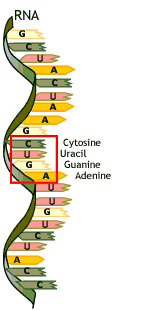
17.
Which process is shown?
a)
diffusion
b)
repiration
c)
recombination
d)
translation
18.
The DNA sequence ATCAGCGCTGGC is part of a gene. How many amino acids are coded for by this message?
a)
4
b)
8
c)
12
d)
20
19.
Which is the mRNA molecule that would be transcribed from this DNA template:
TGGCAA
a)
ACCGTT
b)
UGGCAA
c)
UCCGUU
d)
ACCGUU
20.

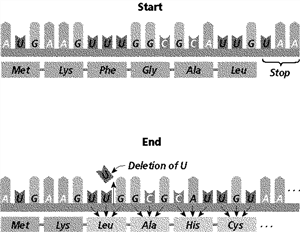
What will be the result of this deletion mutation?

a)

substitution

b)

frameshift mutation

c)

point mutation

d)

insertion

21.

What role does the mRNA play in protein synthesis?

a)

mRNA modifies the original DNA strand

b)

mRNA mutates to form protein

c)

mRNA is the transcribed message from a DNA sequence

d)

mRNA moves the amino acids

22.
The process by which the genetic code of DNA is copied into a strand of RNA is called
a)
translation
b)
transcription
c)
transformation
d)
replication
23.
A possible sequence of nucleotides in the template strand of DNA that would code for the polypeptide sequence phe-leu-ile-val would be?
a)
5'-TTG-CTG-CAG-TAG-3'
b)
3'-AAC-GAC-GUC-AUA-5'
c)
3'-AAA-AAT-ATA-ACA-5'
d)
3'-AAA-GAA-TAA-CAA-5'
24.
In RNA, Uracil pairs with ______. 
a)
cytosine
b)
adenine
c)
guanine
d)
thymine
25.
What is the location in the cell for translation?
a)
nucleus
b)
mitochondria
c)
ribosome
d)
chloroplast
26.

What is the complimentary mRNA sequence to the DNA

sequence A-T-T-G-C-A.

a)

T-A-A-C-G-T

b)

U-A-A-C-G-T

c)

U-A-A-C-G-U

d)

T-A-A-G-C-U

27.
Who is responsible for producing this image?
a)
Francis Crick
b)
James Watson
c)
Rosalind Franklin
d)
Watson and Crick
28.
What did Erwin Chargaff conclude from his experiments?
a)
Nitrogen bases are held together by peptide bonds
b)
A and T, C and G always occur in equal amounts
c)
Proteins are the carriers of genetic information
d)
C and G rarely occur in eukaryotic organisms
29.
Which scientists built a 3-D model of the DNA double helix?
a)
Hershey and Chase
b)
Watson and Crick
c)
Chargaff and Franklin
d)
Griffith and Avery
30.
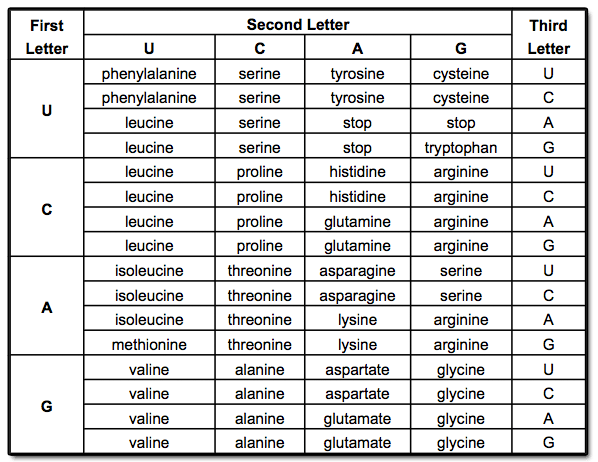
What is the correct amino acid sequence for the mRNA code AUGCCAGUAUGA
a)
Met-Pro-Ala-Val
b)
Met-Pro-Val
c)
Tyr-Gly-His
d)
Tyr-Gly-Arg-His
31.
Which amino acid pairs with the codon AGA
a)
Thr
b)
Arg
c)
Ala
d)
Glu
32.
DNA molecule segment is : TTACGCAAG
The mutated DNA segment is TTCGCAAG. This is an example of ___ mutation.
a)
Substitution
b)
Deletion
c)
Insertion
d)
Inversion
33.
Original: ATC CAT
Mutation: ATC GCAT
What mutation occurred?
a)
deletion
b)
insertion
c)
silent
d)
transverse
34.

Which of the following is genetic disorder that results from having an extra chromosomes?

a)

Cystic Fibrosis

b)

Hemophilia

c)

Down's Syndrome

d)

Color blindness

35.

Down syndrome (Trisomy 21) is an example of...

a)

Nondisjunction

b)

Duplication

c)

Translocation

d)

Gene Mutation

36.

What would be the genotype of an affected individual with an autosomal recessive disorder?

a)

AA

b)

Aa

c)

aa

d)

XaY

37.

Which of the following genotypes could be a carrier?

a)

Tt

b)

TT

c)

tt

d)

XTY

38.

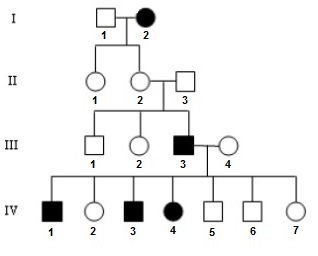
This is an example of which pattern of inheritance?

a)

Autosomal Dominant

b)

Autosomal Recessive

c)

Sex-Linked

d)

Autosomal Chromosomal

39.

Which statement about Sex-Linked Recessive disorders is TRUE?

a)

Disease is common in the family

b)

Disease will never skip a generation

c)

Affected fathers will NEVER pass the disease on to their sons

d)

Females are more likely to inherit the disease than males

40.

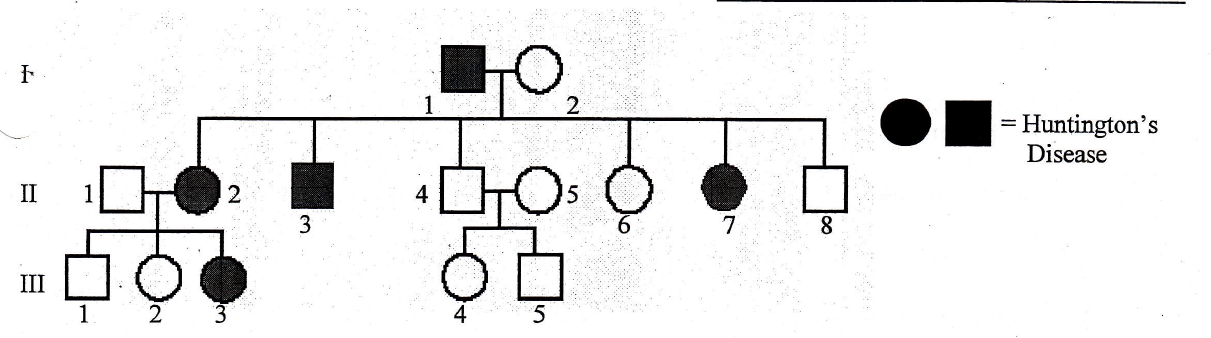
Which pattern of inheritance is this?

a)

Autosomal Dominant

b)

Autosomal Recessive

c)

Sex-Linked

d)

Sex- Chromosome

41.

The inherited disease in which hemoglobin molecules clump into long fibers, changing the shape of blood cells is

a)

cystic fibrosis

b)

sickle cell disease

c)

Huntington's disease

d)

Klinefelter's syndrome

42.

Which suspect should be charged with the crime?

a)

Suspect 1

b)

Suspect 2

c)

Suspect 3

d)

None of these suspects

43.
What process is shown in the picture?
a)
Gene therapy
b)
Cloning
c)
DNA Fingerprinting
d)
Gene Splicing
44.

What is transgenic organisms?

a)

Organisms with genes from other organism

b)

The use of genetic engineering to find solutions to problems.

c)

Scientists study DNA sequences with DNA fragments, DNA polymerase, fluorescently labeled nucleotides, and gel electrophoresis.

d)

All of the above.

45.
Stem cells are used to __________.
a)
make clones
b)
create new species of animals
c)
make babies
d)
grow different types of tissues
46.

A technique for making millions of copies of a specific region of DNA.

a)

DNA ligase

b)

restriction enzymes

c)

gel electrophoresis

d)

polymerase chain reaction

47.
Gregor Mendel is known as the father of _________
a)
Modern Medicine
b)
Father of the Green Revolution
c)
Father of Genitics
d)
The Pea Plant Man
48.

What did Gregor Mendel study?

a)

Mold Spores

b)

Pea Plants

c)

Sun Flowers

d)

Rats

49.

When an organism has two different alleles, it is called

a)

homozygous

b)

heterozygous

c)

recessive

d)

dominant

50.
What is heredity?
a)
A kind of genetic disorder
b)
The way DNA divides
c)
A trait you inherit from your parents
d)
The passing down of traits from parents to children
51.
Genotype refers to the ...
a)
physical expression of the genes
b)
the possible combination of alleles in a gene
c)
whether an allele is dominant or recessive
d)
how an organism will appear
52.
Term for an organism that display two dominant phenotypes at the same time
a)
codominance
b)
incomplete dominance
c)
multiple alleles
d)
linked genes
53.
Incomplete dominance means that the traits are
a)
expressed equally
b)
dominant
c)
recessive
d)
blended
54.
having two of the same genes for the trait (sometimes called purebred).
a)
homozygous
b)
hetrozygous
c)
protein
d)
chromosome
55.
If green is dominant over purple, then what is the genotype for this individual?
a)
Purple
b)
Green
c)
GG
d)
gg
56.

Grey (G) fur is dominant to brown (g) fur in mice. What would be the genotype of a mouse that is homozygous dominant?

a)

GG

b)

Gg

c)

gg

d)

GGG

57.

Wavy hair is a mix of curly and straight hair. Which of the following expalains this blending of traits?

a)

CoDominance

b)

Incomplete Dominance

c)

Incoherent Dominance

d)

DomDominance

58.
What allele combination should go in the missing box?
a)
AA
b)
Aa
c)
aa
d)
none of these
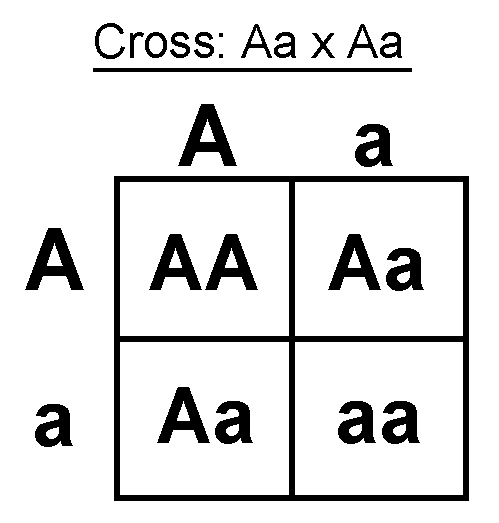
59.

What are the phenotype percentages of the offspring?

(A-Brown fur color; a-white fur color)

a)

50 % Brown fur and 50% White fur

b)

25 % Brown fur and 75% White fur

c)

75 % Brown fur and 25% White fur

d)

0% Brown fur and 100% White fur

60.
If a child has red hair, they inherited a certain _______________ from their parents.
a)
ratio
b)
trait
c)
probability
d)
sex chromosome
61.
This pedigree represents the inheritance of hemophilia in this family. How many of the females have the hemophilia trait?
a)
8
b)
5
c)
2
d)
3
62.

Which individual in the first generation is a carrier?

a)

The male

b)

The female

c)

The grandchild

d)

None of the above

63.
One flower is heterozygous red (Rr) and it is crossed with a homozygous white (rr) plant. Use a Punnett square to determine the probability of one of their offspring having a white color.
a)
100%
b)
25%
c)
75%
d)
50%
64.

In humans, brown eyes (B) are dominant, and blue eyes are recessive (b). If a homozygous dominant male is crossed with a heterozygous female, what are the most likely genotypes of the offspring?

a)

100% homozygous dominant

b)

100% heteozygous

c)

50% homozygous dominant

50% heterozygous

d)

50% homozygous dominant

50% homozygous recessive

65.

How many people in this whole pedigree are heterozygous?

a)

7

b)

3

c)

4

d)

6

e)

5

66.
A red flowered plant (RR) is crossed with a white flowered plant (WW). The gene for petal color in these plants expresses incomplete dominance.  What percentage of the offspring will have pink (RW) flowers?
a)
0%
b)
25%
c)
50%
d)
100%
67.
In chickens, feather color is codominant.  If a black chicken BB is mated with one that is black and white (BW) what are the chances of having a chicken that is black and white?
a)
50%
b)
0%
c)
25%
d)
100%
68.

If a person has type B blood, the phenotype is B. What can the genotype be?

a)

IBIB or IBi

b)

IAIA or IAi

c)

IAIB

d)

ii

69.

What type of inheritance is determined by multiple genes and there can be a range of traits?

a)

Codominance

b)

Incomplete dominance

c)

Polygenic traits

70.
If a woman is a carrier for a sex linked recessive trait of hemophilia and her husband has hemophilia, which of the following is true? Make a punnett square!
a)
All sons will have hemophilia
b)
all daughters will have hemophilia
c)
50% of daughters and 50% of sons have hemophilia
d)
100% of sons have hemophilia and 100% of daughters are carriers
71.

The woman who is colorblind marries a man with normal vision. What is the probability that their sons will be colorblind?

a)

0%

b)

25%

c)

50%

d)

100%

72.

Based off this punnett square, what fraction of the offspring will have wrinkled, yellow seeds?

a)

9/16

b)

3/16

c)

1/16

d)

16/16

73.
There are no carriers for Huntington's Disease- you either have it or you don't. Is Huntington's disease caused by a dominant or recessive trait?
a)
Dominant
b)
Recessive
74.

Farmers breed cows to produce high amounts of milk. This is an example of _____________.

a)

Natural Selection

b)

Variations in a species

c)

Selective Breeding

d)

inbreeding

75.
The diagram shows fossils in different rock layers. Which of these statements about the age of these fossils is most likely correct?
a)
Fossil A and C are the same age
b)
Fossil B is older than fossil C
c)
Fossils A is older than fossil B
d)
Fossil D is older than fossil C
76.

When a species is separated by water, mountains, or some type of natural barrier, what type of speciation can occur?

a)

Geographic Isolation

b)

Reproductive Isolation

c)

Genetic Drift

d)

Co-evolution

77.

What do the similarities of these structures suggest?

a)

a common ancestor

b)

grow at different rates

c)

evolved slowly

d)

lived a long time

78.
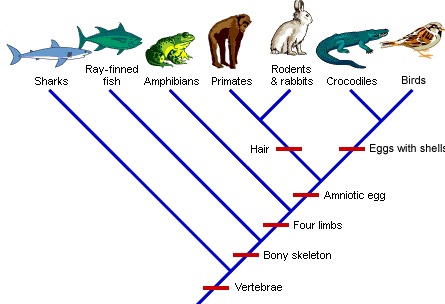
Which two orgainsms have hair? 
a)
Sharks & Ray Finned Fish
b)
Primates & Rodents
c)
Birds & Crocodiles
d)
Rabbits & Birds
79.

If the embryos of several different species are very similar in their early stages of development, the similarities could indicate which of the following?

a)

The species are in the same genus.

b)

The embryos are a result of external fertilization.

c)

The embryos are probably cloned.

d)

The species are closely related and share a close common ancestor.

80.

Some tortoises on the Galapagos Islands have rounded shells and shorter necks so that they can eat the vegetation near the ground, and some of them have long necks with shells that are bent upwards. This feature allows these particular tortoises to be able to eat from taller shrubs and vegetation that is higher off the ground. What is this an example of?

a)

an adaptation

b)

a geographical isolation

c)

a homologous structure

d)

a vestigial structure

81.

When all the members of a species completely dies out, it is called __________________.

a)

Adaptation

b)

Extinction

c)

Fossilization

d)

Mutation

82.

Charles Darwin was fascinated by the diversity of life on Earth. He wanted to know why organisms were so different, yet some were so similar. During his quest for more knowledge, he developed the _______________.

a)

Theory of Relativity

b)

Theory of Diversity

c)

Theory of Adaptations

d)

Theory of Evolution by Natural Selection

83.

A mutation occurs in a green lizard population that causes some lizards to be brown instead of green. In what circumstance would this mutation be MOST beneficial to the brown lizards?

a)

The brown lizards are also larger in size.

b)

The brown color provides better camouflage from predators.

c)

The green lizards move to a new habitat.

d)

The brown color allows them to be more easily seen by predators.
84.

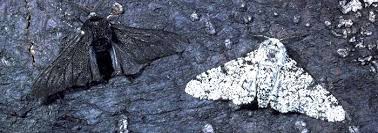
Predict which moth would increase in population.

a)

light

b)

dark

c)

neither

d)

both

85.

Which of the following was probably not present in the atmosphere of the primitive Earth?

a)

methane

b)

oxygen

c)

water

d)

carbon dioxide

86.

In 1953, Stanley Miller and Harold Urey developed an apparatus that contributed to which of the following theories?

a)

Primordial Soup Theory

b)

Endosymbiotic Theory

c)

RNA World Theory

d)

Geologic Time Scale Theory

87.
According to this cladogram, birds are LEAST related to -
a)
Amphibians
b)
Sharks
c)
Ray Finned Fish
d)
Crocodiles
88.
a)
A=convergent B=divergent C=adaptive radiation
b)
A=adaptive radiation B=convergent C=divergent
c)
A=divergent B=convergent C=adaptive radiation
d)
A=divergent B=adaptive radiation C=convergent
89.
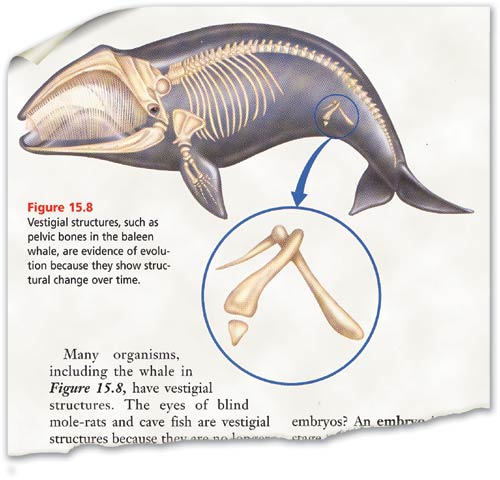
The hind leg bones in a whale are examples of
a)
homologous structures
b)
analogous structures
c)
fossils
d)
vestigal structures
90.
Which species’ DNA is most similar to the DNA of the toothed whale? 
a)
Hippopotamus 
b)
Baleen Whale
c)
Grazing Mammals
d)
Camels
91.
Which sex chromosomes would indicate a typical human male?
a)
XX
b)
X
c)
XY
d)
XXY
92.

A normal human zygote should have _____ chromosomes inside.

a)

46

b)

23

c)

92

d)

64

93.
Crossing over helps promote 
a)
male genotype
b)
genetic variation
c)
DNA replication
d)
mitosis
94.
If two parents are heterozygous for type A blood, what is the probability that their offspring would have type O blood?
a)
100 %
b)
75%
c)
50%
d)
25%
95.
This karyotype is taken from a  ___________.
a)
normal female
b)
normal male
c)
male with Klinefelter's syndrome
d)
female with Turner's syndrome
96.

When one gene turns OFF the expression of (an)other gene(s) this is an example of:

a)

polygenic inheritance

b)

epistasis

c)

multiple alleles

d)

co-dominance.

97.

Traits that have a wide range of phenotype (eye color, fur color, etc.) are said to be:

a)

polygenic

b)

sex-linked

c)

co-dominant

d)

dominant

98.
A chromosome that is not a sex chromosome is known as a(an)
a)
autosome.
b)
karyotype.
c)
pedigree.
d)
chromatid.
99.
Can an individual be a carrier for a dominant  genetic disorder. 
a)
Yes 
b)
No
100.
What type of reproductive barrier separates species because one mates at dawn and the other at dusk?
a)
Habitat Isolation
b)
Behavioral Isolation
c)
Temporal Isolation
d)
Embryo Isolation