
 Worksheets
All 6th Grade Science Content
Total questions: 95
Worksheet time: 1hrs 10mins
What is the first step of the scientific method?
Analyze the data
Make an observation or ask a question
Draw a conclusion
Form a hypothesis
What are the factors that can be changed or manipulated in an experiment called?
independent variables
control variables
dependent variables
confounding variables
What is the term for a possible explanation or answer to a scientific question?
conclusion
theory
observation
hypothesis
What are the factors that remain constant and unchanged in an experiment called?
constants
experimental variables
independent variables
dependent variables
Which subtopic of the Nature of Science focuses on making observations and asking questions?
Data Analysis
Experimental Design
Hypothesis Testing
Scientific Inquiry
What is the term for information gathered during an experiment?
results
observations
findings
data
What is the term for a well-tested explanation for a broad range of observations in nature?
law
scientific theory
hypothesis
experiment
What are the factors that are measured or observed in an experiment called?
independent variables
control variables
confounding variables
dependent variables
In a line graph, what does the vertical axis (Y-axis) typically represent?
The dependent variable
The independent variable
The control variable
The confounding variable
In a circle graph, what does each sector represent?
A percentage of the total
The total number of items
The radius of the circle
The circumference of the circle
What is another name for a circle graph?
Bar graph
Pie chart
Line graph
Scatter plot
What is the term for the variable that is measured in an experiment?
Independent variable
Dependent variable
Control variable
Confounding variable
What is the variable that is deliberately changed in an experiment called?
Dependent variable
Control variable
Independent variable
Confounding variable
Which of the following is a scientific law?
Newton's Law of Motion
Darwin's Theory of Evolution
Einstein's Theory of Relativity
Freud's Theory of the Unconscious
What distinguishes a scientific theory from a scientific law?
A theory is an educated guess, while a law is a statement of fact
A theory is a statement of fact, while a law is an educated guess
A theory explains why something happens, while a law describes what happens
A theory describes what happens, while a law explains why something happens
Which of the following is an example of a scientific model?
A globe representing the Earth
A weather forecast predicting rain
A diagram of a cell
All of the above
What is the term for a simplified representation of a more complex real-world object or phenomenon in science?
Observation
Scientific Model
Experiment
Data Analysis
What is the term for the conclusion drawn from an experiment or observation?
Inference
Observation
Experiment
Measurement
What is the term for the process of gathering information through the senses?
Experimentation
Observation
Hypothesis
Conclusion
What is the term for the process of another scientist repeating an experiment to ensure the results are consistent and not just an accident?
Replication
Observation
Experimentation
Conclusion
A(n) ____ is a large body of air that has the same properties as the Earth's surface over which it develops.
air mass
cloud
tornado
front
____ humidity is a measure of the amount of water vapor that air is holding compared to the amount needed for saturation at a specific temperature.
Total
Partial
Relative
none of the above
The temperature at which air is saturated and condensation forms is the ____.
dew point
rain point
wind point
relative humidity
The interaction of air, water, and ____ causes weather.
the Sun
humidity
land
wind
Clouds form as warm air rises, expands, cools, and becomes saturated, and then ____ condense(s) into tiny drops, which collect.
snowflakes
water vapor
smog
smoke
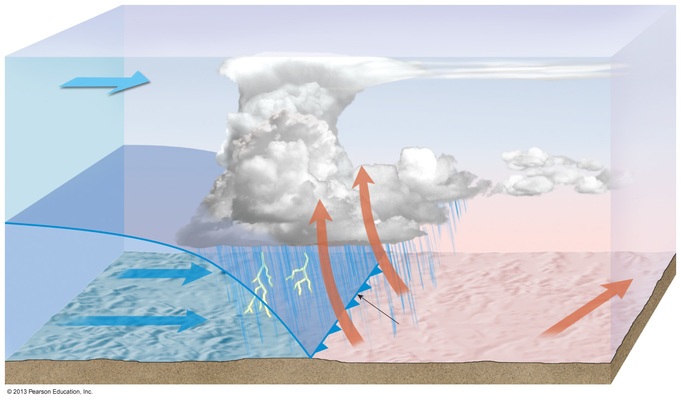
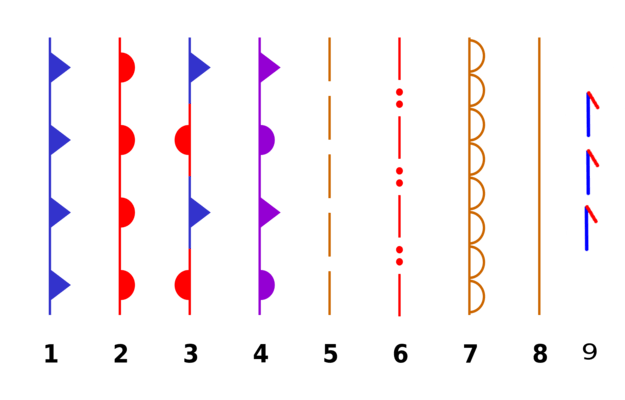
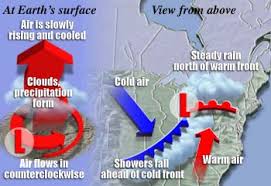
Which of these does NOT cause different climates?
Geography
Elevation
Longitude
Latitude


As the ball is dropped, the potential energy decreases while the kinetic energy increases. What happens to the total amount of energy?
It decreases
It increases
It stays the same
It disappears

What type of energy is stored in batteries or food?
Potential energy
Thermal energy
Chemical energy
Mechanical energy

Energy in the form of moving waves of light
Chemical Energy
Sound Energy
Nuclear Energy
Electromagnetic Radiation

Where do humans get their energy from? What kind of energy is it?
Food
Radiant
Food
Potential
Food
Chemical
Food
Mechanical

What 2 things does kinetic energy depend on?
Mass
and
Speed
Shape
and
Position
Mass
and
Color
Speed
and
Position

What 2 things does potential energy depend on?
Position
and
motion
Mass
and
Height
Position
and
color
Speed
and
Mass

A pendulum is given potential energy by being pulled up to location W. At which location does the pendulum have maximum kinetic energy?
Location W
Location X
Location Y
Location Z
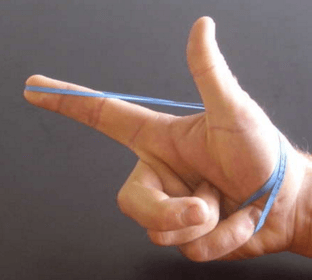
Match the description to the graph:
"The car is stopped."


a change in an objects speed or direction
speed
velocity
acceleration
motion
The acceleration of an object as produced by net force. F = m*a
Newton's 1st Law
Motion
Newton's 2nd Law
Newton's 3rd Law
An object at rest stay at rest and an object in motion stays in motion until acted upon by an unbalanced force.
Newton's 3rd Law
Force
Newton's 2nd Law
Newton's 1st Law


Which of these has the strongest gravity?
Earth
Moon
Jupiter
Sun
Venus

If I drop a large rock and a small rock from the same height at the same time, which one will hit the ground first?
the large rock
the small rock
both will hit at the same time
______________ is a force that always acts in the direction opposite of motion.
applied
friction
gravity
normal

This sphere contains all of the solid water on Earth
Hydrosphere
Biosphere
Atmosphere
Geosphere
Cryosphere


A scientist collects water samples from a river near a volcano. This scientist is collecting data about the _______
hydrosphere
geosphere
atmosphere
biosphere

Heat transfer is really neat! It always goes from
hot to cold
cold to hot
top to bottom
bottom to top

Deep currents are caused mainly by differences in salinity and _____.
winds
gases dissolved in the water
the Coriolis Effect
water temperature

Surface currents and deep ocean currents join together to make
the East Australian Current
warm currents
the global conveyor belt
the Coriolis Effect
Energy transferred by particles touching each other
Conduction
Convection
Mechanical wave
Radiation

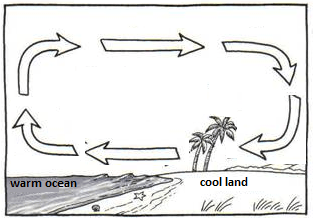
This picture is an example of ________.
Conduction
Convection
Mechanical wave
Radiation

Refer to the diagram of the winds and currents to answer the question.
Which of the following best explains the curvature of the arrows for the westerlies and the trade winds?
The ocean currents create winds flowing in a similar direction to the current.
The Coriolis effect causes the winds to curve that way because the Earth rotates from left to right.
The Coriolis effect causes the winds to curve that way because the Earth rotates from right to left.
The sun is shining and warming the air from the right side of this diagram.


The Gulf Stream is an example of a _______________
upwelling
surface current
The build up of land by depositing of soil and sediment in a new location.
Weathering
Erosion
Deposition
Destruction
Small bits of weathered rock
Weatherbits
Sediments
Deposited
Erosion


The carrying away of rocks and soil from one place to another
weathering
erosion
glacier
earthquake

Sand dunes are created by . . .
wind
water
waves
gravity

All the following are characteristics of living things, Except...
Can Reproduce
Made of Cells
Can Grow
Needs Energy
Can Move
Which of the following image contains cells?


It is made of cells
All of the above
Which of the pictures shows a unicellular (single-celled) organism?


Producer

Omnivore

Carnivore

Herbivore

Scavenger
Bacteria contains...
Viruses
A nucleus with a virus cell
One cell, no nucleus but has a different structure and chemical processes from those of Archaea
None of the above
A group of similar, closely related organisms
genus
species
domain
taxonomy
the scientific study of how organisms are classified is
toxicity
taxidermy
taxonomy
domain
the broadest level of organisation is
kingdom
domain
class
species

What are the names of the three domains of life?
Bacteria, Archaea, Eukarya
Bacteria, Archaea, Animalia
Archaea, Plantista, Animalia
Life, Animals, Plants
Which body system eliminates pathogens and sicknesses from invading the body?
excretory system
nervous system
immune system
respiratory system
The stomach is part of which organ system?
digestive system
respiratory system
excretory system
nervous system
Reorder the following from smallest to largest structures in a multicellular organism from left to right ----->.
Cell
Tissue
Organ
Organ System
Organism
Which organelle controls the cell?
mitochondria
membrane
nucleus
chloroplast
Which of these organelles would NOT be a part of an animal cell?
nucleus
chloroplast
cell membrane
mitochondria
The ________ contains DNA and acts as the control center of the cell.
Mitochondria
Cell Membrane
Nucleus
None of the above

What is the function of the cell membrane?
To control what comes in and out of the cell
To break down food inside the cell
to serve as a barrier
to eat the cells food
Which of these organisms are not eukaryotes?
Yeast
Algae
Fungi
Bacteria
Nickname: The shippers
Function: Packages, modifies, and transports.
Found in: Plant and animal
Golgi apparatus
Endoplasmic reticulum
Lysosomes
Chloroplast

