wayground logo

Free Printable Worksheets

Font size

S
M
L
XL
Worksheets

MJMS 6th Grade TCAP Review - Earth Systems

Total questions: 100

Worksheet time: 1hrs 19mins

Name
Class
Date
1.
Surface currents are a result of
a)
Global Wind Patterns
b)
Earth's Rotation
c)
Density
d)
All of the above
2.
Deep Ocean currents are a result of
a)
Global Wind Patterns
b)
Earth's Rotation
c)
Density
d)
All of the above
3.
The Coriolis Effect is caused by
a)
Earth rotating around the sun
b)
Earth rotating on its axis
c)
The tides
d)
Gravity
4.
The Gulf stream carries _____________ water from the east coast of The United States to the West coast of Europe.
a)
Cold
b)
Warm 
c)
Freezing
d)
Fresh
5.
What happens to a current when it comes in contact with a continent or landmass?
a)
It continues over the continent
b)
It stops
c)
It changes direction
d)
It is absorbed by the land
6.
Warm ocean currents generally come from
a)
The North Pole
b)
The South Pole
c)
The Equator
d)
Both A and B
7.
Cold ocean currents generally come from
a)
The North Pole 
b)
The South Pole
c)
The Equator
d)
Both A and B
8.
The California Current (west coast) carries _________ water from canada
a)
Cold 
b)
Warm
c)
Freezing
d)
Fresh
9.
Two types of water currents are
a)
local and global
b)
sea and land
c)
surface and deep
d)
warm and cold
10.
Ocean currents have an affect on which two things
a)
climate and weather
b)
temperature and density
c)
land and sea
d)
equator and poles
11.
A strong surface current that runs along the east coast of the United States and carries warm water to Europe.
a)
California Current
b)
Global Conveyor Belt
c)
Gulf Stream
d)
Surface Current
12.
A cool current in the Pacific Ocean near North America that brings cold water down from Canada.
a)
California Current
b)
Global Conveyor Belt
c)
Gulf Stream
d)
Surface Current
13.
Constantly moving system of deep-ocean circulation driven by temperature and salinity. It moves water around the globe.
a)
California Current
b)
Global Conveyor Belt
c)
Surface Currents
d)
Gulf Stream
14.
A horizontal movement of ocean water that is caused by wind and that occurs at or near the ocean's surface.
a)
Gulf Stream
b)
Global Conveyor Belt
c)
Surface Current
d)
Gyre
15.
What process brings the deep cold ocean currents up to the surface?
a)
Conduction
b)
Global Wind Patterns
c)
Convection Currents
d)
Temperature and salinity
16.
Why are surface currents at the surface of the ocean?
a)
colder temperature
b)
colder temperature & more salinty
c)
warmer temperature & less salinty
d)
less salinty
17.

Deep Ocean currents are caused by ____________________.

a)

Global Wind Patterns

b)

Earth's Rotation

c)

Temperature difference & differences in salinity

d)

Local winds

18.

Large bodies of water affect climate because _________________.

a)

water heats up and cools more slowly than land

b)

water heats up and cools faster than land

c)

water and land cool at the same rate

d)

water and land heat at the same rate

19.

As water gets denser, how does it move?

a)

expands toward warmer water

b)

sinks toward the ocean floor

c)

gets pushed toward the poles

d)

gets pulled up by evaporation

20.

Which currents carry warm water away form the Equator?

a)

deep currents

b)

evaporation

c)

surface currents

d)

freezing

21.

Compared to surface currents, deep currents are___________.

a)

colder and less dense

b)

warmer and less dense

c)

warmer and denser

d)

colder and denser

22.

A large coastal city probably has cooler summers than a city at the same latitude that is ___________________________.

a)

on a mountain

b)

much smaller

c)

near a volcano

d)

far inland

23.

Regions at different latitudes around the world receive different amounts of solar radiation. Polar regions receive less amounts of solar radiation, while the equator receives the most. How does this affect the global climate.

a)

Regions at Equator experience cooler temperatures

b)

the global climate is mostly warm

c)

polar regions experience colder temperatures

d)

the global climate is mostly cold

24.
The main reason that we have currents in the ocean and air is
a)
the sun heats the air and ocean evenly everywhere
b)
the heat inside the earth heats the ocean and the ocean heats the air
c)
the sun cannot heat both the air and water, so one must heat the other
d)
the sun heats air and water more at the equator because it receives more direct sunlight
25.
Energy for convection on the Earth comes from...
a)
The sun
b)
The moon
c)
Solar winds
d)
The ocean
26.
In convection, COOL air
a)
Rises
b)
Sinks
27.
In convection, WARM air
a)
Rises
b)
Sinks
28.
What is one role of the ocean in convection?
a)
to provide a home for animals
b)
to absorb & release heat
c)
To surf on
d)
To drink from
29.
The way the heat is moving from the hot coffee is called...
a)
convection
b)
radiation
c)
insulation
d)
conduction
30.
What causes warm air to rise?
a)
the fact that it's less dense than cold air 
b)
The fact that it weighs more than cold air 
c)
The fact that it has higher pressure than cold
d)
the fact that its more dense than cold air 
31.
What causes wind to blow?
a)
Differences in longitude 
b)
Shock waves from clouds 
c)
Differences in air temperature and pressure 
d)
The rotation of the earth
32.
Which term best describes how the earth's atmosphere is heated?
a)
Spirally
b)
Unevenly
c)
Circularly
d)
Kinetically
33.
What can you conclude about prevailing winds from their name? 
a)
They blow from west to east
b)
They blow all the time
c)
The air they contain is very warm 
d)
The air they contain is very cool
34.
What creates the air pressure difference between the equator and the poles?
a)
The length of the seasons
b)
The shape of the earth 
c)
the duration of the solar year
d)
The amount of direct sunlight each area receives 
35.
How do jet streams influence the weather? 
a)
by creating clouds 
b)
by increasing the moisture in the atmosphere 
c)
by moving weather from one area to another very quickly 
d)
by drying out the atmosphere 
36.
The reason why global winds flow from east to west and west to east, but not north to south, or south to north.
a)
Bernoulli's principle 
b)
Coriolis effect 
c)
high pressure 
d)
low pressure 
37.
What are the two main factors that determine the climate of an area?
a)
precipitation and humidity
b)
temperature and air pressure
c)
wind conditions and humidity
d)
temperature and precipitation
38.
What causes winds to form on Earth?
a)
solar energy
b)
ocean currents
c)
elevation differences
d)
uneven heating of the Earth by the sun
39.
What are the surface features of an area called?
a)
latitude
b)
longitude
c)
topography
d)
elevation
40.
What are the 3 major climate zones in order from equator to the poles?
a)
polar, temperate, tropical
b)
tropical, temperate, polar
c)
temperate, polar, tropical
41.
Which sentence best describes how latitude and temperature are related?
a)
LOWER latitude = COLDER air temperature
b)
HIGHER latitude = COLDER air temperature
c)
HIGHER latitude = WARMER temperatures
42.

The closer an area is to a warm ocean current,

a)

the warmer the climate will be relative to other areas at the same latitude.

b)

the cooler the climate will be relative to other areas at the same latitude.

c)

receive more precipitation.

d)

the less precipitation the climate will receive.

43.
The sun’s rays are least direct __________.
a)
near the poles.      
b)
in July.
c)
near the equator.
d)
far from the ocean.
44.
 What is the reference point used to measure elevation?
a)
lake level
b)
sea level
c)
zero
d)
elevation
45.
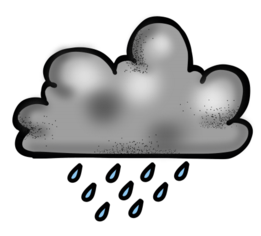
What part of the water cycle does this picture show?
a)
condensation
b)
precipitation
c)
evaporation
46.
Which of these is an example of precipitation?
a)
snow
b)
air
c)
clouds
d)
vapor
47.
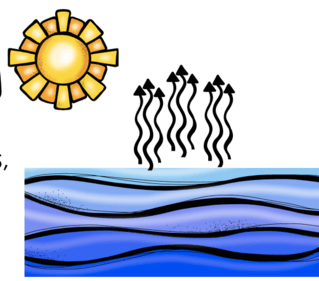
What part of the water cycle does this picture show?
a)
condensation
b)
precipitation
c)
evaporation
48.
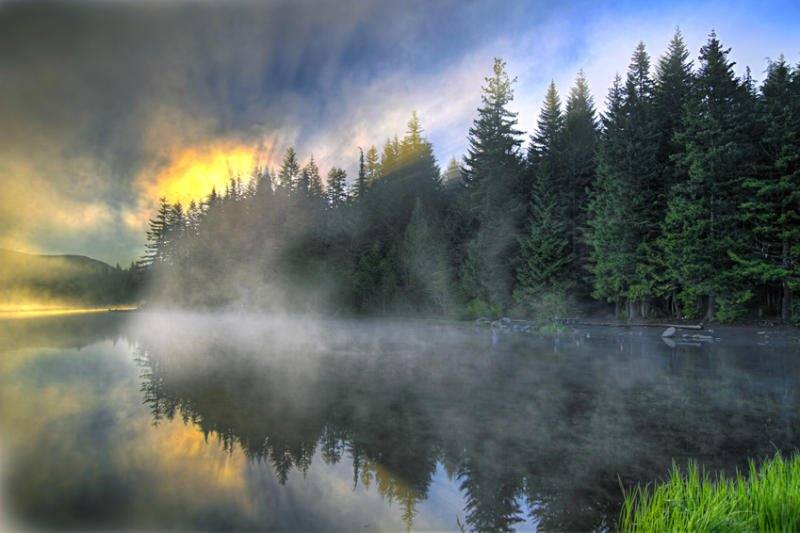
What part of the water cycle does this picture show?
a)
condensation
b)
precipitation
c)
evaporation
49.
What is evaporation?
a)
The part of the water cycle when the sun heats up water, turning it from a liquid into water vapor or steam. It rises from the ground into the air.
b)
The part of the water cycle when the water vapor in the air gets cold. The water turns back into a liquid and forms clouds.
c)
The part of the water cycle when clouds get heavy and can no longer hold the liquid water. This causes the water to fall from the sky to the earth as rain, snow, sleet, or hail.
50.
What is condensation?
a)
The part of the water cycle when the sun heats up water, turning it from a liquid into water vapor or steam. It rises from the ground into the air.
b)
The part of the water cycle when the water vapor in the air gets cold. The water turns back into a liquid and forms clouds.
c)
The part of the water cycle when clouds get heavy and can no longer hold the liquid water. This causes the water to fall from the sky to the earth as rain, snow, sleet, or hail.
51.
What is precipitation?
a)
The part of the water cycle when the sun heats up water, turning it from a liquid into water vapor or steam. It rises from the ground into the air.
b)
The part of the water cycle when the water vapor in the air gets cold. The water turns back into a liquid and forms clouds.
c)
The part of the water cycle when clouds get heavy and can no longer hold the liquid water. This causes the water to fall from the sky to the earth as rain, snow, sleet, or hail.
52.
When water condenses, the water vapor in the air gets ___________ and changes back into liquid.
a)
cold
b)
hot
c)
warm
d)
solid
53.
When water condenses, the liquid water forms ______________.
a)
water vapor
b)
steam
c)
air
d)
clouds
54.
Which best explains why runoff is important?
a)
It returns water to other locations on Earth
b)
It increases the chance of flooding
c)
It makes evaporation occur faster
d)
It increases condensation
55.
What happens after groundwater at the very end/beginning of the water cycle?
a)
Evaporation
b)
Transpiration
c)
Condensation
d)
Groundwater
56.
What is it called when plants give off water vapor as a waste product?
a)
condensation
b)
evaporation
c)
sublimation
d)
transpiration
57.
After the rain falls down onto Earth's surface, what most likely happens?
What is it called?
a)
1. The remains of the water is soaked into the ground.
2.Groundwater
b)
1. Groundwater
2. The remains of the water is soaked into the ground.
c)
1. Groundwater
2. Transpiration happens to the plants.
d)
1. The liquid turns into a gas or water vapor
2. Evaporation
58.
The water cycle is also known as ..........
a)
Hypertonic Solution
b)
Hydrological Cycle
c)
Hyperlogical Cycle
d)
None of these
59.
What do we call water that flows over the ground surface rather than soaking in?
a)
runoff
b)
discharge
c)
recharge
d)
tributary
60.

An underwater rock formation that holds water is a(n)...

a)

watershed

b)

reservoir

c)

aquifer

d)

dam

61.

Earth's water supply is constantly recycled in the _______________

a)

water system

b)

water cycle

c)

water pattern

d)

recycling system

62.
What is water that flows in rivers and streams into the oceans and lakes?
a)
evaporating
b)
condensing
c)
precipitating
d)
runoff
63.

On a summer day, a barometer reading shows an increase in air pressure. The humidity is 30%. Based on these data, what type of weather should be expected for the next day?

a)

Clear and sunny

b)

Cloudy and rainy

c)

Rainy and windy

d)

Cloudy and cold

64.

What kind of weather is a low-pressure system most likely to bring?

a)

Fair weather

b)

Hot, sunny weather

c)

Precipitation (rain or snow)

d)

Light breezes

65.

Which instrument measures air pressure?

a)

sling psychrometer

b)

hygrometer

c)

barometer

d)

anemometer

66.

Which instrument measures temperature?

a)

sling psychrometer

b)

thermometer

c)

barometer

d)

anemometer

67.

At which humidity is it most likely to rain?

a)

50%

b)

20%

c)

77%

d)

99%

68.

What kind of weather is a high-pressure system most likely to bring?

a)

Clear, sunny weather

b)

Hot, sunny weather

c)

Precipitation (rain and snow)

d)

Light breezes

69.
The local meteorologist said that a Continental Tropical (cT) air mass was moving over Tennessee in the next few days. What kind of weather will it possible bring?
a)
Warm, dry weather
b)
Cold, dry weather
c)
Warm, wet weather
d)
Cold, wet weather
70.
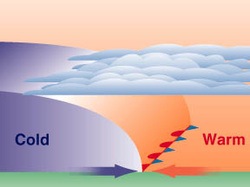
when a warm air mass moves over a cold air mass and sometimes causes light precipitation. What type of front is this describing?
a)
Cold front
b)
Occluded front
c)
Warm front
d)
Stationary front
71.
maritime tropical mT forms above ____ and Near _____
a)
over water and near the poles
b)
over land and near the poles
c)
over water and near the equator
d)
over land and near the equator
72.
continental polar cP forms above ____ and Near _____
a)
over water and near the poles
b)
over land and near the poles
c)
over water and near the equator
d)
over land and near the equator
73.

The local meteorologist said that a maritime polar mP air mass was moving over New Jersey in the next few days. What kind of weather will it possible bring?

a)

Warm, dry weather

b)

Cold, dry weather

c)

Warm, wet weather

d)

Cold, wet weather

74.

Which instrument measures wind speed?

a)

sling psychrometer

b)

hygrometer

c)

barometer

d)

anemometer

75.
a)
Warm Front
b)
High Air Pressure
c)
Cold Front
d)
High Temperatures
76.
a)
Low Clouds
b)
Low Temperatures
c)
Light Wind
d)
Low Air Pressure
77.
a)
High Air Pressure
b)
High Temperatures
c)
Heavy Rain
d)
Hail
78.
a)
High Pressure
b)
Warm Front
c)
Cold Front
d)
Mountains
79.
High Pressure is associated with this type of weather...
a)
Cloudy/Overcast Weather
b)
Cold Weather
c)
Warm Weather
d)
Fair Weather
80.
Low Pressure is associated with this type of weather...
a)
Cloudy/Overcast Weather
b)
Cold Weather
c)
Warm Weather
d)
Fair Weather
81.
A cold front moving into an area can bring this type of weather...
a)
Warmer Temperatures, Clear Skies
b)
Colder Temperatures, Clear Skies
c)
Warmer Temperatures, Clouds
d)
Colder Temperatures, Clouds, and Precipitation
82.
The picture represents the symbol for a _______________________Front.
a)
Cold
b)
Warm
c)
Occluded
d)
Stationary
83.
Which city is experiencing thunderstorms?
a)
Denver
b)
New York 
c)
Miami 
d)
Boise
84.
Which city is closest to a high pressure system?
a)
New York
b)
Miami
c)
Minneapolis
d)
Boise
85.
 Atmospheric pressure begins to fall slowly during the afternoon on a clear summer day. The pressure continues to drop overnight. What kind of weather will most likely occur the next day?
a)
Sunny and warm
b)
Sunny and cold
c)
Cloudy with rain
d)
Cloudy with snow
86.
On a summer evening, a barometer reading shows a gradual increase in air pressure. The humidity is 80%. The thermometer reading is slightly increasing. Based on these data, what type of weather should be expected for the next day?
a)
Clear and sunny
b)
Cool and rainy
c)
Rainy and windyc. Rainy and windy
d)
Cloudy and cold
87.
lightning and thunder may occur
a)
cold front
b)
warm front
88.
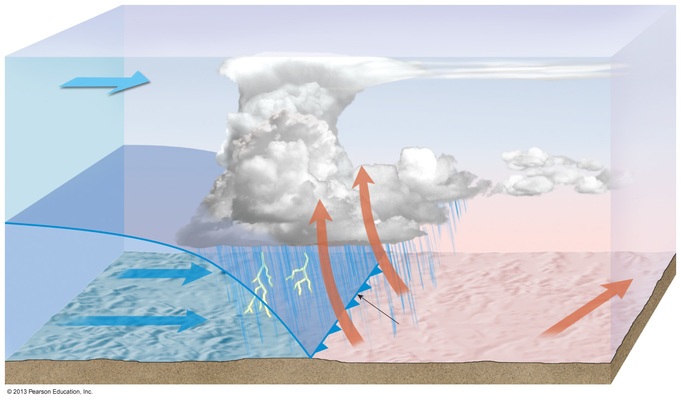
What type of storm front is this? 
a)
warm front
b)
cold front
c)
stationary front
d)
occluded front
89.
Which type of front is pictured?
a)
Cold front
b)
Warm front
c)
Occluded front
d)
Stationary front
90.
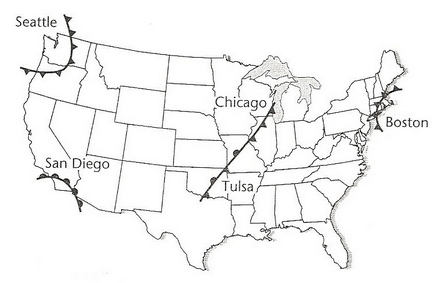
Which type of front is located near Chicago?
a)
warm front
b)
cold front
c)
occluded front
d)
stationary front
91.
This weather instrument is a...
a)
rain gauge
b)
U.F.O.
c)
satellite
d)
anemometer
92.
What kind of weather is usually associated with a high pressure system?
a)
clear, fair, Sunny weather
b)
Precipitation (rain, snow, etc.)
c)
clear, wet, and cloudy
d)
unstable, cloudy, and humid 
93.
A cold front moving into an area can bring this type of weather...
a)
Warmer Temperatures, Clear Skies
b)
Colder Temperatures, Clear Skies
c)
Warmer Temperatures, Clouds
d)
Colder Temperatures, Clouds, and Precipitation
94.
The density of the two air masses are very similar, causing this type of front, which results in the same weather for several days.
a)
warm
b)
cold
c)
stationary
d)
occluded
95.
This type of front can bring strong storms, but then be followed by cooler, clear weather.
a)
cold
b)
warm
c)
stationary
d)
occluded
96.
What kind of pressure predicts clearing skies and dry weather?
a)
high
b)
low
c)
cold
d)
stationary
97.
When a cold front is approaching, what happens?
a)
warm air is pushing under cold air causing dry, fair weather and lower temperatures
b)
warm air rises, cools, and causes rain and thunderstorms
c)
warm air is pushing under cold air causing humid weather and higher temperatures
d)
cold air is pushing warm air up causing rain and thunderstorms
98.
If an air mass is rising, it must be...
a)
cold and less dense
b)
cold and more dense
c)
warm and more dense 
d)
warm and less dense 
99.
If a meteorologist sees that a high pressure system is moving toward Tennessee and the thermometer is increasing, what is a good prediction based on this data?
a)
Fair, clear, and warmer weather
b)
Colder weather with a chance of precipitation
c)
Sunny, clear, and colder weather
d)
Warmer weather with a chance of precipitation
100.
Looking at the weather map. What is the best prediction for Florida's weather in the next day or two?
a)
Cooler temperatures with dry weather 
b)
Cooler temperatures with unstable, wet weather 
c)
Warmer temperatures with dry weather 
d)
Warmer temperatures with unstable, wet weather