
 Worksheets
Intro to Science
Total questions: 96
Worksheet time: 8hrs 0mins
Species on earth have changed over time because some organisms are more likely to survive and to reproduce, passing favorable traits to their offspring.
hypothesis
theory
law
Force = Mass x Acceleration
hypothesis
theory
law
Match the correct IF with the THEN to form a proper hypothesis
Students who eat breakfast
perform better than those that don't
If I do not study
Then I will fail my test
If children play violent games
Then they might show aggression
If local tourism is promoted
Then the economy will benefit
Categorize the Variable characteristics
The cause
The thing you change
The effect
The change that happens
Remains the same
The constants
Does the type of ball affect the bouncing height?
Which hypothesis is correct?
Which hypothesis is correctly written?
I think I will do well on my test today, because I ate a good breakfast.
If I eat a good breakfast, then I will do well on my test today.
If I eat a good breakfast, then I will earn a passing grade on my test today.
If I do well on my test today, I get to out to eat for breakfast.
Which one is a good hypothesis?
If we add more soap to the mixture, then the mixture will bubble over.
We'll add more soap to the mixture, then it will bubble over.
If we add more soap to the mixture, the mixture will bubble over.
Which one is a good hypothesis?
If we mix blue and yellow water together, the water will turn green.
We'll mix blue and yellow water together, then the water will turn green.
If we mix blue and yellow water together, then the water will turn green.
Which one is the best hypothesis?
If we moved one pumpkin into the fridge, then that pumpkin would melt.
If we moved one pumpkin into the fridge, then that pumpkin would turn red.
If we moved one pumpkin into the fridge, then that pumpkin would last longer than the other pumpkins.

A students was doing an experiment using the scientific method. Every three days the student plans to count the green leaves. Which would be a good hypothesis for this experiment?
If plants are placed in direct sunlight, then they will grow more green leaves.
If plants are places in bright light, then they will grow more green leaves than in dim light.
If plants are place in clay pots, then they will grow more green leaves than plastic pots.
If plants are in warmer temperatures, then they will grow more green leaves.
Tamar is talking about evolution with a friend. The friend says, “It’s just a theory, so I don’t believe it. When they prove it and it becomes the law of evolution, then maybe I’ll change my mind.” Which of these possible replies best describes scientific principles or the work of scientists?
Scientific theories do not become scientific laws; they are explanations for natural phenomena based on evidence.
Science always finds the right answer; the answers that scientists and researchers discover never change.
He should be wary of science because it is based on research and evidence, not bias and opinion.
Scientists take each other at their word regarding experimental results, and the public should, too
Which of the following are well supported descriptions about what happens in nature, without attempting to explain why it happens?
Scientific law
Scientific Theory
Both a scientific law and theory
Scientific Observations
Which of the following are well supported descriptions about what happens in nature, without attempting to explain why it happens?
Scientific law
Scientific Theory
Both a scientific law and theory
Scientific Observations
Joe tells Gabby his theory about why sea turtles nest on the beach instead of in the ocean. He says, “The turtle eggs would sink to the bottom of the ocean, and the baby turtle would drown. I know this because my uncle is a fisherman, and he told me this information. Gabby tells Joe that his theory is not scientific. Why does Joe’s idea not meet the requirements to be a scientific theory?
Joe’s idea is already a scientific law.
Joe’s idea is not supported by scientific evidence.
Joe’s idea is a good guess that can be tested by experiments.
Joe and his uncle are not scientists.
general assumptions of how systems work.
mathematical principles that can be proven true.
large amounts of data collected over time.
observations from within only one scientific discipline.
Scientific theory
Explains why or how something happens in nature
Scientific law
Describes what happens in nature
Scientific model
representation of a real event
Hypothesis
a proposed explaination, starting point of an experiment

Which statement best describes the nature of science?
The nature of science is for scientists to prove that their hypotheses are correct.
The nature of science is to recreate nature in the laboratory.
The nature of science is for scientists to prove their point of view is correct.
The nature of science is to investigate and understand the natural world and to use this understanding to make useful predictions.

A tentative and TESTABLE explanation for an observation.
An "IF..THEN" statement
Inference
Independent Variable
Hypothesis
Dependent Variable
The group that does not receive the experimental treatment.
Constants
Control Group
Experimental Group
Variable
Data based on physical descriptions.
Ex. Red, Blue
Qualitative Data
Quantitative Data
Hypothesis
Homeostasis
Number based data
Ex. 5 mL or 7 mL
Quantitative Data
Conclusion
Qualitative Data
Single Variable
The variable that the scientist changes in an experiment.
Independent Variable
Dependent Variable
Control Group
Constant
The effect or outcome of an experiment. What is measured in an experiment.
Contant
Independent Variable
Dependent Variable
Control Group

What is the dependent variable?
Height (cm)
Location of Plant
Day(s)
Type of Plant

What is the independent variable?
Height (cm)
Location of Plant
Day(s)
Type of Plant
Explains a broad range of information
Ex. Evolution
Law
Theory
Hypothesis
Observation
Precise and usually a formula. Based on Facts
Ex. Gravity, E=mc^2
Law
Theory
Observation
Inference

Based on this graph, which statement would be the best conclusion about the effect of temperature on bacterial growth?
The highest rate of bacterial growth is around 25 °C
The highest rate of bacterial growth is around 35 °C
The highest rate of bacterial growth is around 45 °C

Having an experiment repeated by others is called ?
Repetition
Replication
Experiment
When you do many trails during an experiment then it is called
Variables
Test
Repetition
Explaining why theories change
For what reasons could a theory be changed or replaced? Check all that apply.
New technology is developed that provides more information about the theory.
New experimental methods are designed to test a theory
A new, untested hypothesis is proposed
New information is discovered that does not support the theory
Which statements correctly describe theories? Check all that apply
Theories result from several repeated experiments
Theories cannot predict what may happen in the future
Theories explain observations and hypotheses
Theories may be revised over time.
Which statements correctly describe laws? Check all that apply.
Laws are created based on repeated experimentation.
Laws are based on observation.
Laws can be changed or replaced.
Laws are factual statements
Atomic theory, which describes the atoms that make up matter, has been explored for centuries. Scientists in Ancient Greece first proposed that matter was made of units called atoms. For many years, scientists thought atoms were solid and could not be divided. Then, in the nineteenth century, scientists began to discover the particles that make up atoms. Modern techniques have allowed scientists to split atoms into increasingly smaller particles. Which of the following statements about theories is supported by the history of the atomic theory?
If new evidence contradicts earlier theories, it is a result of an experimental error
Experiments with modern equipment can not be used to support earlier theories
A theory is discarded when new evidence contradicts a part of the theory.
Theories can change in response to new evidence

Which choice best explains why the scientific model of the atom has changed over time?
The discovery of new evidence resulted in changes to the atomic theory.
Advancements in atomic models proved the atomic theory was accurate.
The atomic theory was modified with the discovery of a new element.
Changes in atomic models show that the atomic theory was based on opinion.
Having an experiment repeated by others is called ?
Repetition
Replication
Experiment


Look at the bar graph. Can you tell what the bar graph measures?
Kilowatts used by appliances per day
Average Hours appliances were used per day
Number of hours each appliance was used per day
Hours appliance used monthly

Which month had the greatest number of books read?
November
December
January
February
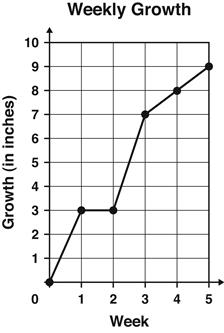
The graph shows the number of inches a plant grew each week.
Between which 2 weeks did the plant grow the MOST?
Week 1 and Week 2
Week 2 and Week 3
Week 3 and Week 4
Week 4 and Week 5


Which month did the restaurant sell 40 pizzas?
March
May
July
August
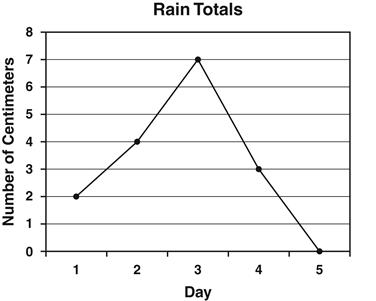
How many centimeters of rain fell on the third day?
2
3
4
7
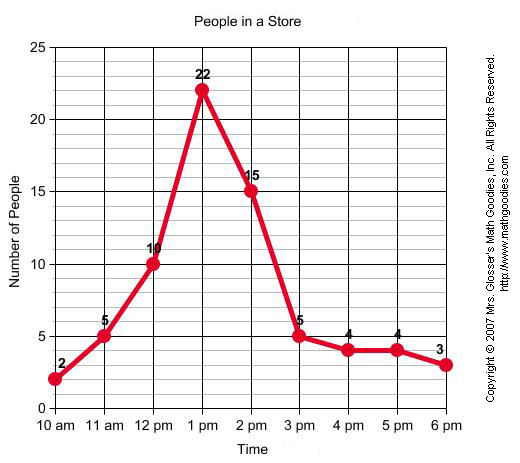


Which is true using this graph?
most kids ride their bikes
most kids walk or skate
most kids ride the bus
there are 3 kids who get picked up by their parents


What is the difference between the number of frogs in the pond when the rainfall was 5cm and when the rainfall was 20cm?
20
40
50
60
A wildlife scientist studies the behaviors of frogs in South American rainforests. The scientist wants to study the frog behaviors in January and August and see the differences. Which type of investigation is this?
observational investigation
experimental investigation
comparative investigation
hypothesis investigation
Collecting data to make conclusions about a natural or man-made things.
observational investigations
experimental investigations
comparative investigations
hypothesis investigations
Collecting data on different things or under different conditions to make a comparison.
Comparative Investigation
Experimental Investigations
Observational Investigations
Hypothesis Investigations
A chemist observes the element oxygen and describes its structure.
Comparative Investigation
Experimental Investigation
Observational Investigation
Hypothesis Investigation
Collecting data on different things or under different conditions to make a comparison.
Comparative Investigation
Experimental Investigations
Observational Investigations
Hypothesis Investigations
Mark wanted to find out if salt water evaporates faster than pure, fresh water. He formulated a hypothesis and then placed 100 mL of fresh water in a beaker. He placed 100 mL of salt water in another beaker. He placed both beakers on the same hot plate. Mark then watched the beakers and timed how long it took the water to evaporate. He then analyzed or studied and recorded the results. Which type of scientific investigation did Mark use?
Comparative Investigation
Observational Investigation
Experimental Investigation
Hypothesis Investigation
An example of an observational investigation would be -
investigating how light affects plant growth under controlled conditions.
Testing the gas mileage of a dimpled car compared to a regular car.
Studying the different species of sharks that live in the Gulf of Mexico.
In the experiment that tests if talking to plants makes them grow taller...
identify the independent variable.
Plant Height
Talking
Soil, Sunlight, Water, Air, Temperature
In the experiment that tests if talking to plants makes them grow taller...
identify the dependent variable.
Plant Height
Talking
Soil, Sunlight, Water, Air, Temperature
Students observe plant and animal cells under the microscope and use a Venn diagram to compare what they observe.
Descriptive
Comparative
Experimental
How are EXPERIMENTAL and OBSERVATIONAL investigation similar?
They both require a question that can be researched, a hypothesis and procedures.
They both require a question that can be researched, procedures and a conclusion
They both require a hypothesis, and procedures.
Gab wants to weigh in on which gym provides better service, the one near his home or the one near his school.
comparative
observational
experimental
Can plants grow in zero gravity?
experimental
observational
comparative
How does temperature affect the growth of plants?
experimental
observational
comparative
You are curious whether the temperature of the environment would affect the growth of bacteria.
experimental
observational
comparative
The purpose of a EXPERIMENTAL investigation is to determine cause and effect relationships.
TRUE
FALSE
OBSERVATIONAL investigation is generally used when LITTLE IS KNOWN.
TRUE
FALSE

