
 Worksheets
Hydrology Test Review
Total questions: 101
Worksheet time: 1hrs 5mins
Which of the following is MOST true about saltwater?
It is less dense than freshwater.
It is more dense than freshwater.
It has the same density as freshwater.
It has no density.
When it rains, a portion of the water seeps into the ground to replenish the Earth's
unsaturated zone.
water table.
permeability.
groundwater (aquifers).
What is the relationship between salinity and the density of water?
The density of freshwater is exactly the same as the density of saltwater
As the salinity decreases, the density increases
As the salinity increases, the density increases
Density and salinity are not related
Which natural force creates surface currents?
Gravity
Wind
Sunlight
Waves
What is the energy source for the water cycle?
Wind from the Earth's rotation
Heat from the sun
Gravity from the moon
Heat from the Earth's core

What two elements are the most abundant in salt water in the ocean?
Acid Rain
magnesium and calcium
Chloride and Sodium
Condesation of lakes and rivers

The section of the ocean floor that is flat and extends from the shore to beneath the ocean ?
continental slope
abyssal plain
deep ocean trench
continental shelf

Which process in the water cycle happens when cool air causes water vapor to change to liquid water ?
condensation
evaporation
transpiration
infiltration
What happens to the temperture and pressure as you descend to the bottom of the ocean?
temperature increases and pressure decreases
temperature decreases and pressure increases
temperature and pressure increase
temperature and pressure decrease
Where would you find the greatest pressure?
Abyssal plain
Continental shelf
Continental slope
Ocean Trench

What feature of the ocean floor forms at a subduction zone and creates the deepest location in the ocean?
continental shelf
continental slope
ocean trench
abyssal plain
As water gets denser, how does it move?
Rises to the surface
Sinks to the ocean floor
Moves toward the poles
Moves toward the equator
Which of the followign causes ocean waves?
gravity
coriolis effect
nekton
wind
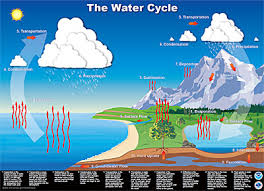
Which stage in the water cycle happens when liquid water heats up and turns into vapor?
condensation
evaporation
precipitation
run off

Which type of water accounts for 97% of all water?
Saltwater
Freshwater
Glaciers
groundwater (aquifers)

Where is the most freshwater found on Earth?
Surface water like lakes and rivers
glaciers
oceans
ground water (aquifers)

What happened to the total amount of water during the experiment?
the amount of water stayed the same even though the evaporation stage turned it into water vapor the condensation stage turned it back into liquid water.
the amount of water decreased because the evaporation stage got rid of all the water.
Saving water is called conservation. Choose the reason that drinkable water is becoming more scare.
Agriculture
Growing population of people
Aquifers are getting emptied
All of the above

The mostly flat section from the shoreline (beach) into the shallow ocean.
Continental divide
Continental Shelf
Continental Slope
Continental Margin

The large flat, almost level area of the ocean floor
Guyot
Ocean Floor
Abyssal Plain
Seamount

Huge cracks in the ocean floor that create the deepest part of the ocean.
Mid-ocean Ridge
Ocean Trench
Guyot
Seamount

The cause of waves at the surface of the ocean
Boats
Wind
Marine life
Geothermal energy

Cause of deep ocean currents
Differences in Density caused by temperature and salinity
Wind blowing across the surface of the ocean
Volcanic Activity
Gravity

A large stream of water moving through an ocean
Wave
Tide
Current
Wake


When water vapor turns into water droplets on the outside of a glass because of cooling
evaporation
condensation
melting
boiling

When a liquid transforms into a gas as a result of heating
Evaporation
Condensation
Melting
Sublimation
Rain, snow, sleet, hail
Evaporation
Condensation
Precipitation
Specific Heat
The journey that water takes as it circulates from the land to the sky and back down to the land again without losing any water.
Water cycle
Precipitation
Salinity
Hydrosphere
The _____ powers, or drives, the water cycle
Moon
Gravity
Sun
Earth
An aquifer stores.....
Surface Water
Groundwater
Oil
Natural Gas

Your mom got a really high water bill because too much water got used, why would it be important to check the house for water leaks?
to avoid a house fire
so she does not get a ticket
to conserve drinking water that is being wasted
so she does not get reported to the water police
Jon is boiling a pot of water on the stove. The stove adds energy to the water until it becomes ____ ______, the gaseous form of water.
water vapor
ice
snow
carbon dioxide
What two things affect the density of water causing it to sink deeper in the ocean?
temperature increases and salinity decreases
both temperature and salinity increase
temperature decreases and salinity increases
both temperature and salinity decrease

which of the following would create a cloud?
water pressure heating and condensing
air pressure increasing
warm air cooling and condensing
cool air heating and condensing
When water vapor (gas) changes to a liquid
evaporation
condensation
precipitation
infiltration
Which of the following describes tides?
the daily rise and fall of the ocean levels cause by gravitational pull of the moon and sun on earth
the movement of energy through water
the stream like movement of water through a larger body of water
the ongoing cycle of water from the land to the atmosphere back to the ocean/land
Which of the following describes waves?
the daily rise and fall of the ocean levels cause by gravitational pull of the moon and sun on earth
the movement of energy through water caused by the wind
the stream like movement of water through a larger body of water
the ongoing cycle of water from the land to the atmosphere back to the ocean/land
Which of the following describes currents?
the daily rise and fall of the ocean levels cause by gravitational pull of the moon and sun on earth
the movement of energy through water
the stream like movement of water through a larger body of water
the ongoing cycle of water from the land to the atmosphere back to the ocean/land
Which of the following describes the water cycle?
the daily rise and fall of the ocean levels cause by gravitational pull of the moon and sun on earth
the movement of energy through water
the stream like movement of water through a larger body of water
the ongoing cycle of water from the land to the atmosphere back to the ocean/land without the loss of any water
As the moon revolves around the earth, the water follows the motion and causes...
sea levels
waves and currents
moon phases
high tides and low tides
____ ____ occur in the spaces between the high tides.
High tides
Medium tides
Low tides
Super tides

The bulges that occur in the Earth's oceans are called ______ _______.
low waters
low tides
high tides
big dips

As the _____ revolves around the Earth and Earth rotates, the tidal bulge moves around the Earth.
sun
ocean
Earth
moon

The tidal bulge follows the movement of the _____.
moon
sun
Earth
ocean
______ causes deep ocean currents
The Coriolis Effect
gravity
wind
density differences
Decreasing ocean temperature causes the density of the water to ______.
decrease
increase
stay the same
fluctuate
Warming ocean water rises because the density
increases
stays the same
decreases
Cold ocean currents generally come from
The North Pole
The South Pole
The Equator
Both the North and the South Pole
The __________ is a surface current that flows along the eastern US and brings warm water to Europe.
California Current
Gulf Stream Current
North American Gyre
Arctic Current

Deep Atlantic Currents are formed largely as a result of
erosion by surface winds
heating of surface water
the rotation of the Earth
denser water sinking
What phase of the water cycle causes salinity to increase?
Evaporation
Condensation
Precipitation
run-off
What phase of the water cycle causes salinity to decrease?
Transpiration
Evaporation
Precipitation
Condensation
What happens to the salinity of the ocean near fresh water like a river delta?
Salinity Increases
Salinity Decreases
What type of day would create the largest waves?
Sunny day
Windy day
Hot day
Cold
Why do objects sink or float in water?
Because their densities are higher or lower than compared to water
Because their densities are using gravity to pull down
Because their densities are heavier or lighter
Because their mass and volumes are equal

Why does an egg float in a glass of salt water?
the egg is more dense than the salt water
the salt water is more dense than the egg
the salt water is more dense than the glass
the egg is more dense than the glass

The water is ______ dense than the boat causing the boat to float on the water.
more
less

Why does the egg not sink or float?
it is more dense than the water
it is less dense than the water
it has the same density as the water
it is light

What causes an object to sink in a water?
if the object's density is less than the water's density.
if the object's density is the same as water's density.
if the object's density is greater than water's density.
if the object's density is zero
An object will float in a liquid if it is
cooled to the same temperature.
heated to the same temperature.
less dense than the liquid.
more dense than the liquid.
When the density of a substance is lower than the density of water the substance _____________ in water.
Sinks
Floats
When the density of a substance is higher than the density of water the substance ______________ in water.
Sinks
Floats

