wayground logo

Free Printable Worksheets

Font size

S
M
L
XL
Worksheets

Light and Sound Waves

Total questions: 101

Worksheet time: 1hrs 6mins

Name
Class
Date
1.
The bending of a wave due to a change in its speed is
a)
interference
b)
reflection
c)
diffraction
d)
refraction
2.
The interaction between waves that meet is
a)
reflection
b)
diffraction
c)
refraction
d)
interference
3.
The ability of a medium to bounce back after being disturbed is called
a)
echolocation
b)
elasticity
c)
density
d)
interference
4.
Which property of sound describes your perception of the energy of a sound?
a)
loudness
b)
intensity
c)
pitch
d)
wave speed
5.
The electromagnetic waves with the longest wavelengths and lowest frequencies are
a)
radio waves.
b)
infrared rays.
c)
X-rays.
d)
gammy rays.
6.
When scientists talk about white light, they areMOST likely referring to light that is
a)
a combination of all of the colors in the visible region of the electromagnetic spectrum.
b)
the unabsorbed refracted light produced by a black light.
c)
the narrow band corresponding to white light in the electromagnetic spectrum.
d)
a combination of all the types of electromagnetic radiation.
7.
Which of the following statements BEST describes visible light?
a)
Light is an electromagnetic wave of a single frequency that makes up a small part of the electromagnetic spectrum.
b)
Light is an electromagnetic wave of a single frequency that makes up most of the electromagnetic spectrum.
c)
Light includes a range of electromagnetic waves that make up a small part of the electromagnetic spectrum.
d)
Light includes a range of electromagnetic waves that make up most of the electromagnetic spectrum.
8.
Which color of light is produced when all of the colors of visible light in the electromagnetic spectrum are combined?
a)
gray
b)
white
c)
black
9.
Light waves are arranged in the electromagnetic spectrum by
a)
wavelength and brightness.
b)
speed and color.
c)
brightness and color.
d)
wavelength and frequency.
10.
Which of these colors of visible light has the shortest wavelength?
a)
red
b)
green
c)
violet
d)
yellow
11.
As the loudness of a sound wave increases, which will also increase?
a)
amplitude
b)
frequency
c)
velocity
d)
wavelength
12.
If a student playing the drums hits the drums with greater force, the sound would be
a)
quieter
b)
louder
c)
lower in pitch.
d)
higher in pitch.
13.
An echo is a sound wave that has been
a)
absorbed.
b)
refracted.
c)
scattered.
d)
reflected
14.
A fifth-grade student fastened a piece of cardboard to his bicycle wheel so that the spokes would cause the card to vibrate. When the student rode the bike fast, the student heard a high pitch. When the student rode the bike slowly, the student heard a low pitch. Which BEST explains why the student heard both high and low pitches from the cardboard?
a)
The vibrations were faster when the student rode slowly.
b)
The vibrations were slower when the student rode faster.
c)
The cardboard vibrated at the same speed.
d)
The cardboard vibrated at different speeds.
15.
When a transverse wave passes from right to left through a medium, what happens to the particles of the medium?
a)
Particles travel from right to left along the wave.
b)
Particles move back and forth parallel to the wave.
c)
Particles travel from left to right along the wave.
d)
Particles move back and forth perpendicular to the wave.
16.
Which is a source of sound?
a)
thermal energy
b)
potential energy
c)
a vibration
d)
a medium
17.
which material does sound travel the fastest?
a)
solid 
b)
liquid 
c)
gases
18.
When Mrs. Daniel is talking out loud in the hall and our classroom door is open.  We are allow to hear her because of the bending of waves around a barrier which is called
a)
amplitude
b)
hertz
c)
diffraction
d)
wavelength
19.
When a wave strikes and object and bounces off. (example echo)
a)
medium
b)
refraction
c)
reflection
d)
interference
20.
When a wave bends as it passes through at an angle from one medium to another.(example: pencil in a glass of water-)
a)
medium
b)
refraction
c)
reflection
d)
interference
21.

Why does sound move faster through a solid than through a gas?

a)

atoms are closer together in solids

b)

longitudinal sound waves carry more energy through a solid

c)

Sound waves move away from their source in every direction

d)

Sound moves faster sideways than up or down

22.

What kind of wave travels the fastest

a)

sound wave

b)

water wave

c)

light wave

d)

microwave

23.

How are sound waves different from light waves?

a)

sound waves send signals to the brain through a special nerve

b)

sound waves need a medium, such as water or metal, to move through.

c)

sound waves move energy through space and time

d)

sound waves are part of the electromagnetic spectrum

24.

Which cup is opaque?

a)
b)
c)
25.

Which cup is translucent?

a)
b)
c)
26.

Which cup is transparent?

a)
b)
c)
27.
The distance between the line of origin to the top of the wave is called
a)
amplitude
b)
wavelength
c)
frequency
d)
speed
28.
True or false: The angle of incidence equals the angle of reflection.
a)
True
b)
false
29.
If the wavelength increased, what would happen to the sound made by this wave?
a)
it would get softer
b)
it would get louder
c)
it would have a lower pitch
d)
It would have a higher pitch
30.
Concave or Convex?
a)
Concave
b)
Convex
31.
The bending of a wave as it travels from one medium to another and as a result changes speed is called
a)
reflection
b)
refraction
c)
diffraction
d)
interference
32.
Two waves combining to form a wave with a larger amplitude results in
a)
constructive interference
b)
destructive interference
33.
The Tacoma Narrows Bridge was opened to traffic on July 1, 1940 and collapsed on November 7, 1940. One theory created for the bridge's failure is that the pressure of the wind caused the natural frequencies of the bridge to move. This condition is called —
a)
amplification
b)
reflection
c)
diffraction
d)
resonance
34.
Which electromagnetic wave has the shortest wavelength?
a)
radio
b)
gamma
c)
visible
35.
When a wave strikes a surface and does not reflect it _____
a)
 is destroyed.
b)
 is absorbed.
c)
 has changed wavelength.
d)
has changed frequency.
36.
—Constructive interference results in —____.
a)
larger amplitude.
b)
larger frequency.
c)
lower amplitude.
d)
lower wavelength
37.
—As a firetruck passes, the pitch of the siren changes. This is an example of what process?
a)
Refraction
b)
Diffraction
c)
Doppler Effect
d)
Reflection
38.
A light ray reflects from a mirror.  If the ray strikes the mirror at an angle of 30° with the normal, the reflected ray would leave at an angle of ____.
a)
60°
b)
90°
c)
120°
d)
30°
39.
As the fire truck passes, you would expect the sound frequency to appear to
a)
increase.
b)
decrease.
c)
stay the same.
d)
vary.
40.
White light from the sun strikes a piece of green cellophane.  What color is transmitted (not absorbed) by the cellophane?
a)
red
b)
green
c)
blue
d)
all colors
41.
Noise cancelling headphones take advantage of what process to reduce background noise?
a)
destructive interference
b)
constructive interference
c)
diffraction
d)
refraction
42.
Sound will usually travel the fastest in a ____________.
a)
vacuum
b)
solid
c)
liquid
d)
gas
43.
 If a material absorbs all frequencies of light waves EXCEPT green, what color will be perceived by the observer? 
a)
Green
b)
White
c)
Black
d)
Yellow
44.
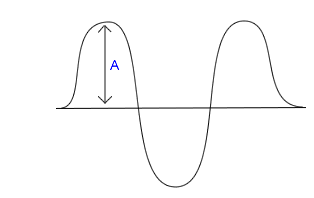
If the distance represented by the letter A were increased, how would it change the way the sound was heard?
a)
The sound would be higher. 
b)
The sound would be lower. 
c)
The sound would be softer. 
d)
The sound would be louder. 
45.
Which of the following can sound travel through?
a)
solid
b)
liquid
c)
gas
d)
all of the above
46.
Where is a place a person would hear no sound?
a)
in a cave
b)
in a forest
c)
in space
d)
in water
47.
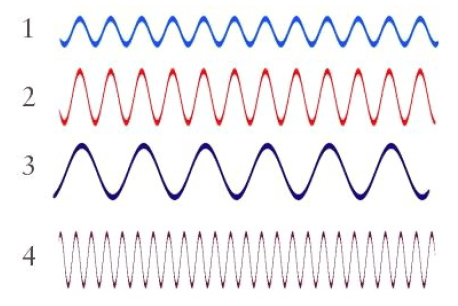
This is a wave pattern diagram for two transverse waves.
How do the waves compare?
a)
Both waves have the same frequency.
b)
Both waves have the same wavelength.
c)
Wave 1 has a longer wavelength than Wave 2.
d)
Wave 1 has a higher frequency than Wave 2.
48.
A high soprano singer can break a crystal glass if the glass resonates with her voice. In order to do this, the sound the singer makes has to be —
a)
speeded up before reaching the glass
b)
amplified before reaching the glass
c)
reflected off the glass
d)
able to vibrate the glass 
49.
Which of these transmits sound the fastest?
a)
Water in a pool
b)
A metal rod
c)
Air in a balloon
d)
Empty space
50.
During a thunderstorm, you see the lightning before you hear thunder. This is because —
a)
light has a greater mass than sound
b)
sound has longer wavelengths than light
c)
light travels faster than sound 
d)
sound and light travel at the same speed
51.
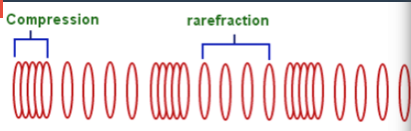
A student used a coiled children's toy to show the class about sound waves.  What did he demonstrate?
a)
light
b)
radio
c)
compression
d)
x-ray
52.

The larger the amplitude, the less energy

a)

true

b)

false

53.
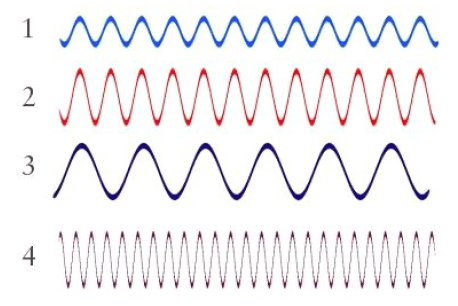
Which wave in the diagram has the greatest frequency?
a)
1
b)
2
c)
3
d)
4
54.
Which wave in the diagram has the greatest wavelength?
a)
1
b)
2
c)
3
d)
4
55.

Loudness is?

a)

how well a sound is heard

b)

how low a sound is

c)

how high a sound is

d)

how frequent a sound occurs

56.
The two waves above are traveling at the same speed. Which statement best describes the difference between the waves?
a)
Wave A has a higher frequency than wave B.
b)
Wave A has a lower frequency than wave B
c)
Wave A has a higher amplitude than wave B.
d)
Wave A has a lower amplitude than wave B.
57.
What is the main difference between mechanical waves and electromagnetic waves?
a)
Mechanical waves are produce by charged particles, and electromagnetic waves transfer energy through matter.
b)
Electromagnetic waves transfer energy, but mechanical waves do not.
c)
Mechanical waves transfer energy through matter, and electromagnetic waves are produced by vibrating charges.
d)
Mechanical waves transfer energy, but electromagnetic waves do not.
58.
When the wavelength of a sound is increased, its
a)
Frequency will increase.
b)
Pitch will become higher
c)
Frequency will decrease
d)
Amplitude will increase
59.
Which diagram of a sound wave represents the sound with the highest pitch?
a)
A
b)
B
c)
C
d)
D
60.
High Amplitude =__________________
a)
Louder sounds
b)
Quieter Sounds
61.
Low Amplitude = ______________
a)
Quieter Sounds
b)
Louder sounds
62.
Low frequency = _______ Pitch
a)
Low
b)
High
63.
High frequency = _______ Pitch
a)
High
b)
Low
64.
The Doppler effect can cause an apparent change in...
a)
loudness
b)
intensity
c)
pitch
d)
reasonance
65.
The speed of a sound wave depends on
a)
the frequency
b)
the medium
c)
both air temperature and medium
d)
the air temperature
66.
As a sound source approaches and then moves past a stationary observer, the observer will hear
a)
a steady rise in pitch
b)
a sudden drop in pitch
c)
a drop in pitch, then a rise in pitch
d)
a rise in pitch, then a drop in pitch
67.
Which wave has a greater frequency?
a)
A
b)
B
68.

Light is refracted and spread out by a ____.

a)

concave lens

b)

convex mirror

c)

concave mirror

d)

convex lens

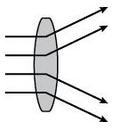
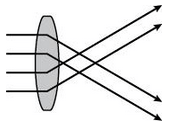
69.

Which lens represents the path light takes through a concave lens?

a)
b)
c)
d)
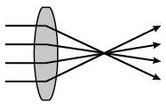
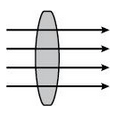
70.

Which figure represents the path light takes through a convex lens?
a)
b)
c)
d)
71.

Which of the following properties makes a light wave different from a mechanical wave?

a)

A light wave slows down in a vacuum

b)

A light wave is able to transmit energy

c)

A light wave exists as a transverse wave

d)

A light wave can travel without a medium

72.

A reflected light ray makes an angle of 60 degrees with a mirror's surface. What angle did the incoming light ray form with the mirror's surface?

a)

30

b)

60

c)

90

d)

180

73.
What is X?
a)
22.5°
b)
45°
c)
67.5°
d)
90°
74.
_____ is a lens that is thicker in the middle and makes an object appear bigger.
a)
prism
b)
convex lens
c)
concave lens
d)
mirror
75.

_____?_____ materials allow SOME light waves to pass through, but not in a straight path.

a)

Opaque

b)

Transparent

c)

Translucent

76.

_____?______ materials do not allow ANY light waves to pass through.

a)

Opaque

b)

Transparent

c)

Translucent

77.

_____?_____ materials allow ALL light waves to pass through easily.

a)

Opaque

b)

Transparent

c)

Translucent

78.

The volume of a sound corresponds to the

a)

amplitude

b)

frequency

c)

wavelength

79.

The pitch of a sound corresponds to the

a)

amplitude

b)

frequency

c)

wavelength

80.

Between waves B and D, which is louder?

a)

Wave B

b)

Wave D

81.

The pitch of a sound corresponds to the

a)

amplitude

b)

frequency

c)

wavelength

82.

Between waves F and G, which is lower in pitch?

a)

Wave F

b)

Wave G

83.

When you yell in a canyon, you hear an echo of your voice. Why is this?

a)

The sound waves are absorbed by the walls of the mountains.

b)

The sound waves are reflected by the walls of the mountians.

c)

The sound waves are transmitted through the walls of the mountains.

84.

In movie theaters, they build the walls between theaters with materials that block the sounds from traveling to the next theater. What material would be best?

a)

Materials that transmit sound waves.

b)

Materials that absorb sound waves.

85.

Which letter shows a wave being reflected?

a)

A

b)

B

c)

C

86.

Which letter shows a wave being transmitted?

a)

A

b)

B

c)

C

87.

Electromagnetic waves ________ a medium to travel through, while mechanical waves ___________ a medium.

a)

do not need/need

b)

need/do not need

88.

The brightness of a light corresponds to the

a)

amplitude

b)

frequency

c)

wavelength

89.

The color of a light corresponds to the

a)

amplitude

b)

frequency

90.

Between waves B and D, which is brighter?

a)

Wave B

b)

Wave D

91.

Below are two waves. Based upon their properties, what color light is Wave 1?

a)
b)
92.
Visible light is which type of wave?
a)
seismic
b)
mechanical
c)
longitudinal
d)
electromagnetic
93.
Waves transfer
a)
water. 
b)
wind. 
c)
energy. 
d)
particles. 
94.
Sound travels as a ___________ wave. 
a)
longitudinal
b)
transverse
c)
water
d)
slinky
95.
Sound travels as a ___________ wave. 
a)
longitudinal
b)
transverse
c)
water
d)
slinky
96.
If you see an object as orange,
a)
it is absorbing orange light and reflecting all other colors. 
b)
it is reflecting all colors. 
c)
it is absorbing all colors. 
d)
it is reflecting orange light and absorbing all other colors. 
97.
A sound wave can travel through a vacuum or empty space.
a)
True
b)
False
98.
A sound wave requires a medium, or material to travel through.
a)
True
b)
False
99.
A green plant appears green because it is absorbing all colors except
a)
yellow.
b)
blue.
c)
red.
d)
green.
100.
As frequency _____, pitch _____.
a)
rises, falls
b)
decreases, increases
c)
increases, decreases
d)
increases, increases
101.
The bending of waves as they pass from one substance into another.
a)
Reaction
b)
Reflection
c)
Refraction
d)
Repost