wayground logo

Free Printable Worksheets

Font size

S
M
L
XL
Worksheets

PMA/CFE Test Review for 1st and 2nd Quarter

Total questions: 93

Worksheet time: 1hrs 21mins

Name
Class
Date
1.

Jonathan and Sarah have performed an experiment and are not sure their results are valid. What should they do to check their results?

a)
average their data
b)
change their lab report
c)
perform a new experiment
d)
repeat the same experiment
2.
The factor in an experiment that will be changed. 
a)

dependent or outcome variable

b)

independent or testing variable

c)
controlled variable
d)
inferences 
3.
You use your five senses to describe something
a)
observation
b)
prediction
c)
experiment
d)
conclusion
4.
This variable is the actual data collected during the experiment. 
a)

independent or testing variable

b)

dependent or outcome variable

c)
control group
d)
data group
5.

What is an inference?

a)

Just a guess.

b)

A guess based on observations.

c)

The same as an observation.

d)

Examples of something.

6.
Which statement is an observation?
a)
That house is empty because there are no lights on. 
b)
Her hair is brown. 
c)
Her hair is brown because she dyed it. 
d)
Her hair has not been cut in two years. 
7.

Theory or Law??? What Is a well-tested EXPLANATION for a wide range of observations and experimental results.

a)

Law

b)

Theory

8.

Theory or Law??? Is a DESCRIPTION of what scientists determine to happen every time under a certain set of conditions.

a)

Law

b)

Theory

9.
Which of the following statements is an inference about the picture
a)
The vase is broken.
b)
The girls' bow is blue and purple.
c)
The girl broke the vase.
d)
The girl has blonde hair.
10.
There are fourteen penguins.
a)
Observation
b)
Inference
11.
More penguins are going to jump in next.
a)
Observation
b)
Inference
12.
Energy due to motion is ____________ energy. 
a)
Potential 
b)
Energy
c)
Kinetic
d)
Friction
13.
The faster an object moves, the ________ kinetic energy it has. 
a)
more
b)
less
c)
none of the above
d)
all of the above 
14.
__________ is stored energy. 
a)
Potential
b)
Kinetic
c)
None of the above 
d)
All of the above 
15.

Potential energy depends on the ________ and ________ of the object.

a)

Height and mass

b)

Friction and movement

c)

Mass and Movement

d)

Height and Friction

16.
What kind of energy is in a rock at the edge of a cliff?
a)
Potential
b)
Kinetic
17.
What kind of energy is in a moving skateboard?
a)
Potential
b)
Kinetic
18.
Energy can not be created or destroyed, only converted from one form to another.
a)
true
b)
false
19.
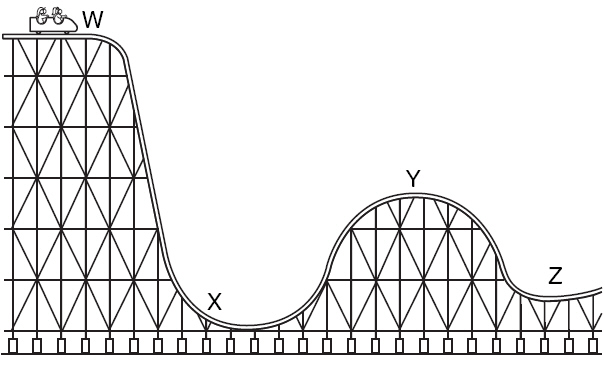
At which point is potential energy greatest?
a)
W
b)
X
c)
Y
d)
Z
20.
At which point is kinetic energy greatest? 
a)
W
b)
X
c)
Y
d)
Z
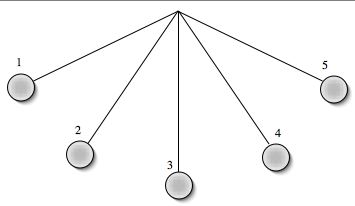
21.
When a pendulum swings, at which point is kinetic energy highest?
a)
1
b)
2
c)
3
d)
4
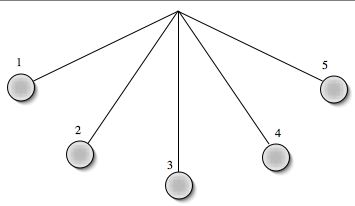
22.
When a pendulum swings, at which point is potential energy at its greatest?
a)
1
b)
2
c)
3
d)
4
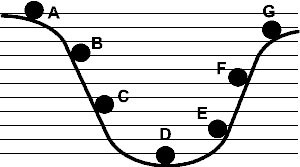
23.

Which point has the least potential energy?

a)

G

b)

a

c)

c

d)

d

24.

Increasing an object's mass will increase its kinetic energy.

a)

True

b)

False

25.

What 2 factors affect an object's kinetic energy?

a)

area and volume

b)

weight and height

c)

mass and height

d)

speed and mass

26.

If the net force on an object is zero, what can you

conclude?

a)

The object is not moving.

b)

The object is slowing down.

c)

The object is moving fast.

27.
What is the net force?
a)
40 N left
b)
0 N Balalnced
c)
400 N right
d)
40 N right
28.
What is the net force?
a)
30 N left
b)
25 N right
c)
5 N left
d)
55 N right
29.

You and your dad are moving the couch from one side to another. Your dad pushes with a force of 35 N to the right and you push with a force of 25 N right. What is the net force on the couch?

a)

60 N right

b)

10 N left

c)

10 N right

d)

60 N left

30.
The sum of all forces acting on an object and direction
a)
Contact Force
b)
Balanced Force
c)
Unbalanced Force
d)
Net Force
31.
Are forces balanced or unbalanced when a marble rolls down a ramp?
a)
Balanced
b)
Unbalanced
32.
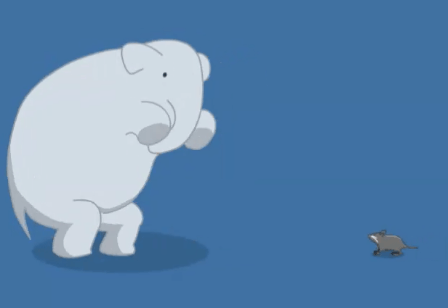
Which objects have a STRONG force of gravity?
a)
Objects with GREATER mass, like elephants
b)
Objects with LESS mass, like mice
33.
Forces that do not need to touch to exert force
a)
Unbalanced Force
b)
Contact
c)
Balanced Force
d)
Non-contact Force
34.
A push or pull
a)
Force
b)
Motion
c)
Position
d)
Displacement
35.
The force that one surface exerts on another when the two rub against each other
a)
Electrical 
b)
Magnetic
c)
Gravitational 
d)
Friction
36.
Force that resists the motion of two surfaces that are touching each other.
a)
Unbalanced Force
b)
Contact Force
c)
Balanced Force
d)
Non-contact Force
37.

Which is needed to determine the amount of gravitational force between two objects?

a)

distance and mass

b)

weight and time

c)

area and weight

38.

The gravitational force exerted by an object depends on its

a)

volume

b)

mass

c)

weight

39.

Amanda weighs about 600 N on Earth, but would only weigh about 100 N on the Moon. Which BEST explains why Amanda would weigh less on the Moon than on Earth?

a)

The circumference of the Moon is smaller than Earth, therefore it has less gravity.

b)

The lack of air pressure on the Moon weakens the gravitational force of the Moon.

c)

The mass of the Moon is less than that of Earth, therefore it has a weaker gravitational force.
40.
What is the speed of a car that travels 400 m in 20 minutes?
a)
20 miles/hr
b)
20 m/min
c)
800 m/min
d)
200 miles/hr
41.
What is the equation to calculate speed?
a)
speed = distance/time
b)
speed = time/distance
c)
speed = time x distance 
d)
speed = speed/time 
42.
Mr. Rudman speed walked 2 miles in 10 minutes, what is his speed?
a)
0.2 miles/min
b)
2 miles/min
c)
20 miles/min
d)
40 miles/min
43.
A dog can run 50 km in 5 days and a cat can run 15 km in 3 days. What is the difference in the two speeds? (Hint: You need to subtract!)
a)
10 km/day
b)
5 km/day
c)
15 km/day
d)
50 km/day
44.
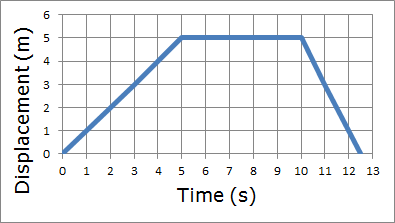
What is the person doing from 5 seconds to 10 seconds?
a)
Walking 
b)
Running
c)
Standing Still 
d)
Walking Fast
45.
What does this graph represent?
a)
Constant Speed
b)
Acceleration
c)
Not moving
46.

As distance between two objects increases, what happens to the pull of gravity?

a)

Increases

b)

Decreases

c)

Stays the same

47.

Read and observe the following diagram. Are the statements true or false?

a)

True

b)

False

48.
Water evaporating from the surface of a lake moves from the...
a)
Atmosphere to the geosphere 
b)
Geosphere to the hydrosphere 
c)
Hydrosphere to the atmosphere 
d)
Atmosphere to the hydrosphere 
49.
This sphere includes the continents, the ocean floor, all the rocks on the surface, and all of the sand in the deserts. 
a)
Hydrosphere 
b)
Biosphere 
c)
Atmosphere 
d)
Geosphere 
50.
Composed of all the water on or near the earth
a)
Hydrosphere 
b)
Biosphere 
c)
Atmosphere 
d)
Geosphere 
51.
This sphere is composed of all the living things 
a)
Hydrosphere 
b)
Biosphere 
c)
Atmosphere 
d)
Geosphere 
52.
Body of air surrounding our planet. 
a)
Hydrosphere 
b)
Biosphere 
c)
Atmosphere 
d)
Geosphere 
53.
When dead plants decompose and nitrogen is returned to the soil, the interaction is between which two spheres? 
a)
The biosphere and atmosphere 
b)
The atmosphere and geosphere 
c)
The geosphere and atmosphere 
d)
The biosphere and geosphere 
54.
When carbon dioxide dissolves from the air into the ocean- the interaction is between...
a)
The atmosphere and geosphere 
b)
The atmosphere and hydrosphere 
c)
The atmosphere and biosphere 
d)
The atmosphere and atmosphere 
55.
When a plants takes carbon dioxide from the air which two spheres are interacting? 
a)
Biosphere and atmosphere 
b)
Geosphere and atmosphere 
c)
Hydrosphere and atmosphere 
d)
Atmosphere and atmosphere 
56.

Heavy cloud cover impacted the temperature of the land by making it cooler. What 2 spheres are interacting during this event?

a)

Atmosphere and Hydrosphere

b)

Hydrosphere and Cryosphere

c)

Atmosphere and Geosphere

d)

Geosphere and Hydrosphere

57.

Coral reefs protect the coastline by absorbing the energy from the pounding waves. What 2 spheres are interacting in this event?

a)

biosphere and hydrosphere

b)

hydrosphere and geosphere

c)

geosphere and biosphere

d)

geosphere and atmosphere

58.
Which of the following does NOT belong in the hydrosphere?
a)
Lakes 
b)
Rivers
c)
Fish 
d)
Rain
59.
Which of the following is an example of convection?
a)
A hair dryer is drying up your hair.
b)
When the AC or heater changes the temperature.
c)
When a car engine turns hot after being turned on.
d)
When you are making soup and the water is rising and lowering.
60.
The heat from a hot burner to a pot is transferred by ______.
a)
convection
b)
insulation
c)
radiation
d)
conduction
61.
Warm air rises and the cool air sinks demonstrates this type of heat transfer. 
a)
conduction
b)
convection
c)
radiation
d)
Insolation 
62.
The baby chickens are kept warm from the heat lamps demonstrates this type of heat transfer. 
a)
conduction
b)
convection
c)
radiation
63.
You're holding hands with your best friend.  Your friend's hands are REALLY warm and yours are really cold.  After a few minutes, this has changed.  How might you explain what happened?
a)
The cold energy from your hand transferred to your friend's hand through conduction.
b)
The heat energy from your friend's hand transferred to your hand through conduction. 
c)
The cold energy from your hand transferred to your friend's hand through convection.
d)
The heat energy from your friend's hand transferred to your hand through convection.
64.
What is the definition of CONVECTION
a)
When heat transfers through waves.
b)
When heat transfers from objects that are touching.
c)
a  hot liquid or air that  expands, becomes less dense, and rises or becomes more dense, and sinks.  Hot air rises and cold air sinks.
d)
Heat traveling from the sun
65.

Warm air is __________ dense (thick) than cold air and RISES creating convection currents.

a)

more

b)

less

66.
The candle will slowly heat the metal and transfer the heat directly to the mans hand.
a)
conduction
b)
convection
c)
radiation
67.

Why is the equator the hottest?

a)

It is farthest away from the sun

b)

It is above the sun..

c)

The sun's radiation waves hit it directly.

d)

The sun's radiation waves hit it indirectly.

68.
Convection currents, which affect weather and climate, are created by
a)
the uneven heating of the Earth
b)
mining of the seafloor
c)
erosion of ocean beaches
d)
slow, constant tectonic movement
69.

Which substance heats up and cools down the fastest?

a)

land

b)

water

70.
Which term best describes how the earth's atmosphere is heated?
a)
Spirally
b)
Unevenly
c)
Circularly
d)
Kinetically
71.
When warm air rises, ______ pressure forms at the surface of the land or sea.
a)
high
b)
some
c)
low
d)
none
72.

Winters in Maine can reach temperatures below zero and the atmosphere is very cold. Is this weather or climate?

a)

Climate

b)

Weather

73.
Changes from minute-to-minute, hour-to-hour, day-to-day is known as....
a)
Climate
b)
Weather
74.

Last week is snowed for 3 days straight.

a)

Climate

b)

Weather

75.
Texas has long, hot summers.
a)
Climate
b)
Weather
76.
What is climate?
a)
 What's going on with the atmosphere at any particular time
b)
The type of weather that occurs during a particular season
c)
An area's pattern of weather over a long period of time
d)
How much sunshine an area gets 
77.
Which changes faster?
a)
weather
b)
climate
78.

You are testing how the amount you water a plant affects its growth. What would be the INDEPENDENT OR TESTING VARIABLE in this experiment.

a)

They type of pot you put the plants in.

b)

The amount you water each plant.

c)

The amount of sunlight the plants get.

d)

The amount the plant grows.

79.

An experiment is performed on plants to see how different liquids affect plant growth. Each plant in the experiment is given a different liquid; water, apple juice, or milk. Each plant has the same amount of soil, sunlight, and listens to the same music. In this investigation, the independent or testing variable is ...

a)
The type of plant
b)
The amount of sunlight
c)
The type of music
d)
The type of liquid
80.

If you were testing the time it took for objects of different sizes to reach the ground after being dropped from 30 feet in the air, which of these would be the DEPENDENT OR OUTCOME VARIABLE?

a)

The time it takes for each object to hit the ground.

b)

The size of each object.

c)

The type of object you use.

d)

The height you drop the object from

81.

Sadie is testing how the age of a seed affects how fast plants grow. Look at the picture to see if you can figure out what makes her experiment unfair. Mark all that apply.

a)

She used different types of seeds/plants.

b)

The plants are in different pots.

c)

She did not plant very many plants.

d)

Seed age might not make a difference.

82.

An experiment is being done to determine how light affects the growth of small zinnia plants. One plant is placed in full sunlight, the second in a shaded area, the third in an unlit closet. What is the independent or testing variable in the zinnia experiment?

a)
The plant growth
b)
The amount of sunlight
c)
The length of time needed to conduct the experiment
d)
The amount of water given daily
83.

EXPERIMENTAL investigation requires a HYPOTHESIS.

a)

TRUE

b)

FALSE

84.

OBSERVATIONAL investigation requires a HYPOTHESIS.

a)

TRUE

b)

FALSE

85.

In a COMPARATIVE investigation words like OBSERVE and DESCRIBE are used.

a)

TRUE

b)

FALSE

86.

OBSERVATIONAL investigation is generally used when LITTLE IS KNOWN.

a)

TRUE

b)

FALSE

87.

The purpose of a EXPERIMENTAL investigation is to determine cause and effect relationships.

a)

TRUE

b)

FALSE

88.

The purpose of a COMPARATIVE investigation is to make comparisons.

a)

TRUE

b)

FALSE

89.

An EXPERIMENTAL Investigation requires Independent, dependent and

Control Variables.

a)

TRUE

b)

FALSE

90.

An OBSERVATIONAL Investigation requires Independent, dependent and

Control Variables.

a)

TRUE

b)

FALSE

91.

You are curious whether the temperature of the environment would affect the growth of bacteria.

a)

experimental

b)

observational

c)

comparative

92.

How are EXPERIMENTAL and COMPARATIVE investigation different?

a)

* EXPERIMENTAL requires control / control group.

* COMPARATIVE does not require control / control group.

b)

* EXPERIMENTAL requires variables .

* COMPARATIVE does not require variables.

93.


What is the process of obtaining information by using the five senses?

a)

experiments

b)

observations

c)

hypothesis