wayground logo

Free Printable Worksheets

Font size

S
M
L
XL
Worksheets

Unit 2 Solids, Liquids & Gases

Total questions: 90

Worksheet time: 49mins

Name
Class
Date
1.

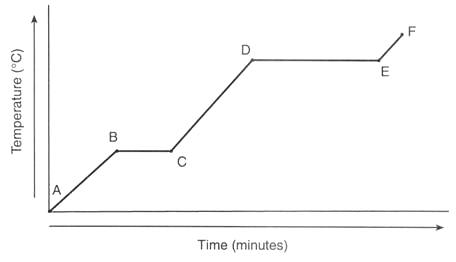
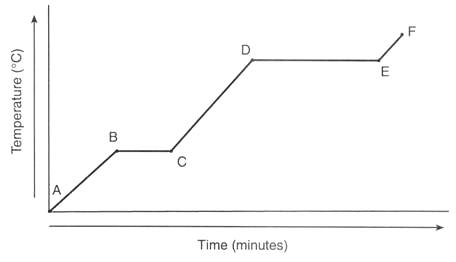
What line segment represents only the solid state?

a)

A-B

b)

B-C

c)

C-D

d)

D-E

2.
In which segment is the kinetic energy remaining constant?
a)
A-B
b)
B-C
c)
C-D
d)
E-F
3.
What state(s) of matter are present at D-E?
a)
Solid-liquid
b)
Liquid
c)
Liquid-gas
d)
Gas-Solid
4.
Between which points is the temperature of the substance remaining constant?
a)
A-B only. 
b)
A-B, C-D, E-F
c)
B-C only. 
d)
B-C, D-E
5.
What state of matter is segment 5?
a)
Solid
b)
Liquid
c)
Gas
d)
Plasma
6.
Between which points is the temperature of the substance increasing?
a)
A-B only. 
b)
A-B, C-D, E-F
c)
B-C only. 
d)
B-C, D-E
7.
Between which points is the substance changing state?
a)
A-B only. 
b)
A-B, C-D, E-F
c)
B-C only. 
d)
B-C, D-E
8.
True or false: melting and freezing occur at the same temperature!
a)
True
b)
False
c)
I don't know
9.
A substance's heating curve is shown in the graph.  What is its boiling point?
a)
100 C
b)
60 C
c)
80 C
d)
20 C
10.
Which of the following terms identifies the change from a liquid to gas?
a)
Vaporization
b)
Condensation
c)
Deposition
d)
Sublimation
11.
When the temperature of matter increases the particles...
a)
speed up and move closer
b)
speed up and move farther apart
c)
slow down and move closer together
d)
slow down and move farther apart
12.
No definite shape, but has a definite volume
a)
Gas
b)
Liquid
c)
Solid
13.
Definite shape and a definite volume.
a)
Gas
b)
Liquid
c)
Solid
14.
No Definite Shape and No Definite Volume
a)
Gas
b)
Liquid
c)
Solid
15.
Phase change from a gas to a liquid.
a)
condensation
b)
evaporation
c)
melting
d)
deposition
16.
Phase change from a gas to a liquid.
a)
condensation
b)
evaporation
c)
melting
d)
deposition
17.
Phase change from a solid to a gas.
a)
sublimation
b)
deposition
c)
condensation
d)
evaporation
18.
What happens to the energy of particles in a substance as it changes from gas, to liquid, to solid?
a)
KE decreases
b)
KE increases
c)
KE stays the same
d)
KE goes up and then goes down
19.
The speed of the molecules determines the _____.
a)
volume
b)
density
c)
pressure
d)
temperature
20.
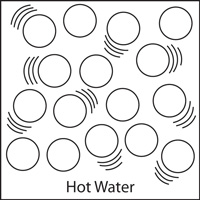
The molecules in the picture are tightly held together with little movement. They have shape and energy.  Therefore, the picture represents _________.
a)
solid
b)
liquid
c)
gas
d)
plasma
21.
What does this picture represent? 
a)
solid
b)
liquid 
c)
gas
d)
plasma
22.
What does this picture represent? 
a)
solid
b)
liquid
c)
gas
d)
plasma
23.

The attraction between particles gives solids a definite

a)

shape and volume

b)

shape and color

c)

shape and position

d)

flow and radius

24.

An example of an amorphous solid is

a)

glass

b)

dry ice

c)

liquid crystals

d)

water

25.

An example of a substance that can undergo sublimation is

a)

glass

b)

liquid crystals

c)

water

d)

dry ice (frozen carbon dioxide)

26.
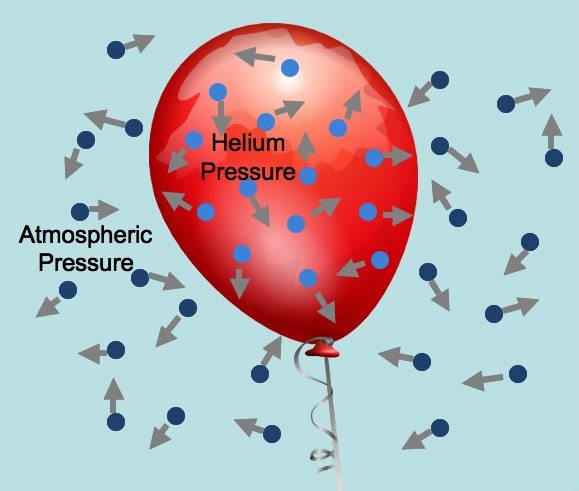
When pressure increases, which of the following also increases?
a)
mass
b)
volume
c)
temperature
d)
length
27.
Which of the following states of matter has the most kinetic energy?
a)
solid
b)
liquid
c)
gas
28.
Which of the following states of matter has the lowest kinetic energy? 
a)
solid
b)
liquid 
c)
gas
29.
To make a solid become a liquid, you must increase its________________.
a)
mass
b)
density
c)
kinetic energy
d)
potential energy
30.
Gas particles move around at __________ speeds. 
a)
low
b)
slow
c)
high
d)
unknown
31.
Adding thermal energy to matter casues its particles to _________________.
a)
move slower
b)
move faster
c)
melt
d)
feeze
32.

Which of the following states of matter are compressible?

a)

solid

b)

liquid

c)

gas

33.
What causes surface tension?
a)
gaps between particles
b)
rapid movement of particles
c)
attractive forces between particles
d)
crystalline arrangement of particles
34.

Measure of the average kinetic energy of the particles in an object

a)

thermal energy

b)

temperature

c)

kinetic energy

35.

The total potential and kinetic energy of an object

a)

thermal energy

b)

temperature

c)

kinetic energy

36.

Evaporation and boiling are two kinds of _______

a)

condensation

b)

vaporization

c)

sublimation

d)

melting

37.

Deposition is a change from a __________

a)

gas to a solid.

b)

solid to a gas.

c)

liquid to a gas.

d)

gas to a liquid.

38.

Vaporization that occurs within a liquid is _________

a)

boiling.

b)

evaporation.

c)

sublimation.

d)

condensation.

39.

Which state of matter is able change to the shape of the container but not be compressed?

a)

Solids

b)

Gases

c)

Liquids

d)

Sublimation

40.

What temperatures does water melt at and boil at? You need both (2) answers please

a)

0 oC

b)

1 oC

c)

100 oC

d)

60 oC

41.

What temperatures does water freeze at and boil at? You need both (2) answers please

a)

1 oC

b)

-100 oC

c)

0 oC

d)

100 oC

42.

The reason that liquids can take the shape of the container that they are in is because...

a)

The particles have a random structure

b)

The particles have space between them

c)

The particles can move around each other

d)

The particles are closer together so take up less space

43.

High viscosity can be described as...

a)

a liquid that flows quickly

b)

a liquid that flows slowly

44.

Peanut butter is an example of a...

a)

High viscosity liquid

b)

Low viscosity liquid

c)

Isnt a liquid at all! Don't be silly.

45.

What is a fluid?

a)

A firm and stable shape.

b)

A substance that has no fixed shape and yields easily to external pressure.

46.

Which of these are fluids?

a)

Sand

b)

Water

c)

Oxygen

d)

Rocks

47.

What is Viscosity?

a)

A fluids colour.

b)

A fluids temperature.

c)

A fluids resistance to flow.

48.

Which of these factors affects Viscosity?

a)

Temperature

b)

Colour

c)

Taste

49.
If a liquid has high viscosity, it probably has:
a)
strong resistance to flow
b)
weak resistance to flow
50.

Which of the following liquids is viscous?

a)

honey

b)

water

c)

soy sauce

d)

cooking oil

51.

Which of the following liquids is non-viscous?

a)

tomato sauce

b)

glue

c)

paint

d)

juice

52.

A substance that flows quickly has __________.

a)

low viscosity

b)

high viscosity

53.

Liquids with very low viscosity ,flow very _______________________.

a)

fast

b)

not at all

c)

slow

d)

whenever it wants

54.
What does Boyle's law relate to?
a)
Temperature and Volume
b)
Volume and Pressure
c)
Temperature and Pressure
55.
When the temperature of matter increases the particles...
a)
speed up and move closer
b)
speed up and move farther apart
c)
slow down and move closer together
d)
slow down and move farther apart
56.
How do gas molecules move? 
a)
in an orderly fashion 
b)
constantly and randomly
c)
in straight line paths
d)
in a circular motion
57.
In Charles' Law the pressure remains constant.
a)
True
b)
False
58.
What type of relationship is Charles' Law?
a)
Inverse
b)
Direct
c)
Not enough information
d)
#goals
59.
True or False: Gases can be compressed. 
a)
True
b)
False
60.
When Pressure increases then the Volume must...
a)
Increase
b)
decrease
61.
When Volume increases then Pressure must...
a)
Increase
b)
Decrease
62.
What type of relationship to pressure and volume have?
a)
direct
b)
inverse
c)
no relationship
d)
I don't know
63.
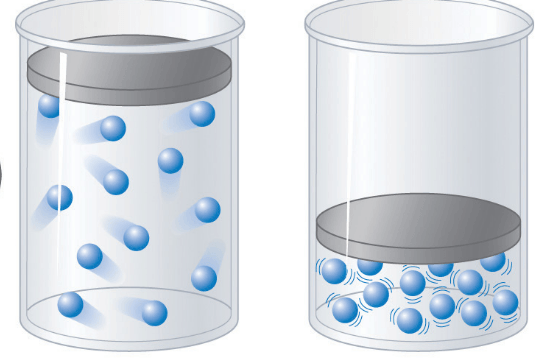
Which container will have a lower pressure?
a)
left
b)
right
c)
they both have the same pressure
d)
I don't know
64.
What causes pressure?
a)
The walls of the container
b)
The vacuum in the container
c)
The collisions of the particles
d)
Atmospheric pressure acting on the outside walls
65.
The relationship of which two variables are compared in Boyle's Law?
a)
pressure & volume
b)
volume & temperature
c)
temperature & pressure
d)
volume & moles (amount of gas)
66.
Boyle's law : When _______ is held constant, the pressure and volume of a gas are ________  proportional
a)
temperature,  equally
b)
mass, inversely
c)
temperature, inversely
d)
mass, equally
67.
What type of relationship is Charles' Law?
a)
Inverse
b)
Direct
c)
Not enough information
d)
#goals
68.
Charles's law shows the relationship between which two factors of a gas ?
a)
volume and temperature 
b)
volume and pressure 
c)
pressure and volume
d)
volume and mass
69.
Directly proportional means that as one value increases ....................
a)
the other stays the same 
b)
the other increases as well
c)
the other decereases
d)
the other goes to zero
70.
Inversely proportional means as one value increases the other............. 
a)
increases 
b)
decreases 
c)
stays the same 
d)
goes to zero
71.
The word inverse means.......
a)
the same
b)
opposite 
72.
Boyle's law shows the volume and pressure of a gas are always ........
a)
inversely proportional 
b)
directly proportional 
73.
Charles's law shows that the temperature and volume of a gas are always........
a)
inversely proportional 
b)
directly proportional 
74.
Temperature describes  the ______________ of particles.
a)
volume
b)
mass
c)
motion
d)
conductivity
75.
When a basketball is left outside in the cold it goes flat because the volume of air inside the ball has been reduced. What  gas law does this represent?
a)
Boyle's Law
b)
Charles's Law
76.
If you push down the plunger of a bicycle pump the chamber's volume is decreased. When that happens pressure in the chamber increases and the air then rushes out of the pump and into your flat tire. What gas law does this represent?
a)
Charles's law
b)
Boyle's law
c)
Newtons laws
d)
Coulombs laws
77.
a)
this is a graph representing Boyle's law
b)
this is a graph representing Charles's law
78.
a)
This is an example of Charles's law
b)
This is an example of Boyle's law
79.

Surface tension is the property of water in which...

a)

water molecules at the surface tend to stick together.

b)

water spills easily.

c)

water tends to be see-through.

80.

Describe COHESION.

a)

Water molecules attracted to other substances.

b)

Water molecules climbing upwards against the force of gravity.

c)

Water molecules dissolving many substances because of its polarity.

d)

Water molecules attracted to other water molecules.

81.
Water beads up on the surface of a penny because of this property.
a)
Adhesion
b)
High Surface Tension
c)
Universal Solvent
d)
Changes in Density
82.
Which characteristic of water will allow a paperclip to remain floating on water when the paperclip is gently placed on top of the water?
a)
adhesion
b)
surface tension
c)
solvent properties
d)
nonpolar
83.
Rain drops are spherical in shape because of
a)
low temperature
b)
Surface Tension
c)
Viscosity
d)
External forces
84.

surface tension of water can be reduced by

a)

heating

b)

Adding soap solution

c)

cooling

d)

adding salt

85.
Force of attraction between similar molecules is called 
a)
Cohesive force
b)
Adhesive force
c)
Magnetic force
d)
gravitational force
86.

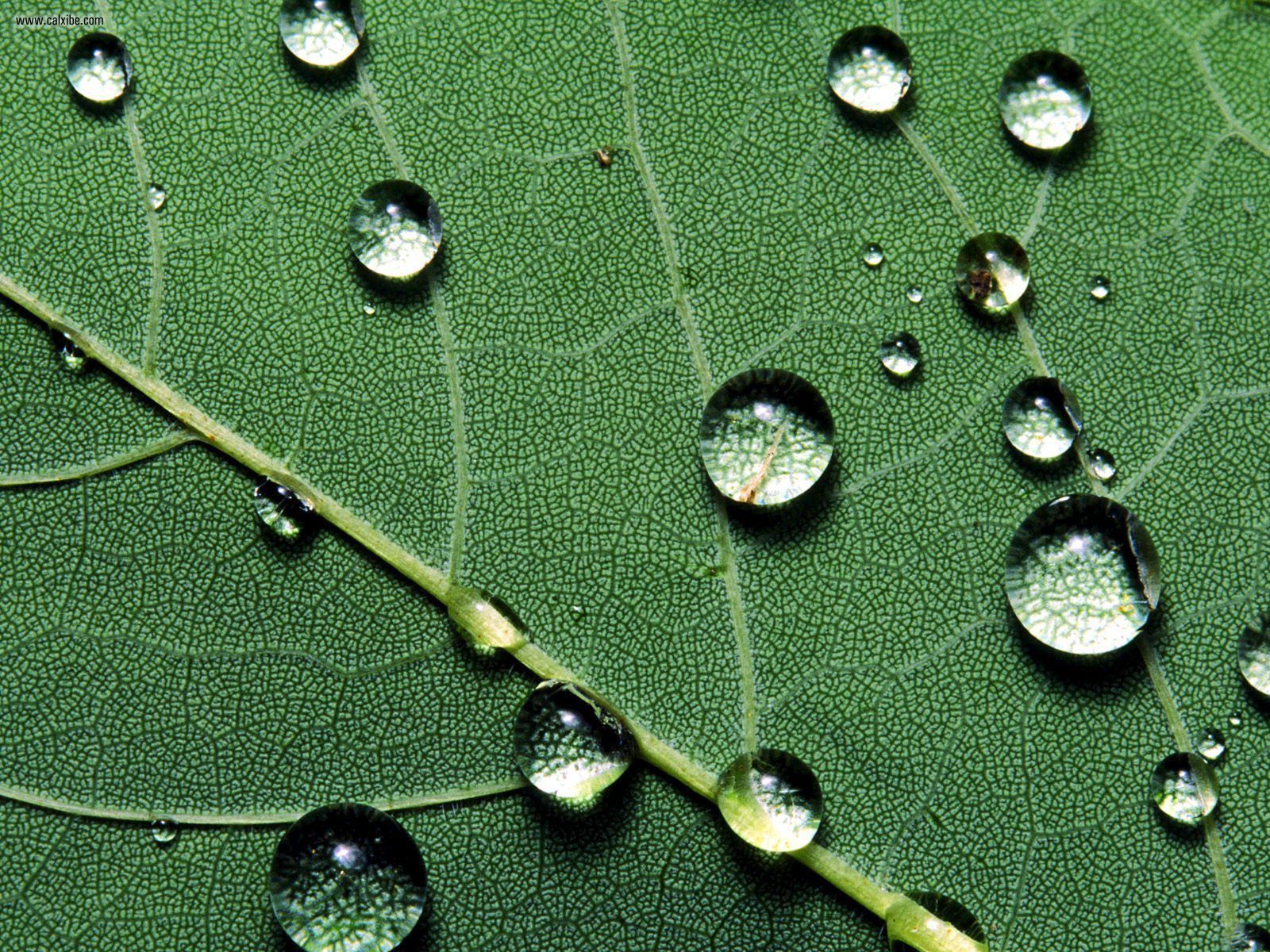
Refer to the picture of water sticking to a leaf; this is occurring because of:

a)

Adhesion

b)

Cohesion

87.
What word describes when water is attracted to other substances?
a)
cohesion
b)
adhesion
c)
capillary action
d)
surface tension
88.
tendency of molecules of the same kind to stick to one another
a)
cohesion
b)
adhesion
c)
solution
d)
polar molecule
89.

Water's ability to stick to glass is

a)

adhesion

b)

cohesion

c)

surface tention

d)

capillary action

90.
What is adhesion?
a)
Water's ability to stick to itself
b)
Water's ability to stick to other substances
c)
The strength of the cohesion of all the water molecules combined
d)
Tape, glue and other adhesives