wayground logo

Free Printable Worksheets

Font size

S
M
L
XL
Worksheets

Climate and Weather

Total questions: 91

Worksheet time: 2hrs 45mins

Name
Class
Date
1.

What is weather?

a)

The conditions of the atmosphere at a certain time and place

b)

The movement of water into the air

c)

The usual weather conditions over an extended amount of time.

2.

Which are examples of weather?

a)

Troposphere, Thermosphere, Mesosphere, Stratosphere

b)

Rain, Sleet, Snow, Cloudy, Sunny

3.

When water changes from a liquid to a gas

a)

atmosphere

b)

evaporation

c)

condensation

4.

Precipitation is when water falls to the Earth in the form of rain, snow, sleet, or hail.

a)

True

b)

False

5.

Cold fronts often bring in______.

a)

thunderstorms

b)

sunny days

c)

water cycles

6.

________________ is the study of weather.

a)

Zoology

b)

Weatherology

c)

Meteorology

7.
Which of the following gases DOES NOT trap heat?
a)
carbon dioxide
b)
nitrogen
c)
water vapor
d)
methane
8.
Which of the following have been linked to climate change?  
a)
droughts
b)
flooding
c)
melting of polar ice caps
d)
all of the above
9.
The warming of the atmosphere by the trapping of heat being radiated to space is called
a)
evaporation
b)
condensation
c)
the greenhouse effect
d)
radiation
10.
The condition of the atmosphere, such as temperature, cloud cover, wind speed and rainfall
a)
climate
b)
weather
c)
trend
d)
season
11.
the amount of water vapor in the air
a)
warm front
b)
precipitation
c)
humidity
d)
air pressure
12.
An instrument used to measure how hot or cold something is
a)
barometer
b)
thermometer
c)
wind sock
d)
rain guage
13.
An instrument that measures air pressure
a)
thermometer
b)
barometer
c)
rain guage
d)
wind sock
14.
Average weather conditions of a region year after year
a)
weather
b)
season
c)
cold front
d)
climate
15.
What causes winds to form on Earth?
a)
solar energy
b)
ocean currents
c)
elevation differences
d)
uneven heating of the Earth by the sun
16.
A student states the weather is the same as the climate. Which response BEST tells the student the difference between weather and climate?
a)
Weather is about the wind and the rain, but climate is about the clouds.
b)
Weather is the conditions in one day, but climate is the conditions over a long time.
c)
Weather is measured with tools like thermometers, but climate is measured with tools like forecasts.
d)
Weather is recorded on charts, but climate is recorded on world maps.
17.
This is the symbol for a... 
a)
Cold Front
b)
Warm Front
c)
Stationary Front
d)
Occluded Front 
18.
This is the symbol for a... 
a)
Occluded Front
b)
Stationary Front
c)
Warm Front
d)
Cold Front 
19.
The average yearly weather pattern over many years.
a)
weather
b)
air pressure
c)
climate
d)
zone
20.
Which of the following is not a factor that affects climate? 
a)
latitude
b)
longitude
c)
oceans
d)
mountains
21.
What angle would Earth's tilt need to be in order for there to be NO seasons on Earth?
a)
0o
b)
45o
c)
60o
d)
Earth's tilt does not offset the seasons.
22.
Climate change can lead to _______________.
a)
sea level rise and floods in coastal areas
b)
droughts
c)
spread of dengue fever and malaria
d)
all of the above
23.
What is causing climate change
a)
wind 
b)
the sun
c)
green house gasses
d)
water
24.
What is currently happening to polar regions?
a)
nothing
b)
freezing
c)
moving
d)
melting
25.

What are greenhouse gases?

a)

gases that are found in a greenhouse

b)

invisible gases in the air that act like panes of of a greenhouse and trap some of the Earth's heat

c)

gases that are green in the air

d)

a place where plants grow

26.

Without greenhouse gases our planet would be a frozen wasteland

a)

true

b)

false

27.

Many countries and companies are working to reduce this to help with climate change concern

a)

minimum wage

b)

stress

c)

carbon dioxide emissions

d)

employees

28.

Type of energy from the sun

a)

solar

b)

wind

c)

nuclear

d)

chemical

29.
The biggest factor in determining climate is?
a)
elevation
b)
an ocean
c)
latitude
d)
mountain
30.
A tropical climate in the US would be?
a)
Virginia
b)
New York
c)
California
d)
Florida
31.
What is the climate of the top of a mountain like as compared to the bottom of the mountain?
a)
warmer
b)
cooler
c)
drier
d)
wetter
32.
The gradual increase in the temperature of the atmosphere is known as ___________________.
a)
greenhouse effect
b)
global warming
c)
fossil fuels
d)
ice ages
33.
Which of these is NOT a factor that determines the climate of a place?
a)
latitude
b)
wind patterns
c)
longitude
d)
elevation
34.
Which sentence best describes the relationship between elevation and air temperatures?
a)
 LOWER elevation = COLDER temperatures
b)
HIGHER elevation = COLDER temperatures
c)
HIGHER elevations = WARMER temperatures
d)
There is no relationship
35.
What are the 3 major climate zones in order from equator to the poles?
a)
polar, temperate, tropical
b)
tropical, temperate, polar
c)
temperate, polar, tropical
d)
temperate, tropical, polar
36.
What climate does a desert have?
a)
Tropical
b)
Polar
c)
Arid/Dry
d)
Temperate
37.
The seasons are caused by___________?
a)
The direction the Earth's axis is tilted toward the sun
b)
Tropical Storms
c)
Changes in the moon
d)
The Earth's rotation on its axis
38.
What is going on with the atmosphere at any particular time.
a)
Weather
b)
Climate
39.
Daily temperature, daily rainfall, daily amount of sunshine
a)
Weather
b)
Climate
40.
The short-term condition of the atmosphere .
a)
Climate
b)
Weather
41.
What can change entire ecosystems and create extinctions in species?
a)
Climate
b)
Weather
42.
Blizzards, Heatwaves, High winds are all examples of __________________ events.
a)
Climate
b)
Weather
43.
Blizzards, Heatwaves, High winds are all examples of __________________ events.
a)
Climate
b)
Weather
44.
Human activities and burning fossil fuels have released excessive amounts of greenhouse gases into the atmosphere.  This has increased Global Warming. THESE ACTIONS HAVE CHANGED THE...
a)
Climate
b)
Weather
45.
Blizzards, Heatwaves, High winds are all examples of __________________ events.
a)
Climate
b)
Weather
46.
What is the best explanation for these two statements?
1. Some mountains located near the Earth's Equator have snow-covered peaks. 
2. Icecaps exist at the Earth's poles.
a)
High elevation and high latitude have a similar effect on climate. 
b)
Both mountain and polar regions have arid climates.
c)
Mountain and polar regions receive more energy from the Sun than other regions.
d)
An increase in snowfall and an increase in temperature have a similar effect on climate. 
47.
What effect does a large body of water usually have on a nearby landmass?
a)
The water causes cooler summers and colder winters. 
b)
The water causes cooler summers and warmer winters. 
c)
The water causes hotter summers and warmer winters. 
d)
The water causes warmer summers and colder winters. 
48.
The planetary winds on Earth are indicated by the curving arrows in the diagram. 
The curved paths of the planetary winds are a result of 
a)
changes in humidity.
b)
changes in temperature.
c)
Earth's rotation on its axis
d)
Earth's gravitational force
49.

Which of these has no effect on climate?

a)

Latitude

b)

Altitude

c)

Distance from the Sun

d)

Topography

50.

Distance from the equator is_.

a)

Latitude

b)

Elevation

c)

Attitude

d)

Longitude

51.

Height above sea level is __.

a)

Latitude

b)

Elevation

c)

Attitude

d)

Ocean Currents

52.
Which of the following best describes climate?
a)
day to day conditions of the atmosphere at a place in regards to heat, dryness, sunshine, wind, rain, etc.
b)
long-term conditions (30 or more years) of the atmosphere at a place in regards to heat, dryness, sunshine, wind, rain, etc.
53.
Which of the following best describes weather?
a)
day to day conditions of the atmosphere at a place in regards to heat, dryness, sunshine, wind, rain, etc.
b)
long-term conditions (30 or more years) of the atmosphere at a place in regards to heat, dryness, sunshine, wind, rain, etc.
54.

What drives our climate here on Earth?

a)

latitude from the equator

b)

the Sun

c)

the rotational speed of the Earth

d)

longitude from the Prime Meridian

55.
A severe storm that involves strong winds and forms over warm water is:
a)
tornado
b)
thunderstorm
c)
hurricane
d)
blizzard
56.
A severe storm which involves a funnel cloud forming from a cumulonimbus cloud:
a)
hurricane
b)
tornado
c)
thunderstorm
d)
blizzard
57.
This severe weather involves lightning, rain, and forms from a cumulonimbus cloud.
a)
thunderstorm
b)
tornado
c)
hurricane
d)
blizzard
58.
What is the most abundant gas found in the atmosphere?
a)
Carbon Dioxide
b)
Nitrogen
c)
Oxygen
d)
Water Vapor
59.
________________ are made of water vapor that condenses in the troposphere.
a)
dew
b)
clouds
c)
evaporation
d)
transpiration
60.
Because the earth is spinning on its axis, the global winds appear to curve. This is known as the __________ ________.
a)
Coriolis Effect
b)
Greenhouse Effect
c)
Climate Effect
d)
Atmosphere Effect
61.
What is storm that contains storm surges and has wind speeds of 74 mph - 200 mph?
a)
thunderstorms
b)
severe thunderstorms
c)
tornadoes
d)
hurricanes
62.
Does lightning or thunder come first?
a)
thunder
b)
lightning
c)
it depends
63.

Which type of air mass is dry and warm?

a)

Continental polar

b)

Continental tropical

c)

Maritime polar

d)

Maritime tropical

64.

Why does warm air rise above cold air?

a)

Warm air is less dense

b)

Warm air is more dense

c)

Cold air is stronger than warm air

65.

Applying what you know about air masses, which air mass would you expect to find here in Chad, Africa? (circled on the picture **hint: find the equator line**)

a)

Continental polar

b)

Continental tropical

c)

Maritime polar

d)

Maritime tropical

66.

Which of the following has caused repeating 100,000-year cycles of ice ages in the past?

a)

an increase in sun spots

b)

several major volcanic eruptions

c)

changes in Earth's orbit and the tilt of its axis

d)

continental drift

67.

The closer you live to the ocean, the more likely your climate will be a...

a)

marine climate

b)

tropical climate

c)

continental climate

d)

subtropical climate

68.

Clues to ancient climates were like come from...

a)

ice cores

b)

fossil tree rings

c)

plant pollens

d)

all of the above

69.

Climate changes may be linked to changes in the number of _______________ on the surface of the sun.

a)

sun spots

b)

air masses

c)

seasonal winds

d)

currents

70.

Which zones are polar zones?

a)

Zones A and B

b)

Zones A and E

c)

Zones E and D

d)

Zones A, E, and C

71.

Which zones are temperate zones?

a)

Zones B and C

b)

Zones B, C, and D

c)

Zones, D and C

d)

Zones D and B

72.

Which zone is the tropical zone?

a)

Zone B

b)

Zone C

c)

Zone D

d)

Zone E

73.
A _____________________ is something that scientists use to represent an object or process
a)
mass
b)
matter
c)
model
d)
weight
74.
__________________ is the measure of how much matter is in a given volume
a)
dancer
b)
density
c)
Geology
d)
science
75.

A measure of the average kinetic energy of molecules in a given area

a)

Temperature

b)

Pressure

c)

Momentum

d)

Humidity

76.
Which of the following could contribute to an increase in pollution?
a)
high wind velocity
b)
occurrence of rain and snow
c)
change in amount of sunlight
d)
heavy auto traffic
77.
At the beach in the summertime, the transfer of heat from the sand to the bottoms of your feet is called
a)
radiation
b)
fission
c)
conduction
d)
convection
78.
What is the 2nd most abundant gas in the atmosphere?
a)
Nitrogen
b)
Oxygen
c)
Argon
d)
Carbon Dioxide
79.
Practically all clouds & storms occur in this layer of the atmosphere.
a)
Stratosphere
b)
Thermosphere
c)
Troposphere
d)
Mesosphere
80.
Cloudy nights can be warmer than clear nights because clouds trap heat____
a)
produced by the friction of air particles
b)
generated from tropical winds
c)
released from Earth's interior
d)
absorbed by Earth during daylight hours
81.
The different layers of Earth's atmosphere can be categorized by variations in _____
a)
air pressure
b)
humidity
c)
temperature
d)
dew point
82.
Which of the following determines the properties of an air mass?
a)
The conditions of the area over which it forms
b)
The phase and position of the moon when it forms
c)
The exact time of year when it forms
d)
The geology of the area where it forms
83.
Thunder is caused by ___
a)
the discharge of ultraviolet energy
b)
the electric barrier
c)
the rapid expansion of superheated air
d)
the impact of electricity hitting the Earth
84.
Which would be most useful outside based on the following weather conditions: Temp 72 degrees, Dew Point 72 degrees.
a)
Sun glasses
b)
Warm coat
c)
An umbrella
d)
Ski gloves
85.
El Nino & La Nina are associated with ____
a)
movement of air along the Polar Easterlies
b)
movement of large areas of warm water in Atlantic Ocean
c)
movement of large areas of warm water in Pacific Ocean
d)
movement of air pollution across the US
86.
On a weather map, what are the lines that connect points of equal temperature called?
a)
isobars
b)
contour lines
c)
isotemps
d)
isotherms
87.

This instrument measures the amount of rain

a)

wind vane

b)

barometer

c)

rain gauge

d)

anemometer

88.

An anemometer measures

a)

wind speed

b)

air pressure

c)

amount of rain

d)

temperature

89.

A wind vane measures

a)

wind height

b)

wind direction

c)

wind color

d)

wind speed

90.

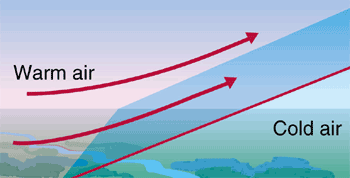
Name the front

a)

warm front

b)

stationary front

c)

cold front

d)

ice cream cones

91.

What does the "L" on a weather map mean

a)

low pressure

b)

lonely pressure

c)

lumpy pressure

d)

lucky pressure