wayground logo

Free Printable Worksheets

Font size

S
M
L
XL
Worksheets

Climate & Currents (Atmospheric & Ocean)

Total questions: 91

Worksheet time: 2hrs 30mins

Name
Class
Date
1.
What causes winds to form on Earth?
a)
solar energy
b)
ocean currents
c)
elevation differences
d)
uneven heating of the Earth by the sun
2.

What are the two main factors that determine the climate of an area?

a)

precipitation and humidity

b)

temperature and salinity

c)

wind conditions and humidity

d)

temperature and precipitation

3.

What is the term for the condition of the Earth's atmosphere at a certain time and place?

a)

climate

b)

temperature

c)

weather

d)

air pressure

4.
Which BEST describes why latitudes closest to the equator have warmer climates?
a)
they are at lower elevations
b)
they receive more solar energy
c)
they are nearer to ocean currents
d)
they get more winds that carry energy in the form of heat
5.
What is the measure of distance in degrees north and south from the equator?
a)
latitude
b)
longitude
c)
elevation
d)
topography
6.

What is the term for weather conditions in an area over a long period of time?

a)

climate

b)

temperature

c)

elevation

d)

precipitation

7.
A front is
a)
where warm air is cooling at earth's surface
b)
a line where hot and cold air are separating
c)
a line where two different air masses meet
d)
where cold air is rising and forming rain clouds
8.
The conditions of the atmosphere at a certain time and place. 
a)
weather
b)
climate
c)
precipitation
d)
atmosphere
9.
What types of air masses form over oceans?
a)
Maritime
b)
Continental
c)
Polar
d)
Tropical
10.
What's the humidity and temperature of a continental tropical air mass?
a)
Wet and cold
b)
Dry and warm
c)
Wet and warm
d)
Dry and cold
11.
What's the humidity and temperature of a maritime tropical air mass?
a)
Wet and cold
b)
Dry and warm
c)
Wet and warm
d)
Dry and cold
12.
A wet and cold air mass would be a...
a)
Maritime polar
b)
Continental polar
c)
Maritime tropical
d)
Continental tropical
13.
A dry and hot air mass would be...
a)
Maritime arctic
b)
Maritime tropical
c)
Continental tropical
d)
Continental polar
14.
Where would you find a tropical maritime air mass?
a)
over the ocean, near the equator
b)
over the ocean, near the poles
c)
over a continent, near the equator
d)
over a continent, near the poles
15.
Air travels
a)
from high pressure to low pressure
b)
from low pressure to high pressue
16.

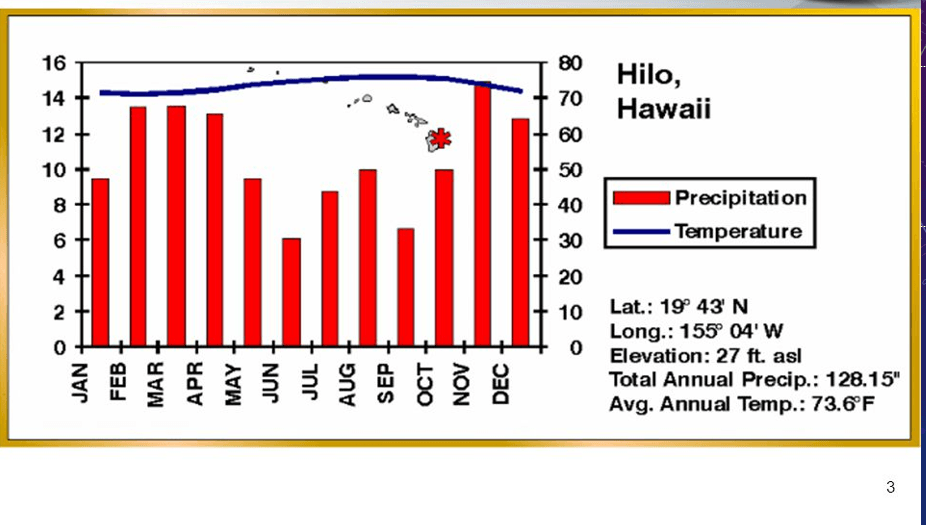
When does the least precipitation occur?

a)

February - March

b)

April - May

c)

June - July

d)

November - December

17.

Which month has the coldest temperature?

a)

January

b)

April

c)

September

d)

March

18.

Air moves from where pressure is __________ to where pressure is __________.

a)

lower / higher

b)

higher / lower

19.

Convection currents occur when differences in temperature and pressure cause the flow of air to go in a __________ .

a)

loop, or a shape that produces a curve that bends and crosses itself.

b)

S curve

c)

bell shape

20.

Wind moves around the world in this type of way:

a)
b)
21.

When cool air moves from land to water.

a)

land breeze

b)

sea breeze

22.

When cool air moves from water to land.

a)

land breeze

b)

sea breeze

23.

What is this imaginary red line known as?

a)

latitude

b)

equator

c)

longitude

d)

prime meridian

24.
When air is heated, it will MOST likely
a)
expand and fall
b)
expand and rise
c)
condense and fall
d)
condense and rise
25.
A sea breeze blows from the ocean toward the shore. Why does this occur?
a)
High pressure over the land causes a downdraft to occur.
b)
The tide carries the wind to the shore as it moves back and forth.
c)
Conduction of heat from the warm water produces wind from the ocean.
d)
Air over land heats faster than air over water, which causes convection.
26.
Which of these MOST likely causes winds to blow on Earth?
a)
Earth spins quickly, causing air to blow around.
b)
The gravity of Earth and the Moon push and pull the air.
c)
Warm air rises and cool air falls toward Earth's surface.
d)
Ocean waves push air onto the shore and across Earth's surface.
27.
What type of winds blow constantly, predictably, and over long distances?
a)
land breezes
b)
mountain breezes
c)
global winds
d)
land breezes
28.
The curving of air to the right in the Northern hemisphere is caused by ___________ and is called the _________ effect.
a)
Earth's rotation...Coriolis
b)
Earth's revolution...Coriolis
c)
Earth's rotation...Doppler
d)
Earth's revolution...Doppler
29.
Where does the initial source of energy come from that creates winds?
a)
the moon
b)
the sun
c)
the Earth's surface
d)
the rotation of the Earth
30.
The Coriolis effect causes ___________.
a)
the Earth to rotate on its axis
b)
continental deflection
c)
global winds and surface currents to move in a curved path instead of a straight line
d)
global winds and deep ocean currents to move in a curved path instead of a straight line.
31.
How do differences in air pressure affect the movement of air?
a)
Air always moves from areas of high pressure to areas of low pressure.
b)
Air always moves from areas of low altitudes to high altitudes.
c)
Air always moves from areas of low pressure to areas of high pressure.
d)
Air always moves from east to west.
32.
Why does warm air rise?
a)
Warm air is more dense than cooler air.
b)
Warm air has more pressure than cooler air.
c)
Warm air is less dense than cooler air.
d)
Warm air has a higher dew point than cooler air.
33.
What causes wind to blow?
a)
Differences in longitude 
b)
Shock waves from clouds 
c)
Differences in air temperature and pressure 
d)
The rotation of the earth
34.
Which term best describes how the earth's land and atmosphere are heated?
a)
Evenly
b)
Unevenly
c)
Circularly
d)
Kinetically
35.
Which of the following are narrow belts of strong winds found in the upper troposphere?
a)
doldrums
b)
westerlies
c)
trade winds
d)
jet streams
36.
Which of these BEST explains the cause of convection currents in Earth's atmosphere?
a)
Heat from Earth's core heats the land only at the equator.
b)
Glaciers moving away from the poles cool Earth unevenly.
c)
Sunlight is more concentrated in some places on Earth than others.
d)
The light and heat reflected from the moon varies as the moon changes phases.
37.
Which statement correctly defines wind?
a)
Wind is the movement of air from areas of low pressure to areas of high pressure
b)
Wind is the movement of air to a colder area in the atmosphere.
c)
Wind is the movement of air from areas of high pressure to areas of low pressure.
d)
Wind is the movement of air pushed around and bouncing off Earth's surface.
38.
Which statement correctly describes the properties of cold air?
a)
less dense and less pressure than warm air
b)
more dense and more pressure than warm air
c)
more dense and less pressure than warm air
d)
less dense and more pressure than warm air
39.
In which direction do prevailing westerlies flow?
a)
from east to west
b)
from west to east
c)
from north to south
d)
from south to north
40.
Which global winds are found at the poles? 
a)
Polar Westerlies
b)
Prevailing Easterlies
c)
Polar Easterlies
d)
Trade Winds
41.
Which global winds directly effect weather in the U.S.?
a)
Trade Winds
b)
Prevailing Westerlies
c)
Polar Easterlies
d)
Doldrums
42.
The tropical winds running from 0 to 30 degrees latitude are called:
a)
subtropical westerlies
b)
polar westerlies
c)
trade winds
d)
polar winds
43.
Warm, rising air at the Equator forms a calm, weak wind called the:
a)
Doldrums
b)
Trade Winds
c)
Polar Easterlies
d)
Westerlies
44.
Cool, sinking air at 30 degrees North create a pressure belt known as the:
a)
Trade Winds
b)
Doldrums
c)
Horse Latitudes
d)
Westerlies
45.
Surface currents are a result of
a)
Global Wind Patterns
b)
Earth's Rotation
c)
Density
d)
All of the above
46.
The Gulf stream carries _____________ water from the east coast of The United States to the West coast of Europe.
a)
Cold
b)
Warm 
c)
Freezing
d)
Fresh
47.
What happens to a current when it comes in contact with a continent or landmass?
a)
It continues over the continent
b)
It stops
c)
It changes direction
d)
It is absorbed by the land
48.
As you go deeper in the ocean, the water is colder and less salty.
a)
True
b)
False
49.
Due to the Coriolis Effect, water in the northern hemisphere moves
a)
clockwise
b)
counter clockwise
c)
both
d)
neither
50.
Due to the Coriolis Effect, water in the southern hemisphere moves
a)
clockwise
b)
counter-clockwise
c)
both
d)
neither
51.
Warm ocean currents generally come from
a)
The North Pole
b)
The South Pole
c)
The Equator
d)
Both A and B
52.

Two types of water currents are

a)

local and global

b)

sea and land

c)

surface and deep-ocean

d)

warm and cold

53.
Ocean currents have an affect on which two things
a)
climate and weather
b)
temperature and density
c)
land and sea
d)
equator and poles
54.
A strong surface current that runs along the east coast of the United States and carries warm water to Europe.
a)
California Current
b)
Global Conveyor Belt
c)
Gulf Stream
d)
Surface Current
55.
Constantly moving system of deep-ocean circulation driven by temperature and salinity. It moves water around the globe.
a)
California Current
b)
Global Conveyor Belt
c)
Surface Currents
d)
Gulf Stream
56.
A horizontal movement of ocean water that is caused by wind and that occurs at or near the ocean's surface.
a)
Gulf Stream
b)
Global Conveyor Belt
c)
Surface Current
d)
Gyre
57.
The large, circular surface-current pattern found in each ocean.
a)
California Current
b)
Surface Current
c)
Gyre
d)
Global Conveyor Belt
58.
What process brings the deep cold ocean currents up to the surface?
a)
Conduction
b)
Global Wind Patterns
c)
Convection Currents
d)
Temperature and salinity
59.
How do warm-water currents affect the coastal areas along which they flow?
a)
Cool the coast
b)
Warm the coast
c)
Cause snow to fall
d)
Cause higher tides
60.
Where is ocean water the densest.
a)
The surface
b)
The middle
c)
The bottom
d)
Lake Michigan
61.
Upwelling is associated with
a)
a decrease in access to nutrients for phytoplankton
b)
cooler, nutrient-rich waters being pushed up from deeper ocean waters
c)
temperature gradients moving water from the equator to the poles
d)
an increase in human fatalities
62.
Water travels in definite paths around the ocean called
a)
Highways
b)
Currents
c)
Rivers
d)
Streams
63.
As salinity  increases
a)
Density increases
b)
Density decreases
64.
In addition to salinity, what factor affects the density of seawater?
a)
depth
b)
latitude
c)
temperature
d)
salt content
65.
What term is the measure of dissolved salts in water?
a)
Thermocline
b)
Salinity
c)
Saltiness
d)
Tides
66.
Which ocean, the Atlantic or the Pacific, has higher average surface salinities?
a)
Pacific
b)
Atlantic
67.

Which of the following events would cause the ocean area around it to become saltier.

a)

river run off

b)

precipitation

c)

ice formation

d)

boston tea party

68.
Deep Ocean currents are a result of
a)
Global Wind Patterns
b)
Earth's Rotation
c)
Density
d)
All of the above
69.
The Coriolis Effect is caused by
a)
Earth rotating around the sun
b)
Earth rotating on its axis
c)
The tides
d)
Gravity
70.
What is the movement of air from areas of high pressure to areas of low pressure?
a)
Wind
b)
Convection
c)
Monsoon
d)
Coriolis effect
71.
Which is NOT a characteristic of global winds?
a)
They occur as global wind belts.
b)
They occur within small areas.
c)
They occur over large areas.
d)
They blow steadily over long distances.
72.
Which is NOT a characteristic of local winds?
a)
They occur within a small area.
b)
Land and sea breezes are examples.
c)
They blow over short distances.
d)
They blow steadily over long distances.
73.
What characteristic do global winds and local winds share?
a)
They are both wind.
b)
They are both created by unequal heating of the Earth’s surface.
c)
They both occur in small areas.
d)
They both occur in small areas.
74.
What kind of air pressure does COLD air have?
a)
High pressure
b)
Low pressure
75.
What kind of air pressure does WARM air have?
a)
High pressure
b)
Low pressure
76.
During the day, warm air rises over the land then cools and falls over water in a continuous cycle.
a)
Land breeze
b)
Sea breeze
77.
At night, warm air rises over water then cools and falls over the land in a continuous cycle.
a)
Land breeze
b)
Sea breeze
78.
What is responsible for warming the Earth’s surface and creating wind?
a)
The Moon
b)
Earth's interior (inside)
c)
Coriolis effect
d)
The Sun
79.
Steady winds that flow from east to west between 30°N latitude and the equator and 30°S latitude and the equator.
a)
Prevailing westerlies
b)
Horse latitudes
c)
Trade winds
d)
Polar easterlies
80.
Steady winds that flow from west to east between latitude lines 30°N and 60°N and 30°S and 60°S.
a)
Doldrums
b)
Prevailing westerlies
c)
Polar easterlies
d)
Trade winds
81.
Cold winds that blow from east to west between latitude lines 60°N and the North Pole and 60°S and the South Pole.
a)
Prevailing westerlies
b)
Trade winds
c)
Horse latitudes
d)
Polar easterlies
82.

Which of the following is NOT a Global Wind?

a)

Polar Easterlies

b)

Westerlies

c)

Trade Winds

d)

Tropical Winds

83.
When there is an mP air mass moving over an area, the type of weather would most likely be:
a)
hot and dry
b)
warm and humid
c)
cold and rainy or snowy
d)
cold and dry
84.
In which wind belt would you find a location like this?
a)
Trade Winds
b)
Westerlies
c)
Polar Easterlies
85.
The equator is dominated by
a)
high pressure
b)
cold air
c)
low pressure
86.
In both hemispheres the winds that flow toward the equator between 30 and 0 degrees latitude are called
a)
Fronts
b)
Westerlies
c)
Easterlies
d)
Trade winds
87.
Warm air ____ and cold air ____.
a)
rises, sinks
b)
sinks, rises
c)
falls, stays
d)
rises, stays the same
88.
The equator gets ____ energy from the sun than the energy that the poles get from the sun.
a)
the same amount of
b)
more
c)
less
89.
Winds are caused by differences in
a)
precipitation
b)
humidity
c)
air pressure
d)
turbulence
90.
Which statement correctly describes the properties of cold air?
a)
less dense and less pressure  warm air
b)
more dense and more pressure than warm air
c)
more dense and less pressure than warm air
d)
less dense and more pressure than warm air
91.
What factor causes surface currents north and south of the equator to move in different directions?
a)
the sun's energy
b)
the Coriolis force
c)
the density of the water or air
d)
continental deflection