wayground logo

Free Printable Worksheets

Font size

S
M
L
XL
Worksheets

U2 Review #4

Total questions: 96

Worksheet time: 3hrs 38mins

Name
Class
Date
1.
Which of the following are secondary organs of the digestive system? 
a)
liver, stomach, & esophagus
b)
pancreas, liver, and gall bladder
c)
liver, stomach, & intestines
d)
intestines, anus, and stomach
2.
Which part carries food into your stomach?
a)
esophagus
b)
mouth
c)
trachea
d)
vessels
3.
Where does chemical and mechanical digestion take place?
a)
liver and gall bladder
b)
stomach and mouth
c)
mouth and esophagus
d)
intestines and rectum
4.
Where does most of the chemical digestion of food takes place?  Nutrients from food are also absorbed into the bloodstream here. 
a)
Large Intestines
b)
Small Intestines
c)
Gall Bladder
d)
Liver
5.

The Digestive System is:

a)

a loop: a closed system

nothing goes into the digestive system and nothing comes out

b)

a long tube - one opening and one exit

c)

a long tube - same entrance as exit

d)

unknown - no one has ever studied the digestive system

6.
A fluid in the mouth that helps digest food.
a)
pepsin
b)
pepsi
c)
saliva
d)
salty
7.
The process by which the body breaks down food so that it can be used for energy.
a)
composition
b)
digestion
c)
deposition
d)
absorption
8.
a)
esophagus
b)
liver
c)
stomach
d)
pancreas
9.
a)
stomach
b)
pancreas
c)
large intestine
d)
small intestine
10.
The chewing and grinding of food into smaller pieces is an example of...
a)
Mechanical Digestion
b)
Chemical Digestion
11.
What is the definition for digestion?
a)
Breaking down food into smaller nutrients
b)
Getting rid of waste products
c)
Getting food into our bodies
d)
Getting nutrients into our bloodstream, so that our cells can use them
12.
The muscular tube that moves food from the mouth to the stomach?
a)
esophagus
b)
small intestine
c)
stomach
d)
mouth
13.
Enzymes and acids are examples of 
a)
mechanical digestion
b)
chemical digestion
14.

Which is NOT a function of the Digestive System?

a)

To rid the body of solid waste

b)

Absorb nutrients for energy & growth

c)

Break down nutrients from food

d)

Pump blood around the body

15.
Where does digestion begin?
a)
Mouth
b)
Esophagus
c)
Stomach
d)
Small Intestine
16.

Which of the following is the best synonym for "digestion"?

a)

breaking down

b)

building up

c)

formation

d)

respiration

17.
What churns food and breaks it down further using strong acids?
a)
Stomach
b)
Salivary glands
c)
Liver
18.
What absorbs water and minerals and holds waste?
a)
Large Intestine (Colon)
b)
Small Intestine
c)
Gall Bladder
19.
What is the definition for absorption?
a)
Breaking down food into smaller nutrients
b)
Getting rid of waste products
c)
Getting food into our bodies
d)
Getting nutrients into our bloodstream, so that our cells can use them
20.
Where does the digestion of starch begin?
a)
esophagus
b)
small intestine
c)
stomach
d)
mouth
21.
Where are nutrients absorbed into the blood?
a)
esophagus
b)
small intestine
c)
stomach
d)
mouth
22.
The organ where food is mashed and then broken down by acids?
a)
esophagus
b)
small intestine
c)
stomach
d)
mouth
23.
The organ where food doesn't pass through but it does break down fats and detoxify poisons?
a)
liver
b)
small intestine
c)
stomach
d)
large intestine
24.
Where extra water and minerals are absorbed through the cells of this organ ...
a)
liver
b)
small intestine
c)
stomach
d)
large intestine
25.
Food broken down by physical processes is called
a)
mechanical digestion
b)
chemical digestion
26.
Food broken down by chemicals is called
a)
mechanical digestion
b)
chemical digestion
27.
Chewing, grinding, and churning are examples of...
a)
mechanical digestion
b)
chemical digestion
28.
Enzymes and acids are examples of 
a)
mechanical digestion
b)
chemical digestion
29.
Number 3 is pointing to the ...
a)
Esophagus
b)
Rectum
c)
Small Intestine
d)
Stomach
30.
Number 6 is pointing to the ...
a)
Esophagus
b)
Rectum
c)
Small Intestine
d)
Stomach
31.
Number 4 is pointing to the ...
a)
Large intestine
b)
Rectum
c)
Small Intestine
d)
Stomach
32.
Number 5 is pointing to the ...
a)
Large intestine
b)
Rectum
c)
Small Intestine
d)
Stomach
33.
What is the correct order in which food passes through the digestive system?
a)
mouth>stomach>large intestine>small intestine
b)
esophagus>sm intestine>stomach>lg intestine
c)
stomach>sm intestine>esophagus>mouth
d)
mouth>esophagus>stomach>sm intestine>lg intestine
34.

Which of these is NOT a function of the digestive system?

a)

breaks down food

b)

absorbs nutrients

c)

eliminates waste

d)

takes oxygen to body cells

35.

The process of breaking down food into nutrient rich molecules.

a)

absorption

b)

digestion

c)

peristalsis

d)

villi

36.

The process by which nutrient molecules pass through the wall of your digestive system into your blood.

a)

absorption

b)

digestion

c)

peristalsis

d)

villi

37.

absorbs nutrients

a)

stomach

b)

small intestine

c)

large intestine

d)

liver

38.

absorbs water

a)

small intestine

b)

stomach

c)

villi

d)

large intestine

39.

The pancreas, liver, and gallbladder are known as...

a)

accessory organs

b)

the digestive tract

c)

acid makers

d)

digestion helpers

40.

Which organ stores bile?

a)

gall bladder

b)

villi

c)

pancreas

d)

liver

41.

Amylase in saliva changes starch into...

a)

sugar

b)

waste

c)

stomach acid

d)

chyme

42.
Your small intestine completes the process of chemical break down with help from these two organs:
a)
Stomach & Liver
b)
Liver & Kidneys
c)
Liver & Pancreas
d)
Liver & Large Intestine
43.
This is the process of nutrients leaving your digestive system and moving into your blood, carrying nutrients to the rest of your body.  
a)
Absorption
b)
Acidification
c)
Digestion
d)
Nutrification
44.
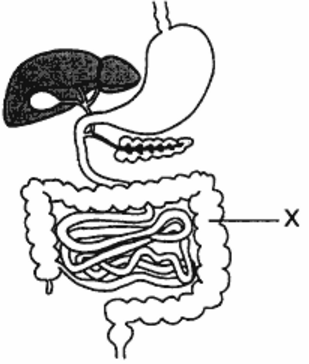
The diagram represents a portion of a human body. The principal function of structure X  is to
a)
produce salivary enzyme
b)
produce sex hormone
c)
absorb water
d)
absorb nutrients
45.

Which of the following tests for glucose?

a)

Iodine

b)

Benedicts

c)

Biuret

d)

Emulsion

46.

Which of the following tests for starch?

a)

Iodine

b)

Benedict's

c)

Biuret

d)

Emulsion

47.

Another name for a sugar molecule

a)

Glucose

b)

Benedicts solution

c)

Net Movement

d)

Indicator

48.

Solution that turns from brown to black/purple when mixed with starch

a)

Benedicts solution

b)

Lugols iodine solution

c)

Starch Solution

d)

Glucose solution

49.
Solution that turns from blue to orange when mixed with glucose turns from blue to orange
a)
Benedict's Solution
b)
Glocose
c)
Lugol's Iodine solution
d)
Starch
50.
Large Carbohydrate. A group of several glucose molecules
a)
Glucose
b)
Carb
c)
Starch
d)
Lugol
51.

Any solution that shows the presence of certain substances

a)

Starch

b)

Glucose

c)

Indicator

d)

Solution

52.
What is the path of the digestive system? 
a)
Mouth, Esophagus, Stomach, Small Intestines, Large Intestines
b)
Esophagus, Stomach, Large Intestine, Small Intestine, Mouth
c)
Mouth, Esophagus, Stomach, Large Intestine, Small Intestine
d)
Mouth, Esophagus, Small Intestine, Stomach, Large Intestine
53.

Amylase in saliva changes (complex carbohydrates) starch into...

a)

sugar

b)

waste

c)

stomach acid

d)

chyme

54.

Which indicator will change color in the presence of glucose sugar solution?

a)

Iodine

b)

Starch indicator

c)

Glucose indicator/Benedict's solution

d)

Dialysis tubing

55.

Another name for starch indicator solution is

a)

Benedict's solution

b)

Iodine

c)

Biological catalyst

d)

Semi-permeable

56.
What is unicellular? 
a)
one cell 
b)
many cells 
c)
no nuclues 
d)
DNA 
57.
What is multicellular? 
a)
one cell 
b)
no cells 
c)
many cells 
d)
no nucleus 
58.

Living thing made up of only one cell

a)

multicellular organism

b)

unicellular organism

c)

tissue

d)

organ

59.

Is the jelly-like substance in the cell that contains the organelles

a)

ribosome

b)

cytoplasm

c)

cell wall

d)

chloroplast

60.
All cells have a:
a)
Nucleus
b)

Cell membrane

c)
Cell wall
d)
Buddy
61.

Something that has all the characteristics of life.

a)

homeostasis

b)

organism

c)

cells

d)

response

62.

Organelles found in both plant cells and animal cells. It filters what goes in and out of the cell

a)

Cell wall

b)

Chloroplast

c)

Mitochondria

d)

Cell membrane

63.
All living things are made of...
a)
atoms 
b)
cells 
c)
bacteria 
d)
plants 
64.

What body system has structures called the mouth, stomach, and intestines?

a)

Digestive System

b)

Skeletal System

c)

Respiratory System

d)

Muscular System

65.

The first organ of Digestive system is?

a)

Food Pipe

b)

Mouth

c)

Stomach

d)

Liver

66.

Glucose molecules are ​ (a)   than starch molecules.

Choose from the below words
smaller
larger
the same size
67.

Substances in food that the body needs to function properly are:

a)

nutrition

b)

macromolecules

c)

calories

d)

nutrients

68.
Which biomolecule contains pastas and breads?
a)
Lipid
b)
Protein
c)
Nucleic Acid
d)
Carbohydrate
69.
Which biomolecule is made of amino acids?
a)
Nucleic Acid
b)
Carbohydrate
c)
Protein
d)
Lipid
70.
Which biomolecule contains fats, oils, and waxes?
a)
Proteins
b)
Nucleic Acid
c)
Lipids
d)
Carbohydrate
71.
The monomer of a protein is called...
a)
an amino acid
b)
a monosaccharide
c)
a fatty acid
d)
a nucleotide
72.
What happens when the food goes to the small intestine?
a)
nutrients gets into the blood
b)
the food keeps on going
c)
nothing
73.
Food is broken down to supply energy for your body in the ____________
a)
digestive system
b)
endocrine system
c)
excretory system
d)
reproductive system
74.
Breaking food down with the use of enzymes is known as:
a)
Chemical Digestion
b)
Physical Digestion
75.
Chewing food is an example of _____________.
a)
chemical digestion
b)
mechanical digestion
76.

The process of food getting physically changed into smaller pieces is what type of digestion?

a)

chemical

b)

mechanical

c)

both

d)

neither

77.

Which part of the digestive system prevents food from entering the windpipe?

a)

Esophagus

b)

Epiglottis

c)

Salivary glands

d)

Stomach

78.

Another name for a sugar molecule

a)

Glucose

b)

Benedicts solution

c)

Net Movement

d)

Indicator

79.
What are the basic building blocks for all matter?
a)
atoms
b)
elements
c)
compounds
d)
chemicals
80.
All ____________ are made up of two or more atoms bonded together.
a)
atoms
b)
molecules
c)
electrons
d)
elements
81.
The basic unit of structure and function in the human body is the....
a)
organ
b)
organ system
c)
cell
d)
tissue
82.

Glucose is a ​ (a)   molecule, and starch is a ​ (b)   molecule.

Choose from the below words
simple
complex
polar
compound
83.

If starch is present in a solution ___________ should produce a __________________ color.

a)

glucose; yellow/orange/brownish

b)

starch indicator/iodine; blue-black

c)

glucose indicator; blue

d)

Benedict's solution; yellow/orange.brownish

84.

Amylase in saliva changes (complex carbohydrates) starch into...

a)

sugar

b)

waste

c)

stomach acid

d)

chyme

85.

Any solution that shows the presence of certain substances

a)

Starch

b)

Glucose

c)

Indicator

d)

Solution

86.
Large Carbohydrate. A group of several glucose molecules
a)
Glucose
b)
Carb
c)
Starch
d)
Lugol
87.
Which biomolecule is found in fats, oils, and waxes and is a source of long-term energy
a)
Proteins
b)
Nucleic Acid
c)
Lipids
d)
Carbohydrate
88.
Which biomolecule has sugars and starches?
a)
Lipids
b)
Proteins
c)
Carbohydrates
d)
Nucleic Acid
89.
A monomer is ...
a)
a single atom
b)
a building block for polymers
c)
a single element
d)
is an inorganic molecule
90.
Enzymes are considered to be 
a)
Lipids
b)
Carbohydrate
c)
Protein
d)
Nucleic Acid
91.
Proteins are made of monomers called ___________
a)
Nucleotides
b)
Monosaccharides
c)
Amino Acids
d)
Glycerol and fatty acids
92.

What do proteins break down into?

a)

Fatty Acids

b)

Amino Acids

c)

Sugars

93.

Why does the amount of glucose increase in the mouth?

a)

Trypsin breaks down complex carbohydrates into glucose.

b)

Amylase breaks down complex carbohydrates into glucose.

c)

Lipase breaks down glucose into complex carbohydrates.

94.

Why are some molecules absorbed into the blood stream, but some molecules are not?

a)

Some molecules are bigger than others.

b)

Some molecules are liquids.

c)

Some molecules are healthier for you.

d)

Some molecules are smaller than others.

95.

Why do molecules in the small intestine seem like they are disappearing?

a)

The molecules are getting absorbed into the blood

b)

The molecules are returning to the stomach

c)

The molecules are going to the large intestine

d)

The molecules are broken down and no longer exist

96.

What's the difference between starch and glucose?

a)

Starch is a type of protein and glucose is a sugar

b)

Starch is made up of many glucose molecules bonded together

c)

Glucose is made up of many starch molecules bonded together

d)

Glucose is a type of protein and starch is a sugar