
 Worksheets
PMA 2 Comprehensive Review
Total questions: 100
Worksheet time: 5hrs 0mins

Location inside of a plant cell where the process of photosynthesis occurs.
leaves
mitochondria
chloroplasts
chlorophyll

A gas that plants release during photosynthesis
oxygen
methane
propane
carbon dioxide

A gas that plants take in through small holes in their leaves for the process of photosynthesis.
oxygen
methane
propane
carbon dioxide

Taken in by the leaves of the plant to give the chloroplasts energy for food production.
chlorophyll
oxygen
water
sunlight
Where does Photosynthesis take place in a plant cell?
Nucleus
Chloroplast
cytoplasm
mitochondria
What are the two products of photosynthesis?
oxygen and carbon dioxide
sunlight and carbon dioxide
sugar and oxygen
water and oxygen
Pigment in green plants that capture the energy in sunlight is called __________
Greenplasts
chlorophyll
stomata
chloroplasts
Which of the following is the correct equation for photosynthesis?
CO2 + light + H2O ---> O2 + Sugar
CO2 + sugar + water --> O2 + light
O2 + light + water ---> sugar + CO2
CO2 + O2 + light ---> sugar + water
What is the purpose of Photosynthesis?
to release energy
for growth
to create glucose
to get oxygen for respiration
A gas that plants take in through small holes in their leaves for the process of photosynthesis.
oxygen
methane
propane
carbon dioxide
Which of the following is the correct equation for photosynthesis?
CO2 + light + H2O ---> O2 + Sugar
CO2 + sugar + water --> O2 + light
O2 + light + water ---> sugar + CO2
CO2 + O2 + light ---> sugar + water
___ is the process that cells use to take energy from glucose.
cellular respiration
photosynthesis
transpiration
excretion
___ cells use the process of cellular respiration.
nearly all
mostly plant
mostly animal
mostly fungi
The ___ is the cell part (organelle) inside cells where cellular respiration happens.
mitochondria
chloroplast
nucleus
ribosome
In a cell, the mitochondria is like the ___.
powerhouse
kitchen
control center
highway system
___ is needed for cellular respiration, it is absorbed from the air.
oxygen
glucose
carbon dioxide
water
___ is needed for cellular respiration, it comes from food.
glucose
water
oxygen
carbon dioxide
The primary purpose of cellular respiration is to produce ___.
ATP
sugar
glucose
heat
Both ___ are leftover as waste products after cellular respiration.
water & carbon dioxide
oxygen & glucose
carbon dioxide & oxygen
water & oxygen
Cellular respiration and photosynthesis are ___.
exact opposites
basically the same
not related in any way
not important for life
Cellular respiration ___ energy.
releases
stores
creates
destroys
Cellular respiration ___ glucose molecules.
breaks
makes
shakes
wakes
Which of the following is the word equation for cellular respiration?
glucose + oxygen ---> ATP + carbon dioxide + water
carbon dioxide + water ---> ATP + glucose + oxygen
glucose + water ---> ATP + carbon dioxide + oxygen
glucose + carbon dioxide ---> ATP + oxygen + water
A phase change from liquid to gas is called ...
condensation
vaporization
sublimation
deposition
Melting is a process that changes _____________________________.
solid to liquid
liquid to solid
liquid to gas
gas to liquid
Condensation occurs when you _______ thermal energy.
add
remove
Melting occurs when you _______ thermal energy.
add
remove

Where on the graph are phase changes taking place?
1
2
3
4
5

What phase of matter exists in part C of the graph?
Gas
Liquid
Solid
Plasma
What phase change occurs when you start at D and end at E?
Freezing
Melting
Condensing
Vaporization

What is the boiling point of this substance?
100 oC
60 oC
-60 oC
20 oC
Density is _____________.
Mass/Volume
Weight/Volume
Mass/Weight
Volume/Mass
Volume/Weight

If all masses are 20g, which material has the GREATEST volume? (Volume = mass/density)
Oil
Kool-aid
Sprite
Vinegar
If I cut a block of gold in half, what happens to its density?
Density is cut in half.
Density stays the same.
Density doubles.
Density cannot be determined.

The mass of the jade is 13g, what is the density?
1.3 g/mL
0.81 g/mL
1.24 g/mL
0.77 g/mL

What is the same about the cubes?
Density
Weight
Mass
Volume

This diagram represents...
An element
A molecule
A compound
A mixture of elements and compounds


Mixtures are different than pure substances because mixtures-
have lower boiling points
can be separated physically
are less dense than pure substances
contain only one type of atom


The subatomic particles that make up an atom.
solid, liquid, gas
electrons, protons, nucleus
energy, protons, nucleus
electrons, protons, neutrons

__________ are negatively charged particles that are in the orbitals around the nucleus.
protons
nucleus
neutrons
electrons

A proton has a ___________ charge.
positive
negative
neutral
massive.
An electron has a _________ charge
positive
neutral
negative
massive


The mass number is always larger than the atomic number.
TRUE
FALSE


The Atomic number is known as the _______
Number of electrons in an atom
Number of Protons in an atom
Number of neutrons in an atom
Number of Protons and electrons in an atom
Elements in the same group have : (2 correct answers)
Similar chemical properties
Similar names
Same number of outer (valence) electrons)
The same number of protons
If the soil is acidic what we should do to make it neutral
Add salt
Add acid
Add base
Add sugar
If the ph value is 5 what is the substance
Acid
Base
Neutral
Sweet
Products of a neutralization reaction are always:
an acid and a base
an acid and a salt
a salt and water
a salt and a base

When the pH scale goes lower than 7, it means that the substance is ______.
neutral
acidic
basic
salt
The pH of pure water
5.6
7.0
8.1
0.0
A substance with a ph of higher that 7.5 is a?
Pure Neutral Solution
Base
Acid
Salt
What may happen to light that strikes an object?
The light may be reflected, refracted or absorbed.
The light may be reflected, transmitted and refracted.
The light may be refracted, absorbed and transmitted.
Which of the following is the best example of an object absorbing light?
A black sweater in the sun.
A clean window in the sun.
A curved mirror in the sun.
A long shadow in the sun.
Which has more energy than visible light?
Microwaves
Radio waves
Infrared light
Gamma rays
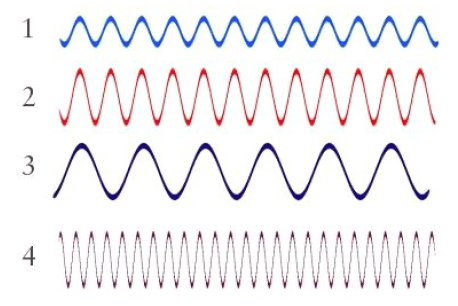
Which wave in the diagram has the greatest wavelength?
1
2
3
4

Why do diamonds look so shiny?
They absorb light waves.
The reflect light waves.
Light is refracted as it passes through.
Sound waves travel faster than light waves.
True
False

A student placed a pencil in a cup of water. The pencil appears broken because light
always travels in a straight line.
slows down when it passes through water.
makes the water in the glass evaporate.
reflects the pencil on the water's surface.
Thermal energy is transferred from ________ temperature to _____________ temperature.
lower, higher
higher, lower
same, same
higher, higher
In conduction, when one part of the object is heated, the particles ________
vibrate more vigorously, collide with adjacent particles and transfer energy
vibrate more slowly and transfer energy
expand due to the heat and allow the hotness to flow.
flow from one of the object to other.
Which of the following statements is true about temperature?
The faster the particles move, the lower the temperature.
The faster the particles move, the higher the temperature.
The slower the particles move, the higher the temperature.
The slower the particles move, the temperature is still the same.
When does the transfer of heat stops from one body to another body?
When the other body reach its high temperature
When there is no more thermal energy in each body.
When the temperatures of the objects are 100°C apart.
When thermal equilibrium is reached.
George holds an ice cube in his hand. As he squeezes the ice, it begins to melt. Which of the following best explains why this happens?
George releases cold to the ice.
Heat moves from George's hand into the cube.
Cold moves from the ice onto George’s hand as it melts.
George absorbs heat from the ice.
John has a fever. His mother puts a cold towel on his forehead. Which of the following is correct?
Heat flows from John's forehead to the towel.
Heat flows from the towel to John's forehead.
Temperature flows from John's forehead to the towel.
Temperature flows from the towel to John's forehead.

The transfer of heat in a fluid or a liquid caused when hotter, less dense fluids rise and cooler, more dense fluids sink.
convection
conduction
radiation
kinetic energy

When moving fluids result in a transfer of heat in a cycle, it is called a _______
heat transfer
insulator
convection current
conductor
Rod-shaped organelles that convert energy in food molecules to energy the cell can use to carry out its functions
Mitochondria
Golgi Apparatus
Ribosomes
Endoplasmic Reticulum
Organelle in the cells of plants and some other organisms that captures energy from sunlight and changes it to an energy form that cells can use in making food
Cell Wall
Chloroplast
What two organelles are NOT in an animal cell?
Cell Membrane and Mitochondria
Nucleus and Ribosomes
Cell Wall and Chloroplasts
Golgi Body and Lysosomes

Name this organelle
Ribosomes
Vacuole
Nucleus
Chloroplast
Creates energy for ALL cells, the powerhouse of the cell
Nucleolus
Vacuole
Cytoplasm
Mitochondria
Creates energy for some cells using sunlight, the solar panel of the cell
Vacuole
Chloroplast
E.R.
Ribosomes

Name this organelle
Cell Wall
Mitochondria
Nucleus
Vacuole
What are plants that convert energy from the sun called?
decomposer
primary consumer
secondary consumer
producer

