
 Worksheets
All Year 7 topics key questions
Total questions: 95
Worksheet time: 48mins
What is meant by the particle model?
All materials are made of billions of tiny pieces called particles.
Materials are made of large, visible pieces.
Particles are only found in gases.
Only liquids are made of particles.
What does the term 'substance' mean?
A word that can be used to refer to any solid, liquid, or gas.
A term for only liquids.
A term for only gases.
A term for only solids.
How are particles arranged in a solid?
Particles are closely packed and can only vibrate.
Particles are far apart and move freely.
Particles are loosely packed and move randomly.
Particles are arranged in a straight line.
How are particles arranged in a liquid?
Particles are loosely packed and move randomly.
Particles are closely packed and can only vibrate.
Particles are far apart and move freely.
Particles are arranged in a straight line.
How are particles arranged in a gas?
Particles are far apart and move freely.
Particles are closely packed and can only vibrate.
Particles are loosely packed and move randomly.
Particles are arranged in a straight line.
What are the properties of a solid?
Fixed shape, particles can only vibrate.
No fixed shape, particles move randomly.
Particles independently move throughout the container.
Particles are far apart and move freely.
What are the properties of a liquid?
No fixed shape, particles move randomly.
Fixed shape, particles can only vibrate.
Particles independently move throughout the container.
Particles are far apart and move freely.
What are the properties of a gas?
Particles move independently and randomly throughout the container.
Fixed shape, particles can only vibrate.
No fixed shape, particles move randomly.
Particles are closely packed and can only vibrate.
Define melting.
When a solid turns to a liquid.
When a liquid turns to a gas.
When a gas turns to a liquid.
When a liquid turns to a solid.
Define boiling.
When a liquid turns to a gas.
When a solid turns to a liquid.
When a gas turns to a liquid.
When a liquid turns to a solid.
Define condensation.
When a gas turns to a liquid.
When a liquid turns to a gas.
When a solid turns to a liquid.
When a liquid turns to a solid.
Define freezing.
When a liquid turns to a solid.
When a solid turns to a liquid.
When a gas turns to a liquid.
When a liquid turns to a gas.
Define sublimation.
When a solid turns straight to a gas without becoming a liquid.
When a liquid turns to a solid.
When a gas turns to a liquid.
When a liquid turns to a gas.
What happens to particles as you heat them up?
The speed they move at increases.
The speed they move at decreases.
They stop moving.
They become larger.
What happens to the particles during boiling?
Particles gain enough energy to break away from the liquid and become a gas.
Particles lose energy and become a solid.
Particles stop moving.
Particles become smaller.
Define boiling point.
A temperature specific to a substance at which a liquid will turn into a gas.
A temperature at which a solid turns into a liquid.
A temperature at which a gas turns into a solid.
A temperature at which a liquid turns into a solid.
Define melting point.
A temperature specific to a substance at which a solid will turn into a liquid.
A temperature at which a liquid turns into a gas.
A temperature at which a gas turns into a solid.
A temperature at which a liquid turns into a solid.
What is the smallest particle of a chemical element?
Molecule
Atom
Compound
Mixture
What is a substance made up of only one type of atom called?
Compound
Mixture
Element
Solution
What is a substance made up of two or more different types of atoms joined together?
Element
Mixture
Compound
Solution
What does it mean if a substance is pure?
It is a mixture of different particles.
It is made up of only one type of particle.
It contains both solids and liquids.
It is a combination of gases.
What is a combination of different particles that are in the same place but not joined together?
Element
Compound
Mixture
Solution
What is a solid substance that can dissolve in a liquid called?
Insoluble
Soluble
Compound
Mixture
What is a solid substance that doesn’t dissolve in a liquid called?
Soluble
Insoluble
Compound
Mixture
Which of the following is NOT a method of separation?
Filtration
Distillation
Evaporation
Fusion
What process could you use to separate an insoluble solid from a liquid?
Evaporation
Filtration
Distillation
Chromatography
What process could you use to separate a soluble solid from a liquid?
Filtration
Evaporation
Distillation
Chromatography
What process could you use to separate two liquids?
Filtration
Evaporation
Distillation
Freezing
What is a chemical reaction?
A process that involves the rearrangement of atoms to make new substances.
A process that involves mixing substances without changing them.
A process that involves only physical changes.
A process that involves the evaporation of water.
How can you identify a chemical reaction?
By the change in colour, gas production, or energy change.
By the increase in size of the substance.
By the decrease in temperature only.
By the change in shape of the substance.
Why are chemical reactions useful?
They release heat and energy, and help make medicines and building materials.
They only release energy without any other benefits.
They are not useful in any practical applications.
They only help in cooling down substances.
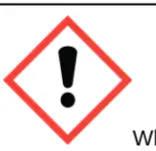
What does the safety symbol with an exclamation mark indicate?
Safety symbol, irritant
Safety symbol, explosive
Safety symbol, flammable
Safety symbol, radioactive
What does the corrosive safety symbol mean?
Corrosive safety symbol
Flammable safety symbol
Radioactive safety symbol
Explosive safety symbol
What does the environmental hazard symbol mean?
Harmful to the environment - do not pour down the sink!
Safe for the environment
Beneficial to the environment
Neutral to the environment
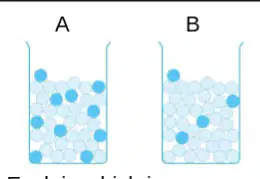
Which is more concentrated, A or B?
A is more concentrated
B is more concentrated
Both are equally concentrated
Neither is concentrated
What safety precaution should you take when using acids and alkalis?
Wear goggles and wash hands to dilute any chemical on your skin.
Use bare hands to handle chemicals.
Avoid wearing any protective gear.
Only use gloves without washing hands.
What other safety precautions should you take when doing practical work?
Stand with chairs and bags tucked under tables.
Leave chairs and bags scattered around.
Ignore safety protocols.
Only focus on the experiment without considering surroundings.
What is an indicator?
A substance that changes colour to identify an acid or alkali.
A substance that changes shape when heated.
A substance that remains unchanged in all conditions.
A substance that only reacts with water.
What is a Universal Indicator?
A mixture of dyes that change colour to show how acidic or alkaline a solution is.
A single dye that changes colour randomly.
A mixture of dyes that only show temperature changes.
A single dye that remains colourless.
What colour and number represent a neutral substance on the pH scale?
Green 7
Red 1
Blue 14
Yellow 3
What colour would a strong acid show on the pH scale?
Red
Blue
Green
Yellow
What happens when you mix an acid and an alkali together?
It forms a gas
It is a neutralisation reaction
It creates a solid
It produces electricity
Complete the word equation to show a neutralisation reaction: Acid + Alkali ➔ _______ + _______
Salt + water
Salt + carbon dioxide
Water + carbon dioxide
Acid + base
Why are some acids stronger than others?
They have more colour
They dissolve faster
More chemicals in the compound split up in water
They are heavier
What is a base?
A substance that dissolves in water
A substance that neutralises an acid
A type of metal
A form of gas
What is an alkali?
A soluble base
A type of acid
A form of salt
A metal compound
What are salts?
A type of acid
A neutral substance formed from an acid and a metal
A form of gas
A type of base
Name the salt made when you react Sodium (metal) with Hydrochloric Acid.
Sodium sulphate
Sodium chloride
Sodium nitrate
Sodium carbonate
How can you make salt crystals?
Mix metal oxide with cold water
Mix an excess amount of metal oxide into a warm acid
Mix metal oxide with a base
Mix metal oxide with a gas
What is the first step in the process of making copper sulphate crystals?
Filter the copper oxide.
Heat the solution.
Add copper oxide powder to dilute sulphuric acid.
Leave the solution in a warm place.
What are the different aspects of healthy living we need to consider?
Diet, Exercise, Sleep and Mental health.
Diet, Exercise, Sleep and Social life.
Diet, Exercise, Sleep and Work.
Diet, Exercise, Sleep and Entertainment.
Name the 7 nutrient groups.
Carbohydrates, protein, fats / lipids, fibre, vitamins, minerals and water
Carbohydrates, protein, fats / lipids, fibre, vitamins, minerals and sugar
Carbohydrates, protein, fats / lipids, fibre, vitamins, minerals and salt
Carbohydrates, protein, fats / lipids, fibre, vitamins, minerals and caffeine
Why does our body need carbohydrates?
To provide us with energy
To build muscles
To improve vision
To strengthen bones
Why does our body need protein?
For growth and repair of tissues in our body.
For energy storage
For improving digestion
For enhancing memory
Why does our body need fats?
Slow release energy and insulation.
To improve skin texture
To enhance taste
To increase metabolism
What does RDA stand for?
Recommended daily allowance
Required daily amount
Regular dietary advice
Routine diet assessment
What unit do we use to measure the amount of energy in food?
Calories
Joules
Watts
Volts
What is a calorie surplus and what effect does it have on us?
When we consume more calories than we burn. Causes us to put on weight.
When we consume fewer calories than we burn. Causes us to lose weight.
When we consume equal calories to what we burn. Maintains weight.
When we consume no calories. Causes starvation.
What is a calorie deficit and what effect does it have on us?
When we consume less calories than we burn. Causes us to lose weight.
When we consume more calories than we burn. Causes us to gain weight.
When we consume equal calories to what we burn. Maintains weight.
When we consume no calories. Causes starvation.
Describe a method to compare the amount of calories in different foods.
Hold the burning piece of food below a boiling tube of water. Measure the temperature increase of the water.
Weigh the food and compare weights.
Taste the food and compare flavors.
Count the number of ingredients in each food.
Why do we need a digestive system?
To break down large food molecules into small solubles nutrients
To store food for later use
To improve taste of food
To eliminate waste from the body
Name at least 3 organs in the digestive system.
Mouth, oesophagus, stomach
Heart, lungs, brain
Kidneys, bladder, urethra
Skin, hair, nails
How do nutrients travel around the body?
In the blood
Through the skin
Via the nerves
In the air
In which part of our body do nutrients from our food enter the blood?
Small intestine
Large intestine
Stomach
Liver
What word describes someone who does not have a balanced diet?
Malnourished
Overweight
Athletic
Energetic
If someone is lacking a specific vitamin or mineral they may develop what?
A deficiency disease
A growth spurt
A strong immune system
A high metabolism
What condition is caused by a lack of iron?
Anaemia
Scurvy
Rickets
Diabetes
What condition is caused by a lack of vitamin C?
Scurvy
Rickets
Anaemia
Diabetes
What condition is caused by a lack of vitamin D?
Rickets
Scurvy
Anaemia
Diabetes
What does your pulse rate tell us?
The number of times your heart beats per minute
The amount of blood in your body
The speed of your breathing
The temperature of your body
What happens to heart rate during exercise?
Heart rate will decrease
Heart rate will increase
Heart rate will stay the same
Heart rate will stop
What is the job of the heart?
To digest food
To pump blood around the body
To produce hormones
To store energy
Your heart rate changes during exercise because:
To supply more oxygen and glucose to the muscles for energy
To cool down the body
To increase body temperature
To reduce stress
How do we calculate BMI and why do we use it?
Mass (KG) / Height^2 (m), used as an indicator of health
Height (m) / Mass^2 (KG), used to measure intelligence
Mass (KG) x Height^2 (m), used to determine age
Height (m) - Mass (KG), used to assess fitness
What is a drug?
A chemical that affects the way your body functions
A type of food that gives energy
A vitamin that improves health
A mineral that strengthens bones
What is the addictive drug in cigarettes?
Nicotine
Caffeine
Alcohol
Sugar
What sticky chemical in cigarettes affects your lungs?
Tar
Carbon dioxide
Oxygen
Water vapor
What are the long-term effects of smoking?
Cancer, heart disease, lung disease, fertility issues
Improved lung capacity
Increased energy levels
Enhanced memory
What are the long-term effects of excessive alcohol consumption?
Cirrhosis of the liver, increased risk of cancer, depression, and infertility
Improved digestion
Enhanced physical strength
Better sleep quality
What is an independent variable?
The one thing that you change during an experiment
The thing that you measure during an experiment
All factors that need to be kept the same
The result of the experiment
What is a dependent variable?
The thing that you measure during an experiment
The one thing that you change during an experiment
All factors that need to be kept the same
The result of the experiment
What is a control variable?
All factors that need to be kept the same so they do not affect the investigation
The one thing that you change during an experiment
The thing that you measure during an experiment
The result of the experiment
What is a force?
A push or pull that an object feels due to another object affecting it.
A measure of how hard something is pulled to the ground.
The quantity of material that something contains.
A single force showing the overall effect of all individual forces on an object.
What is the unit of force?
Newtons
Kilograms
Meters
Joules
What is meant by 'Resultant force'?
A single force showing the overall effect of all individual forces on an object.
A measure of how hard something is pulled to the ground.
The driving force on a rocket or plane.
A force that pulls one object towards another.
Define 'Thrust'.
The driving force on a rocket or plane.
A force that pulls one object towards another.
A measure of how hard something is pulled to the ground.
The quantity of material that something contains.
Define 'Gravity'.
A force that pulls one object towards another.
The driving force on a rocket or plane.
A measure of how hard something is pulled to the ground.
The quantity of material that something contains.
Define 'Weight'.
A measure of how hard something is pulled to the ground.
The quantity of material that something contains.
A single force showing the overall effect of all individual forces on an object.
A push or pull that an object feels due to another object affecting it.
Define 'Mass'.
The quantity of material that something contains.
A measure of how hard something is pulled to the ground.
A single force showing the overall effect of all individual forces on an object.
A push or pull that an object feels due to another object affecting it.
What is the unit of mass?
Kilograms
Newtons
Meters
Joules
What happens if there is a forwards resultant force on a moving object?
The object will speed up.
The object will slow down.
It will stay at a constant speed.
The object will stop.
What happens if there is a backwards resultant force on a moving object?
The object will slow down.
The object will speed up.
It will stay at a constant speed.
The object will stop.
What happens if there is zero resultant force on a moving object?
It will stay at a constant speed.
The object will speed up.
The object will slow down.
The object will stop.
'Balanced forces' is another way of saying what?
Zero resultant force
A push or pull
The driving force
A measure of mass
What piece of equipment can be used to measure force?
Newton Meter
Kilogram Scale
Thermometer
Barometer

