wayground logo

Free Printable Worksheets

Font size

S
M
L
XL
Worksheets

Genetics review

Total questions: 101

Worksheet time: 5hrs 29mins

Name
Class
Date
1.

Which of the following is not a benefit of asexual reproduction?

a)

Offspring will be successful in an unchanged environment.

b)

Good at adapting to changing environments.

c)

Only requires one parent to produce offspring.

d)

Can reproduce rapidly.

2.

Asexual reproduction is associated with what type of cell division?

a)

Mitosis

b)

Meiosis

3.

An organism that has been reproduced by asexual means receives ______________ of its chromosomes from its one parent.

a)

3

b)

25%

c)

50%

d)

100%

4.

In asexual reproduction, all of the offspring are:

a)

Physically Identical

b)

Genetically Identical

c)

Physically and Genetically Identical

d)

Not Identical

5.

What is the big advantage of sexual reproduction?

a)

Can quickly grow the population

b)

Offspring are guaranteed to be successful in an unchanged environment.

c)

Only one parent is required to reproduce.

d)

Can adapt to changing environments

6.

What is the type of cell division associated with sexual reproduction?

a)

Mitosis

b)

Meiosis

7.

An organism that has been reproduced by sexual reproduction received ____________ of its chromosomes from the male parent.

a)

4

b)

25%

c)

50%

d)

100%

8.

During mitosis the parent cell produces:

a)

2 daughter cells with the same number of chromosomes as the parent cell.

b)

2 daughter cells with the half the number of chromosomes as the parents cell.

c)

4 daughter cells with the same number of chromosomes as the parent cell.

d)

4 daughter cells with half the number of chromosomes as the parent cell.

9.

During meiosis the parent cell produces:

a)

2 daughter cells with the same number of chromosomes as the parent cell.

b)

2 daughter cells with the half the number of chromosomes as the parents cell.

c)

4 daughter cells with the same number of chromosomes as the parent cell.

d)

4 daughter cells with half the number of chromosomes as the parent cell.

10.

Which process is nature cloning itself?

a)

Somatic Transfer

b)

Mitosis

c)

Meiosis

d)

Photosynthesis

11.

Meiosis produces sex cells that have half the number of chromosomes as the parent cell. Select all that are examples of sex cells.

a)

Sperm Cell

b)

Skin Cell

c)

Egg Cell

d)

Pollen

e)

Somatic Cell

12.

A fruit fly has 8 chromosomes like in the picture above. Which answer correctly shows the results of a fruit fly cell going through mitosis?

a)
b)
c)
d)
13.

A fruit fly has 8 chromosomes like in the picture above. Which answer correctly shows the results of a fruit fly cell going through meiosis?

a)
b)
c)
d)
14.

If a cow has 60 chromosomes in a somatic cell how many chromosomes would be in a cow's sex cell?

a)

60

b)

120

c)

30

d)

90

15.

The specific section of DNA that carries the code to control the specific characteristic or trait.

a)

Nucleus

b)

Chromosome

c)

Gene

d)

Allele

16.

What is the type of reproduction that only requires one parent?

a)

Asexual

b)

Sexual

17.

Which type of reproduction results in diversity because the offspring are a combination of the parents and genetically different?

a)

Asexual

b)

Sexual

18.
What is it called when a sperm and egg meet?
a)
meiosis
b)
fertilization
c)
cell division
d)
mitosis
19.
Which process and type of resulting cells are represented?
a)
mitosis, gametes
b)
mitosis, body cells
c)
meiosis, gametes
d)
meiosis, body cells
20.
The chromosomes that pair up during meiosis, are called __________ chromosomes.  
a)
homozygous 
b)
asexual
c)
homologous
d)
genes
21.
A male shark has 40 chromosomes in each of its sex cells. How many would be present in its body cells?
a)
20
b)
40
c)
80
d)
160
22.
Which letter(s) in the diagram correspond to cells that are haploid? 
a)
A
b)
B
c)
C
d)
A and B
23.
Compared to the number of chromosomes contained in a body cell, how many chromosomes would normally be contained in a gamete?
a)
The same number
b)
One-fourth as many
c)
Twice as many
d)
Half as many
24.
What causes genetic variation in meiosis?
a)
chromosomes lining up
b)
crossing over of chromosomes
c)
separation of chromosomes
d)
chromosomes pulling apart
25.
What is one of the advantages, why is it better to reproduce sexually versus asexually?
a)
survival of the fittest
b)
overproduction
c)
genetic variation
d)
cloning
26.
Crossing over helps promote 
a)
male genotype
b)
genetic variation
c)
DNA replication
d)
mitosis
27.
A human zygote should have _____ chromosomes inside.
a)
46
b)
23
c)
92
d)
64
28.
A human being has a somatic cell that has 46 chromosomes.  What is the haploid number found in a gamete?
a)
23
b)
46
c)
69
d)
92
29.
Diploid Cells are represented by
a)
2n
b)
n
c)
4n
d)
1/2 n
30.
Identify the phase:
a)
Metaphase I
b)
Metaphase II
c)
Anaphase I
d)
Anaphase II
31.
Identify the phase.
a)
Metaphase I
b)
Metaphase II
c)
Anaphase I
d)
Anaphase II
32.
Identify the process.
a)
Mitosis
b)
Meiosis I
c)
Meiosis II
d)
Interphase
33.
After meiosis II the daughter cells will contain ____ chromosomes if the original cell contained 78.
a)
78
b)
39
c)
23
d)
46
34.
Which of the following cells is a gamete?
a)
egg
b)
bone
c)
heart
d)
muscle
35.
The pair of chromosomes that contain the same genes (but may be coded differently) and are inherited from a male and female parent are termed ___.
a)
gametes
b)
alleles
c)
zygote
d)
homologs
36.

Is the following cell diploid or haploid?

a)

Diploid

b)

Haploid

37.
When does replication of chromosomes occur in animal cell meiosis?
a)
Before Meiosis I and Meiosis II
b)
Before Meiosis II Only
c)
Before Meiosis I Only
d)
During Prophase I and Prophase II
38.
Identify the phase.
a)
Telophase I
b)
Telophase II
c)
Metaphase I
d)
Metaphase II
39.
This type of RNA moves amino acids to the ribosomes.
a)
mRNA
b)
tRNA
c)
rRNA
40.

1n indicates that the cell is ____.

a)

Diploid

b)

Haploid

41.

This type of asexual reproduction has the offspring growing off of the parent.

a)

Budding

b)

Regeneration

c)

Runner

d)

Binary Fission

42.
What are the nucleotides made of?
a)
Sugar, Phosphate, nitrogen base
b)
Phosphate, Adenine, nitrogen base
c)
Thymine, Adenine, Cytomine
d)
Phosphate, Nitrogen, Adenine
43.
Adenine bonds with ______________.
a)
Guanine
b)
Thymine
c)
Cytosine
d)
Adenine
44.
Guanine bonds with ______________.
a)
Adenine
b)
Guanine
c)
Cytosine
d)
Thymine
45.
Why is DNA important?
a)
it is very small and very complicated
b)
it's in everything
c)
it serves as the blueprint for traits of all living things
d)
because we eat it every day for energy
46.
What are the 4 nitrogen bases?
a)
adenine, thymine, cytoplasm, and guanine
b)
adenine, thymine cytosine, and guanine
c)
adenine, thymine, cytosine, and gylcerol
d)
adenine, thymine, cytosine, and glucose
47.
Which sequence of DNA bases would pair with this partial strand
ATG TGA CAG
a)
ATG TGA CAG
b)
TAC ACT GTC
c)
GTA AGT GAC
d)
CAT TCA CTG
48.

In eukaryotes, which organelle is DNA usually found in?

a)

cell membrane

b)

vacuole

c)

chloroplast

d)

nucleus

49.
Which shows the correct complementary base pairing for DNA?
a)
C-A, T-G
b)
A-G, C-T
c)
C-G, U-A
d)
T-A, G-C
50.
What does DNA stand for?
a)
Deoxyribonucleic acid
b)
Denitrogenous acid
c)
Deribonucleic acid
d)
Diribonucleic acid
51.
The building block of nucleic acids are nucleotides.  Nucleotides are composed of a sugar, a phosphate group, and a _________________ base.
a)
oxygen
b)
hydrogen
c)
nitrogen
d)
carbon
52.
The sugar in DNA is ?
a)
sucrose
b)
glucose
c)
deoxyribose
d)
fructose
53.
Which of the following monomers are repeatedly joined together to form a strand of DNA?
a)
amino acids
b)
nucleotides
c)
fatty acids
d)
polysaccharides
54.
What determines the code, or information, of a DNA molecule?
a)
the shape (structure) of the nitrogen bases
b)
the order (sequence) of the nitrogen bases
c)
the color of the nitrogen bases
d)
the frequency (number) of nitrogen bases
55.
Which 2 molecules form the sides (backbone) of the DNA ladder?
a)
deoxyribose sugar and adenine
b)
deoxyribose sugar and a hydrogen bond
c)
deoxyribose sugar and the nucleus
d)
deoxyribose sugar and phosphate
56.
The two strands of nitrogenous bases in DNA are joined by which type of bond?
a)
polar bonds
b)
ionic bonds
c)
covalent bonds
d)
hydrogen bonds
57.
X outlines a(n) ___________.
a)
amino acid
b)
nitrogen base 
c)
nucleotide
d)
nitrogen base pair
58.
A long chain of amino acids is a/an
a)
protein
b)
nucleic acid
c)
tRNA
d)
mRNA
59.
If a DNA molecule consists of 29% Guanine, how much cytosine will it contain?
a)
29%
b)
58%
c)
21%
d)
I have no idea.
60.
How many hydrogen bonds do C and G have between them?
a)
1
b)
2
c)
3
d)
4
61.
In RNA, Uracil pairs with ______. 
a)
cytosine
b)
adenine
c)
guanine
d)
thymine
62.
The mRNA leaves the ________ to find the ribosome to make proteins.
a)
cell
b)
nucleotide
c)
nucleus
63.

DNA holds the code for making

a)

lipids

b)

carbohydrates

c)

proteins

d)

sugars

64.

Choose the sequence of the mRNA strand that would be match up with to the following strand:

GTAGTCA

a)

UATUAGA

b)

ACGACTG

c)

CAUCAGU

d)

CATCAGT

65.
The main function of tRNA is to...
a)
carry a message that, when translated, forms proteins
b)
form a portion of ribosomes
c)
string together complementary RNA and DNA strands
d)
bring amino acids from the cytoplasm to the ribosomes
66.
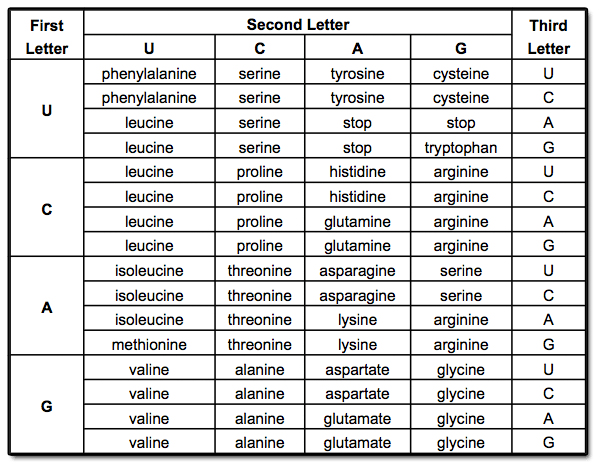
What amino acid is represented by the codon UUA?
a)
Phenylalanine
b)
Tyrosine
c)
Leucine
d)
Stop codon
67.

What is the correct amino acid sequence for the mRNA code AUGCCAGUAUGA

a)

Met-Pro-Ala-Val

b)

Met-Pro-Val

c)

Tyr-Gly-His

d)

Tyr-Gly-Arg-His

68.

Which is the mRNA molecule that would be created from this DNA template:

TGGCAAGTACGT

a)

ACCGTTCATGCA

b)

UGGCAAGUACGU

c)

UCCGUUCUUGCU

d)

ACCGUUCAUGCA

69.
Contains the bases adenine, uracil, cytosine and guanine
a)
DNA
b)
RNA
c)
Both
70.
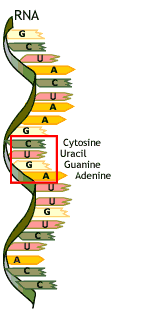
What part of protein synthesis does this diagram represent?
a)
mRNA
b)
tRNA
c)
rRNA
d)
RNA
71.
DNA travels outside of the nucleus.
a)
true
b)
false
72.
Messenger RNA carries a copy of the DNA code.
a)
true
b)
false
73.
Where do cells get the information to make proteins?
a)
RNA
b)
DNA
c)
phosphate group
74.

In what process is mRNA synthesized?

a)

Transcription

b)

Translation

c)

DNA Replication

d)

Mitosis

75.

Where does TRANSCRIPTION occur?

a)

Nucleus

b)

Ribosome

c)

Cytoplasm

d)

Mitochondria

76.

Why must transcription occur where DNA can be found?

a)

because DNA can't leave

b)

because ribosomes are in the nucleus

c)

because DNA polymerase is found there

d)

because helicase unzips the DNA

77.

How many codons equals 1 amino acid?

a)

1

b)

2

c)

3

d)

4

78.

How many nucleotides equal 1 amino acid?

a)

1

b)

2

c)

3

d)

4

79.

TRANSCRIBE this DNA sequence: TACGTTACT

a)

AUGCAAUGA

b)

ATGCAATGA

c)

AUGGATUGA

d)

TACGTTACT

80.

Which of the following are differences in the structure between RNA and DNA

a)

DNA uses deoxyribose sugar, RNA uses sugar ribose

b)

DNA pairs Adenine with Uracil, RNA pairs Adenine with Thymine

c)

DNA is a double helix, RNA is a single helix

d)

DNA pairs Adenine with Thymine, RNA pairs Adenine with Uracil

81.

Which organelle is the location where protein is made?

a)

Ribosome

b)

Nucleus

c)

Cytoplasm

d)

Nucleotide

82.

When these bond together, they form a protein

a)

Amino Acids

b)

Peptide Bonds

c)

Ribose

d)

Nucleotides

83.
What is the term for a three-nucleotide sequence that codes for an amino acid?
a)
base
b)
codon
c)
amine
d)
serine
84.
The process to go from DNA to mRNA is _______
a)
translation
b)
transcription
c)
replication
85.
The process to go from mRNA to a protein is called ____
a)
transcription
b)
rRNA
c)
replication
d)
translation
86.
Does the order of amino acids in a protein matter?
a)
YES!
b)
NO!
87.
How many base pairs would be needed to chain together 3 amino acids?
a)
3
b)
6
c)
9
d)
12
88.

What process is steps 1-3 referring to?

a)

DNA Replication

b)

Transcription

c)

Translation

d)

Nucleus

89.

What is 11. pointing to?

a)

Cytoplasm

b)

Ribosome

c)

mRNA

d)

Nucleus

90.

What is 2. pointing to?

a)

Cytoplasm

b)

Ribosome

c)

mRNA

d)

Nucleus

91.

What process is step 12 referring to?

a)

DNA Replication

b)

Transcription

c)

Translation

d)

Nucleus

92.

What does tRNA carry to the ribosome?

a)

Nucleus

b)

Codons

c)

Amino Acids

d)

None of the Above

93.

What mutation has occurred here?

T-G-A-C-C-A

T-G-A-G-C-A

a)

Substitution

b)

Deletion

c)

Insertion

d)

Frameshift

94.

Which of the following would result in a frameshift mutation?

a)

Insertions only

b)

Substitution only

c)

Deletion only

d)

Insertions and Deletions

95.

DNA molecule segment is : TTACGCAAG

The mutated DNA segment is TTCGCAAG. This is an example of ___ mutation.

a)

Substitution

b)

Deletion

c)

Insertion

d)

Inversion

96.

A mutation is defined as:

a)

A change in the cell's structure

b)

Anything that changes in an embryo

c)

Any change in the physical features of a human

d)

A change in the DNA sequence

97.

ATTTGAGCC- Original

ATTGAGCC - Mutated

The example above is an example of a

a)

Insertion- Frameshift

b)

Deletion- Substitution

c)

Deletion -Frameshift

d)

All of the above

98.

What mutation has occurred here?

T-G-A-C-C-A

T-G-A-G-C-A

a)

Substitution

b)

Deletion

c)

Insertion

d)

Frameshift

99.

Why are insertion and deletion (frameshift) mutations so harmful?

a)

They change all of the codons from the mutation on down the line, which changes the amino acid sequence

b)

They insert things that an organism doesn't need.

c)

They often delete things that organisms need.

d)

Insertion and deletions are not any more harmful than substitution mutations.

100.

Which mutation will cause translation to stop?

a)

Mutations 1 and 3 only

b)

Mutation 1 only

c)

Mutation 2 only

d)

Muations 1, 2, 3

101.

Which type of mutation does the model demonstrate?

a)

Deletion

b)

Substitution

c)

Insertion

d)

Translocation