
 Worksheets
Quarter 3 Exam Practice Questions
Total questions: 100
Worksheet time: 24hrs 2mins

Take out your Unit 7A packet before starting!
An object travels from the triangle straight to the square, then straight to the pentagon. What distance did the object travel?
+10.797 squares
10.797 squares
-10.797 squares
about 7 squares
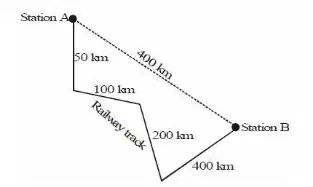
A train takes the railway track (solid line) from station A to station B and back again to station A. What distance did the train travel?
0 km
400 km
1500 km
3000 km
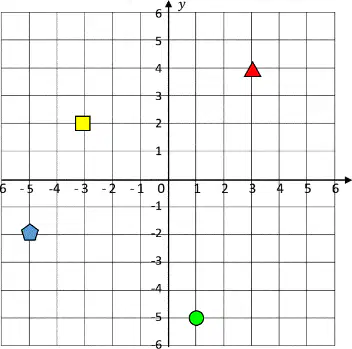
What is the position of the square relative to the center of the graph paper?
(-3,+2)
(-3,2)
(2,-3)
(+2,3)
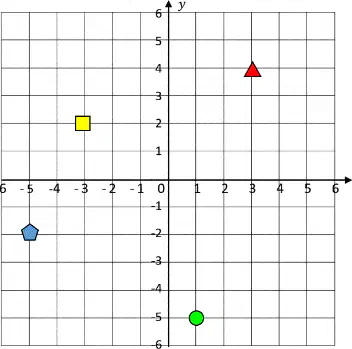
What is the position of the pentagon relative to the circle?
(-5,-2)
(-6,+3)
(+3,-6)
(-2,-5)
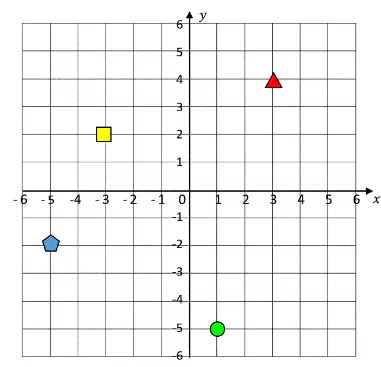
An object travels from the triangle to the square to the pentagon. What is the displacement of the object?
(0,0)
(-8,-6)
(-2,-4)
(-5,-2)
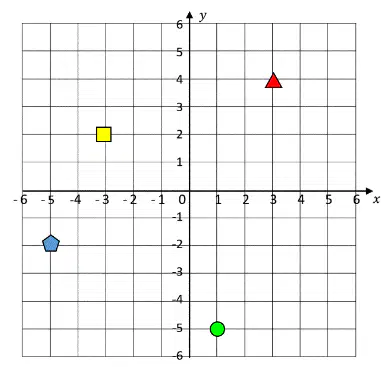
An object travels from the triangle to the square back to the triangle. What is the displacement of the object?
(+3,+4)
(-3,+2)
(0,0)
(-6,-2)

What does this graph indicate about the object it describes?
The object is not moving.
The object is moving away from where it started.
The object is moving toward where it started.
The object first moves away and then moves toward where it started.
Did this object stop moving?
The object never stopped moving.
The object stopped moving once.
The object stopped moving twice.
The object stopped moving three times.
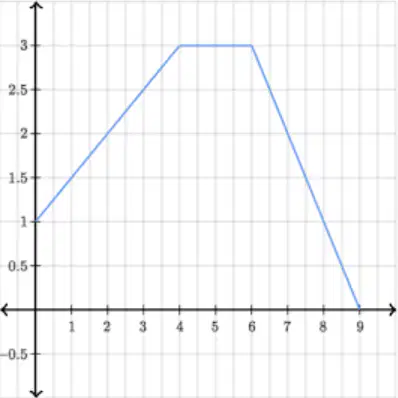
How far did this object travel?
3 meters
2 meters
5 meters
0 meters
Take out your Unit 7B packet before continuing!
Speed or Velocity?:
A turtle is crawling 34 cm/min.
Speed
Velocity
Neither
Both
On the way home from school, a student stops at the gas station to buy a snack. If you divide the distance the student walks to get home by the amount of time it took to get home from school, you are calculating the student’s
average speed.
average velocity.
time interval.
displacement.
What is the average speed of a car that traveled a distance of 300 miles in 5.5 hours and parks 250 miles west of where it began?
0 mph
45 mph
55 mph
-55 mph
What is the average velocity of a person who walks 4.25 miles throughout a park over 2 hours and ends up back at their parked car?
0 mph
2.125 mph
4.25 mph
-2.125 mph
What is the average velocity of a bird that flies 1.3 miles around the sky over a period of 0.75 hours and ends up 0.75 miles south of where it began?
a. 0 mph
b. -1 mph
c. +1 mph
d. -1.73 mph
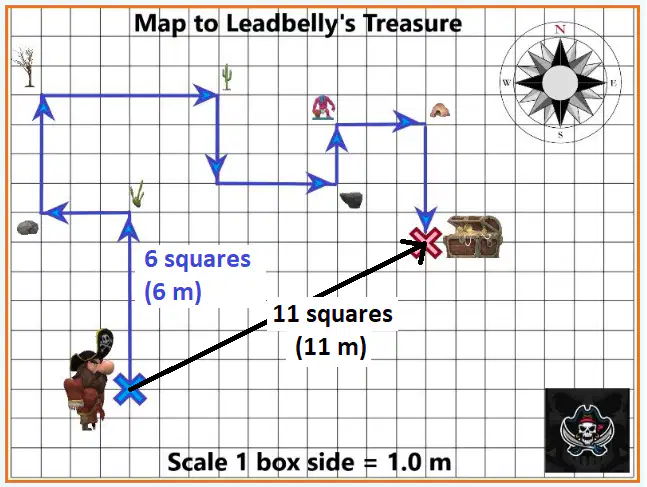
Leadbelly sets out on a treasure hunt at 5 am. He travels along the path shown in blue. After fighting the pink ogre, he stops for brunch. He ultimately arrives at the treasure at 11 am. What was Leadbelly's AVERAGE VELOCITY during the treasure hunt?
1.83 m/h northeast
5.67 m/h northeast
1.83 m/h southwest
5.67 m/h southwest
Leadbelly sets out on a treasure hunt at 5 am. He travels along the path shown in blue. After fighting the pink ogre, he stops for brunch. He ultimately arrives at the treasure at 11 am. What was Leadbelly's AVERAGE SPEED during the treasure hunt?
1.83 m/h
5.67 m/h
1.83 m/h northeast
5.67 m/h northeast
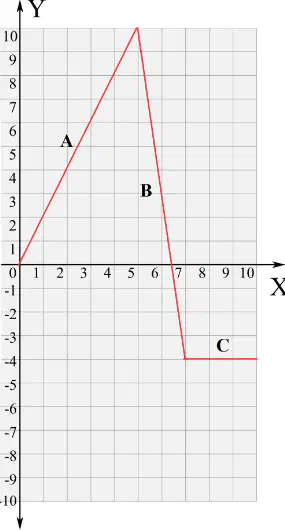
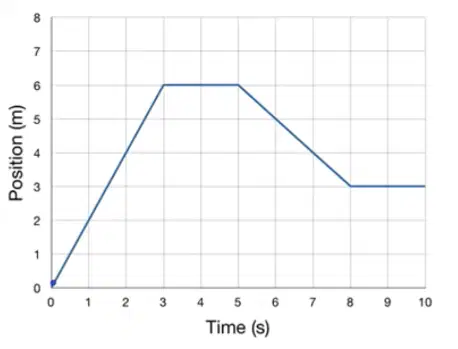
According to the graph, what is the average speed of the object between 0 and 10 seconds?
a. 1.4 m/s
b. -0.3 m/s
c. 2.4 m/s
d. 0 m/s
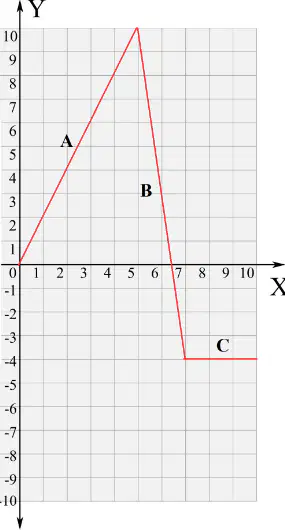
According to the graph, what is the instantaneous speed of the object at 3 seconds?
a. 2 m/s
b. -2 m/s
c. 6 m/s
d. 3.3 m/s
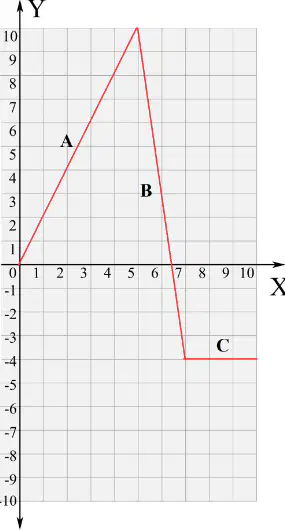
According to the graph, what is the average velocity of the object between 0 and 10 seconds?
a. -0.4 m/s
b. -0.3 m/s
c. 2.4 m/s
d. 0 m/s
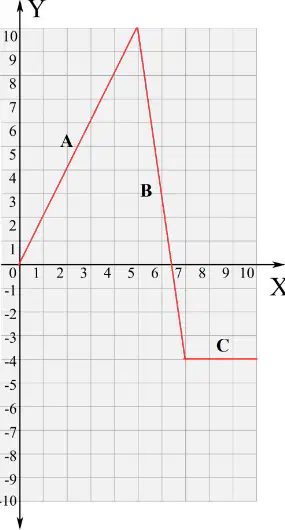
According to the graph, what is the instantaneous velocity of the object at 6 seconds?
a. -3 m/s
b. -7 m/s
c. 3 m/s
d. 2 m/s
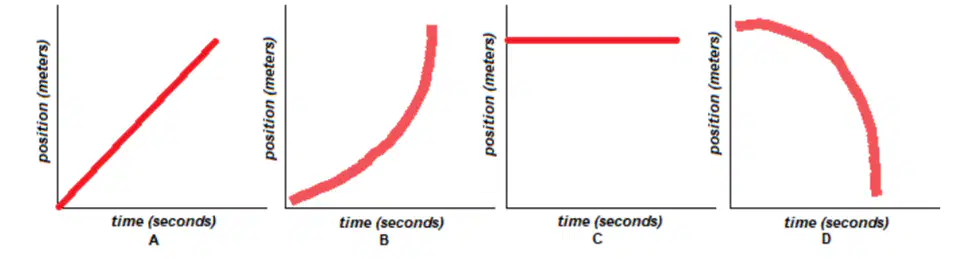
Which of the objects above is moving at a constant speed?
A
B
C
D
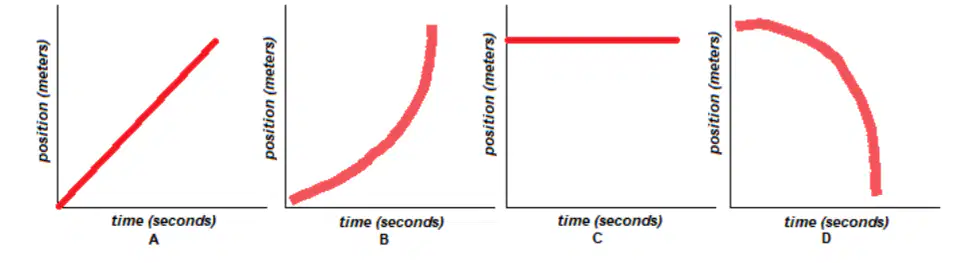
Which of the objects above is not moving?
A
B
C
D
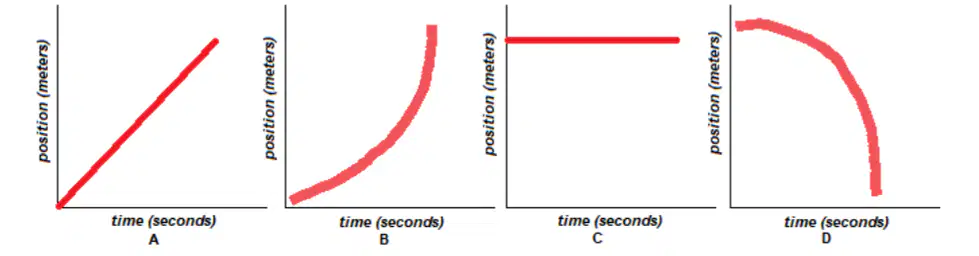
Which of the objects above is moving toward the observer?
A
B
C
D
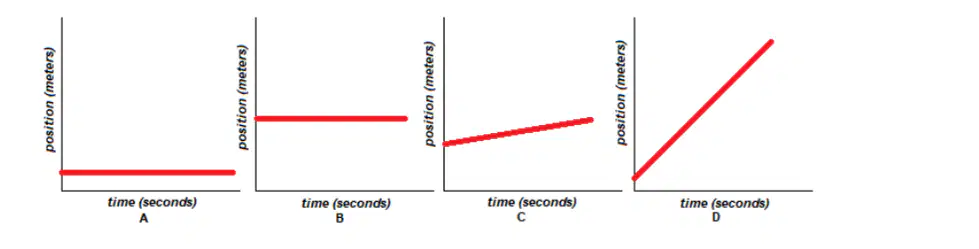
Which of the objects below is moving the fastest?
A
B
C
D
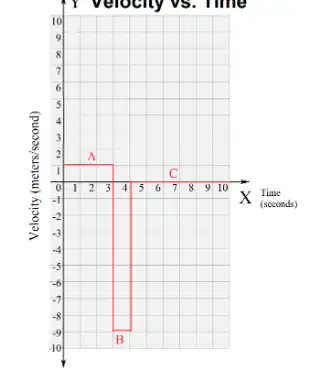
During which segment(s) of the Velocity vs. Time graph was the object moving at a constant speed (not speeding up and not slowing down)?
A
B
C
more than one
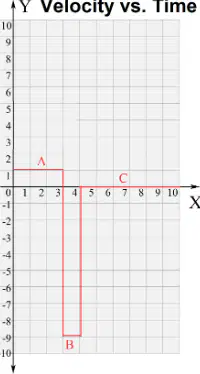
During which segment(s) of the Velocity vs. Time graph was the object not moving?
A
B
C
more than one

During which segment(s) of the Velocity vs. Time graph was the object moving fastest?
A
B
C
more than one

Where should segment A be drawn on the Speed vs. Time graph?
horizontally from (0,3) to (3,3)
horizontally from (0,1) to (3,1)
diagonally from (0,0) to (3,9)
diagonally from (0,1) to (3,9)
Take out your Unit 7C packet before continuing!
A rocket sled traveling in a straight line speeds up from 10 m/s to 50 m/s in 2 seconds. What is the average acceleration of the sled?
+10 m/s²
+20 m/s²
+25 m/s²
+40 m/s²
A car goes from 60 mph to 30 mph in 6 seconds on a straight road. The average acceleration of the car is:
+0.2 mi./h/s
-5 mi./h/s
+10 mi./h/s
+5 mi./h/s
In physics, the term “free fall” means:
no forces act on the object except gravity.
the speed of the falling object remains constant.
the object is dropped from an initial speed of zero.
the object is dropped straight down.
A person drops a golf ball into an endless hole. Without any air resistance, what can be said about the acceleration and speed of the golf ball?
The acceleration is 9.8 m/s2 downward and the speed is constant.
The acceleration is 9.8 m/s2 downward and the speed is increasing.
The acceleration is increasing and the speed is 9.8 m/s.
The acceleration is constant and the speed is constant.
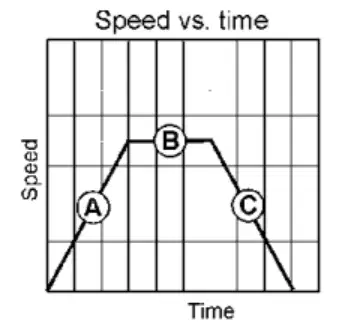
What is happening at point C on this velocity versus time graph? (note: the graph shown says speed, but you need to read it as velocity for this question!)
positive acceleration
zero acceleration
negative acceleration
constant position
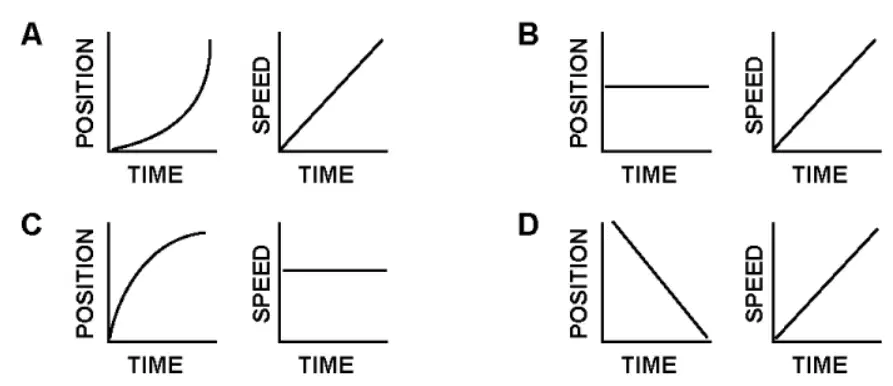
Which pair of motion graphs represent an object that has positive acceleration?
A
B
C
D

The acceleration shown in the graph to the right is:
0.2 m/s²
0.4 m/s²
2.5 m/s²
5.0 m/s²
Take out your Unit 8A packet before continuing!
Calculate the weight of a 60-kilogram person who is standing still on Earth.
-540 N
-60 N
-6.1 N
-588 N
Calculate the mass of a parked car that weighs 18,600 newtons on Earth.
18,980 kg
1,898 kg
0.00053 kg
180,000 kg
A 70-kilogram person travels to a planet where he weighs 1750 newtons. What is the gravitational field strength on that planet?
-120,000 N/kg
-0.040 N/kg
-25 N/kg
-690 N/kg
Which direction should the gravitational force arrow point on a force diagram?
up
down
left
right
What is the normal force acting on a parked car that weighs 15,500 newtons on Earth?
+1,580 N
+15,500 N
-15,500 N
+9.8 N
Calculate the normal force acting on a 75-kilogram person who is standing still on Earth.
75 N
+0.13 N
+85 N
+735 N
A 70-kilogram person travels to Mercury where the gravitational field strength is -3.7 N/kg. What is the value of the normal force acting on that person while they stand on that planet?
+259 N
-259 N
+3.7 N
-3.7 N
Which direction should the normal force arrow point on a force diagram?
up
down
left
right
Which of the following is NOT an example of an applied force?
pushing an object
pulling an object
air resistance on an object
hitting an object
What is the unit for applied force?
kilograms
newtons
newtons per kilogram
grams
A car stalls in the middle of the road. The driver gets out of the car and pushes it with 800 newtons of force. The car, which weighs 10,000 N, does not move. What is the value of the applied force?
+800
-10,000
-200
+200
A mover attempts to push a 50-kg couch from the living room of an apartment to the moving van, but the couch doesn’t move. If the mover is pushing with a force of 82 newtons toward the van, what is the value of the static friction force?
82 newtons toward the van
82 newtons away from the van
490 newtons toward the van
490 newtons away from the van
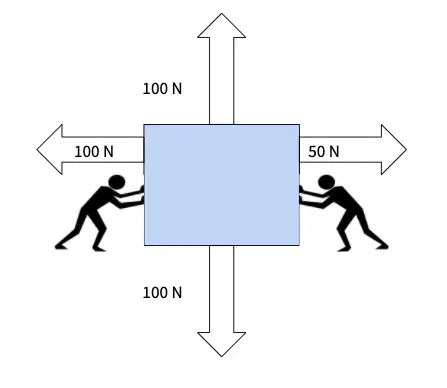
Bob attempts to push the box to the right. Kelly attempts to push the box to the left. What is the value of the Kelly's applied force on the box?
50 N to the left
100 N to the left
50 N to the right
150 N to the left
100 N to the right
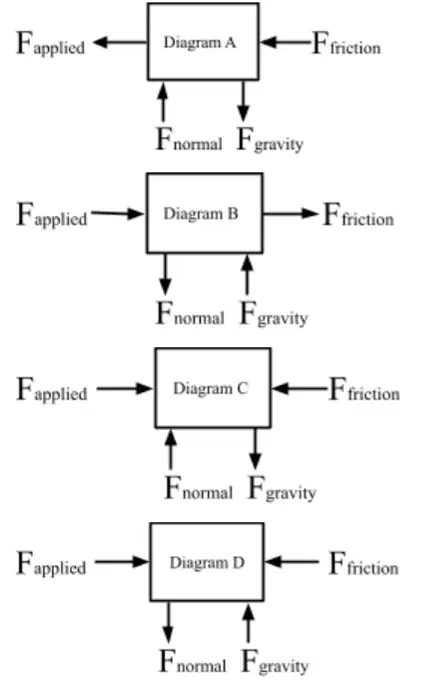
A toddler tries to push a chair out of his way, but he is unsuccessful because the chair is too heavy. Which force diagram best represents the situation?
Diagram A
Diagram B
Diagram C
Diagram D
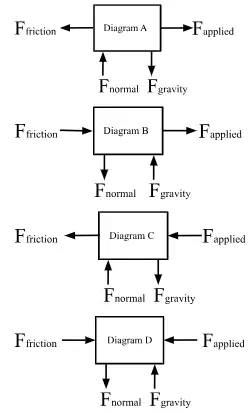
A truck tries to pull a stalled car off the road, but is unsuccessful because the car is too heavy. Which force diagram best represents the situation?
Diagram A
Diagram B
Diagram C
Diagram D

Take out your Unit 8B packet before continuing!
As shown in the diagram with two dogs tugging on opposite ends of a rope toy, if each dog pulls with 50 newtons of force, what is the tensile force acting along the rope toy?
a. 0 N
b. 50 N
c. 100 N
d. 200 N
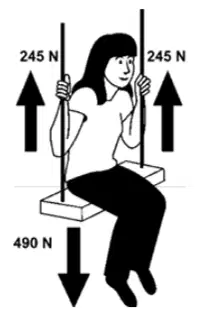
As shown in the diagram with a girl sitting motionless on a swing, what is the tensile force in each rope supporting the swing and girl?
a. 0 N of tensile force along each rope
b. 122.5 N of tensile force along each rope
c. 245 N of tensile force along each rope
d. 490 N of tensile force along each rope
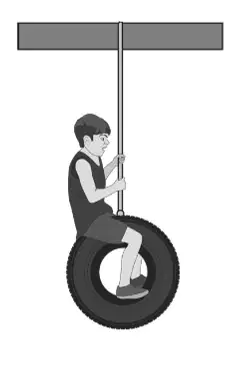
As shown in the diagram with a 47-kilogram boy sitting motionless on a tire swing, what is the tensile force acting along the rope?
a. 0 N
b. 47 N
c. 460 N
d. 920 N
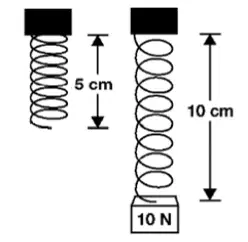
Two identical springs are shown in the picture. If a 10-newton force causes the spring to expand to 10 centimeters, what amount of force would cause the spring to expand to 7.5 centimeters?
5 N
7.5 N
2.5 N
20 N
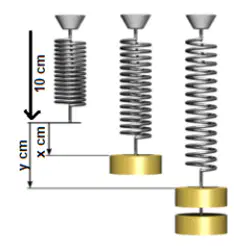
As shown in the picture, the natural length of the spring is 10 cm. When one 10-gram weight is added to the spring it expands by 2 centimeters (x = 2 cm). How much would the spring expand (y = ?) if two 10-gram weights were added to the spring?
2 cm
4 cm
12 cm
14 cm

How do the compression (applied) force and spring force change from picture A to picture B?
both the compression force and spring force increase
both the compression force and spring force decrease
the compression force increases and the spring force decreases
the compression force decreases and the spring force increases
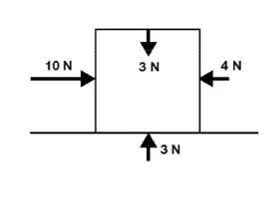
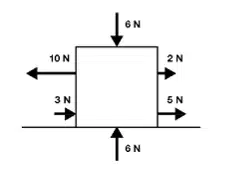
What is the net force acting on this object?
0 N
6 N to the left
6 N to the right
6 N upwards
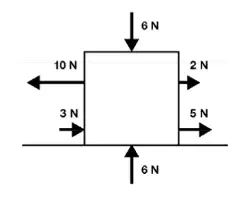
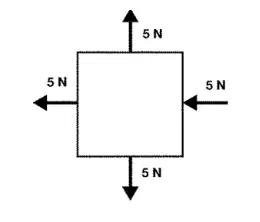
What is the net force acting on this object?
0 N
6 N to the left
10 N to the left
12 N toward the center
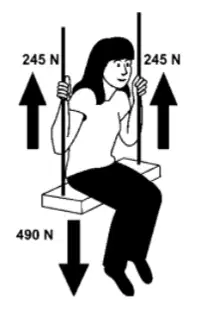
The girl shown in the picture is sitting motionless on a swing. What is the net force on the girl?
0 newtons
+245 newtons
+490 newtons
-490 newtons
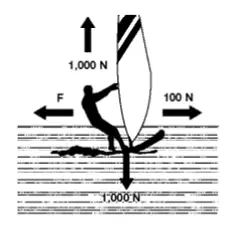
The picture shows all of the forces acting on a windsurfer. If all forces are balanced, what is the value of force F?
-100 N
+100 N
0 N
+2,100 N
Take out your Unit 8C packet before continuing!
Which of the following is an object in equilibrium?
A box resting on a table without moving
A box being pushed from rest to a speed of 5 cm/s
A box in free fall on Earth
A box thrown into the air
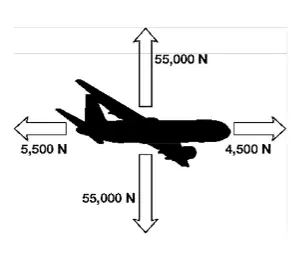
The picture shows four forces acting on a moving airplane. Due to these forces, the airplane will:
speed up
slow down
go higher
go lower
The picture shows four forces acting on a moving airplane. What is the value of the thrust force acting on the plane?
4500 N to the right
5500 N to the left
1000 N to the left
-1000 N
Which statement best describes the motion of the object?
not moving
accelerating to the right
accelerating to the left
accelerating upwards
Which statement best describes the motion of the object?
not moving
accelerating to the right
accelerating to the left
accelerating downwards
If the net force on a moving object is zero:
the object will slow down and stop
the object will change direction
the object will change speed
the object will not change speed or direction
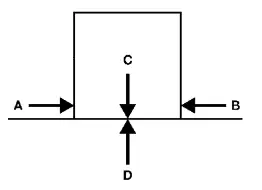
The box in the diagram is being pushed to the right. Which arrow depicts the sliding friction force acting on the box?
A
B
C
D
How can the force of friction between two surfaces be reduced?
By changing the motion from rolling to sliding
By making smooth surfaces rougher
By separating the surfaces with a fluid
By increasing the weight pulling down on one surface
If you slide an object across the floor, which of the following would increase the magnitude of the sliding friction force?
Increasing the weight of the object
Decreasing the weight of the object
Putting water between the object and the floor
Putting an air-gap between the object and the floor
What effect does friction force have on the acceleration of an object that is rolling down a ramp?
The friction force increases the acceleration of the object
The friction force decreases the acceleration of the object
The friction force has no effect on the acceleration of the object
The friction force first increases then decreases the acceleration of the object
As the net force on an object increases, what happens to the inertia of the object?
It increases.
It decreases.
It stays the same (it is not determined by net force).
As the mass of an object increases, what happens to the inertia of the object?
It increases.
It decreases.
It stays the same (inertia is not determined by mass).
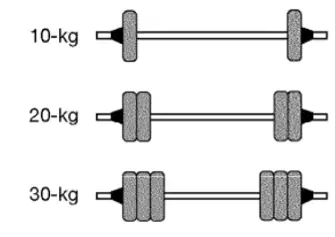
If each of the barbells shown were lifted with a force of 100 newtons, which would be most likely to begin moving upward?
The 10-kg barbell.
The 20-kg barbell.
The 30-kg barbell.
They would all move equally.

Three different forces were applied to three identical objects in identical conditions. The acceleration of each object was plotted on the graph. If the objects were made heavier and the same experiment was run, how would the graph compare?
The new graph for the heavier objects would have a steeper slope.
The new graph for the heavier objects would have a less steep slope.
The new graph for the heavier objects would be identical to this graph.
A 0.15-kilogram baseball and a 7.25-kilogram bowling ball are both rolling along at 3 m/s. Which object is easier to stop and why?
The bowling ball because it has less inertia.
The baseball because it has more inertia.
The bowling ball because it has more inertia.
The baseball because it has less inertia.
A 20-kilogram dog on ice skates is accelerating at 2 meters per second per second. What is the net force on the dog?
2 N.
10 N.
22 N.
40 N.
When a net force of 2 newtons is applied, a 4-kilogram object accelerates at:
2 m/s².
0.5 m/s².
4 m/s².
8 m/s².
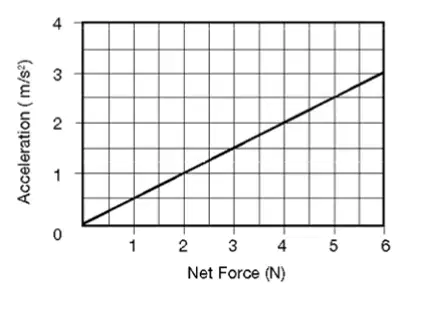
What is the mass of the object depicted in the graph?
0.2 kg
0.5 kg
1 kg
2 kg
Child A pushes a toy car with 1 newton of force and it accelerates at 0.22 m/s². Child B then pushes the same toy car with 2 newtons of force. Compare the acceleration of each car.
Child B’s car accelerates ¼ as much as child A’s car.
Child B’s car accelerates ½ as much as child A’s car.
Child B’s car accelerates twice as much as child A’s car.
Child B’s car accelerates the same as child A’s car.
Which of the following is NOT an example of a force pair?
A fist hits a wall and the wall hits the fist.
A head bumps a ball and the ball bumps the head.
A bug hits a windshield and the windshield hits the bug.
Gravity pulls down on a chair and the normal force pushes up on the chair.
A bat exerts a force of exactly 50 newtons on a baseball. The force that the baseball exerts on the bat is:
less than 50 newtons.
exactly 50 newtons.
more than 50 newtons.
approximately 50 newtons.
A kayaker paddles a boat through the water. Which of the following describes the force pair in this situation?
The force of the paddle pushing on the water and the force of the water pushing on the paddle.
The force of the paddle pushing on the water and the force of the kayak pushing on the water in front of it.
The force of her hand pushing on the paddle and the force of the water pushing on the paddle.
The force of her hand pushing on the paddle and the force of the kayak pushing on the water in front of it.
A sister and brother are roller skating and collide. The sister has a mass of 60 kg and the brother has a mass of 30 kg. How do their decelerations compare?
The sister decelerates faster than the brother.
The brother decelerates faster than the sister.
They both have the same deceleration.
Neither decelerate.
Take out your Unit 9A packet before continuing!
The action that WOULD require work to be done is:
an ice skater lifting his/her/their partner into the air
an ice skater carrying his/her/their partner across the ice
an ice skater gliding to a stop on the ice
an ice skater holding a bouquet of flowers on the ice
The action that would require NO work to be done is:
holding a 30-pound object over your head
pushing a 25-kilogram box of books across the floor
pulling a 100-newton wagon down the street
lifting a balloon filled with air from the floor to a desk
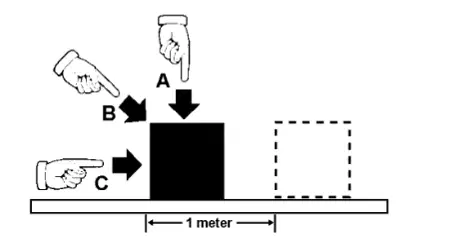
If forces A, B, and C are equal, the work done by the forces as they are exerted on the box to move it 1 meter is:
greatest for force A
greatest for force B
greatest for force C
the same for all forces
How much work is done by a person who pushes a cart with a force of 50 newtons to the left if the cart moves 20 meters to the left?
0 J
2.5 J
0.4 J
1,000 J
An electric hoist does 500 joules of work lifting a crate 2.0 meters. How much force does the hoist use?
0 N
250 N
1,000 N
0.004 N
How far does a 100-newton force have to move an object in order to do 1,000 joules of work?
0 m
10 m
1,100 m
100,000 m
You decide to push on a brick wall with all of your strength for 5 minutes. You push so hard that you begin to sweat, but the wall does not move. If you pushed with 500 newtons, how much work did you do?
0 J
500 J
2500 J
100 J
A 0.60-kilogram basketball balances on the rim of a basketball hoop that is 3.0 meters high. The basketball’s potential energy is about:
1.8 J
5.0 J
9.0 J
17.6 J
A bowler lifts a bowling ball a distance of 0.50 meters using 35 joules of energy. What is the weight of the bowling ball?
3.6 N
7.1 N
4.9 N
70 N
A bowler lifts a bowling ball a distance of 0.50 meters using 35 joules of energy. What is the mass of the bowling ball?
3.6 kg
7.1 kg
4.9 kg
70 kg
How high would you need to lift a 2.0-kg bottle of soda to increase its potential energy by 500 joules?
0 m
25.5 m
250 m
1000 m
If the mass of an object doubles, what effect does this have on its kinetic energy (assuming it is still traveling the same speed)?
It halves.
It stays the same.
It doubles.
It quadruples.
If the speed of an object doubles, what effect does this have on its kinetic energy?
It halves.
It stays the same.
It doubles.
It quadruples.
Calculate the kinetic energy of a 4-kilogram cat running at 5 meters per second.
100 J
10 J
50 J
20 J
What is the mass of a car that is traveling at 30 m/s if it has 450,000 joules of kinetic energy?
30,000 kg
1,000 kg
500 kg
900,000 kg
A 4.0-kg steel ball is dropped from a platform. It has 488 joules of kinetic energy at the moment before it hits the ground. What is the speed of the ball in the moment before it hits the ground?
120 m/s
11 m/s
240 m/s
16 m/s
A 5 kg ball is tossed upward (in a world with no friction). In the moment before it hits the ground, it has 90 joules of kinetic energy. What is the speed of the ball in the moment before it hits the ground?
6 m/s
36 m/s
15 m/s
0.5 m/s

