wayground logo

Free Printable Worksheets

Font size

S
M
L
XL
Worksheets

Unit 6 Review - Waves

Total questions: 100

Worksheet time: 1hrs 18mins
Name
Class
Date
1.

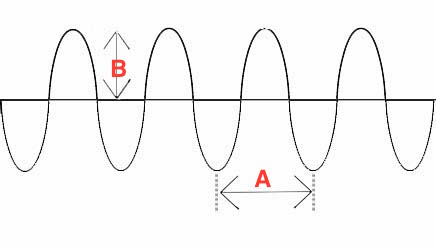
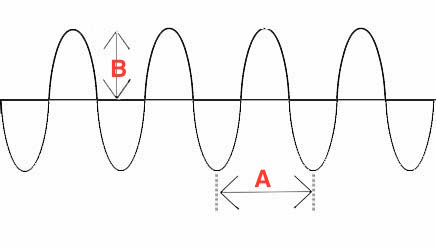
What property of this wave is represented by the letter "A"

a)

amplitude

b)

crest

c)

trough

d)

wavelength

2.
What property of the wave is represented by the letter "B"?
a)
amplitude
b)
crest
c)
trough
d)
wavelength
3.
The highest point on a wave is:
a)
the crest
b)
the trough
c)
the top
d)
the coast 
4.
The lowest point on a wave is the:
a)
Amplitude
b)
Crest
c)
Trough
d)
Wavelength
5.
The number of wavelengths that pass a point each per second is:
a)
frequency
b)
period
c)
longitudinal 
d)
transverse wave 
6.
The type of waves that require medium to pass:
a)
Mechanical Waves
b)
Electromagnetic Waves
7.
When the frequency of a wave increases, what happens to the wavelength?
a)
The wavelength is not directly affected by the frequency of a wave.
b)
The wavelength increases.
c)
The wavelength decreases.
d)
More specific information is needed to form a conclusion about the wavelength.
8.
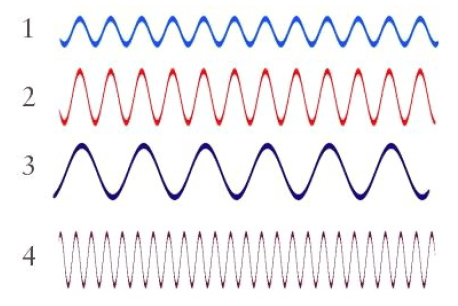
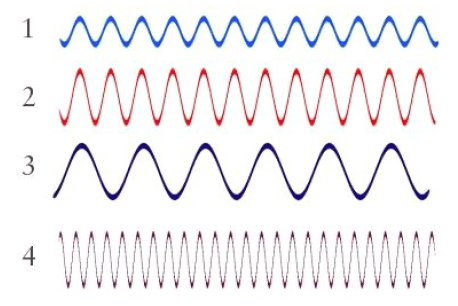
Which wave in the diagram has the greatest frequency?
a)
1
b)
2
c)
3
d)
4
9.
Which wave in the diagram has the greatest wavelength?
a)
1
b)
2
c)
3
d)
4
10.
Which of the following can sound travel through?
a)
solid
b)
liquid
c)
gas
d)
all of the above
11.

Through which material does sound travel the fastest?

a)

solid

b)

liquid

c)

gases

12.

When a wave strikes and object and bounces off. (example echo)

a)

medium

b)

refraction

c)

reflection

d)

interference

13.

When a wave bends as it passes through at an angle from one medium to another. (example: pencil in a glass of water)

a)

medium

b)

refraction

c)

reflection

d)

interference

14.
What kind of waves can travel through space?
a)
electromagnetic waves
b)
compressional waves
c)
longitudinal waves
d)
sound waves
15.
A compressional wave is another name for a 
a)
longitudinal wave
b)
electromagnetic wave
c)
radio wave
d)
hair wave
16.
In a longitudinal wave, the particles move...?
a)
back and forth
b)
up and down
c)
not at all
d)
at a 90 degree angle
17.
The units for frequency are measured in _____________.
a)
hertz
b)
seconds
c)
m/s
d)
grams
18.
You can't hear sounds in outer space because there is no
a)
matter
b)
light
c)
energy
d)
heat
19.
What kind of wave moves at right angles to the direction of the wave?
a)
compressional waves
b)
mechanical waves
c)
transverse waves
d)
ultraviolet rays
20.
All waves carry
a)
energy
b)
light 
c)
matter
d)
particles
21.
Which answer best explains how a wave is created?
a)
A wave is created when energy stays still
b)
A wave is created when a force causes a vibration
c)
A wave is created when molecules become a medium
d)
A wave is created when a liquid becomes a solid
22.
An interaction that occurs when 2 waves meet is known as what?
a)
Diffraction
b)
Standing wave
c)
Interference
d)
Resonance
23.
When 2 waves meet and there amplitude increases it is known as what?
a)
Constructive Interference
b)
Amplitude Addition
c)
Positive Interference
d)
Destructive Interference
24.
Interference that causes a wave that appears to be standing still is known as what?
a)
Standing wave
b)
Resonance
c)
Destructive Interference
d)
Constructive Interference
25.
An interaction between 2 waves that causes a smaller amplitude
a)
Constructive interference
b)
Destructive interference
c)
Resonance
d)
Diffraction
26.
When a wave enters a new medium and one side of the wave changes speed before the other it causes the wave to.....
a)
Break
b)
Fold
c)
Bend
d)
Ignite
27.
Sound travels in a _____.
a)
boat
b)
wave
c)
straight line
d)
particle
28.
A sonic boom happens when two planets collide.
a)
yes
b)
no
c)
unknown
29.
The cracking of a whip is actually the tip breaking the sound barrier.
a)
true
b)
false
30.
 Sound waves travel faster in solids than in gases.
a)
True
b)
False
31.
What happens when something travels faster than the speed of sound?
a)
A sonic boom
b)
Nothing happens
c)
Nothing can travel faster than the speed of sound
32.
When wavelength is large...
a)
frequency is small.
b)
frequency is large.
c)
There is no relationship between wavelength and frequency.
33.
'Supersonic speed' is dependent on the medium in question.
a)
True
b)
False
34.
A musician is playing a low-pitched recorder. Which of the following statements is true about his instrument?
a)
The instrument is likely small.
b)
The musician must blow harder to achieve sound.
c)
The instrument is pink.
d)
The instrument is likely large.
35.
Do sound waves oscillate parallel to or perpendicular to the direction in which the wave travels?
a)
Parallel
b)
Perpendicular
c)
The waves are random
36.
Which waves have the longest wavelength?
a)
Sonic waves
b)
Ultrasonic waves
c)
Infrasonic waves
d)
Wavelengths are all the same
37.
_____ is the highness or lowness of a sound.
a)
Pitch
b)
Sonic boom
c)
Amplitude
d)
Frequency
38.
Sound is a _______.
a)
longitudinal wave
b)
transverse wave
c)
Hertz wave
39.
Sound waves with low pitch have ___ frequency. Sound waves with high pitch have ___ frequency.
a)
high, low
b)
low, high
c)
high, high
d)
low, low
40.
Any speed that is faster than the speed of sound in the substance of interest is called ______.
a)
speed of light
b)
supersonic speed
c)
sonic boom
d)
transverse wave
41.
An indication of how high or low a sound is which is primarily determined by the frequency of the sound wave.
a)
volume
b)
pitch
c)
wavelength
d)
amplitude
42.

All sounds begin with vibrating matter.

a)

True

b)

False

43.
The distance between two crests is called the amplitude (A). 
a)
True
b)
False
44.
We hear thunder after we see lightning because sound travels faster than light.
a)
True
b)
False
45.
The Doppler affect applies to ______.
a)
Only stationary objects that make sound.
b)
Only moving vehicles that create sound.
c)
Any moving object that creates sound.
d)
Any stationary object that emits light.
46.
Sounds over ____ decibels can cause damage to human ears.
a)
10
b)
130
c)
1030
d)
3000
47.
Bats and porpoises both use sonar. 
a)
True
b)
False
48.
________ surfaces produce the best echoes.
a)
Soft
b)
Hard
c)
Round
d)
Rough
49.

Light is:

a)

a star and a galaxy

b)

a wave and a particle

c)

sound and energy

d)

unable to be measured

50.
Electromagnetic waves are produced by ...
a)
waves
b)
magnetism
c)
vibrating electric charges
d)
the spectrum
51.
What is the speed of light in a vacuum, like in space?
a)
300,000 km/s
b)
200,000 km/s
c)
100,000 km/s
d)
150,000 km/s
52.
Which is the correct order of the electromagnetic spectrum from highest frequency to lowest frequency?
a)
Gamma, X-ray, Ultraviolet, Visible, Infrared, Microwave, Radio
b)
Gamma, Ultraviolet, Visible, Infrared, X-ray, Microwave, Radio
c)
Ultraviolet, Microwave, Radio, Visible, X-ray, Gamma, Infrared
d)
Radio, Microwave, Infrared, Gamma, X-ray, Ultraviolet, Visible
53.
Which class of electromagnetic radiation has the least energy?
a)
Radio
b)
Gamma
c)
Infrared
d)
Visible
54.
Which is the correct order for the speed of light from fastest to slowest?
a)
Vacuum, Gas, Liquid, Solid
b)
Solid, Liquid, Gas, Vacuum
c)
Solid, Liquid, Gas  (cannot move through vacuum)
d)
Gas, Liquid, Solid (cannot move through vacuum)
55.
What are the two alternating perpendicular forces that move with the light wave?
a)
Electric field & Magnetic field
b)
Electronic force & Neutronic force
c)
Gravity field & Photospheric field
d)
Turbulent force & Friction force
56.
Which is the correct order for the speed of sound from fastest to slowest?
a)
Vacuum, Gas, Liquid, Solid
b)
Solid, Liquid, Gas, Vacuum
c)
Solid, Liquid, Gas  (cannot move through vacuum)
d)
Gas, Liquid, Solid (cannot move through vacuum)
57.
What waves is used in night vision goggles and remote controls?
a)
Visible light
b)
Radio
c)
Infrared
d)
Xray
58.
This type of EM wave shows a break in bones.
a)
gamma ray
b)
x-ray
c)
brokenometer
d)
radio wave
59.
This type of EM wave can cause skin cancer. 
a)
microwaves
b)
ultraviolet ray
c)
radio
d)
infrared
60.
_____ have the longest wavelengths and lowest frequencies of all electromagnetic waves.
a)
microwaves
b)
radio waves
c)
gamma rays
d)
ultraviolet
61.
_____________________light is the only type of EM wave detected by the human eye.
a)
Red
b)
Gamma
c)
Microwave
d)
Visible
62.
Which of the following is NOT an electromagnetic wave?
a)
Sound
b)
Gamma Wave
c)
Microwave
d)
Visible light
63.

A light particle is called a(n):

a)

electromagnetic wave

b)

photon

c)

electron

d)

atom

64.
Electromagnetic waves are
a)
Longitudinal waves
b)
Surface waves
c)
Transverse waves
d)
Mechanical waves
65.
All electromagnetic waves have the same...
a)
frequency
b)
speed
c)
wavelength
d)
energy
66.
Which kind of wave has the greatest frequency?
a)
gamma rays
b)
infrared
c)
ultraviolet
d)
microwaves
67.
High frequency waves have _________ wavelength.
a)
varying
b)
high
c)
the same
d)
low
68.
Look carefully at the waves.  Which carries the most energy?
a)
microwave
b)
infrared
c)
ultraviolet
d)
x-ray
69.
Red has the longest wavelength of the spectrum of visible light.
a)
True
b)
False
70.
What are the two main types of lenses?
a)
Converging lenses, and diverging lenses
b)
Converted lenses and diverted lenses
c)
Convex lenses and refractive lenses
d)
Reflective lenses and concave lenses
71.
Violet has a longer wavelength than Red.
a)
True
b)
False
72.
The reason we see things is because light reflects off them and enters our eyes.
a)
True
b)
False
73.
Light travels faster in __________.
a)
glass than in water or air.
b)
water than in glass or air.
c)
air than in glass or water.
74.
When light or sound waves bounce off an obstacle, we call it a  ______. 
a)
refraction
b)
reflection
c)
absorbtion
d)
ray-bounce
75.
The shorter the wavelength, the more energy a wave has.
a)
True
b)
False
76.
Which has the longest wavelengths?
a)
Visible light
b)
Ultraviolet rays
c)
Radio waves
d)
All waves have the same wavelength
77.
To _____ is to make a ray of light change direction when it enters at an angle.
a)
reflect
b)
refract
c)
absorb
d)
dual-natured
78.
What does the eye do to change its focus?
a)
The eye changes the shape of the lens.
b)
The eye changes the distance between the lens and the retina.
c)
The eye changes the distance between the lens and the rods and cones.
d)
The eye changes the shape of the rods and cones.
79.
The additive primary colors of light are _____, ____, and _____.
a)
Red, yellow, blue
b)
Red, cyan, blue
c)
Green, cyan, yellow
d)
Green, red, blue
80.
(For this question, remember that blue + green = cyan, red + blue = magenta, and red + green = yellow.)
If a computer monitor makes a green dot and then puts a blue dot in the same place, what color will you see?
a)
You will see a magenta dot.
b)
You will see a cyan dot.
c)
You will see a yellow dot.
d)
You will see a red dot.
81.

_____?______ materials do not allow light waves to pass through.

a)

Opaque

b)

Transparent

c)

Translucent

82.

_____?_____ materials allow some light to partially pass through, but not in a straight path.

a)

Opaque

b)

Transparent

c)

Translucent

83.

_____?_____ materials allow light waves to pass through easily.

a)

Opaque

b)

Transparent

c)

Translucent

84.

The production of light by living organisms is

a)

bioluminescence

b)

evolution

c)

adaptation

d)

chemistry

85.

A chemical reaction where light is produced is known as

a)

chemistry

b)

fluorescence

c)

phosphorescence

d)

chemiluminescence

86.

Incandescent light is......

a)

emitting light as a result of being heated

b)

the emission of light by a substance that has not been heated

87.

a convex lens does what to rays

a)

diverges

b)

converges

c)

implodes

d)

merges

88.

a convex mirror does what to rays

a)

diverges

b)

converges

c)

implodes

d)

merges

89.
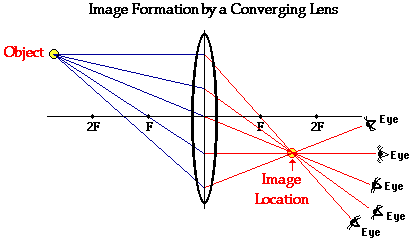
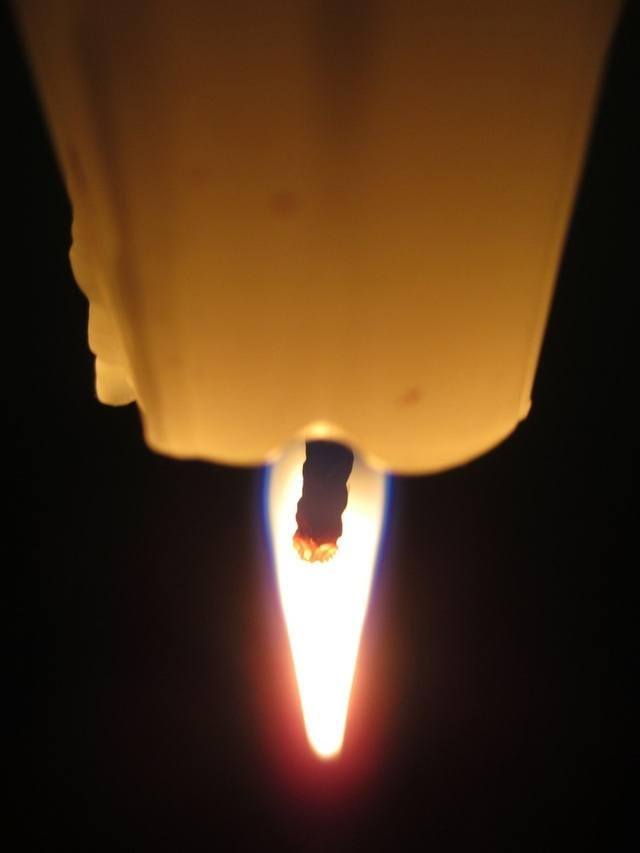
What type of image does this lens form?
a)
Virtual image
b)
Real Image
c)
No Image
90.
Compared to the object in front the lens, its image is.....
a)
inverted and smaller
b)
inverted and larger
c)
not inverted and smaller
d)
not inverted and larger
91.

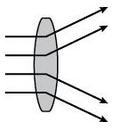
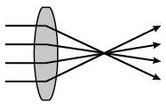
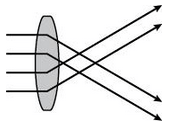
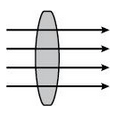
Which figure represents the path light takes through a converging lens?
a)
b)
c)
d)
92.

Light always travels in a

a)

straight line

b)

wavy line

c)

curved line

d)

zig-zag line

93.

The angle of reflection is always equal to the angle of incidence.

a)

True

b)

False

94.
Primary colors of light can combine to make
a)
black light
b)
white light
c)
primary pigments
d)
ultraviolet light
95.
_____ is a lens that is thicker in the middle.
a)
Convex
b)
Concave
96.
_____ is a lens that is thinner in the middle..
a)
Convex
b)
Concave
97.
What do water droplets in a rainbow act like?
a)
prisms
b)
flashlights
c)
reflectors
d)
lasers
98.
Which part of the eye opens in dark places and closes in bright places?  
a)
Cornea
b)
Retina
c)
Pupil
d)
Lens
99.
Which part of the eye is the place where images are inverted?  
a)
Retina
b)
Cornea
c)
Lens
d)
Iris
100.
Which part of the eye is where images are converted to nerve impulses?  
a)
Retina
b)
Cornea
c)
Optic Nerve
d)
Lens