wayground logo

Free Printable Worksheets

Font size

S
M
L
XL
Worksheets

CBA 2 Review

Total questions: 99

Worksheet time: 2hrs 43mins
Name
Class
Date
1.
Enzymes are...
a)
nucleic acids
b)
proteins
c)
lipids
d)
carbohydrates
2.
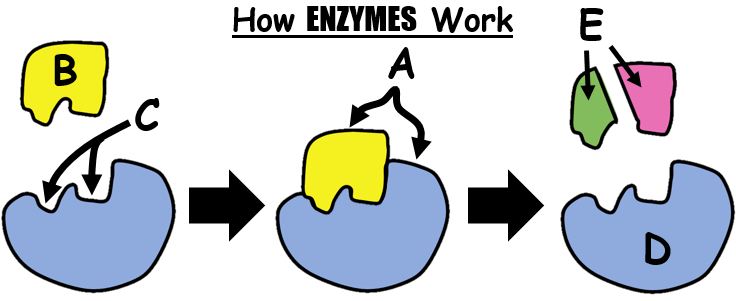
In the diagram, what is letter A? 
a)
product
b)
substrate
c)
enzyme-substrate complex
d)
active site
3.
Any substance that is acted upon by an enzyme is called a(n)?
a)
Coenzyme
b)
Substrate
c)
Vitamin
d)
Polypeptide
4.
What is a substance called if it speeds up a chemical reaction?
a)
reusable
b)
catalyst
c)
specific
d)
fragile
5.
What will most likely happen if an appropriate enzyme is added to a chemical reaction? 
a)
The reaction rate will increase.
b)
The equilibrium of the reaction will be maintained. 
c)
The reaction rate will decrease.
d)
The reaction will stop. 
6.
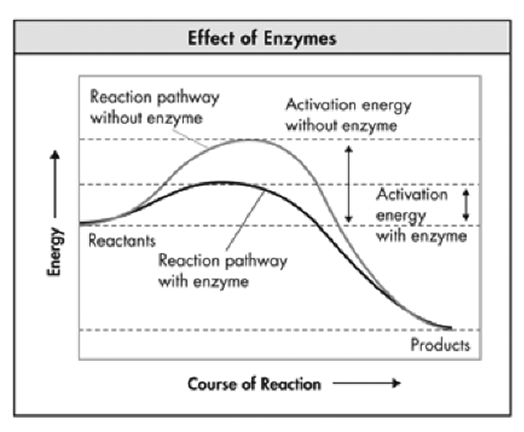
The graph shows how enzymes affect reactions in cells. Which statement best summarizes the information shown in the graph?
a)
Enzymes increase the energy of the reactants.
b)
Enzymes decrease the energy level of the products.
c)
Enzyme decrease the activation energy of the reaction.
d)
Enzymes reverse the direction of the reaction.
7.

________ are small individual molecules that when linked together form a _______

a)

polymers

monomer

b)

carbohydrates

lipid

c)

proteins

nucleic acid

d)

monomers

polymer

8.

Which biomolecule is a source of quick energy for cells?

a)

carbohydrates

b)

lipids

c)

proteins

d)

nucleic acids

9.

Which biomolecule is involved in long term energy storage?

a)

carbohydrates

b)

lipids

c)

proteins

d)

nucleic acids

10.

Which biomolecule plays a role in muscle development and repair?

a)

carbohydrates

b)

lipids

c)

proteins

d)

nucleic acids

11.

Which type of biomolecule makes up cell membranes?

a)

carbohydrates

b)

lipids

c)

proteins

d)

nucleic acids

12.

A mutation in DNA would initially start with which biomolecules?

a)

carbohydrates

b)

lipids

c)

proteins

d)

nucleic acids

13.

DNA and RNA belong to this biomolecule group.

a)

carbohydrates

b)

lipids

c)

proteins

d)

nucleic acids

14.

Which of these is NOT a lipid

a)

fats

b)

oils

c)

amino acids

d)

waxes

15.

The breakdown of ________ supplies immediate, quick energy for all cell activities.

a)

carbohydrates

b)

lipids

c)

proteins

d)

nucleic acids

16.

1. The four most common elements found in biomolecules are __________.

a)

Sulfur, Phosphorus, Carbon, Oxygen

b)

Carbon, Oxygen, Nitrogen, Hydrogen

c)

Sulfur, Nitrogen, Carbon, Iron

d)

Carbon, Nitrogen, Hydrogen, Sulfur

17.
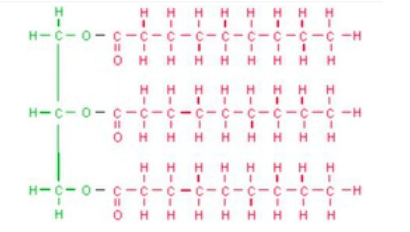
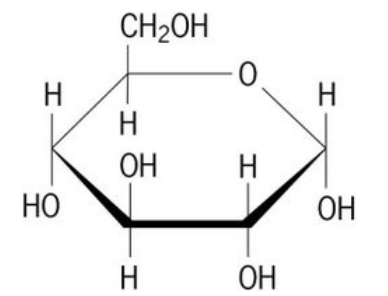
Which biomolecule is this a picture of?
a)
Protein
b)
Nucleic Acid
c)
Lipid
d)
Carbohydrate
18.
Which biomolecule is this a picture of?
a)
Protein
b)
Nucleic Acid
c)
Lipid
d)
Carbohydrate
19.

Which of the following is the correct order for least related to most related?

a)

Domain

Kingdom

Phylum

Class

Order

Family

Genus

Species

b)

Species

Kingdom

Phylum

Class

Order

Family

Genus

Domain

c)

Species

Genus

Family

Order

Class

Phylum

Kingdom

Domain

d)

Domain

Kingdom

Class

Phylum

Order

Genus

Family

Species

20.

Which of the following sets of insects would be the most closely related?

a)

Insects in the same class

b)

Insects in the same family

c)

Insects in the same order

d)

Insects in the same species

21.

Which of the following taxonomic groups would contain plants with the greatest amount of variety and differences?

a)

Kingdom

b)

Phylum

c)

Order

d)

Family

22.

Which of the following taxonomic groups would contain the most related set of animals?

a)

Domain

b)

Species

c)

Family

d)

Order

23.

Black panthers (Panthera onca) are a color variant of a species of large cats.  Black panthers would be most closely related to what organism listed below?

a)

Tiger (Panthera tigris)

b)

Cheetah (Acinonyx jubatus)

c)

Puma (Puma concolor)

d)

Jaguar (Panthera onca)

24.

Students examine images of a certain species of bat commonly found in Texas. Using the bat dichotomous Key, they conclude that the bat species is a Mexican free-tailed bat due to its large, round ears.

Based on the dichotomous key, in addition to the shape of the bat's ears, which other set of features should the students look for to confirm the identity of the bat?

a)

Solitary with a wingspan greater than 35cm

b)

Solitary with a wingspan less than 35cm

c)

Colonial with a wingspan greated than 35cm

d)

Colonial with a wingspan less than 35cm

25.

A researcher determines an organism to be eukaryotic, unicellular and autotrophic. In which taxonomic group should this organism be classified?

a)

bacteria

b)

protista

c)

archaea

d)

animalia

26.
Some shrimp and crab live and capture food from within the tentacles of giant anemones. 
a)
Parasitism
b)
Commensalism
c)
Mutualism
27.
A pearlfish spends the day inside the alimentary tract, or intestines, of a sea cucumber. The fish emerges from the sea cucumber at night to feed on small crustaceans. The pearlfish gets a safe place to live. The sea cucumber does not gain anything from the relationship, nor is it harmed. 
a)
Mutualism
b)
Commensalism
c)
Parasitism
28.
Some shrimp and crab live and capture food from within the tentacles of giant anemones. 
a)
Parasitism
b)
Commensalism
c)
Mutualism
29.
A pearlfish spends the day inside the alimentary tract, or intestines, of a sea cucumber. The fish emerges from the sea cucumber at night to feed on small crustaceans. The pearlfish gets a safe place to live. The sea cucumber does not gain anything from the relationship, nor is it harmed. 
a)
Mutualism
b)
Commensalism
c)
Parasitism
30.
A cymothoid isopod lives inside the mouth of a snapper fish. The isopod severs blood vessels in the fish’s tongue, causing the tongue to atrophy and degenerate.The isopod then hooks its pereopods, or legs, to the base of the fish’s tongue,essentially replacing the tongue. The isopod stays there for the rest of its life, feeding on blood, mucus, and stray pieces of food from the fish.
a)
Commensalism
b)
Parasitism
c)
Mutualism
31.
A boxer crab carries a pair of small anemones in its chelipeds, or claws. When approached by a predator, the crab waves the stinging tentacles of the anemones to deter the predator. The anemones benefit from the small particles of food dropped by the crab during feeding. 
a)
Commensalism
b)
Mutualism
c)
Parasitism
32.
An alpheid shrimp digs and maintains a deep burrow. While underground, the shrimp is safe. Above ground, it is vulnerable to predators. A go by fish lives in the burrow with the shrimp. The go by fish sits at the entrance, keeping watch for predators, and signals the shrimp with a flick of its tail when it is safe to come out. Or, if a predator swims by, the go by darts into the burrow and the shrimp retreats further inside.These two animals are completely dependent on each other—the go by benefits by getting a burrow to live in and the shrimp knows when predators are near. 
a)
Parasitism
b)
Mutualism
c)
Commensalism
33.
Corals feed off the byproducts of a microscopic algae living within their own tissue,called zooxanthellae. The photosynthetic activity of the algae is vital to the survival of the coral animals, which use the energy to extract calcium from the seawater and build their calcareous skeletons. The zooxanthellae are protected by the hard coral and obtain plant nutrients from the coral. 
a)
Mutualism
b)
Commensalism
c)
Parasitism
34.
Some species of barnacles attach themselves to sea turtles or whales. As the whales or sea turtles travel, the barnacles gain access to food in nutrient-rich waters. Their host neither benefits nor is harmed by its riders.
a)
Mutualism
b)
Parasitism
c)
Commensalism
35.
A tapeworm needs to eat food that is already digested, so it lives in the intestines of a dogfish shark and derives nourishment from the shark. As a result of the tape worm infestation, the shark is weakened and more vulnerable to disease and predation. 
a)
Parasitism
b)
Commensalism
c)
Mutualism
36.
Imperial shrimp attach themselves to sea cucumbers and get transported by their host to a large area of potential food with only a minimal expenditure of energy. They have been observed getting off their host cucumber to feed in productive areas and then getting back on for a ride to the next spot. 
a)
Mutualism
b)
Commensalism
c)
Parasitism
37.
The siboglinid tube worm, found at deep-sea hydrothermal vents and cold seeps,has no digestive tract. It relies on symbiotic bacteria that live in the tube worm’s tissues. The bacteria oxidize hydrogen sulfide or methane for the worm.
a)
Mutualism
b)
Commensalism
c)
Parasitism
38.

A 3-point buck is killed by a hunter. What type of symbiotic relationship is this?

a)

mutualsim

b)

commensalism

c)

parasitism

d)

predation

39.

Mosquitoes are parasitic with humans because:

a)

They feed off human blood

b)

The human host is harmed

c)

They are annoying

d)

they spread disease

40.

Which organelle contains genetic material?

a)

Endoplasmic Reticulum

b)

Golgi Complex

c)

Nucleolus

d)

Nucleus

41.
What organelle is called the "powerhouse" of a cell?

a)
Endoplasmic Reticulum
b)
Nucleus
c)
Mitochondria
d)
Nucleolus
42.
What is the function of the vacuole?
a)
Sac that stores water, nutrients, and waste products
b)
Sac filled with digestive chemicals
c)
Jelly-like substance within the plasma membrane
d)
stack of membranes that packages chemicals
43.
What is the function of nucleus?
a)
Structure that organizes motion of chromosomes. 
b)
Structure that contains DNA and directs the cell 
c)
Membrane that surrounds and protects the cell 
d)
Stack of membranes that packages chemicals
44.
Where does photosynthesis occur?
a)
mitochondria
b)
stomata
c)
xylem
d)
chloroplast
45.
I make proteins for the cell. What am I?
a)
ribosome
b)
mitochondria
c)
chloroplast
d)
lysosome
46.
What can only be found in plant cells?
a)
Cell membrane
b)
Vacuole
c)
Chloroplast
d)
Mitochondrion
47.
The two kinds of cells are Prokaryotes and Eukaryotes. How are they different?
a)
Prokaryotes have a nucleus.
b)
Eukaryotes have a nucleus.
c)
Prokaryotes are plant cells.
d)
There is no difference.
48.
Complex cell. Can be plant or animal. Contains membrane bound organelles. 
a)
Eukaryotic Cell
b)
Prokaryotic Cell
c)
Bacteria
d)
Blood cell
49.
This organelle takes food and turns it into ENERGY for plant and animal cells.
a)
Chloroplast
b)
Mitochondria
c)
Lysosome
d)
Ribosome
50.
A rigid layer that lies outside the cell's  membrane is...
a)
Cytoskeleton
b)
Cilia
c)
Cell Wall
d)
Flagella
51.
Only eukaryotic cells have....
a)
membrane-bound organelles 
b)
DNA
c)
ribosomes
d)
cell membranes 
52.
What is the fluid inside a cell called? 
a)
Endoplasimic Reticulum
b)
Orange Juice
c)
Water
d)
Cytoplasm
53.
This organelle eliminates waste. 
a)
Nucleus
b)
ER
c)
Vacuole
d)
Lysosome
54.
What organelle helps with cell digestion?
a)
Lysosomes
b)
Ribosomes
c)
Golgi Complex
d)
ER
55.
Using this image, what organelle is D?
a)
Endoplasmic Reticulum
b)
Flagella
c)
Rough ER
d)
Smooth ER
56.
Using this image, what organelle is N?
a)
Centrioles
b)
Cell Membrane
c)
Golgi Apparatus
d)
Ribosome
57.
I am a protein packaging and shipping machine! Who am I?
a)
vacuole
b)
ribosome
c)
endoplasmic reticulum
d)
golgi apparatus
58.
What is the difference between rough and smooth ER?
a)
There is no difference.
b)
Plants have rough ER, animals have smooth ER.
c)
What type of injuries the Doctors treat.
d)
Rough has ribosomes, smooth does not.
59.
Osmosis is the movement of _____ across a membrane.
a)
food
b)
energy
c)
oxygen
d)
water
60.

When organisms are better adapted to their environment they will survive and reproduce more successfully than organisms less adapted. This process is called what?

a)

Selective breeding

b)

Natural Selection

c)

Cloning

d)

Evolution of all species

61.

Which scientist visited the Galapagos Islands and came up with the theory of natural selection?

a)

Theodor Schwann

b)

Gregor Mendel

c)

Charles Darwin

d)

Rudolf Virchow

62.

Gigantopithecus were very large primates that lived 500,000 years ago. Since none of these mammals are still today, they are said to be....

a)

Extinct

b)

Threatened

c)

Endangered

d)

Declining

63.

Scientists have collected millions of fossils of different organisms, and have developed a timeline of life on Earth. What do we call this?

a)

Mutation

b)

Natural Selection

c)

The theory of evolution

d)

Fossil Record

64.

Sometimes bones in the front limbs of animals are very similar in structure. What do we call similar bone structures that indicate a link to a common ancestor?

a)

Adaptations

b)

Gradualism

c)

Homologous Structures

d)

Extinction

65.

A physical or behavioral trait that helps an organism survive and reproduce in its environment is called a what?

a)

An adaptation

b)

A response to a stimulus

c)

A mutation

d)

Evolution

66.

What most likely caused the finches on the Galapagos Islands to have beaks that were different from the finches on the mainland?

a)

There were different types of predators on the island.

b)

There were different types of food available on the island.

c)

The finches had no water to drink.

d)

The finches on the mainland could not fly high enough.

67.

When looking at two birds of the same species, you notice that one has darker feathers than the other one. You also notice that one has a beak that is just a little longer. These slight differences within members of the same species are called.....

a)

Fossils

b)

Extinction

c)

Meiosis

d)

Variations

68.

What is the study of organisms at the early stages of development?

a)

DNA studies

b)

Comparative Embryology

c)

Extinction

d)

Fossil Record

69.

What do we call a change in a species over time?

a)

Adaptation

b)

Evolution

c)

Extinction

d)

Environmental influences

70.
A giraffe has a long neck in order to better reach leaves to eat.  This is an example of _____. 
a)
an adaptation
b)
environment
c)
response
d)
stimulus
71.
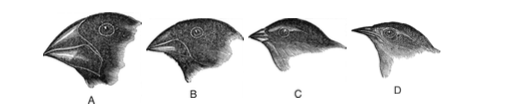
Base your answer(s) to question(s) on the diagram below and on your knowledge of biology. The diagram shows the heads of four different species of Galapagos Islands finches. 
The four different types of beaks shown are most likely the result of 
a)
gene manipulation 
b)
natural selection 
c)
unchanging environmental conditions 
d)
patterns of behavior learned from parents 
72.
Which characteristic is necessary for natural selection to occur in a species? 
a)
stability 
b)
variation 
c)
complex cellular organization 
d)
a very low mutation rate 
73.
"Survival of the Fittest" describes which theory
a)
a) natural selection
b)
b) gravity
c)
c) heredity
d)
d) string theory
74.
Why are advantageous traits more likely to be passed onto offspring?
a)
Because they are more likely to survive and reproduce.
b)
Because they come from dominant alleles.
c)
Because they come from recessive alleles.
d)
Because the trait is an acquired phenotype.
75.
Mutations are a change in what?
a)
DNA
b)
tRNA
c)
genotype
d)
phenotype
76.
Individuals in a population have to compete for resources.
a)
Species
b)
Variation
c)
Mutation
d)
Competition
77.
What do we call traits that increase an individual's chance to survive and reproduce?
a)
Maladaptations
b)
Adaption
c)
Variations
d)
Adaptations
78.
Darwin said that within a species there will be _________________________
a)
nothing different
b)
variation/differences
79.

A grizzly bear survives because he is well-adapted to his environment. When he reproduces he passes on those traits to his offspring. this process is called

a)

Natural Selection

b)

Selective Breeding

c)

Random mutations

d)

Variations in a species

80.
Survival of the Fittest and Evolution were proposed by what scientist?
a)
Charles Darwin
b)
Albert Einstein
c)
Steven Hawking
d)
Isaac Newton
81.
What process is being shown in this image?
a)
Variation
b)
Natural Selection
c)
Selective Breeding
d)
Homeostasis
82.

Which best describes the role of mutations in natural selection?

a)

Mutations help an organism to better survive in their environment

b)

An organism may acquire a helpful mutation by interacting with the environment

c)

A mutation may result in a beneficial trait that makes an organism more likely to survive and reproduce

d)

Organisms with certain traits are more likely to win competitions for mutations

83.

The more genetic variation a population has,

the more likely it is for some individuals to

a)

evolve

b)

migrate

c)

survive

d)

mutate

84.
Why do frogs and other organism reproduce so many eggs or offspring?
a)
so that their babies can have friends to play with
b)
the more offspring the more likely the offspring will survive
c)
the more offspring the less likely offspring will survive 
d)
the more offspring the less competition
85.
Which organisms are most likely to survive?
a)
the best adapted
b)
the fastest
c)
the strongest
d)
the most domesticated (tamed)
86.
Do organisms "decide" to evolve and change?
a)
Yes, they know they need to change to survive 
b)
No, they change because of natural selection
87.
Domesticated dogs are an example of:
a)
Natural Selection
b)
Selective Breeding
88.

Why is competition important for natural selection?

a)

It shows which variations are more successful, allowing the organisms with those variations to survive.

b)

It causes organisms, regardless of which traits they have, to die out, reducing the population size.

c)

It causes organisms to get stronger due to having to outcompete other species.

d)

Competition is not important for natural selection.

89.
When an environment changes faster that an species can adapt, the most likely outcome is...
a)
...biological evolution.
b)
...voluntary mutation
c)
...species extinction
d)
...selective breeding
90.
Drawn observed several different types of finches.  Why are there so many different types?
a)
Finches live in different places, but eat the same food.
b)
Finches live in the same place, but eat different types of food.
c)
Finches live in different habitats and eat different types of food.
d)
Finches are found all over the world.
91.
The differences among a species, like different bird beaks, are called
a)
genes.
b)
variations.
c)
traits.
d)
theories.
92.
Organisms with the most beneficial traits will survive.  This is commonly known as
a)
theory of evolution.
b)
variations.
c)
survival of the fittest.
d)
ecosystems.
93.
This scientist developed the theory of evolution as he studied the finches.
a)
Charles Darwin
b)
Isaac Newton
c)
Albert Einstein
d)
Marie Curie
94.
Behavioral changes of individuals of a species that allow for better survival. (Acquired traits)
a)
Variation
b)
Adaptation
c)
Behavior
d)
Environment
95.
Where the better adapted organisms survive to pass traits along to offspring.
a)
Evolution
b)
Natural Selection
c)
Extinction
d)
Artifical Selection
96.
What are the most studied animals in the galapagos?
a)
Finches
b)
Tortoises
c)
Turtles
d)
Lizards
97.
What is the advantage of having different shaped beaks?
a)
To look different from other species.
b)
To be able to eat the food readily available in the environment.
c)
To protect itself against predators.
d)
To protect itself against prey.
98.
Why are advantageous traits more likely to be passed onto offspring?
a)
Because they are more likely to survive and reproduce.
b)
Because they come from dominant alleles.
c)
Because they come from recessive alleles.
d)
Because the trait is an acquired phenotype.
99.
Do organisms "decide" to evolve and change?
a)
Yes, they know they need to change to survive 
b)
No, they change because of natural selection