Worksheets
Unit 3 Test Review (2023-2024)
Total questions: 100
Worksheet time: 2hrs 44mins

Given the heating curve of a solid being heated at a constant rate, what is the boiling point of this substance?
20°C
50°C
110°C
170°C

Given the heating curve of a solid being heated at a constant rate, how much total time was required to boil this substance after it reached its melting point?
3 minutes
4 minutes
10 minutes
14 minutes

NaCl(s) was heated up starting at an initial temperature of 0°C. The heating curve is shown in the picture. What is the melting point of this substance?
0°C
801°C
1000°C
1465°C

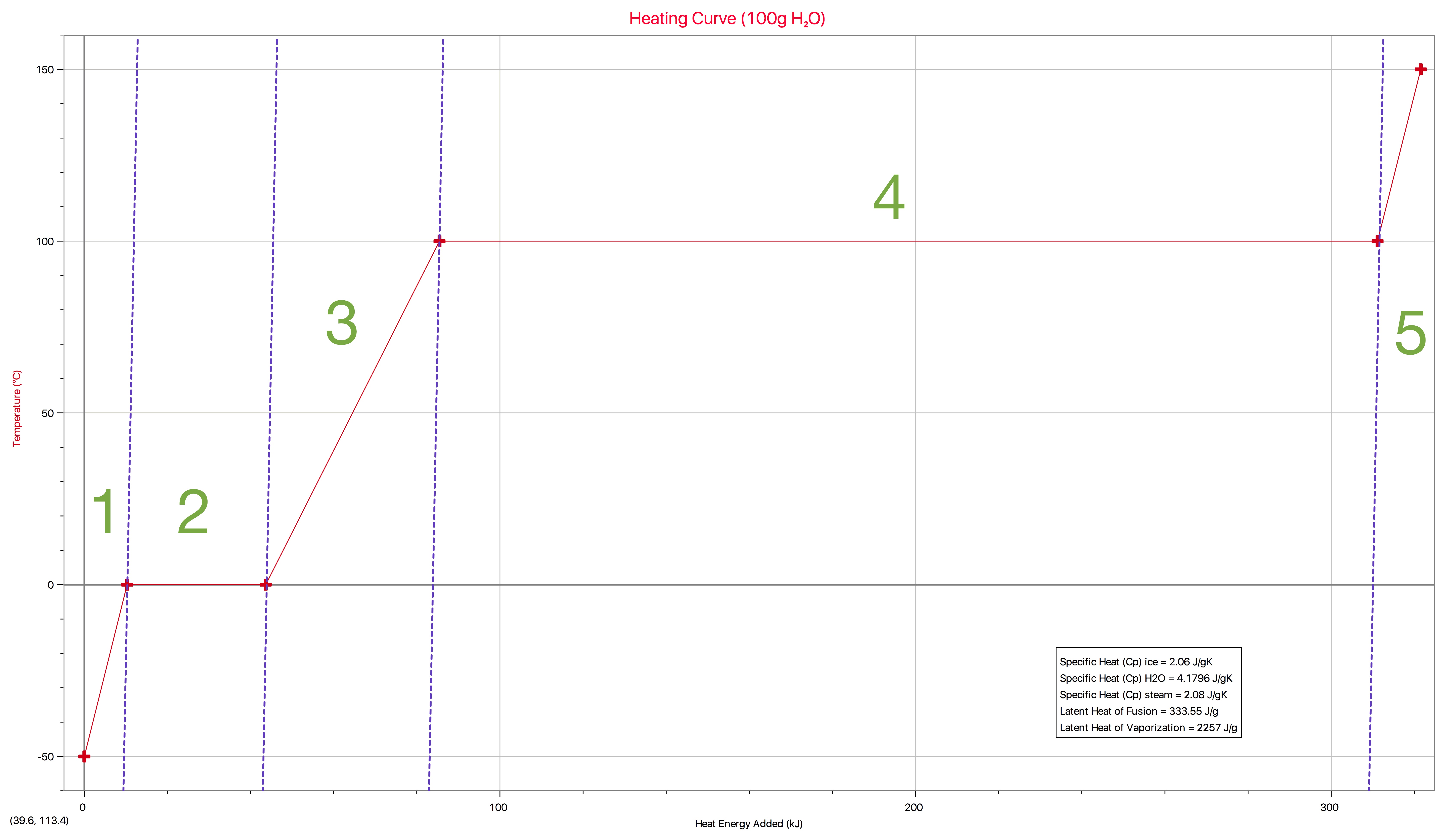
Given the heating curve for water, during which line segment could I find water in both the solid and liquid phase at the same time?
AB
BC
CD
DE
EF

Given the heating curve for water, explain whether it takes more energy to melt water or boil water. Give evidence from the graph to support your response.

A substance is cooled for sixteen minutes according to the cooling curve shown. What is the melting point of this substance?
206°C
150°C
90°C
50°C

Heat is being removed from a substance at a constant rate starting in the liquid phase at 75°C and ending at 15°C. The graph shows the temperature change during cooling. What phase change is occurring?
melting
freezing
boiling
condensation

This curve indicates what about the heat energy?
Heat energy is being added or absorbed
Heat energy is being released
In which region(s) of the graph would the substance be a solid only?
Region 1
Region 2
Region 3
Region 4
Region 5

What is the boiling point for this substance?
40 °C
60 °C
120 °C
140 °C
Melting and freezing occur at the same temperature!
True
False
I don't know


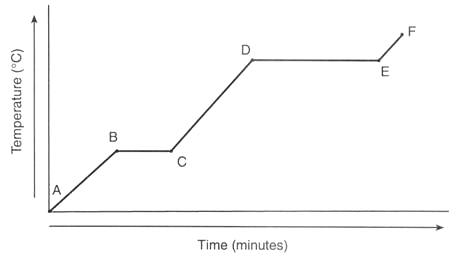
Are the particles moving faster or slower as time goes on? (Diagram F)
Faster
Slower

Is the substance gaining or losing energy? (Diagram D)
Gaining
Losing

Which line segment demonstrates vaporization occurring? (Diagram E)
B-C
C-D
D-E
E-F

What will occur when the substance transitions from B to A? (Diagram A)
condensation
evaporation
melting
freezing
What is the normal boiling point of this substance? (Diagram C)
150 °C
100 °C
-50 °C
0 °C
What is the normal melting point of this substance? (Diagram C)
150 °C
100 °C
-50 °C
0 °C

What phase change occurs at letter F?
Melting
Freezing
Vaporization
Sublimation

What phase change occurs at letter B?
Deposition
Melting
Freezing
Condensation

What phase change occurs at letter C?
Vaporization
Sublimation
Melting
Condensation

What phase change occurs at letter E?
Freezing
Deposition
Condensation
Melting

What phase change occurs at letter A?
Freezing
Condensation
Melting
Deposition
What phase change occurs at letter D?
Freezing
Condensation
Melting
Deposition
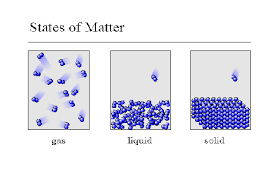
A ___________ substance has a definite volume but not a definite shape.
gas
liquid
solid
The particles in a _____________ vibrate, are close together, and do not move freely.
liquid
gas
solid

What is a crystalline solid?
solids with irregular patterns
solids with regular patterns
solids that are crystals
lines of crystals on the side of the road
What is an amorphous solid?
solids whose particles are aligned
solid whose particles are not arranged in a particular order
solids that are like water
solids that are like gas
What is a liquid?
matter than has a definite shape and definite volume
matter that has an indefinite shape and indefinite volume
matter that has a indefinite shape and definite volume
matter that has definite shape and indefinite volume
What is a gas?
matter that has an indefinite volume but definite shape
matter that has a definite shape but no definite volume
matter that doesn't have a definite shape or definite volume
matter that does not exist
What happens to the particles in gas?
spread out quickly
run into one another
vibrate closely together
slide past each other
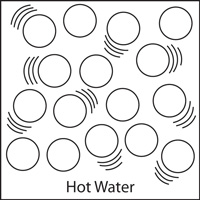
According to Boyle's Law, when Pressure increases then the Volume must...
According to Boyle's Law, when Volume increases then Pressure must...
According to Boyle's Law, what type of relationship to pressure and volume have?
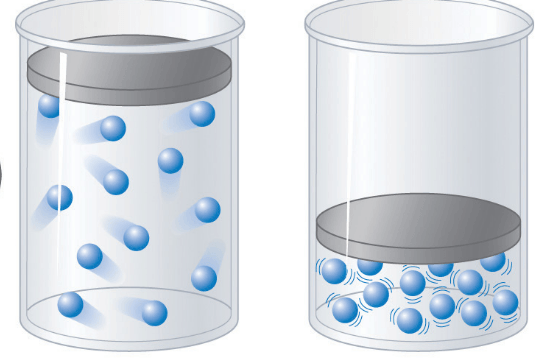
What remains constant according to Charles’ Law?
Length
Pressure
Temperature
Volume
In CHARLES'S LAW, volume and temperature have a ______ proportionality.
direct
inverse
linear
exponential
In CHARLES' LAW, at constant pressure, what happens to temperature of a gas when the volume doubles?
The temperature also doubles.
The temperature decreases to half of its original volume.
The temperature doesn't change.
The temperature quadruples.
You shake a can of soda & then open it, decreasing its pressure. What happens to the volume of of the carbon dioxide in the soda?
volume increases
volume decreases
stays the same
You go camping & roast marshmallows over a campfire. What happens to the volume of the air bubbles inside the marshmallows?
volume increased
volume decreased
stays the same
According to Charles’s law, the relationship between the temperature and the volume of a gas is
direct
inverse
exponential
inverse square
When the temperature of the gas in closed container is increased, the pressure increases.
True
False
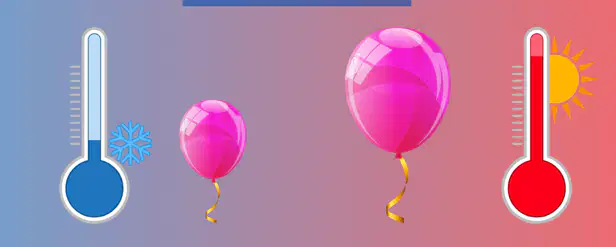
a principle that describes relationship between the temperature and volume of a gas at constant pressure.
Boyles's law
Charles's law
Newton's law
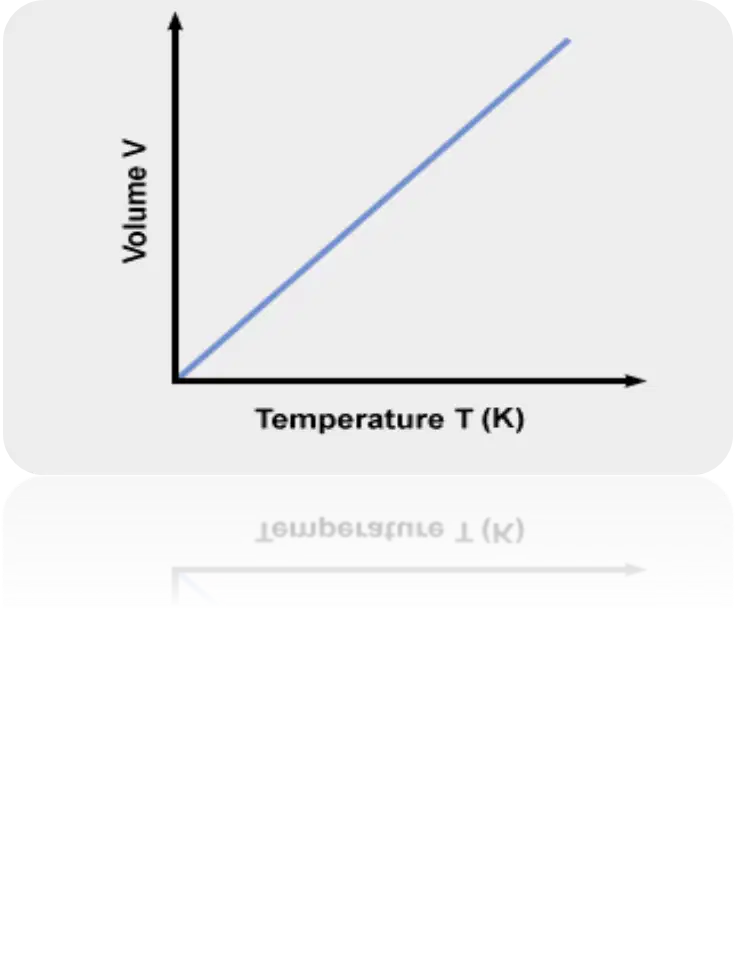
At constant volume, when the temperature of a gas decreases, the pressure.......................
increases
decreases
doesn't change
Surface tension is the property of water in which...
water molecules at the surface tend to stick together.
water spills easily.
water tends to be see-through.
Low viscosity can be described as...
liquids that flow quickly
liquids that flow slowly
High viscosity can be described as...
a liquid that flows quickly
a liquid that flows slowly
Water is an example of a...
Low viscosity liquid
High viscosity liquid
Peanut butter is an example of a...
High viscosity liquid
Low viscosity liquid
Isnt a liquid at all! Don't be silly.
Which viscosity can be described as "thick"?
Low viscosity
High viscosity
Which viscosity can be described as "thin"?
Low viscosity
High viscosity
In which state of matter are the molecules spaced farthest apart?
Solid
Liquid
Gas
All are equal

Which of the pictures demonstrates a state of matter with a fixed shape and a fixed volume?
J
K
L
M
State of matter with a definite volume, but no definite shape.
solid
liquid
gas
State of matter with a definite shape and definite volume.
solid
liquid
gas
State of matter with no definite shape and no definite volume.
solid
liquid
gas