
 Worksheets
HBS EOC Review
Total questions: 101
Worksheet time: 5hrs 3mins
The sternum is ______ to the humerus.
medial
lateral
superior
inferior
Blood, bone, and fat are all examples of _____ tissue.
transport
support
connective
epithelial
If you fracture your ulna, you have broken a bone in your
arm
leg
foot
hand
A restriction enzyme
cuts DNA in a defined pattern, such as every 5th BP
Can Cut DNA randomly
recognizes a specific sequence and cuts DNA
all of the above

Gel electrophoresis is used to separate DNA fragments on the basis of which property?
size
color
functions
chromosomes

Which suspect should be charged with the crime?
Suspect 1
Suspect 2
Suspect 3
None of these suspects

The bones highlighted in red are called the
tibia
fibula
ulna
femur

Which lobe?
Frontal
Parietal
Temporal
Occipital

Which lobe?
Frontal
Parietal
Temporal
Occipital

Which lobe?
Frontal
Parietal
Temporal
Occipital

Name this structure.
Cerebrum
Cerebellum
Brain Stem
Basal Ganglia
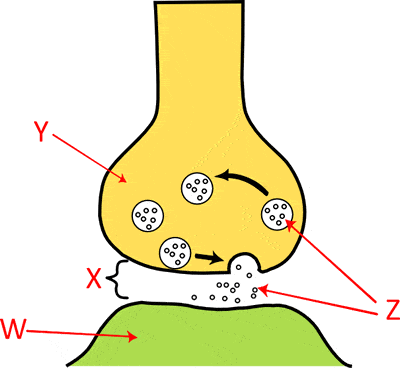

Z
Axon Terminal Button
Neurotransmitters
Dendrite
Synapse
which is the correct path that a nerve impulse will follow in a reflex arc?
motor neuron--> interneuron--> sensory neuron
interneuron--> motor neuron --> sensory neuron
motor neuron--> sensory neuron--> interneuron
sensory neuron--> interneuron--> motor neuron
What do Schwann Cells do?
Intakes information from other neurons
Produces fatty tissue for the Myelin Sheath
Sends information to the next cell
Controls the speed of electrical signal through the axon
An electrical impulse within a single neuron is called a
synapse
membrane potential
action potential
cell body
Which ion is pumped into the axon of a neuron to help maintain the resting potential?
calcium
hydrogen
potassium
sodium
Which one of the following is involved in maintaining a resting membrane potential?
Na+/K+ ATPase pump moves 3Na+ in for every 2K+ out
Na+/K+ ATPase pump moves 3K+ in for every 2Na+ out
Na+/K+ ATPase pump moves 3Na+ out for every 2K+ in
Na+/K+ ATPase pump moves 3K+ out for every 2Na+ in

Depolarization is occuring at number
1
2
4
5


What type of neuron is A?
Sensory
Interneuron
Motor
Dermal
What type of neuron is B?
Sensory
Interneuron
Motor
Interdermal
What type of neuron is C?
Sensory
Interneuron
Motor
Muscular

Name structure A
Pupil
Iris
Cornea
Retina

Name Structure B
Lens
Pupil
Sclera
Cornea

Name structure G
Lens
Pupil
Optic Nerve
Ciliary Muscles

What structure of the eye controls the size of the pupils?
Ciliary Muscles
Iris
Lens
Retina

What is the function of the Lens?
Lining of the back of the eye that contains light receptor cells.
Regulates how much light enters the eye
Tough, transparent, protective coating that bends light as it enters the eye
Focuses light onto the retina

Name structure C
Ciliary Muscles
Retina
Optic Nerve
Iris

Name structure F
Sclera
Cornea
Optic Nerve
Lens

Identify structure D
Retina
Optic Nerve
Sclera
Lens

Identify Structure E
Retina
Sclera
Optic Nerve
Lens
Gives the cornea its bulging, round appearance
Cornea
Vitreous Humor
Sclera
Aqueous Humor
Choroid
Farsightedness
Myopia
Hyperopia
both
Astigmatism
Nearsightedness
Myopia
Hyperopia
both
Astigmatism
What is the function of the small intestine?
To absorb water into the blood
To absorb nutrients into the blood
To absorb stomach acid into the blood
To absorb enzymes into the blood
What is the function of the large intestine?
To absorb water
To absorb nutrients
To absorb stomach acid
To absorb enzymes
We know that a biochemical is an enzyme because its name ends in the suffix...
-ale
-ape
-awe
-ase
Select the type of enzyme that breaks down lipids into fatty acids and glycerol.
amylase
pepsin
lipase
protease
Amylase breaks down starch into...
Amino acids
Fatty acids and glycerol
Glucose
Carbohydrates
Protease breaks down proteins into...
Amino acids
Fatty acids and glycerol
Glucose
Glycerol

Which of the following conclusions can be drawn from the graph?
The optimum pH of the enzyme is at 6.6.
The enzyme's activity increases as pH increases from 5.0 to 9.0.
The optimum pH of enzyme is 5.0.
The enzyme's activity is greater around pH of 8.0.
Enzymes are what type of molecule?
carbohydrates
proteins
fats
starch
Which sentence is FALSE?
Enzymes are proteins
Enzymes are not specific and can act on all substrates
Enzymes are biological catalysts
Enzymes are affected by pH and temperature

Which parts of the diagram is the small and large intestine?
A~ small intestine
E~ large intestine
D~ small intestine
E~ large intestine
C~ large intestine
B~ small intestine
A~ large intestine
C~ small intestine
E~ small intestine
D~ large intestine
The Enzyme model in which the substrate fits perfectly into the enzyme.
Lock and Key Model
Induced Fit Model
Catalyst Model
Coenzyme Model
The Enzyme model in which as the substrate fits into the active site the enzyme and substrate change shape slightly to fit together.
Lock and Key Model
Induced Fit Model
Catalyst Model
Coenzyme Model

Which model is depicting lock and key?
Blue
Red
Neither
Both
Which model is depicting induced fit?
Blue
Red
Neither
Both
Select the following that apply to "catalyst". More than one answer.
Lower activation energy of reactions.
Increase reaction rates
Include molecules such as enzymes
Do not play a large role in human body processes
Are known for decreasing products
How long can a human (statistically) live without food?
3 days
3 hours
3 minutes
3 months
3 weeks
How long can a human (statistically) live without water?
3 days
3 hours
3 minutes
3 months
3 weeks
How long can a human (statistically) live without oxygen?
3 days
3 hours
3 minutes
3 months
3 weeks
Which is used first as a source of energy by the body?
Fats
Carbohydrates
Muscle
Bone
Which is used second as a source of energy by the body?
Fats
Carbohydrates
Muscle
Bone
Catabolism. More than one answer.
involves breaking down organic compounds
involves building up of organic compounds
releases energy
requires energy
Anabolism. More than one answer.
involves breaking down organic compounds
involves building up of organic compounds
releases energy
requires energy
The rate at which heat is given off by an organism at complete rest.
body mass index
metabolism
calorie
TDEE
Basal Metabolic Rate
The amount of energy an individual uses per day.
body mass index
metabolism
calorie
TDEE
Basal Metabolic Rate
The amount of energy needed to raise the temp of 1g of water 1 degree celsius
body mass index
metabolism
calorie
TDEE
Basal Metabolic Rate

Calculate the BMI of the following individual: Height 2m and weight: 80kg.
20
200
40
60
44

Where is the bond broken to release energy?
1
2
3
4
Which letter is the ribose?
A
B
C
D
Which letter is the adenine?
A
B
C
D
Which letter is the phosphate?
A
B
C
D
What is this molecule? More than one answer.
ATP
ADP
Adenosine Triphosephate
DNA
The process of creating ATP from ADP is...
Anabolic
Catabolic
Neither
Both
The process of creating ADP from ATP is...
Anabolic
Catabolic
Neither
Both
Where in the cell is the energy made?
Nucleus
Mitochondria
Rough ER
Golgi Apparatus
The process of making ATP is called...
cellular respiration
photosynthesis
phosphorative generation
deoxinagation
Which type of cells require the most ATP?
bone cells
blood cells
fat cells
skin cells
muscle cells


calcium and magnesium
calcium and phosphorus
calcium and potassium
Calcium and Zinc
Epidermis
Dermis
Hypodermis
Epithelial
A.) Dermis;
B.) Epidermis;
C.) Subcutaneous tissue
Yellow marrow in the bone is mostly
blood plasma
protein
fat
spongy bone
If you blood calcium level is high, the thyroid releases calcitonin which will cause osteoblasts to
use blood calcium to build bone
break down bone to release calcium
break down bone
deliver nutrients to bone
Lymph
Thymus gland
Immunity
Passive acquired immunity
What are the oval-shaped structures that store lymphocytes and filter out pathogens?
Lymph
Lymph Vessels
Lymph Nodes
Lymph Glands

