wayground logo

Free Printable Worksheets

Font size

S
M
L
XL
Worksheets

Chemistry Review #1

Total questions: 103

Worksheet time: 2hrs 0mins

Name
Class
Date
1.

This is used to store and mix chemicals during an experiment

a)

balance scale

b)

thermometer

c)

beaker

d)

tongs

2.

This is used to protect your eyes during an experiment

a)

scoop

b)

funnel

c)

bunsen burner

d)

goggles

3.

This is used to pour dry materials into another container

a)

scoop

b)

funnel

c)

flask

d)

goggles

4.

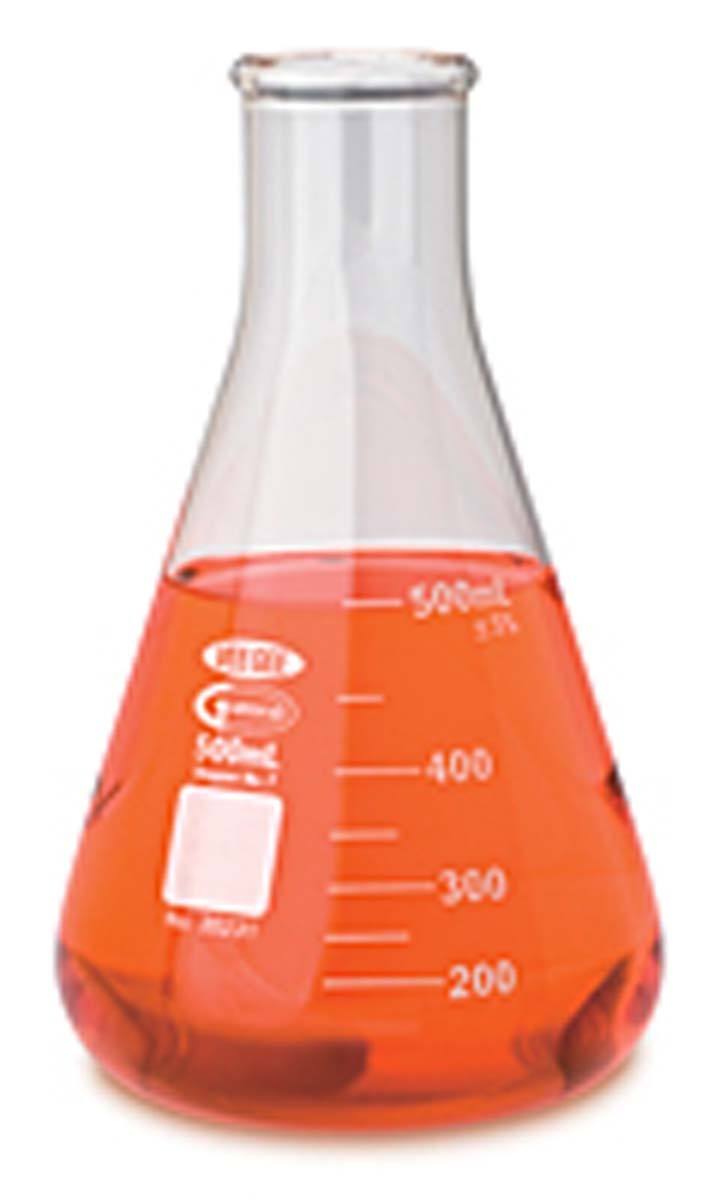
Device shown that is used to swirl, mix, or store chemicals?

a)

Beaker

b)

Flask

c)

Test Tube

d)

Graduated Cylinder

5.
Which item measures more precisely?
a)
test tube
b)
beaker
c)
graduated cylinder
d)
measuring cup
6.

You are heating a piece of glass and now want to pick it up. You should

a)

use a rag or paper towels

b)

pick up the end that looks cooler

c)

use tongs

d)

pour cold water onit

7.

You have been injured in the laboratory (cut, burn, etc.). First you should

a)

visit the school nurse after class

b)

see the doctor after school

c)

tell the science instructor at once

d)

apply first aid yourself

8.

In the laboratory, the following should not be worn

a)

loose clothing

b)

dangling jewelery

c)

sandals

d)

all of the above

9.

Proper disposal of chemical wastes includes

a)

rinsing it down the sink with plenty of water

b)

leaving it at your lab station for the next class

c)

taking them home in a sealed container

d)

disposal according to your teacher's directions

10.

What does corrosive mean?

a)

something that is poisonous

b)

something that is deadly

c)

corrosive substances will destroy other substances when they come in contact

d)

something that hurts your brain

11.

What safety Symbol is this?

a)

Flamable

b)

Oxidizing

c)

No Open Flame

d)

Explosion

12.

What does this WHMIS symbol means?

a)

Radioactive

b)

Health Hazard

c)

Corrosive

d)

Explosive

13.

What does this symbol means?

a)

can cause death with short exposure to small amounts

b)

Corrosive

c)

may cuase less serious health effects

d)

Biohazardous

14.

What does this symbol mean?

a)

Corrosive

b)

Biohazardous

c)

Oxidizing

d)

Environmental

15.
Which is NOT a physical property?
a)
odor
b)
reacts with acid
c)
ability to conduct electric current
d)
hardness
16.

Flammability means the ability to _______ and is a _________ property.

a)

melt; chemical

b)

rust; physical

c)

change; physical

d)

burn; chemical

17.

The ability to hammered into a thin sheet or be bent is

a)

Ductility

b)

Solubility

c)

Density

d)

Malleability

18.

Physical properties....

a)

change the matter when studied

b)

can be observed and measured without changing the matter being studied

c)

include the ability to burn and rust

d)

are useless unless studied in a lab

19.

Which of these statements best describes a chemical property of a substance?

a)

It reacts with an acid to form water

b)

The object has a blue color

c)

The substance has a powdery texture

d)

It has a density of 2.11 g/cm3

20.
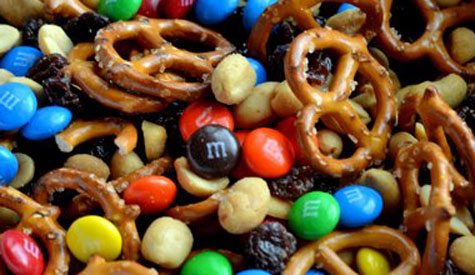
What type of mixture is this?
a)

homogenous mixture /solution

b)

compound

c)

heterogeneous /mechanical mixture 

d)

pure substance

21.

Vinegar is made from 5% acetic acid and water. This is an example of a

a)

solution

b)

Mechanical Mixture

c)
Pure Substance
d)

compound

22.
This picture represents: 
a)
Element
b)
Compound
c)
Mixture of Elements
d)
Mixture of Compounds
23.
Substance with atoms that are all alike.
a)
element
b)
compound
c)
homogeneous mixture
d)
heterogeneous mixture
24.

Methane (shown here) is a

a)

element

b)

Compound

c)

mechanical mixture

d)

solution

25.
This picture represents: 
a)
Element
b)
Compound
c)
Mixture of Elements
d)
Mixture of Compounds
26.

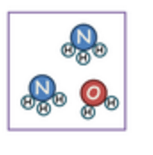
How many molecules of water are in the diagram?

a)

3

b)

2

c)

9

d)

1

27.
What is the total number of atoms in an ammonia (NH3) molecule?
a)
1
b)
2
c)
3
d)
4
28.

How many diffrent TYPES of atoms are shown?

a)

3

b)

2

c)

9

d)

1

29.
Which one of these pictures represents a pure substance? 
a)
1 and 2
b)
1 and 3
c)
2 and 3
d)
1, 2 and 3
30.

Which substance is composed of only one type of atom?

a)

Water (H2O)

b)

Table salt (NaCl)

c)

Gold (Au)

d)

Glucose (C6H12O6)

31.

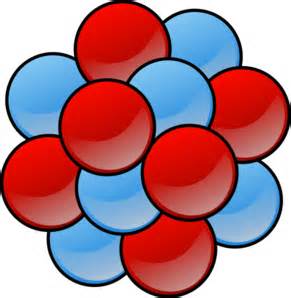
How many atoms are shown in the diagram?

a)

3

b)

2

c)

9

d)

1

32.
A mixture that is NOT evenly distributed is called ....
a)

a solution

b)
Homogenous
c)

mechanical

d)

a compound

33.

Which substance below is an element?

a)

Water (H2O)

b)

Table salt (NaCl)

c)

Gold (Au)

d)

Glucose (C6H12O6)

34.

What kind of substance is table salt (NaCl)?

a)

compound

b)

homogenous mixture

c)

heterogenous mixture

d)

pure substance

35.

The Electron cloud model is based on

a)
Quantum Mechanics
b)
Gold Foil Experiment
c)
Matter is made up of small particles called atoms
d)
Nuclear Theory
36.
Place the following scientists in order, from earliest to latest: 
Rutherford, Dalton, Bohr, Thomson
a)
Dalton, Rutherford, Bohr, Thomson
b)
Thomson, Dalton, Rutherford, Bohr
c)
Dalton, Thomson, Rutherford, Bohr
d)
Bohr, Dalton, Rutherford, Thomson
37.
James Chadwick discovered the ________.
a)
proton
b)
neutron
c)
electron
d)
nucleus
38.
What did Thomson discover?
a)
electron
b)
proton
c)
neutron
d)
electron cloud
39.
A tiny but very dense, positively charged portion of the atom that holds most of the atomic mass
a)
Electron Shells
b)
Orbitals
c)
Electron Cloud
d)
Nucleus
40.
The scientist responsible for "discovering" the nucleus is:
a)
Bohr
b)
Rutherford
c)

Thomsen

d)
Einstein
41.

How did Rutherford discover the atomic nucleus?

a)
Cathode tube ray experiment
b)
Gold Foil Experiment
c)
Planetary Model
d)
Plum Pudding Model
42.
What contribution did John Dalton make to atomic theory? 
a)
He discovered that every atom was positively charged. 
b)
He discovered that every element consisted of one type of atom that couldn't be divided. 
c)
He discovered that atoms had nuclei. 
d)
He discovered that atoms could be divided into smaller parts. 
43.

What scientist is best known for his "Plum Pudding" or raisin bun model of the atom?

a)
J.J. Thomson
b)
Ernest Rutherford
c)
John Dalton
d)
Democritus
44.

In an atom, electrons move in definite orbits or shells around the nucleus in which model?

a)
Thomson
b)
Rutherford
c)
Bohr
d)
Democritus
45.

Who's model does this picture represent?

a)

Dalton 1803-1808

b)

Thomson 1897

c)

Rutherford 1911

d)

Bohr 1913

46.

Which Scientist created this model?

a)

Democritus

b)

Thomsen

c)

Bohr

d)

Rutherford

47.
Which model of the atom came about from experiments with a cathode ray tube?  This also led to the discovery of the electron.
a)
Rutherford Model
b)
Dalton Model
c)
Thomson Model
d)
Bohr Model
48.
How did each model of the atom help to develop the atomic theory? 
a)
Each model provided opinions that were added.
b)
Each model showed different properties of the same structure. 
c)
Each model showed new particles that had been discovered.
d)
Each model built upon the other to show new particles or properties of previously discovered particles. 
49.
Atoms are made up of three basic parts, which are -
a)
Protons, neutrons, electrons
b)
neutrinos, protons, neutrons
c)
quarks, protons, electrons
d)
electrons, neutrons, and quarks
50.
Electrons are not factored into atomic mass because:
a)
They are so small their mass is negligible
b)
They're not in the nucleus
c)
They're too big
d)
They move so quickly their mass is zero
51.
What does the nucleus of an atom contain?
a)
Electrons and neutrons
b)
Protons and neutrons
c)

electrons, protons and neutraons

d)

electrons and protons

52.
Subatomic particles that are neutral in charge
a)
Neutrons
b)
Protons
c)
Nucleus 
d)
Electrons
53.

Subatomic particles with a negative charge

a)

Electrons

b)

Neutrons

c)

Protons

d)

Quarks

54.
Which is an electron?
a)
A
b)
B
c)
C
55.
What is the electrical charge of a proton?
a)
1+
b)
1-
c)
neutral
d)
2-
56.

Which subatomic particles are the smallest?

a)

Neutrons

b)

Protons

c)

Electrons

d)

Atoms

57.
Where are protons located in an atom?
a)
nucleus
b)
electron cloud
c)
neutron
d)
who knows?
58.
What is an atomic number?
a)
The sum of protons and neutrons in an atom.
b)
The sum of protons and electrons in an atom.
c)
The number of protons in an atom of a specific element.
d)
The number of neutrons in a specific element.
59.

The number of neutrons equals...

a)

atomic number (atomic mass) - mass number

b)

Protons - neutrons

c)

Electrons - protons

d)

mass number (atomic mass)- atomic number

60.
Which best explains how elements are arranged on the modern periodic table?
a)
Elements are arranged with number of protons increasing from left to right
b)
Elements are arranged with number of protons decreasing from the left to right
c)
Elements are arranged with the most reactive elements at the top
d)
Elements are arranged with the most metallic elements on the right
61.

What trend is shown here?

a)

As the atomic number increases, the atomic mass increases

b)

As the atomic number increases, the atomic mass decreases

c)

Atomic number is equal to atomic mass

d)

Atomic number is not related to atomic mass

62.
What determines what element an atom is?
a)
The number of electrons
b)
The number of neutrons
c)
The number of protons
d)
The formula of the atom
63.
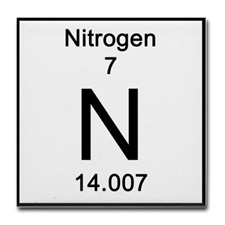
What is the number of protons that the element in this image contain?
a)
14
b)
7
c)
15
d)
18
64.

an atom with atomic number 6 would have how many protons? 
a)
6
b)
12
c)
3
d)
cannot be determined 
65.
If an atom has 10 protons, 10 neutrons, and 10 electrons, what is the mass of the atom?
a)
10
b)
20
c)
30
66.
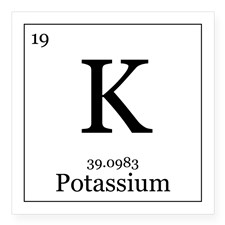
How many neutron are in the atom "K"?
a)
7
b)
2
c)
39
d)
20
67.
What is the number of protons that the element in this image contain?
a)
14
b)
7
c)
15
d)
18
68.
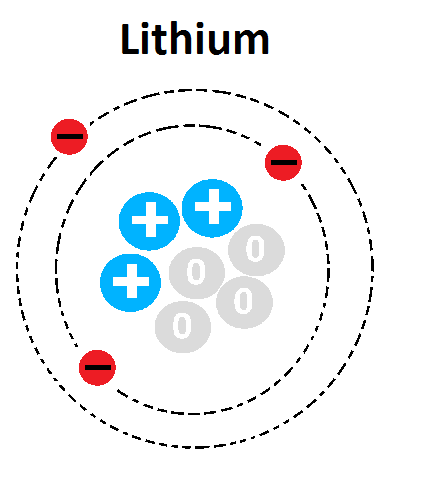
What is the atomic number of this atom?
a)
1
b)
3
c)
4
d)
7
69.

What is the atomic mass of this nucleus?

a)

1

b)

3

c)

4

d)

7

70.

Vertical columns on the periodic table are called ___?

a)

groups

b)

periods

c)

rows

d)

families

71.
Elements that are arranged in __________ have the most similar physical and chemical properties to each other.
a)
periods
b)
groups
72.
Sodium (Na) is found in period 
a)
3
b)
2
c)
4
d)
1
73.
Sodium (Na) is found in group 
a)
1
b)
2
c)
3
d)
4
74.

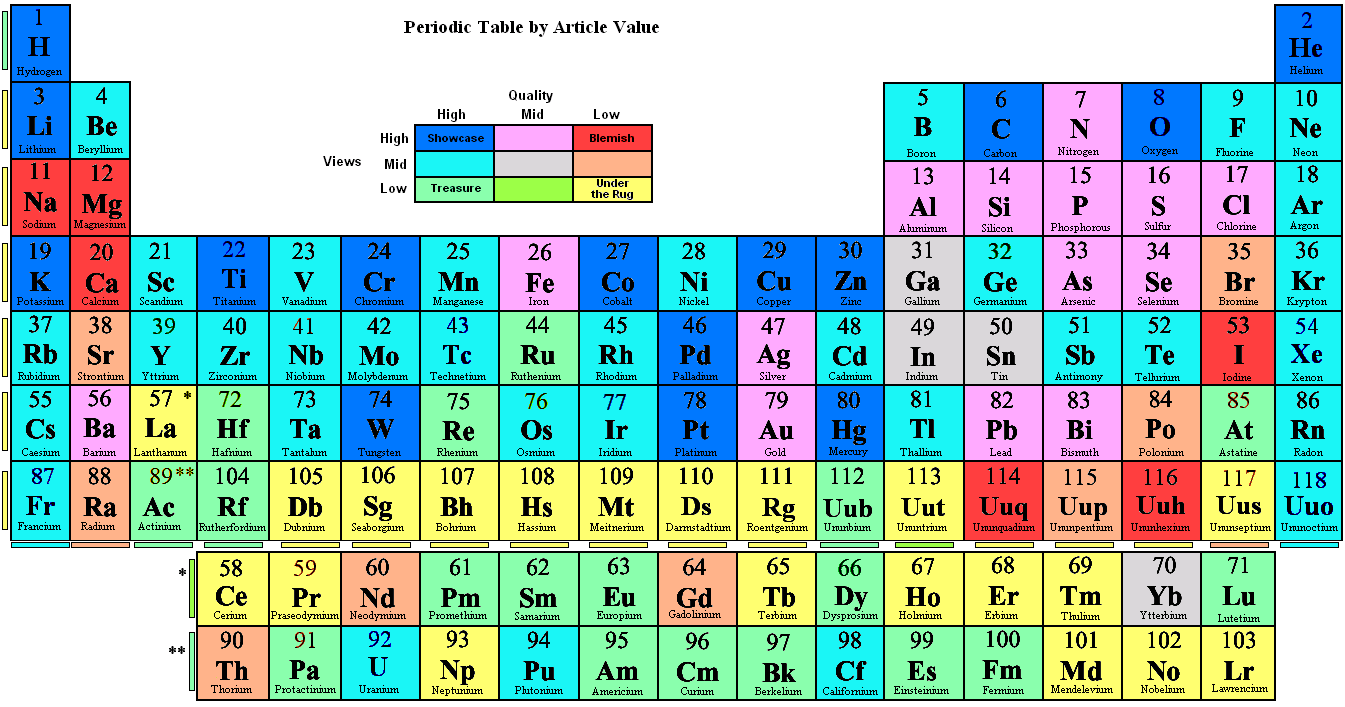
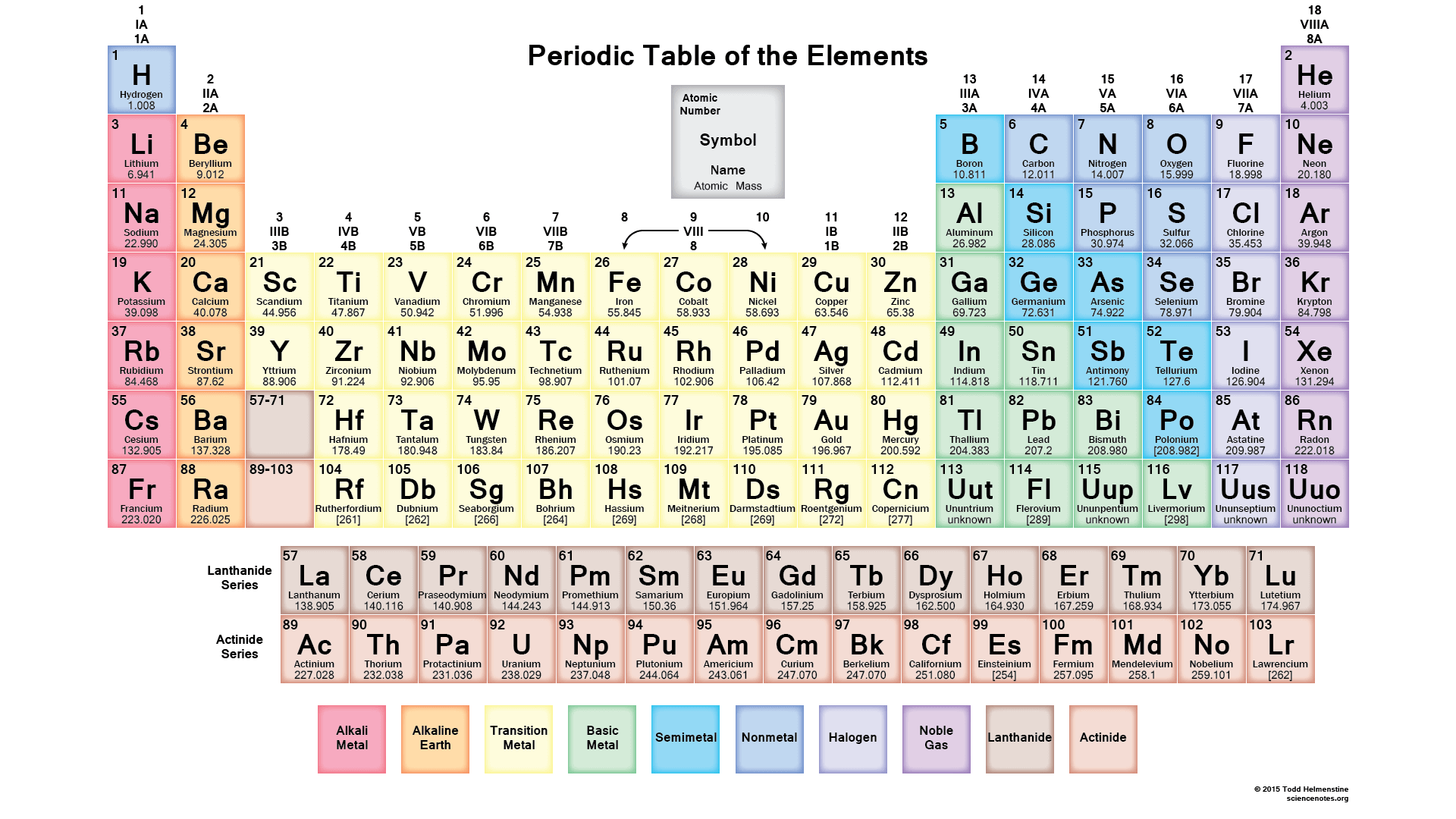
Which color on the image of the periodic table corresponds with the halogens?

a)

red

b)

black

c)

blue

d)

orange

75.

Which color on the image of the periodic table corresponds with the metalloids.

a)

bright yellow

b)

gold

c)

teal

d)

light blue

76.

Which color on the image of the periodic table corresponds with the alkaline earth metals.

a)

yellow

b)

dark yellow

c)

blue/green

d)

teal

77.

Most metals share four common physical characteristics. Which of the options is NOT one of the four?

a)

Luster

b)

Conductivity

c)

Ductility

d)

Malleability

e)

Reactivity

78.

A student has to select an element that is a poor conductor of heat and electricity. Which element should they choose?

a)

Br

b)

Cd

c)

Na

d)

Ti

79.
Elements which are shiny, conduct electricity and heat are called
a)
metal
b)
nonmetal
c)
metalloid
d)
nonexistent
80.

Which element is not a metal?

a)

Li

b)

Be

c)

Na

d)

O

81.

What are the most likely positions of element A and element B on the periodic table?

a)

Both elements A and B are on the left of the periodic table.

b)

Both elements A and B are on the right of the periodic table.

c)

The element A is on the left of the periodic table, and element B is on the right of the periodic table.

d)

The element A is on the right of the periodic table, and element B is on the left of the periodic table.

82.

Which family of elements does not combine with other elements unless under special conditions in a laboratory?

a)

Noble gases

b)

Halogens

c)

Metalloids

d)

Alkaline earth metals

83.

Which of the following is an example of an alkaline earth metal?

a)

Magnesium

b)

Lithium

c)

Oxygen

d)

Fluorine

84.

What is the most reactive nonmetal?

a)

Fluorine

b)

Carbon

c)

Neon

d)

Hydrogen

85.
What element is will have the most similar physical and chemical properties to the element Lithium (Li)?
a)
Sodium (Na)
b)
Magnesium (Mg)
c)
Beryllium (Be)
d)
Calcium (Ca)
86.
Which two groups on the Periodic Table are the MOST reactive?
a)
Group 1 and Group 17
b)
Group 2 and Group 16
c)
Group 13 and Group 15
d)
Group 17 and Group 18
87.
Which element shares chemical properties of Chlorine?
a)
Na
b)

F

c)
Ar
d)
S
88.

According to the diagram, which list represents elements that share the most similar chemical properties?

a)

O, Se, and Kr

b)

Se, Cl, and Ne

c)

S, Cl, and Ar

d)

Ne, Ar, and Kr

89.

Which of these elements will have properties most similar to that of element X?

a)
1
b)
2
c)
3
d)
4
90.
Sodium reacts easily with water. Which of the following elements is likely to react with water in the same way?
a)
Lithium (Li)
b)
Neon (Ne)
c)
Oxygen (O)
d)
Phosphorus (P)
91.

Is this an example of a physical or chemical change?

a)

physical

b)

chemical

92.

Is this an example of a physical or chemical change?

a)

physical

b)

chemical

93.

Is this an example of a physical or chemical change?

a)

physical

b)

chemical

94.
Is Gatorade powder dissolving in water physical or chemical change?
a)
Physical 
b)
Chemical
95.

Is this an example of a physical or chemical change?

a)

physical

b)

chemical

96.

Select ALL of the characteristics of a physical change

a)

changes in appearance only

b)

a new substance is not created

c)

changes in the ph level

d)

burning and fire

e)

chemical bonds are not created or broken

97.
A teacher is demonstrating physical and chemical changes to her class. Which action should she use to demonstrate a chemical change?
a)
cutting a piece of paper
b)
folding a piece of paper
c)
tearing a piece of paper
d)
burning a piece of paper
98.
Which of the following is a sign that a chemical reaction has occurred?
a)
change in shape
b)
melting
c)
formation of a gas
d)
dissolving
99.

A chemical change is when

a)

the chemical bonds change

b)

the chemical bonds do not change

c)

only the physical properties change

100.
Marie had a beaker with a small amount of baking soda. She added a few drops of pickle juice to the baking soda and observed fizzing and bubbling. Based on her observation, which of these can Marie determine about the new substance formed by mixing the baking soda and pickle juice?
a)
A chemical reaction produced a solid.
b)
A chemical reaction produced a gas.
c)
No chemical reaction took place.
d)
Only a physical change happened.
101.
A student added white crystals to a clear liquid. The crystals dissolved in the liquid. After a few seconds, the liquid became quite warm and then turned bright red in color. Indications that a chemical change was taking place could be observed when –
a)
the white crystals were added to the clear liquid.
b)
the crystals dissolved in the liquid leaving only the liquid visible.
c)
There are no indications of chemical change
d)
the temperature of the liquid increased and an unexpected color change occurred.
102.
The Best Friend's Club uses "invisible ink" to write notes to each other. The invisible ink is actually lemon juice that is clear when it dries on paper, but turns brown when a club member holds a burning candle under the paper. Once it is heated, it is never invisible again.
 What type of change is occurring when the paper is heated?

a)
chemical change
b)
elemental change
c)
physical change
d)
temperature change
103.
A student mixes two clear liquids together. After a few minutes, a white powdery solid can be seen settling on the bottom of the test tube. Which of the following is a conclusion that the student can draw based on these observations? The two clear liquids –
a)
were pure substances before they were mixed.
b)
are toxic and should be handled with extreme caution.
c)
have gone through a chemical change in which a new substance called a precipitate was produced.
d)
have been stored too long and are no longer good.