
 Worksheets
Spring Semester Test 2024-2025
Total questions: 95
Worksheet time: 48mins
Name
Class
Date
1.
A wave can be defined as:
a)
A transfer of energy from one place to another
b)
The movement of matter through a medium such as air.
c)
The transfer of matter from one object to another.
d)
A transfer of matter where the vibration of the medium is random
2.

What **shape** of wave is shown in the image below?
a)
Transverse
b)
Longitudinal
c)
Electromagnetic
d)
Mechanical
3.
The two broad categories of waves are:
a)
Transverse and Longitudinal
b)
Transverse and Surface
c)
Gamma and Radio waves
d)
Electromagnetic and Mechanical
4.
Which of the following types of waves requires a medium to travel through?
a)
Electromagnetic
b)
Mechanical
c)
Transverse
d)
Visible Light Waves
5.
Which of the following is true about how Electromagnetic waves can travel?
a)
They can travel through a medium and through empty space
b)
They can travel through a medium, but NOT through empty space
c)
They cannot travel through a medium, but can travel through empty space
d)
They require a solid or a liquid to travel through
6.
Some types of waves require a medium to travel. What is a medium?
a)
Some form of matter (solid, liquid, gas)
b)
The central part of a wave
c)
The cycle of waves from crest to trough
d)
The empty space between the sun and the Earth
7.
What are the two shapes that waves can exist in?
a)
Electromagnetic, Mechanical
b)
Transverse, Sound
c)
Electromagnetic, Sound
d)
Transverse, Longitudinal
8.
An earthquake is a mechanical wave.
a)
True
b)
False
9.
A sound wave can be classified as what kind of wave?
a)
Electromagnetic, Transverse
b)
Electromagnetic, Longitudinal
c)
Mechanical, Transverse
d)
Mechanical, Longitudinal
10.
The unit for wavelength is:
a)
Hertz
b)
meters
c)
meters / second
d)
amplitude
11.
The unit for frequency is:
a)
Hertz
b)
meters
c)
meters / second
d)
amplitude
12.
The unit for wave speed is:
a)
Hertz
b)
meters
c)
meters / second
d)
amplitude
13.
Wave frequency describes ___________.
a)
Wave height
b)
Wave speed
c)
Number of wave cycles in one second
d)
Time required for one wave cycle
14.

How could you produce a wave with a HIGH frequency using a slinky?
a)
increase the energy by moving your hand slowly
b)
decrease the energy by moving your hand quickly
c)
increase the energy by moving your hand quickly
d)
decrease the energy by moving your hand slowly
15.

Which wave has a higher frequency?
a)
blue
b)
red
16.

Which wave has more energy?
a)
blue
b)
red
17.

Which wave is more likely to be a radio wave?
a)
blue
b)
red
18.
T or F: All electromagnetic waves move at the same speed in a vacuum
a)
True
b)
False
19.
Which statement best describes how sound waves move through air and water?
a)
Sound waves move faster in air than in water because air is less dense, making it easier for particles to move back and forth.
b)
Sound waves move at the same speed in air and water because both allow particles to be compressed and expanded in a similar way.
c)
Sound waves move faster in water than in air because water molecules are closer together, allowing the compression and expansion of particles to happen more quickly.
d)
Sound waves cannot travel through water because they need air particles to push against in order to move.
20.
Which statement best describes how light waves move through air and water?
a)
Light waves move faster in water than in air because water molecules are closer together, allowing energy to transfer more efficiently.
b)
Light waves move faster in air than in water because they do not need particles to vibrate, and water slows them down due to its higher density.
c)
Light waves move at the same speed in air and water because they do not rely on particles compressing and expanding to travel.
d)
Light waves cannot travel through air or water because they require a solid medium to move.
21.
Which of the following influences wave speed?
a)
wavelength
b)
frequency
c)
the medium
d)
amplitude
22.
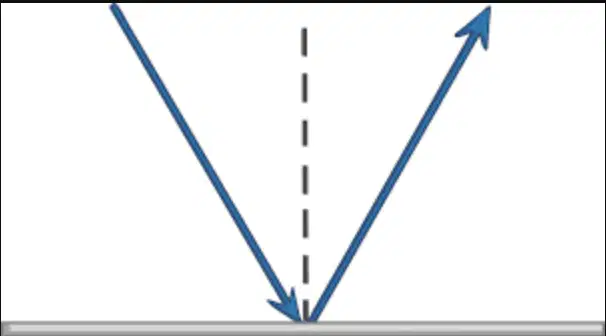
Which wave behavior is shown in the image?
a)
Reflection
b)
Refraction
c)
Absorption
d)
Diffraction
23.
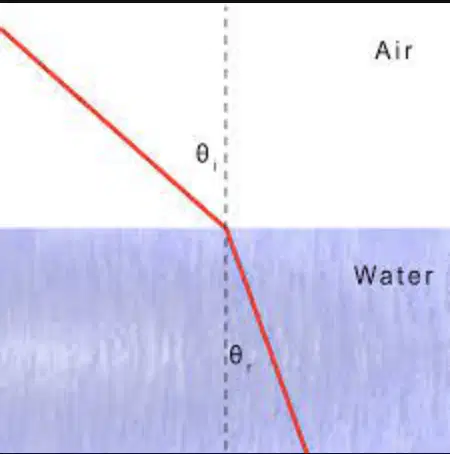
Which wave behavior is shown in the image?
a)
Reflection
b)
Refraction
c)
Diffraction
d)
Absorption
24.
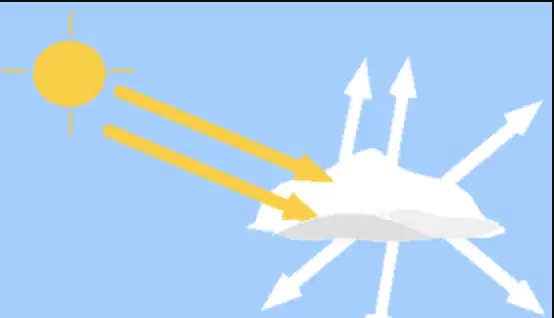
Which wave behavior is shown in the image? (When electromagnetic wave are reflected by
individual particles in a material and move in random
directions causing a whitened appearance (clouds)
a)
Scattering
b)
Reflection
c)
Refraction
d)
Absorption
25.
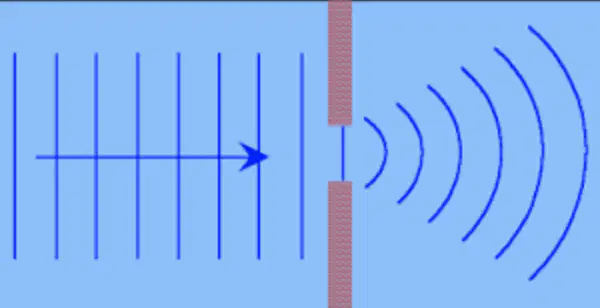
Which wave behavior is shown in the image?
a)
Scattering
b)
Absorption
c)
Diffraction
d)
Refraction
26.
Wavelength and Frequency have an inverse relationship - when one increases, the other decreases.
a)
True
b)
False
27.
Why are gamma rays the most harmful type of electromagnetic wave for living things?
a)
They have the lowest frequency, and therefore the highest energy.
b)
They have the largest wavelength, and therefore the lowest energy.
c)
They have the highest frequency, and therefore the highest energy.
d)
They have the largest wavelength, and therefore the highest energy.
28.

Which statement best explains the image below
a)
The different colors represent reflection of different wavelengths of light
b)
The different colors represent electromagnetic and mechanical waves
c)
The different colors represent longitudinal and transverse waves
d)
The different colors represent the crests and troughs on a transverse wave
29.
Which type of waves allow us to transmit information over long distances (cell phones, wifi, television, etc.)? (they have the longest wavelength of any electromagnetic wave)
a)
Microwaves
b)
Radio Waves
c)
Ultraviolet waves
d)
Gamma waves
30.
Energy is ________________________.
a)
the capacity to do work or the ability to cause change
b)
anything that has mass and takes up space
c)
the flow of protons that provides electricity
d)
measured in kilograms
31.
What is the correct unit for energy?
a)
meter
b)
watt
c)
joule
d)
kilogram
32.

When the person on the sled is at the top of the hill, which of the following statements is true?
a)
Kinetic energy is highest
b)
Potential energy is highest
c)
Half of the energy is potential and half of the energy is kinetic
d)
The elastic energy is highest
33.

When the person on the sled is at the base of the hill, which of the following statements is true?
a)
Kinetic energy is highest
b)
Potential energy is highest
c)
Half of the energy is potential and half of the energy is kinetic
d)
The elastic energy is highest
34.

When the person on the sled is halfway down the hill, which of the following statements is true?
a)
Kinetic energy is highest
b)
Potential energy is highest
c)
Half of the energy is potential and half of the energy is kinetic
d)
The elastic energy is highest
35.
A beaker of water is placed upon a heat source. The molecules begin to vibrate. What type of energy do they possess as they start to vibrate faster and faster?
a)
Kinetic
b)
Potential
36.
Check all of the following that influence potential energy:
a)
mass of the object
b)
velocity of the object
c)
acceleration due to gravity
d)
height of the object
37.
Check all of the following that influence kinetic energy:
a)
mass of the object
b)
velocity of the object
c)
acceleration due to gravity
d)
height of the object
38.
What does g stand for when calculating energy?
a)
It refers to the measurement grams
b)
It refers to the acceleration due to gravity
c)
It refers to the growth of energy
d)
It refers to the measurement of joules
39.
Which of the following are examples of kinetic energy? (check all that are correct) (2 total)
a)
electrical energy
b)
elastic energy
c)
motion energy
d)
gravitational energy
40.
Which of the following are examples of potential energy? (check all that are correct) (2 total)
a)
electrical energy
b)
elastic energy
c)
motion energy
d)
gravitational energy
41.

The gif shows Boppy experiencing a transformation of _________ energy into ____________ energy.
a)
mechanical, thermal
b)
gravitational, mechanical
c)
thermal, mechanical
d)
magnetic, thermal
42.

The gif shows Boppy experiencing a transformation of _________ energy into ____________ energy.
a)
potential, potential
b)
kinetic, kinetic
c)
potential, kinetic
d)
kinetic, potential
43.
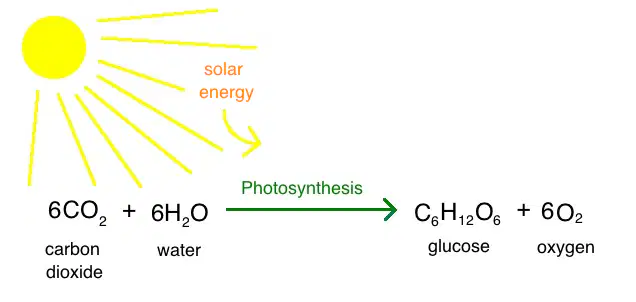
Photosynthesis is the process where plants convert light from the sun into the energy-rich molecule glucose.
When plants undergo photosynthesis, they transform _________ energy into ____________ energy.
a)
elastic, gravitational
b)
mechanical, thermal
c)
electromagnetic, chemical
d)
chemical, electrical
44.
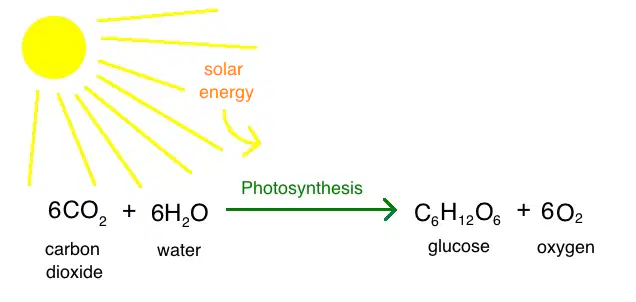
Photosynthesis is the process where plants convert light from the sun into the energy-rich molecule glucose.
When plants undergo photosynthesis, they transform _________ energy into ____________ energy.
a)
kinetic, kinetic
b)
potential, kinetic
c)
kinetic, potential
45.
The law of conservation of energy states that energy cannot be created or ____________________________________________
a)
destroyed, only transformed
b)
transformed, only destroyed
46.

Which of the following statements about the image below is true?
a)
The total energy changes because the potential and kinetic energy are changing
b)
The total energy does not change because the energy is being converted between potential and kinetic
c)
The total energy does not change because the potential and kinetic energy are increasing
d)
The total energy changes because the kinetic and potential energy are decreasing
47.

If this were a real roller coaster with NO extra energy input after point A, the roller coaster would not be able to make it beyond point F. Why not?
a)
Potential energy would begin to decrease after point H.
b)
The mass of the roller coaster has grown too large.
c)
Some energy is lost as heat due to friction.
d)
Some of the energy has been destroyed due to friction.
48.

Which point shows potential energy being converted into kinetic energy?
a)
Point F
b)
Point E
c)
Point H
d)
Point B
49.

Which point shows kinetic energy being converted into potential energy?
a)
Point A
b)
Point C
c)
Point H
d)
Point B
50.

Which point shows minimum potential energy?
a)
Point D
b)
Point C
c)
Point F
d)
Point B
51.

Which point shows minimum kinetic energy?
a)
Point G
b)
Point C
c)
Point F
d)
Point B
52.

At what point does the pendulum have the greatest kinetic energy?
a)
Anywhere, because the energy is conserved
b)
At the bottom of the swing
c)
At the top of the swing
d)
When it isn't moving
53.
When calculating for potential or kinetic energy, the unit for the mass value must always be what?
a)
in grams
b)
in kilograms
c)
in ounces
d)
in pounds
54.
What is the metric unit for velocity?
a)
kg
b)
m/s^2
c)
m/s
d)
J
e)
m
55.
What is unit for gravity?
a)
kg
b)
m/s^2
c)
m/s
d)
J
e)
m
56.
In chemical potential energy, which statement is true?
a)
energy is found in the moving molecules and compounds
b)
energy is found in the compressed molecules and compounds
c)
energy is stored in the bonds of molecules and compounds
d)
energy is found in the nucleus of the atom
57.
In elastic potential energy, which statement is true?
a)
energy is found in the movement of the rubber band after its released
b)
energy is found in the compressed or stretched rubber band
c)
energy is found in the bonds of the molecules of the rubber band
d)
energy is found in the rubber band when it is placed on top of someone's head
58.
In electrical kinetic energy, which statement is true?
a)
energy is found in the movement of electrons through a wire
b)
energy is found in the compressed molecules and compounds
c)
energy is stored in the device that creates electricity (battery)
d)
energy is stored in the bonds between atoms
59.
In thermal energy, which statement is true?
a)
atoms and molecules that move slowly have high thermal energy
b)
atoms and molecules that move quickly have low thermal energy
c)
atoms and molecules that move quickly have high thermal energy
d)
atoms and molecules that do not move have the highest thermal energy
60.
You are driving down the road at 45 miles per hour. You decide to take your foot off the gas and see what happens. Eventually, the car comes to a stop without applying any brakes. Why did this happen?
a)
The kinetic energy of the car was destroyed due to friction
b)
The kinetic energy of the car was transformed into potential energy due to friction
c)
The kinetic energy of the car remained constant until the car stopped due to friction
d)
The kinetic energy of the car was transformed into heat energy due to friction
61.
Which type of substance has high melting and boiling points due to strong bonds?
a)
ionic
b)
covalent
62.
Which type of substance is soft if it is a solid?
a)
ionic
b)
covalent
63.
Metals have more valence electrons than nonmetals
a)
True
b)
False
64.
The Lewis dot structure for Magnesium should have how many dots (valence electrons) around it?
a)
12
b)
2
c)
1
d)
6
65.
Metals form positive ions in reactions because they gain electrons in chemical reactions
a)
True
b)
False
66.
During a bond between Calcium and Oxygen, what would calcium do?
a)
Calcium would lose electrons
b)
Calcium would gain electrons
c)
Calcium would share electrons with oxygen
67.
True or False: Both ionic and covalent bonds result in atoms that have a full outer shell
a)
True
b)
False
68.
After ionic or covalent bonding, the atoms involved are
a)
more stable than before
b)
less stable than before
c)
equally as stable
69.
After ionic bonding, what would be the charge on a chlorine atom?
a)
+1
b)
17
c)
-1
d)
18
70.
Nonmetals form negative ions because they gain electrons in chemical reactions.
a)
True
b)
False
71.
The Lewis dot structure for Phosphorus should have how many dots (valence electrons) around it?
a)
15
b)
5
c)
4
d)
3
72.
What type of bond forms between Hydrogen and Oxygen in water? (H2O)
a)
Chemical
b)
Physical
c)
Ionic
d)
Covalent
e)
Metallic
73.
During ionic bonding:
a)
Metal elements give electrons to nonmetal elements
b)
Metal elements take electrons donated by nonmetals
c)
Metal elements share electrons
d)
Nonmetal elements share electrons
74.
During covalent bonding:
a)
Metal elements give electrons to nonmetal elements
b)
Metal elements share electrons
c)
Nonmetal elements share electrons
d)
Metal elements share electrons with nonmetal elements
75.
During covalent bonding, a metal atom becomes a cation by donating an electron to a nonmetal.
a)
True
b)
False
76.
In a chemical reaction, an atom becomes an anion because ___________
a)
it accepts electrons
b)
it gives away electrons
c)
it shares electrons
d)
it becomes positive
77.
Which of the following elements would become an anion in a chemical reaction?
a)
sodium
b)
lithium
c)
potassium
d)
oxygen
78.
True or False:
A compound formed between Potassium (K) and Selenium (Se) would have covalent bonds.
a)
True
b)
False
79.

What type of bonding is shown below?
a)
ionic
b)
covalent
80.

What type of bonding is shown below?
a)
ionic
b)
covalent
81.
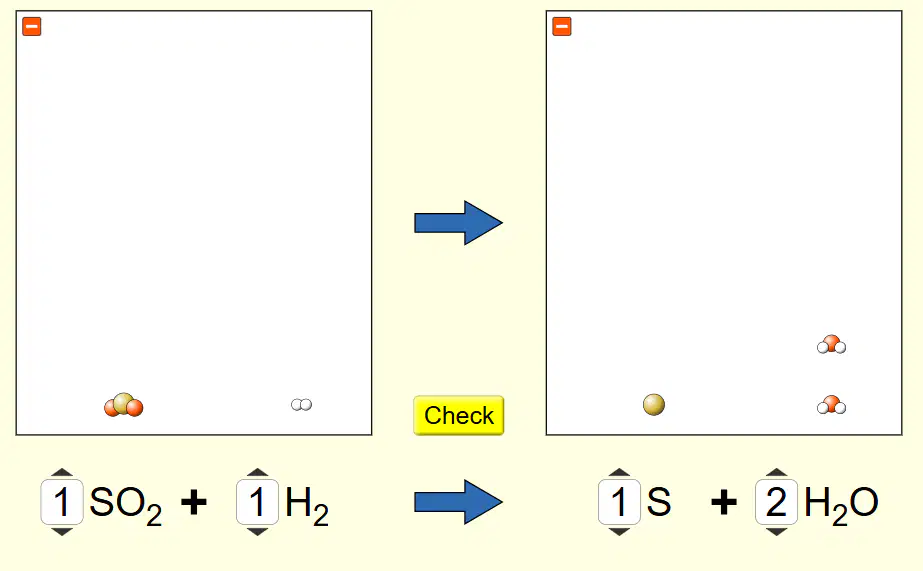
What needs to be added to the reaction below to make it balanced?
a)
Add 1 SO2 in the reactants
b)
Add 1 H2 in the reactants
c)
Add 1 S in the products
d)
Add 1 H2O in the products
82.
The Law of Conservation of Mass says that
a)
The number of reactant atoms must match the number of product atoms
b)
The number of reactant atoms is less than the number of product atoms
c)
The number of reactant atoms is greater than the number of product atoms
d)
The number of product atoms decreases after a reaction
83.
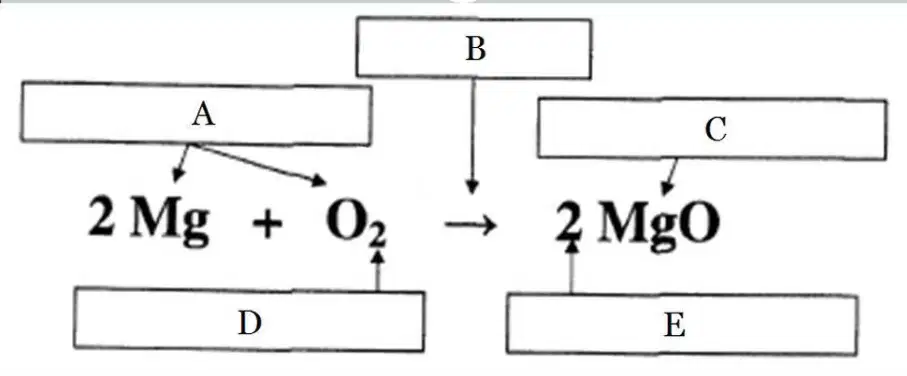
What does A show?
a)
reactants
b)
products
c)
coefficient
d)
subscript
84.
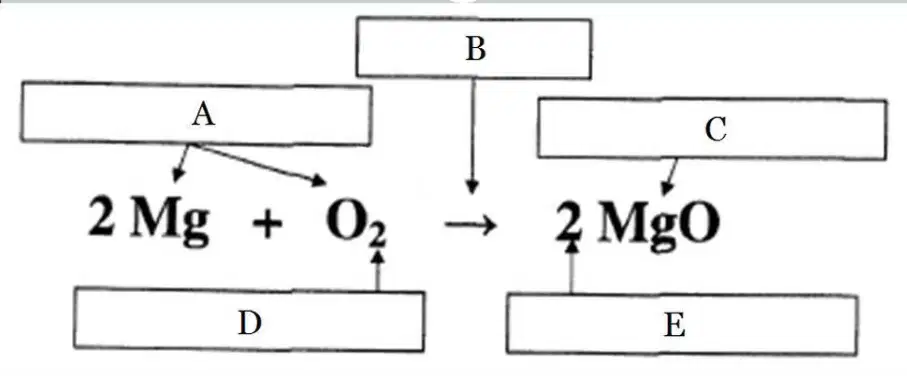
What does C show?
a)
reactants
b)
products
c)
coefficient
d)
subscript
85.
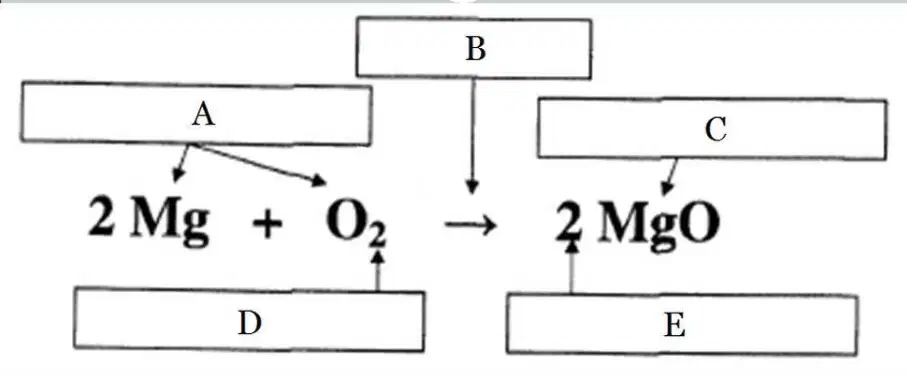
What does D show?
a)
reactants
b)
products
c)
coefficient
d)
subscript
86.
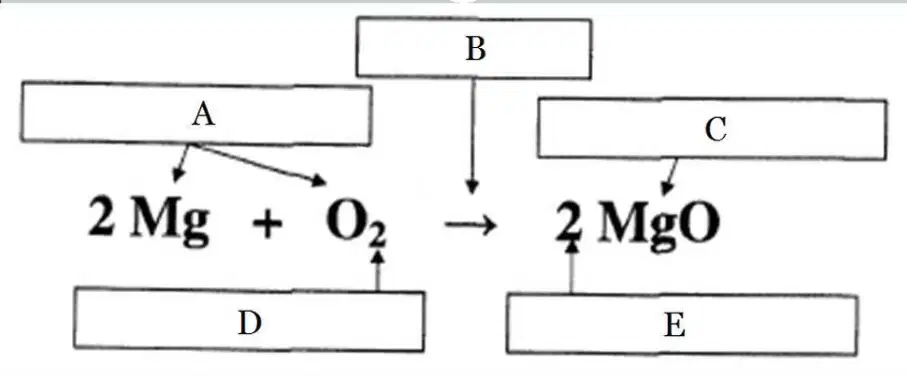
What does E show?
a)
reactants
b)
products
c)
coefficient
d)
subscript
87.
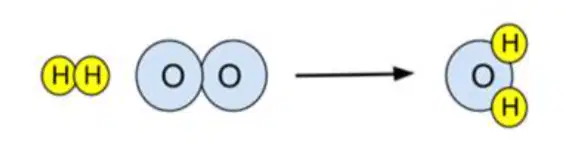
Is this a balanced chemical equation?
a)
Yes
b)
No
88.
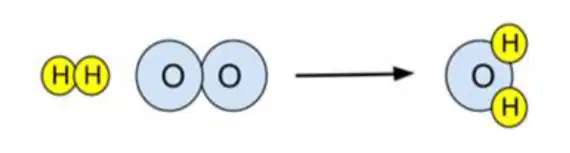
Select the statement that is true
a)
The number of reactant hydrogens is the same as the number of product oxygens
b)
The number of reactant hydrogens is not the same as the number of product hydrogens
c)
The number of reactant oxygens is not the same as the number of product oxygens
d)
The number of reactant oxygens is the same as the number of product oxygens
89.
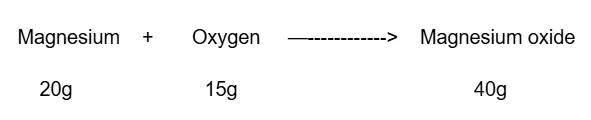
Based on the image below, which option is true?
a)
The mass of the reactants are equal to the mass of the products
b)
The reaction follows the law of conservation of mass because there is more product than reactant
c)
The reaction does not follow the law of conservation of mass because there is more mass in the product than reactants.
d)
The mass of the product is greater because energy has been captured in the reaction.
90.
What type of reaction is this?
Na + Cl ------> NaCl
a)
Synthesis
b)
Decomposition
c)
Combustion
d)
Single Replacement
91.

What type of reaction is this?
CH4 + 02 ---------> CO2 + H20
a)
Synthesis
b)
Decomposition
c)
Combustion
d)
Single Replacement
92.
The substances that are made in a reaction
a)
reactants
b)
products
c)
coefficient
d)
subscript
93.
Substances present at the start of a chemical reaction
a)
reactants
b)
products
c)
coefficient
d)
subscript
94.
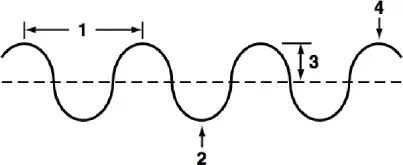
Which of the following has the parts of a wave labeled correctly?
a)
1 - crest
2 - trough
3 - wavelength
4 - amplitude
b)
1 - crest
2 - trough
3 - amplitude
4 - wavelength
c)
1 - wavelength
2 - trough
3 - crest
4 - amplitude
d)
1 - wavelength
2 - trough
3 - amplitude
4 - crest
95.
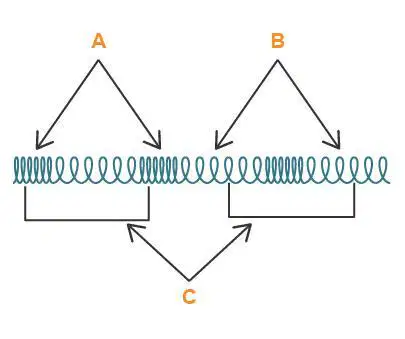
Which of the following has the correct labels for this wave?
a)
a - rarefaction
b - compression
c - wavelength
b)
a - wavelength
b - compression
c - rarefaction
c)
a - compression
b - rarefaction
c - wavelength
100 %

