
 Worksheets
Review Conservation of Atoms and Equilibrium
Total questions: 92
Worksheet time: 6hrs 30mins
Number placed in front of a chemical formula that tells how many molecules are present.
product
coefficient
reactant
subscript
Substances that form as the result of a chemical reaction found on the right hand side of the chemical equation
products
reactants
coefficients
subscripts
How many iron (Fe) atoms are in
FeNO3
1
2
3
6
How many oxygen atoms are in
FeNO3
1
2
3
6
Where do we see carbon in the following chemical reaction? (Choose all that apply)
Where do we see oxygen in the following chemical reaction? (Choose all that apply)
MgCl2 --> Mg4+ Cl2
PCl5+_ H2O→_ HCl+H3PO4
For the following chemical reaction, which substance is a reactant?
2HBr + Mg(OH)2 → MgBr2 +2H2O
MgBr2
Br
Mg
HBr
How many oxygen atoms do I have in the following compound?
2(NH4)3PO4
4
6
8
24
What are the coefficients that would properly balance this equation?
__Ca + __H2O --> __Ca(OH)2 + __H2
2,1 --> 2,1
1,2 --> 1,1
1,2 --> 2,4
1,2 --> 2,1
What are the coefficients that would properly balance this equation?
__AgNO3 + __H2S --> __Ag2S+ __HNO3
2,1 --> 1,2
1,2 --> 1,1
1,2 --> 1,2
1,2 --> 2,1
What are the coefficients that would properly balance this equation?
__Al + __O2--> __Al2O3
4,1 --> 2
4,3 --> 4
3,4 --> 1
4,3 --> 2
Determine the coefficients to make the following equation balanced?
__N2 + __O2--> __NO
1, 1, 1
1, 1, 2
2, 2, 2
1, 2, 2
Balance the the following equation.
__Zn+__HCl -->__ZnCl2 +__H2
1,1,2,1
1,1,1,2
1,2,1,1
2,1,1,1
Al(NO3)3 + _ NaOH -> Al(OH)3 + 3 NaNO3

How many HCl molecules do you need to balance this equation?
2Mg + (a) HCl ---> 2MgCl2 + 2H2
Drag and drop the coefficients that balance this equation 2 Fe + (a) Cl2 ----> (b) FeCl3
Balance this equation. _CF4 + _Br2 → _CBr4 + _F2
3,1,2,1
1,2,1,2
2,2,2,2
12CO2 +H2O --> C6H12O6 + O2
CO2 + 9H2O --> C6H12O6 + O2
CO2 + H2O --> 3C6H12O6 + O2
6CO2 + 6H2O --> C6H12O6 + 6O2
What's unbalanced about this equation?
Al + O2 --> Al2O3
Oxygen (O) only
Aluminum (Al) only
Both oxygen and aluminum
Nothing; it is balanced.
Determine the coefficients to balance the equation.
__Al +__HCl --> __H2 +__AlCl3
2,6,3,2
it's already balanced
4,12,3,4
2,1,4,5
4Fe + 3O2 --> 2Fe2O3
Balance the equation.
__Mg + __Cl2 --> __MgCl2
1, 2,1
already balanced
2,1,1
1,1,2
How many Hydrogen atoms are in 4H2O?
6
8
2
4
How many Nitrogen atoms are in (NH₄)₂CrO₄?
1
2
8
6
A subscript is the small number below the element symbol that tells the number of _______ of that element.
atoms
valence electrons
protons
elements
Balance this equation:
HgO ---> Hg + O2
It is balanced.
2HgO ---> 2Hg + O2
2HgO ---> Hg + O2
HgO ---> Hg + 2O2
P4+O2 --> P2O3
P4 + O2 --> P4O2
2 Na+ _ Cl2 -> 2 NaCl
Al(NO3)3 + _ NaOH -> Al(OH)3 + 3 NaNO3
4Ca(OH)2


What physical state symbol should be included for carbon dioxide?
(s) - solid
(l) - liquid
(g) - gas
(aq) - aqueous
What physical state symbol should be included for oxygen?
(s) - solid
(l) - liquid
(g) - gas
(aq) - aqueous
3Cr(MnO4)6
Balance the following equation:
___ SeCl6+ ___ O2→___ SeO2+____Cl2
1, 1, 1, 3
2, 1, 2, 1
1, 2, 1, 2
2, 2, 2, 4
_N2 + _H2 --> _NH3
Which equation is balanced?
PbO2 + 2H2
SO2 + H20 --> H2SO4
2Na + 2H2O --> 2NaOH + H2

2SO2(g)+O2(g) ⇌ 2SO3(g) + Heat
Increasing the temperature will...
shift equilibrium right
shift equilibrium left
increase pressure
have no change
2SO2(g)+O2(g) ⇌ 2SO3(g) + Heat
Adding SO3(g) will
shift equilibrium right
shift equilibrium left
increase K
have no change
2SO2(g)+1O2(g) ⇌ 2SO3(g) + Heat
Increasing the pressure on the system will...
shift equilibrium right
shift equilibrium left
slow rate of reaction
have no change

CoCI42- +6H2O →Co(H2O)62+ + 4CI-.
What would happen when H2O is added?
Position of equilibrium will shift to left (and become more blue)
Position of equilibrium will shift to right (and become more pink)
Keq will increase as H2O is added
Position of equilibrium will shift to left to reduce the added H2O

1N2 + 3H2 →2NH3
When the pressure on the system is increased, the equilibrium position shifts to the right. Why?
To increase the amount of products
To reduce the pressure, as the right side has fewer molecules of gas
Keq will increase when it is shifted to the right
To increase the pressure, as the right side has more molecules of gas
CoCI42- +6H2O →Co(H2O)62+ + 4CI-
What will happen when CI- ions are added?
Position of equilibrium will shift to left and become more pink
Color of system will turn to all pink
Concentration of reactants and products remain unchanged
Position of equilibrium will shift to left to reduce the added CI- ions

Heat + 1 N2O4 → 2 NO2
What will happen when the temperature is increased?
Position of equilibrium will shift to left and become lighter in color
Position of equilibrium will shift to right and become more brown
No change in position of equilibrium
Position of equilibrium will shift to right and become lighter in color
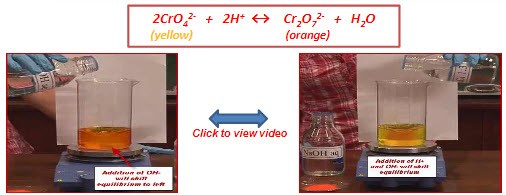
2CrO42- + 2H+→Cr2O72- + H2O
What will happen when OH- ions are added to the system? HINT: They remove the H+ ions.
Position of equilibrium will shift to right and become more orange
Position of equilibrium will shift to left and become more yellow
Position of equilibrium will shift to right and become more yellow
OH- ions will not react, and thus no change is seen.
2SO2(g)+O2(g) ⇌ 2SO3(g) + Heat
Adding SO2(g) will
shift equilibrium right
shift equilibrium left
increase rate of reaction
have no change
2SO2(g) + O2(g) ⇌ 2SO3(g) + Heat
Removing O2(g) will
shift equilibrium right
shift equilibrium left
increase pressure
have no change
2SO2(g)+1O2(g) ⇌ 2SO3(g) + Heat
Increasing the volume of the container will...
shift equilibrium right
shift equilibrium left
slow rate of reaction
have no change

What happens to the equilibrium if we remove water (H2O)?
It shifts left, towards the reactants
It shifts right, towards the products
It does not shift
What happens to the equilibrium if we add hydrogen (H2)?
It shifts left, towards the reactants
It shifts right, towards the products
It does not shift

What happens when sodium ions (Na+) are added?
The reaction shifts left, towards the reactants
The reaction shifts right, towards the products
There is no shift
What is the effect of increasing concentration of a reactant on equilibrium?
It shifts the equilibrium to the left, favoring the formation of reactants.
It has no effect on the equilibrium position.
It shifts the equilibrium to the right, favoring the formation of products.
It causes the equilibrium to become unstable.
What is the effect of adding a catalyst to a reaction at equilibrium?
It changes the position of equilibrium favoring the products.
It slows down the reaction rate of both forward and reverse reactions.
It speeds up the rate of both the forward and reverse reactions equally, but does not change the position of equilibrium.
It only affects the forward reaction, increasing its rate.
How does increasing temperature affect an exothermic reaction at equilibrium?
Increasing temperature shifts the equilibrium to the right, favoring the products.
Increasing temperature shifts the equilibrium to the left, favoring the reactants.
Increasing temperature has no effect on the equilibrium position.
Increasing temperature increases the rate of the reaction without affecting equilibrium.
What is the effect of adding OH- ions to a reaction that produces H+ ions?
Adding OH- ions will shift the equilibrium to the right, favoring the formation of products, as it removes H+ ions.
Adding OH- ions will shift the equilibrium to the left, favoring the formation of reactants, as it increases H+ ions.
Adding OH- ions will have no effect on the equilibrium position of the reaction.
Adding OH- ions will increase the concentration of H+ ions, thus shifting the equilibrium to the right.
What happens to equilibrium when a product is added?
The position of equilibrium shifts to the left, favoring the formation of reactants.
The position of equilibrium shifts to the right, favoring the formation of products.
The position of equilibrium remains unchanged.
The position of equilibrium shifts to the left, favoring the formation of both reactants and products equally.
What happens to equilibrium when a reactant is added?
The position of equilibrium shifts to the right, favoring the formation of products.
The position of equilibrium shifts to the left, favoring the formation of reactants.
The position of equilibrium remains unchanged.
The position of equilibrium shifts to the right, but does not favor any side.
What is the effect of decreasing concentration of a product on equilibrium?
It shifts the equilibrium to the left, favoring the formation of reactants.
It has no effect on the equilibrium position.
It shifts the equilibrium to the right, favoring the formation of products.
It causes the equilibrium to become static.
What happens to the equilibrium if we add methane (CH4)?
It shifts left, towards the reactants
It shifts right, towards the products
It does not shift
What happens to the equilibrium if we remove heat?
It shifts left, towards the reactants
It shifts right, towards the products
It does not shift
What happens to the equilibrium if we remove carbon monoxide (CO)?
It shifts left, towards the reactants
It shifts right, towards the products
It does not shift
Which of the following statements is false about a system in equilibrium?
The concentration of reactants and products may differ
The rates of the forward and reverse reactions may differ
The rates of the forward and reverse reactions must be equivalent
180.18 g/mol
180.12 g/mol
180.24 g/mol
180.06 g/mol
Fe2O3(s) + 3H2(g) → 2Fe(s) + 3H2O(l)
How many moles of iron can be made from 6 moles H2?
How many moles of hydrogen are needed to react with 2 moles of nitrogen?
6 mol H
2 mol H
3 mol H
1 mol H
How many moles of water can be produced if 8 moles H2 are used?
12.00 moles of NaClO3 will produce how many grams of O2?
What mass of O2 will be needed to burn 36.1 g of B2H6?
How many grams of aluminum sulfate would be formed if 250g H2SO4 completely reacted with aluminum?
how many grams of Ca(OH)₂ would be formed with 3.20 moles of CaC₂?
4NH3(g) + 5O2(g) --> 4NO(g) + 6H2O(l)
How many grams of oxygen gas are needed to react with 56.8 grams of ammonia?
How many grams of hydrogen are produced if 120 g of Na are available?
I need to add 8 moles of Carbon to the reaction. How many grams of Carbon should I weigh?
How many grams of potassium chloride can be produced from 356 g of chlorine and 356 g of potassium bromide?
How many moles of carbon dioxide are produced from the combustion of 110 g of CH4?
In the experiment above, 7.62 g of Fe are allowed to react with 8.67 g of S.
How much FeS is formed?

