wayground logo

Free Printable Worksheets

Font size

S
M
L
XL
Worksheets

Central Dogma Review

Total questions: 110

Worksheet time: 1hrs 21mins

Name
Class
Date
1.

Which Nucleotide matches to Cytosine?

a)

Guanine

b)

Adenine

c)

Uracil

d)

Thymine

2.

A codon consists of ___ nucleotides?

a)

2

b)

3

c)

4

d)

5

3.

This is the process by which double stranded DNA produces single stranded RNA:

a)

Photosynthesis

b)

Translation

c)

Pollination

d)

Transcription

4.

Proteins aren't made in the nucleus because they are too big to escape the ______________:

a)

Nuclear Membrane

b)

Cell Membrane

5.

This organelle is crucial for the translation process:

a)

Mitochondria

b)

Ribosome

c)

Gogli Apparatus

d)

Vacuole

6.

The start codon is _______:

a)

AUG

b)

GGG

c)

UCG

d)

AAU

7.

The DNA sequence UAGCGAUUACGU is part of a gene. How many amino acids are coded for by this sequence?

a)

20

b)

4

c)

8

d)

12

8.
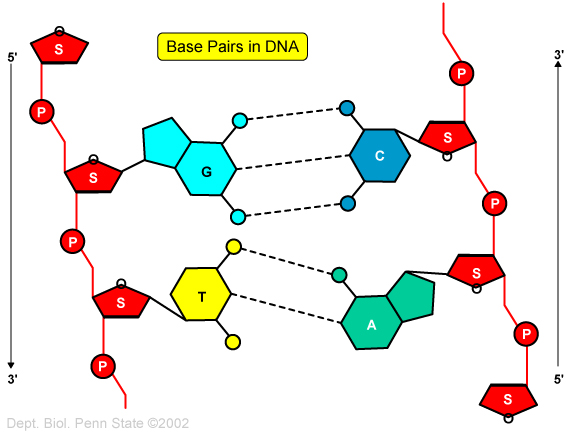
A molecule of DNA is made up of _________.
a)
amino acids and proteins
b)
ATP and enzymes
c)
paired nucleotides
d)
receptor enzymes
9.
Which do DNA and RNA have in common?
a)
Both are double stranded.
b)
Both contain ribose molecules.
c)
Both contain phosphate groups.
d)
Both contain uracil.
10.
If the structure of DNA were likened to a ladder, what would make up the “supporting structure” (not the “rungs”) of the ladder?
a)
amino acids and sugars
b)
nucleotide bases, including thymine
c)
nucleotide bases, including uracil
d)
sugar-phosphate molecules
11.
What process is shown in the illustration below?
a)
commensalism
b)
deletion
c)
passive transport
d)
replication
12.
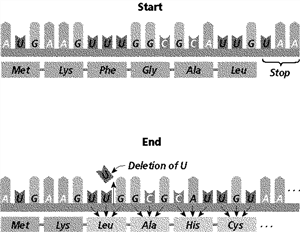
What type of mutation has occurred in Figure 12-3?
a)
substitution
b)
frameshift
c)
lethal
d)
insertion
13.
What is the complimentary mRNA sequence to the DNA sequence A-T-T-G-C-A.
a)
T-A-A-C-G-T
b)
U-A-A-C-G-T
c)
U-A-A-C-G-U
d)
T-A-A-G-C-U
14.
What mutation has occurred here? 
T-G-A-C-C-A
T-G-A-G-C-A
a)
Substitution
b)
Deletion
c)
Insertion
d)
Frameshift 
15.
Are all mutations bad?
a)
Yes
b)
No
16.
Any change in the sequence of DNA is...
a)
transgenic shift
b)
Single Genotype
c)
Monohybrid Trait
d)
Mutation
17.
Which organelle is DNA usually found in?
a)
cell membrane
b)
vacuole
c)
chloroplast
d)
nucleus
18.
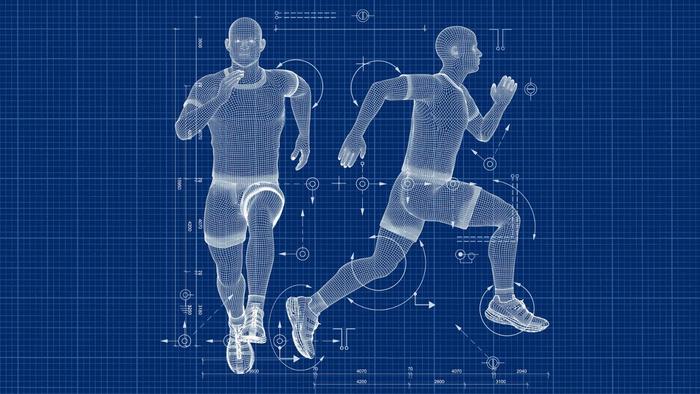
DNA is often considered the "______________" of life.
a)
Blueprint
b)
Mistake
c)
Swimming Pool
d)
Smelly Cheese
19.
What are the building blocks of proteins called?
a)
DNA
b)
RNA
c)
Ribosomes
d)
Amino Acids
20.
DNA has a ______ strand; RNA has a ______ strand.
a)
double/double
b)
double/triple
c)
double/single
d)
single/single
21.
In RNA, the nitrogen base____ replaces ____ that was present in DNA. 
a)
A, U (adenine, uracil)
b)
C, G (cytosine, guanine)
c)
U, T (uracil, thymine)
d)
U, A (uracil, adenine)
22.
The "central dogma" states that genetic information flows from 
a)
Protein-->mRNA-->DNA
b)
Protein-->DNA-->mRNA
c)
mRNA-->DNA-->Protein
d)
DNA-->mRNA-->Protein
23.
Transcription takes place in the 
a)
cytoplasm
b)
ribosome
c)
mitochondrion
d)
nucleus
24.
Translation occurs in the
a)
nucleus
b)
mitochondria
c)
cytoplasm
d)
golgi apparatus
25.
Assembles RNA during transcription
a)
RNA Polymerase 
b)
Mutations
c)
Gene Expression
d)
Point Mutation
26.
What was Watson and Crick's main scientific accomplishment?
a)

Building the first accurate model of DNA

b)

Isolating strains of pneumonia causing bacteria

c)

Determining base pairing rules

d)

Discovering the process of genetic transformation

27.
Who is responsible for producing this image?
a)

Francis Crick

b)

James Watson

c)

Rosalind Franklin

d)

Watson and Crick

28.

Which of these are the correct way for "bases" to pair in DNA?

a)

A-T and C-G

b)

A-C and T-G

c)

A-G and T-C

d)

A-A, T-T, C-C, G-G

29.

In a DNA molecule, 31% of the bases are Adenine. What % would be Thymine?

a)

38%

b)

19%

c)

31%

d)

68%

30.

Which of the following units are repeatedly joined together to form a strand of DNA?

a)

Amino Acids

b)

Nucleotides

c)

Fatty Acids

d)

Polysaccharides

31.

The process of DNA replication is called semi conservative because it results in

a)

none of these

b)

Two DNA molecules.  One original molecule and one with two new strands

c)

two exact copies with new strands

d)

two DNA molecules, each with 1 original strand and one new.

32.

The enzyme used to separate the double helix into 2 single strands is:

a)

Nuclease

b)

Primase

c)

Helicase

d)

DNA polymerase III

33.

In a molecule of double-stranded DNA, the amount of Adenine present is always equal to the amount of

a)

Cytosine

b)

Guanine

c)

Thymine

d)

Uracil

34.

Which enzyme joins together Okazaki fragments?

a)

DNA pol I

b)

Helicase

c)

Ligase

d)

Primase

35.

The DNA sequence of the parent strand is 5'-ATGCTCAGCT-3'. What is the sequence of the daughter strand?

a)

3'-UACGAGUCGA-5'

b)

5'-UACGAGUCGA-3'

c)

3'-TACGAGTCGA-5'

d)

5'-TACGAGTCGA-3'

36.

Why would it be important to replicate DNA before a cell divides in mitosis or meiosis?

a)

In order for the DNA to be contained in the nucleus.

b)

In order for the cell to re-order the DNA sequencing in the new cells.

c)

In order for the cell to be able to increase in size.

d)

In order for genetic information to be transferred into daughter cells.

37.
How would the DNA sequence GCTATA be transcribed to mRNA?
a)

GCUAUA

b)

CGATAT

c)

CGAUAU

d)

GCUTUT

38.
The process by which the genetic code of DNA is copied into a strand of RNA is called
a)

translation

b)

transcription

c)

transformation

d)

replication

39.

RNA has what base that is instead of thymine?

a)

guanine

b)

adenine

c)

thymine

d)

uracil

40.
What process is going on in this photo? 
a)

Transcription 

b)

Translation 

c)

Replication 

d)

All the above 

41.
Translation is the process where.....
a)

mRNA is created in the Nucleus

b)

mRNA is decoded to form a protein 

c)

glucose molecules are made

d)

is where lipids are synthesised

42.
The main function of tRNA is to.......
a)

carry a message that, when translated, forms proteins

b)

form a portion of ribosomes

c)

string together complementary RNA and DNA strands

d)

bring amino acids from the cytoplasm to the ribosomes

43.

How many nucleotides code for 1 amino acid?

a)

1

b)

2

c)

3

d)

4

44.

Match the following to where they occur

a)

nucleus

1.

transcription

b)

cytoplasm

2.

translation

c)

nuclear pore

3.

mRNA leaves through

45.
The anticodon of a particular tRNA molecule is 
a)
complementary to the corresponding mRNA codon.
b)
complementary to the corresponding triplet in rRNA.
c)
the part of tRNA that bonds with a specific amino acid.
d)
catalytic, making the tRNA a ribozyme.
46.

When an extra base is inserted into the DNA sequence of a gene, the protein doesn't work. Which explains why?

a)

the base increases rate of translation

b)

the base causes DNA to be transcribed in opposite direction

c)

the inserted base causes the codons in the sequence to be shifted and read differently

d)

the base signals enzymes to translate DNA rather than RNA

47.
The anticodon is located on 
a)
DNA
b)
mRNA
c)
tRNA
d)
rRNA
48.

In RNA, Uracil pairs with ______.

a)

cytosine

b)

adenine

c)

guanine

d)

thymine

49.

DNA holds the code for

a)

lipids

b)

carbohydrates

c)

proteins

d)

sugars

50.

What process is going on in this photo?

a)

Transcription

b)

Translation

c)

Replication

d)

All the above

51.
Nitrogenous bases are joined by which type of bond?
a)
polar bonds
b)
ionic bonds
c)
covalent bonds
d)
hydrogen bonds
52.

What is the job of messenger RNA?

a)

to transfer amino acids

b)

to assemble the protein

c)

to carry genetic information

53.
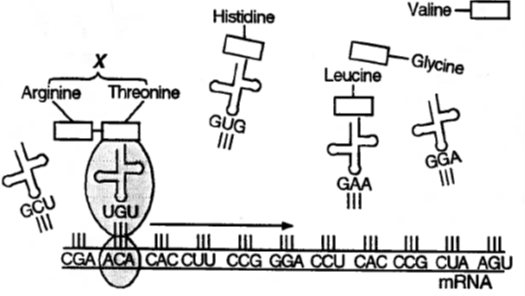
The diagram shows the process of
a)
Transcription
b)
Translation
c)
Replication
d)
Mitosis
54.

Which amino acid is coded C G G ?

a)

Arginine

b)

Proline

c)

Leucine

d)

Glycine

55.

Which amino acid is coded G A U ?

a)

Glutamic acid

b)

Proline

c)

Aspartic acid

d)

Glycine

56.

Which of the following is NOT a codon for serine?

a)

A G C

b)

U C U

c)

G U G

d)

A G U

57.

What is Chargaff's Rule?

a)

In DNA, there is always an equal quantity of the bases A and T and bases G and C.

b)

There are always a greater number of A's and T's in a strand of DNA compared to the number of G's and C's.

c)

In DNA, there is an equal quantity of C's and G's and the same number of A's and U's

58.

What is the function of the helicase enzyme?

a)

to join nucleotides to an open strand of DNA

b)

to add RNA nucleotides to a strand of RNA

c)

to unzip the original DNA along it's weak bonds

d)

to remove nucleotides from a strand of DNA

59.

Which of the following is the tRNA anticodon for the mRNA codon U G G?

a)

A G G

b)

G G U

c)

T C C

d)

A C C

60.

A codon is located on

a)

DNA

b)

mRNA

c)

tRNA

61.

When does DNA replication take place?

a)

During prophase

b)

During interphase

c)

During metaphase

d)

During anaphase

62.

What do you call a section of DNA that codes for a specific protein?

a)

Gene

b)

Enzyme

c)

Splice

d)

Triplet

63.

Which of the following is NOT a role of DNA?

a)

store information

b)

copy information

c)

transmit information

d)

delete information

64.

DNA nucleotides consist of three parts. Which of the following is NOT part of a DNA nucleotide?

a)

phosphate group

b)

5-carbon sugar

c)

nitrogenous base

d)

amino acids

65.

Match the following DNA nucleotides to their complimentary nucleotide:

a)

cytosine

1.

guanine

b)

adenine

2.

thymine

c)

guanine

3.

cytosine

d)

thymine

4.

adenine

66.
What are the building blocks of proteins called?
a)
DNA
b)
RNA
c)
Ribosomes
d)
Amino Acids
67.

Given the mRNA sequence - 3' AUG CAU GGU.5'. What is the original DNA template strand?

a)

5' TAC GTA CCA 3'

b)

5' UAC GUA CGA 3'

c)

3' UAC GUA CGA 5''

d)

3' TAC GTA CGA 5'

68.

Given the DNA strand: 3' TAC-TGT-GGT-TAA 5'. What is the amino acid sequence?

a)

Met-Thr-Pro-Ile

b)

Met-Pro-Thr-Ile

c)

Ile-Pro-Thr-Met

d)

Ile-Thr-Pro-Met

69.

What is this structure called

a)

Double Helix

b)

Double Felix

c)

Two Cats

d)

Single Strand

70.

Name this structure.

a)

Base

b)

Nucleotide

c)

Sugar

d)

DNA

71.

Name the bases of DNA.

a)

Guanine and Cytosine

b)

Adenine

c)

Adenine, Thymine, Guanine, Cytosine

d)

Adenine, Uracil, Guanine, Cytosine

72.

Name the bases of RNA.

a)

Guanine and Cytosine

b)

Adenine

c)

Adenine, Thymine, Guanine, Cytosine

d)

Adenine, Uracil, Guanine, Cytosine

73.

What protein is UCC

a)

Ser

b)

STOP

c)

Thr

d)

Tyr

74.
What is the relationship between a protein, the cell, and DNA?
a)
DNA is produced by protein which is produced in the cell
b)
Protein is composed of DNA which is produced in the cell
c)
DNA controls the production of protein in the cell
d)
A cell is composed of DNA and protein
75.
What is the sugar in RNA?
a)
glucose
b)
ribose
c)
fructose
d)
lactose
76.
The rule we have today that tells us how nitrogen bases pair together is called _____________ .
a)
Base Pairing Rule
b)
Charmander's Rule
c)
Chargaff's Rule
d)
Nucleic Acid Rule
77.

A polypeptide is a sequence of:

a)

proteins

b)

base nucleotides

c)

amino acids

d)

monosaccharides

78.

Which organelle is the site where translation occurs?

a)

ribosomes

b)

tRNA

c)

mRNA

d)

lysosomes

79.
What is a peptide bond?
a)
Bond that holds two amino acids together.
b)
A bond that holds hydrogen and oxygen molecules together.
c)
A bond that holds the phosphate group of one nucleotide and a sugar of a neighboring nucleotide.
d)
A bond that is formed by the sharing of electrons.
80.
Which of the following sequences of processes correctly reflects the central dogma?
a)
protein synthesis, transcription, translation
b)
protein synthesis, translation, transcription
c)
transcription, translation, protein synthesis
d)
translation, transcription, protein synthesis
81.

What will be the result of this deletion mutation?

a)

substitution

b)

frameshift mutation

c)

point mutation

d)

insertion

82.
Which defines a codon in DNA or mRNA?
a)
pair of nucleic acid and sugar
b)
pair of phosphate and sugar
c)
three-base code
d)
two-base code
83.
What mutation has occurred here? 
T-G-A-C-C-A
T-G-A-G-C-A
a)
Substitution
b)
Deletion
c)
Insertion
d)
Frameshift 
84.
Any change in the sequence of DNA is...
a)
transgenic shift
b)
Single Genotype
c)
Monohybrid Trait
d)
Mutation
85.
Which organelle is DNA usually found in?
a)
cell membrane
b)
vacuole
c)
chloroplast
d)
nucleus
86.
DNA is often considered the "______________" of life.
a)
Blueprint
b)
Mistake
c)
Swimming Pool
d)
Smelly Cheese
87.
What are the building blocks of proteins called?
a)
DNA
b)
RNA
c)
Ribosomes
d)
Amino Acids
88.
In RNA, the nitrogen base____ replaces ____ that was present in DNA. 
a)
A, U (adenine, uracil)
b)
C, G (cytosine, guanine)
c)
U, T (uracil, thymine)
d)
U, A (uracil, adenine)
89.
Transcription takes place in the 
a)
cytoplasm
b)
ribosome
c)
mitochondrion
d)
nucleus
90.
Translation occurs in the
a)
nucleus
b)
mitochondria
c)
cytoplasm
d)
golgi apparatus
91.

At which organelle does translation occur?

a)

Nucleus

b)

Ribosome

c)

Mitochondria

d)

Golgi apparatus

92.

What role does the mRNA play in protein synthesis?

a)

mRNA modifies the original DNA strand

b)

mRNA mutates to form protein

c)

mRNA is the transcribed message from a DNA sequence

d)

mRNA moves the amino acids

93.

What does rRNA represent?

a)

Ribosomal RNA

b)

Reconstructed RNA

c)

Reactive RNA

d)

Reusable RNA

94.

What is the role of tRNA?

a)

To treat the DNA strand

b)

To transfer codons

c)

To transfer amino acids

d)

To tackle mutations

95.

What is recombinant DNA

a)

DNA from 2 different organisms combined

b)

DNA from 2 different ribosomes

c)

DNA that is separated out from a vector

96.

In which ways can genetic engineering improve crops

a)

Make them pest or drought resistant

b)

Make them more nutritious

c)

Make them larger

d)

All answers are correct

97.
How does RNA differ from DNA?
a)
RNA contains uracil and deoxyribose
b)
RNA contains ribose and thymine
c)
RNA contains uracil and ribose
d)
RNA contains adenine and ribose
98.
How would the DNA sequence GCTATA be transcribed to mRNA?
a)
GCUAUA
b)
CGATAT
c)
CGAUAU
d)
GCUTUT
99.
The process by which the genetic code of DNA is copied into a strand of RNA is called
a)
translation
b)
transcription
c)
transformation
d)
replication
100.
Which phase of which process does this picture show?
a)
Transcription
b)
Translation
c)
Replication
d)
Cloning
101.
Normal-
GAG-CTC-GAC-AGA
Mutant
GAG CTC-CAC-AGA
a)
no mutation
b)
substitution
c)
insertion
d)
deletion
102.
What are the three types of mutation? 
a)
Insertion, Deletion, Subsitution
b)
Deletion, Newstion, Subsitution 
c)
Newstion, Deletion, Insertion 
d)
Insertion, Newstion, Substitution 
103.
DNA molecule segment is : TTACGCAAG
The mutated DNA segment is TTCGCAAG. This is an example of ___ mutation.
a)
Substitution
b)
Deletion
c)
Insertion
d)
Inversion
104.
Any change in the sequence of DNA is...
a)
transgenic shift
b)
Single Genotype
c)
Monohybrid Trait
d)
Mutation
105.
Where do mutations occur?
a)
DNA and RNA
b)
DNA 
c)
RNA
d)
mRNA and tRNA
106.
Why are insertion and deletion mutations so harmful?
a)
They change all of the codons from the mutation on down the line, which changes the amino acid sequence
b)
They insert things that an organism doesn't need.
c)
They often delete things that organisms need.
d)
Insertion and deletions are not any more harmful than substitution mutations.
107.
Are all mutations bad?
a)
Yes
b)
No
108.

In this type of point mutation, one base pair is lost

a)

substitution

b)

insertion

c)

deletion

d)

translocation

109.

In this type of point mutation, one extra base pair is inserted into a sequence of DNA

a)

substitution

b)

insertion

c)

deletion

d)

translocation

110.
What is a Codon?
a)
An enzyme that breaks down lactose in dairy foods
b)
A type of snake that dances to flute music
c)
A group of 3 nucleotides that code for an amino acid
d)
A type of hormone that carries oxygen in blood cells
e)
A huge section of DNA