wayground logo

Free Printable Worksheets

Font size

S
M
L
XL
Worksheets

Final Exam Review 2025

Total questions: 105

Worksheet time: 3hrs 32mins

Name
Class
Date
1.

What is the length of the screw in centimeters (cm)?

a)

5 cm

b)

6 cm

c)

5 mm

d)

6 m

2.
Select the temperature in °C
a)

12°C

b)
10°C
c)
20°C
d)

54°C

3.

What is the volume of the ring? (new volume - old volume)

a)

64 mL

b)

68 mL

c)

8 mL

d)

4 mL

4.

What do you call a substance that is known as the building blocks of all matter? (Hint - the substance is made of one kind of atom).

a)

element

b)

atom

c)

compound

d)

mixture

5.

What do you call matter made of two or more elements that are chemically bonded (cannot be separated by physical means)?

a)

compound

b)

atom

c)

element

d)

mass

6.

What is the atomic mass of Neon?

a)

10

b)

20.18

c)

2-8

d)

30.18

7.
How many protons are in Beryllium?
a)
4
b)
9
c)
5
d)
2
8.
How many neutrons are in a Gold atom?
a)
79
b)

197

c)
118
d)

394

9.

What is at the center of every atom?

a)

An electron

b)

A compound

c)

A molecule

d)

A nucleus

10.
Which two particles make up the nucleus of an atom?
a)
Protons and Electrons
b)
Protons and Neutrons
c)
Molecules and Compounds
d)
Neutrons and Electrons
11.
What is the role of an electron in an atom?
a)
Electrons live inside the nucleus and carry a neutral charge.
b)
Electrons circle the nucleus and have a positive charge.
c)
Electrons circle the nucleus and have a negative charge.
d)
Electrons live inside the nucleus and have a negative charge.
12.
In an atom, what is the number of protons equal to?
a)
The number of electrons.
b)
The number of neutrons.
c)
The number of molecules.
d)
The number of nuclei.
13.

What is a compound?

a)

The center of an atom that is formed by neutrons, protons, and electrons.

b)

A tiny particle that makes up all matter.

c)

A molecule that is formed from two or more different types atoms.

d)

A molecule that is formed from the same type of atoms.

14.
A proton is a _____ charged particle.
a)
Negatively
b)
Positively
15.
An electron is a _____ charged particle.
a)
Positively
b)
Negatively
16.
What is an atomic number?
a)
The sum of protons and neutrons in an atom.
b)
The sum of protons and electrons in an atom.
c)
The number of protons in an atom of a specific element.
d)
The number of neutrons in a specific element.
17.

The number of neutrons equals...

a)

atomic number - mass number

b)

Protons - neutrons

c)

Electrons - protons

d)

mass number - atomic number

18.

What charge does a neutron have?

a)

positive

b)

negative

c)

neutral

19.
Where are protons located in the atom?
a)

They move around

b)

nucleus

c)

rings

d)

positive

20.

The number of protons plus neutrons.

a)

Atomic Mass

b)

Mass Weight

c)

Atomic number

d)

Atomic weight

21.

Where are neutrons located in the atom?

a)

shells/orbitals

b)

rings

c)

nucleus

22.

All matter is made of

a)

energy

b)

atoms

c)

electrons

d)

compounds

23.

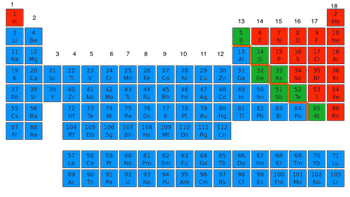
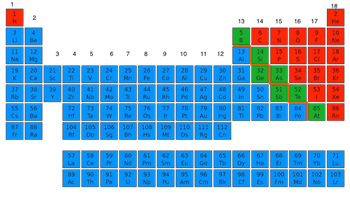
USE THE PERIODIC TABLE

How many valence electrons does carbon have?

a)

4

b)

12

c)

6

d)

14

24.

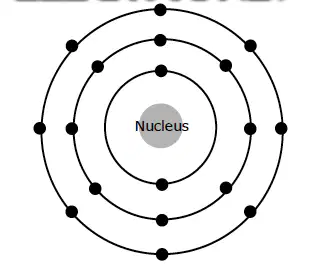
How many valence electrons are shown in the diagram?
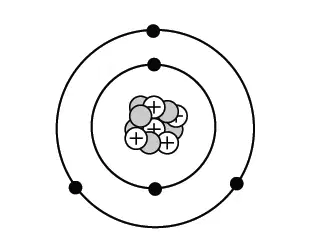
a)
7
b)
8
c)
9
d)
10
25.

How many valence electrons are shown in the diagram?

a)
2
b)
3
c)
5
26.

Identify the element in Period 5 that DOES NOT have 1 valence electron?

a)
Rb
b)
Nb
c)
Ag
d)
Sb
27.

Valence electrons are electrons in the shell

a)

furthest from the nucleus

b)

closest to the nucleus

c)

having the lowest energy level

d)

that has the fastest electrons

28.

Which of the following is false about covalent bonds?

a)

Forms by sharing electrons

b)

represented by overlapping orbits

c)

Represented by a line between atoms

d)

Forms by transferring electrons

29.

Elements that have atoms with stable valence electron configurations in the ground state are

a)

Group 1

b)

Group 2

c)

Group 17

d)

Group 18

30.

What are the elements in group 18 (the far right) of the periodic table called?

a)

Alkali metals

b)

Alkaline earth metals

c)

Halogens

d)

Noble gases

31.

What are the elements in group 17 of the periodic table called?

a)

Alkali metals

b)

Alkaline earth metals

c)

Halogens

d)

Noble gases

32.
Atoms are most stable when their outer shell is complete.
a)
true
b)
false
33.
How are covalent bonds formed?
a)
Sharing of electrons
b)
Transfer of electrons
34.
How are ionic bonds formed?
a)
Transfer of electrons
b)
Sharing of electrons
35.

Why do elements bond?

a)

To be friends

b)

To create a new element

c)

To become stable

d)

To become unstable

36.

Opposite charges _______________.

a)

avoid

b)

attract

c)

push

d)

repel

37.
Where are metals located on the periodic table?
a)
Blue
b)
Green
c)
Red
38.
Where are the nonmetals located on the periodic table? 
a)
Blue
b)
Red
c)
Green
39.
Is this equation balanced?
a)
yes
b)
no
c)
Not enough information
d)
Left side is balanced
40.
Which side of a chemical equation is the product side?
a)
Left (before the yields sign)
b)
Right (after the yields sign)
41.
What is a coefficient?
a)
The small number on the right of the chemical symbol.
b)
The large number to the left of a formula.
42.

Balance this equation

_Zn+_HCl-->_ZnCl2 +_H2

** Write out on scrap paper**

a)

1,1,2,1

b)

1,1,1,2

c)

1,2,1,1

d)

2,1,1,1

43.
The blue numbers in the image below represent ________
a)
Charges
b)
coefficients
c)
subscripts
d)
none of the answers are correct
44.
At the end of chemical reactions, what is the total mass of the reactants compared to the total mass of the products?
a)
the product is doubled
b)
the product is half the mass of the reactants
c)
the mass is the same
d)
the mass changes depending on the reaction
45.

Is this equation balanced or unbalanced?

N2 + H2 = NH4

** Write out on scrap paper**

a)

Balanced

b)

Unbalanced

46.
What does the Law of Conservation of Mass state?
a)
Matter cannot be gained or lost in a chemical reaction.
b)
Matter can only be lost in a chemical reaction.
c)
Matter can only be gained in a chemical reaction.
d)
Matter can be gained and lost in a chemical reaction. 
47.

When Ryan poured vinegar on baking soda, which of the following was a sign that a chemical change occurred?

a)

nothing happened

b)

it fizzed and produced gas

c)

it glowed

d)

its color became darker

48.

In genetics, heterozygous is when...

a)
the alleles are the same
b)
the alleles are different
c)
the alleles are absent
d)
the alleles are present
49.
T - tall and t = short
In the punnett square below, what belongs in the missing square
a)
tt
b)
Tt
c)
Bb
d)
TT
50.
AA and Aa always show up as
a)
dominant
b)
recessive
51.

Aa, DD, Bb, yy are all examples of

a)

genotypes

b)

phenotypes

52.
B = brown eyes
b = blue eyes
What is true about these two brothers that have brown eyes?
One has genotype BB the other Bb.
a)
they have same phenotype and genotype
b)
they have different genotypes and phenotypes
c)
they have same phenotype but different genotypes
d)
they have same genotype but different phenotypes
53.

What gender has an X and a Y chromosome?

a)

male

b)

female

c)

neither

54.
Each one of the boxes on the Punnett Square represents what probability of an offsprings' genotype?
a)
25%
b)
1%
c)
10%
d)
0%
55.
Black fur is dominant (B) over white fur (b).  Find the probability of heterozygous offspring using the following genotype of these parents.
Bb + bb
a)
0%
b)
25%
c)
50%
d)
100%
56.
Gregor Mendel developed some basic principles of heredity by
a)
crossing pea plants
b)
breeding fruit flies
c)
cutting off the tails of mice
d)
growing bacteria in a laboratory
57.
Which of the following best describes a DNA molecule?
a)
double helix
b)
contains ribose
c)
made of amino acids
d)
contains Uracil
58.
Adenine bonds with ______________.
a)
Guanine
b)
Thymine
c)
Cytosine
d)
Adenine
59.
Guanine bonds with ______________.
a)
Adenine
b)
Guanine
c)
Cytosine
d)
Thymine
60.
Which sequence of DNA bases would pair with this partial strand
ATG TGA CAG
a)
ATG TGA CAG
b)
TAC ACT GTC
c)
GTA AGT GAC
d)
CAT TCA CTG
61.
Which organelle is DNA usually found in?
a)
cell membrane
b)
vacuole
c)
chloroplast
d)
nucleus
62.
The backbone of a DNA molecule is made from a ______________ and a _______________ group.
a)
lipid, carbon
b)
sugar, phosphate
c)
nitrogen, oxygen
d)
nitrogen, sulfur
63.

How many chromosomes do humans have?

a)

46

b)

48

c)

23

d)

24

64.
What is a punnett square?
a)
graph used to predict the possible genotypes of offspring in a given cross
b)
a graph used to predict the possible birth rate of offspring.
c)
a graph used to predict the possible behavioral characteristics an offspring could have
d)
None of the above
65.

DNA makes up chromosomes, chromosomes have ________________, ________________ code for proteins, proteins give us our traits.

a)

traits

b)

chromosomes

c)

genes

d)

DNA

66.
Which organisms pictured on the diagram have hair?
a)
prosimians only
b)
prosimians and humans
c)
humans only
d)
prosimians and birds
67.
On the diagram, which feature do all organisms inherit?
a)
A
b)
B
c)
C
d)
D
68.

According to the branching tree diagram, which of the following has specialized shearing teeth?

a)

amphibians

b)

marsupials

c)

dogs

d)

reptiles

69.

According to the branching tree diagram, select ALL organisms that have an amniotic egg.

a)

marsupials

b)

cats

c)

amphibians

d)

reptiles

70.

Evolution is best defined as:

a)

the process which organisms die.

b)

the process which organisms change over time.

c)

the process which organisms that are extinct become revived.

d)

the process which non-living things fossilize.

71.

What type of evidence is represented in the picture above:

a)

Fossils

b)

Early Development (embryology)

c)

DNA

d)

Homologous Structures

72.

What type of evidence is shown in the image above?

a)

Fossils

b)

Early Development (embryology)

c)

Homologous Structures

d)

DNA

73.

What type of evidence are shown in the picture above?

a)

Fossils

b)

Early Development (embryology)

c)

Homologous Structures

d)

DNA

74.

Adaptations are:

a)

any physical or behavioral tendencies.

b)

a physical or behavioral characteristic that is inherited and helps an organism survive and reproduce.

c)

a physical or behavioral characteristics that does not help the organism in any way.

d)

genetic mutations that have gone wrong.

75.
What process is being shown in this image?
a)
Variation
b)
Natural Selection
c)
Selective Breeding
d)
Homeostasis
76.
Darwin wrote that organisms with traits that are best suited to the environment will ________________
a)
increase in number
b)
become extinct
77.

Using the chart provided, How many millions of years ago was the "Formation of Earth"?

a)

4600 MYA

b)

4.6 MYP

c)

46 MYA

d)

46.6 MYA

78.

Using the chart provided, During which period was the"Age of Reptiles (Dinosaurs) "?

a)

Jurassic

b)

Quaternary

c)

Mesozoic

d)

Precambrian

79.

Using the chart provided, What happened the same time as simple multi-celled organisms were alive?

a)

First iron deposits

b)

Oldest know rocks

c)

Supercontinent rifted apart

d)

Modern humans were alive

80.

What causes variations in living things? _______ and ______

a)

sexual reproduction, mutations

b)

asexual reproduction, mutations

c)

biological evolution, genetics

d)

biological evolution, genetics

81.
The purpose of selective breeding is to 
a)
Get bigger animals
b)
get smaller animals
c)
create animals with desirable traits
d)
create animals with bad traits
82.
The transfer of a gene from the DNA of one organism into another organism in order to produce an organism with desired traits.
a)
Genetic Engineering
b)
Karyotype
c)
Pedigree
d)
Genome
83.
Selective, deliberate change of genes by man. (Putting genes from one organism into another)
a)
Genetic Engineering
b)
Cloning
c)
Hybridization
d)
Inbreeding
84.
Looking at this pedigree, how many female family members are carriers?
a)
1
b)
3
c)
10
d)
7
85.

In plants, tall (T) is dominant to short (t). Perform the following cross: Tt x Tt. What is the probability of producing a short plant? (Draw a punnett square on your scrap paper)

a)

0%

b)

25%

c)

50%

d)

75%

86.

Which of the following describes the purpose of the mitosis cell cycle?

a)

To make more genetically different cells.

b)

For growth and repair.

c)

To make proteins

87.
The cells produced in meiosis are...
a)

Genetically Identical

b)

Genetically Unique

88.

Which of the following is not a cell that can go through the cell cycle (mitosis) ?

a)

Heart cell

b)

Toenail

c)

Sperm

d)

Liver cell

89.

Which of the following describes an event that results from mitosis (the cell cycle) but not meiosis?

a)

Two stages of cell division

b)

Replication of cellular genetic material

c)

Daughter cells that are identical to the parent cell

d)

Four daughter cells that are produced from each parent cell.

90.

Name the process in the diagram.

a)

Meiosis

b)

Mitosis

91.
DNA holds the code for
a)
lipids
b)
carbohydrates
c)

proteins

d)

sugars

92.
Which series is arranged in order from largest to smallest in size?
a)
chromosome, nucleus, cell, DNA, nucleotide
b)
cell, nucleus, chromosome, DNA, nucleotide
c)
nucleotide, chromosome, cell, DNA, nucleus
d)
cell, nucleotide, nucleus, DNA, chromosome
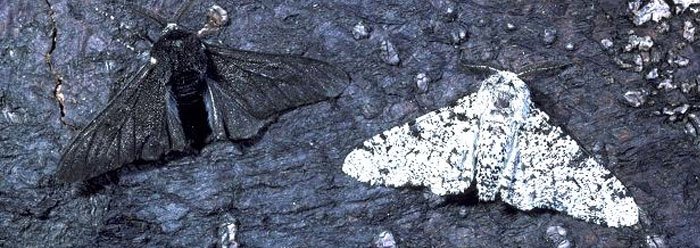
93.
The trees these moths used to live on were white, but have been covered in soot from coal factories. Which moth will be more successful in this environment?
a)
Dark moth
b)
Light moth
c)
Both will be equally successful
d)
Neither will be successful
94.
In the graph shown, how many species of lizards seem to have beneficial adaptations?
a)
1
b)
2
c)
3
d)
4
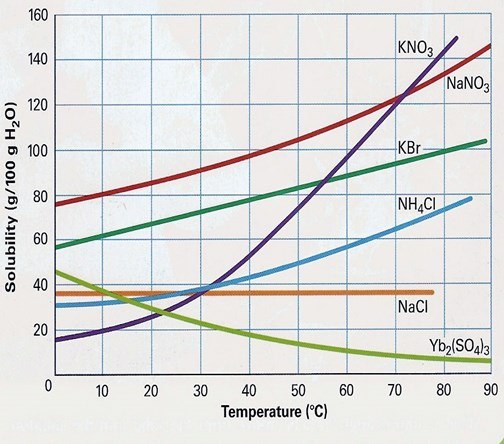
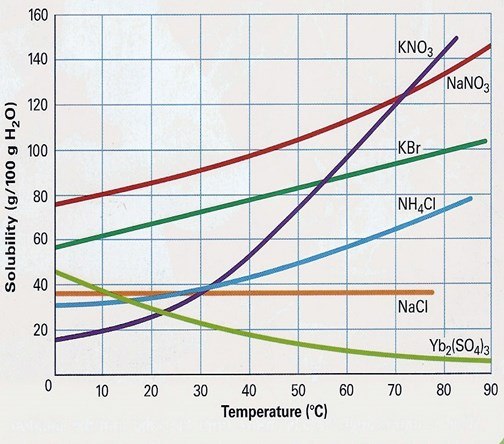
95.

At 30'C, which substance has the lowest solubility?

a)

KNO3

b)

KBr

c)

NaCl

d)

Yb2(SO4)3

96.

Identify if the following solution would be saturated, unsaturated, or supersaturated: 103 g KBr at 70oC.

a)

Unsaturated

b)

Saturated

c)

Supersaturated

97.
Between which points is the substance changing state?
a)
A-B only. 
b)
A-B, C-D, E-F
c)
B-C only. 
d)
B-C, D-E
98.

The theory of evolution is based upon the general principle that the most fit organisms will survive so that they can

a)

be a predator

b)

reproduce

c)

gain control of the land

d)

control the cells

99.

Why did Darwin think the finches had different types of beaks on each island?

a)

Ancestors had different shapes of beaks

b)

Beaks formed to eat different foods on different island

c)

Had very large beaks

d)

Had small beaks

100.

These are all evidences that scientist use for evolution

a)

Fossil record,

Comparative anatomy,

Embryology,

DNA extraction

b)

Fossil record,

Biology,

Embryology,

DNA comparison

c)

Fossil record,

Comparative anatomy,

Embryology,

DNA comparison

d)

Fossil record, Selective breeding, Embryology,

DNA comparison

101.

Which is an example of an organism's adaptation leading to natural selection?

a)

a farmer breeding cows to get more milk

b)

chicken being breed to have more meat

c)

a wolf's thick coat allows it to survive and reproduce

d)

a wolf being breed for its blue eyes

102.

A _____________ is the physical appearance of an organism, while a ___________________ is that organism's genetic code, that made it look that way.

a)

phenotype, genotype

b)

genotype, phenotype

c)

variation, mutation

d)

mutation, variation

103.

How do we end up looking the way we do?

a)

random chance with no pattern

b)

we genetical modify our DNA for specific traits

c)

we inherit traits from our parents

d)

we learn them as we grow

104.

Changes in the DNA sequence are called _____.

a)

adaptations

b)

proteins

c)

genes

d)

mutations

105.
When heat is transferred to a liquid what happens?
a)
A. It melts
b)
B. It vaporizes
c)
C. It sublimates
d)
D. It condenses