
 Worksheets
Semester 1 Review
Total questions: 109
Worksheet time: 53mins
What is the dependent variable?
What is the independent variable?
What would you graph on the Y axis from this statement?
What would you graph on the X axis for the above statement?

What is the dependent variable?
Hours is the dependent variable
Number of E. Coli Bacteria is the dependent variable
What is the independent variable?
Hours is the independent variable
Number of E. Coli Bacteria is the independent variable


Does the type of ball affect the bouncing height?
Which hypothesis is correct?
If the subject bounces a ping pong ball, then the ping pong ball will bounce the highest.
We use a big ball, the ball will bounce really high.
She can use a basketball, then the ball will bounce the lowest.
The subject uses a bowling ball, the bowling ball will bounce the lowest.

If an object has a density of 0.6 g/cm3 and you put it into water, will it sink or float?
sink
float

A possible explanation to a problem that has not yet been tested.
data
theory
hypothesis
fact
What is an observation?
A scientific statement based on ideas
Using your senses to notice what is going on around you
To be unaware of your surroundings
The question that you want an answer to.

Observations made during an experiment are called:
data
problems
conclusions
questions
A scientific observation is:
Based on facts
based on your personal beliefs
Based on opinions
Based on a rumor you heard in the bathroom
Which of the following is NOT a testable question?
How do rockets work?
Does fertilizer help plants grow bigger?
Does heart rate increase with exercise?
Does the freezing point of water change at different elevations?

It must be summer.
Qualitative Observation
Quantitative Observation
Opinion
Inference

The table top is smooth.
Qualitative Observation
Quantitative Observation
Hypothesis
Inference

The penguin got pushed in.
Qualitative Observation
Inference
Quantitative Observation
Hypothesis

The penguins are black and white.
Qualitative Observation
Inference
Hypothesis
Quantitative Observation

These kind of observations are made using instruments such as rulers, balances and thermometers.
Qualitative Observations
Quantitative Observations
Scientific Observations
Measured Observations

There are 29 students in the classroom.
quantitative observation
qualitative observation
inference
hypothesis

The speed of the car is 55 mph.
Qualitative Observation
Quantitative Observation
Hypothesis
Inference

The boy is probably sad...
Qualitative Observation
Hypothesis
Inference
Quantitative Observation

Which statement is an inference about this picture?
The van is tan.
The van is inside the KFC.
The wall is broken.
Someone has already called 911.
Using observations to make a logical theory or good guess.
Observation
Inference
Measuring
Qualitative Observation
Using any of your 5 senses to describe the world around you.
Observation
Inference
Quantitative Observation
Logical Theory

A student recorded how many commercials she saw in one week. Her results are recorded above. What can you you infer?
The tv shows lasted longer on Monday.
She watched more tv on Monday.
The tv shows didn't last as long as usual on Monday.
She watched less tv on Monday.





Why do we need controls in an experiment?
To make it challenging
To collect data
To make it fair and accurate
To make it interesting
A description of a pattern or an event in nature that is always true
Scientific Theory
Scientific Law
Hypothesis
Critical Thinking

Oh no! You dropped a beaker and it broke! What should you do next?
Cry
tell the teacher
sweep it up
tell your lab group
variable that is graphed on the x-axis of a graph
control variable
independent variable
dependent variable
experiment
variable that is graphed on the y-axis
experimental variable
independent variable
dependent variable
controlled variable
variable that is changed by the experimenter
independent variable
dependent variable
control variable
experiment
Mariah is trying out different types of markers to see which will produce the brightest colors. Which is the dependent variable?
the type of marker
brightness of the colors

What is the independent variable/manipulated variable?
Cost of Pizza
Number of Pizza Toppings
Same Pizza Place
What is the dependent variable?
Cost of Pizza
Number of Pizza Toppings
Same Pizza Place
Heat transfer occurs
in many directions.
both from warm objects to colder ones and from cold objects to warmer ones.
only from warm objects to colder ones.
only from cold objects to warmer ones
The sun’s rays are the MOST direct
near the poles.
near the equator.
at high altitudes.
far from the ocean.
The atmosphere is
the layer in which weather occurs.
the layer that contains the ozone layer.
the layer of water in the oceans.
the layer of gases that surrounds Earth.
Earth’s atmosphere is important to living things because it
contains dust and other particles.
is very thin compared to the size of Earth.
provides all the gases that living things need to survive.
maintains a constant relative humidity.
What is the formula for density?
Density = mass/volume
Density = volume/mass
Density = mass x volume
Density = mass + volume
As you rise upwards in the atmosphere, air pressure
increases.
decreases.
doesn’t change.
first increases, then decreases.
From Earth to space, the main layers in our atmosphere are:
troposphere, stratosphere, mesosphere, thermosphere.
stratosphere, troposphere, mesosphere, thermosphere.
mesosphere, troposphere, stratosphere, thermosphere.
thermosphere, troposphere, stratosphere, mesosphere.
The layer of our atmosphere in which weather occurs is the
troposphere.
stratosphere.
mesosphere.
exosphere.
The greenhouse effect is
the absorption of energy by clouds.
a gradual increase in the temperature of the atmosphere.
the reflection of solar energy into the atmosphere.
the process by which gases hold heat in the atmosphere.
Heat from the sun reaches you by
conduction.
light emission.
convection.
radiation.
Most of the heating of the troposphere comes from
conduction.
condensation.
convection.
radiation.
Convection currents in the atmosphere takes place because
warm air is more dense than humid air.
warm and cold air have the same density.
cold air is less dense than warm air.
cold air is more dense than warm air.
Winds are caused by differences in
precipitation.
humidity.
air pressure.
turbulence.
Earth’s rotation makes global winds curve. This is called the
Convection effect.
Global effect.
Coriolis effect.
Rotational effect.
Large clouds that often produce thunderstorms are called
stratus clouds.
cumulonimbus clouds.
cirrus clouds.
nimbostratus clouds.
Which of the following sources of weather data would enable a meteorologist to follow the path of an approaching thunderstorm?
a chart of data from nearby weather stations
Doppler radar
a network of aneroid barometers
weather balloons
When Earth receives energy from the Sun, ____.
some energy is reflected back into space
some is absorbed by the atmosphere
some is absorbed by land and water on Earth's surface
all of the above
The flow of air caused by ____ and the Coriolis effect creates distinct wind patterns on Earth's surface.
differences in heating
the ozone layer
magnetic fields
the jet streams
Air above the equator is heated more than at any other place on Earth because solar rays strike the equator ____.
at a 180° angle
at a 45° angle
more directly
less directly
A(n) ____ is a large body of air that has the same properties as the Earth's surface over which it develops.
air mass
cloud
tornado
front
The interaction of air, water, and ____ causes weather.
the Sun
humidity
land
wind
Structures like the pyramids of Egypt have been harmed by the effects of ____.
chlorofluorocarbons
carbon monoxide
ozone
acid rain
What is climate?
What's going on with the atmosphere at any particular time.
How much sunshine an area gets.
The type of weather that occurs during a particular season.
An area's pattern of weather over a long period of time.

The diagram represents a beaker of water being heated by a flame. The arrows represent heat transfer occurring in the beaker.
Which process is represented by the arrows in the diagram?
Conduction
Convection
Radiation
Soup
The Law of Conservation of Energy states that energy cannot be created or destroyed, but energy can change
its total mass
from one form to another
its total volume
from one state of matter to another

The arrows in the diagram show the circulation of air on a sunny day.
The air circulation shown is caused by
both hot air and cool air sinking
both hot air and cool air rising
hot air sinking and cool air rising
hot air rising and cool air sinking
The naturally occurring ozone layer shields Earth from
aliens
x-rays
magnetic forces
UV radiation
Which of the following does NOT have an affect on a region's climate?
longitude
latitude
mountains
large bodies of water (ex. ocean)
When the sun's rays pass through our atmosphere and then heat is trapped by the atmosphere it is called
Ice Age
Greenland effect
Global Warming
Greenhouse effect
What causes warm air to rise?
it's less dense than cold air
it weighs more than cold air
it has higher pressure than cold air
its more dense than cold air
Which statement correctly defines wind?
The movement of air from areas of low pressure to areas of high pressure
The movement of air to a colder area in the atmosphere.
The movement of air from areas of high pressure to areas of low pressure.
The movement of air pushed around and bouncing off Earth's surface.
What is the jet stream?
Football flying over the Earth
Strong winds above the Earth's surface
Weather over a long period of time
Clouds that form from jet plane exhaust
How does the jet stream affect the weather?
The jet stream brings only bad weather.
The jet stream releases oxygen so we can breathe.
The jet stream does not affect the weather.
The jet stream transports weather systems that affect us.
Which of the following has kinetic energy?
a rock poised for a fall
a rolling bowling ball
an archer’s bow that is drawn back
a car waiting at a red light
Climates are classified according to two major factors:
elevation and precipitation.
elevation and latitude.
latitude and temperature.
precipitation and temperature.
Unlike kinetic energy, potential energy is
stored.
energy of motion.
conserved.
not measurable
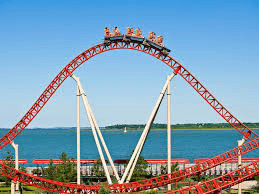
When a roller coaster is at the top of a hill it has
high potential energy
high kinetic energy
low potential energy
equal amounts of kinetic and potential energy
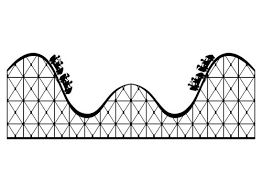
When a roller coaster is at the bottom of a hill it has
high potential energy
high kinetic energy
low kinetic energy
equal amounts of kinetic and potential energy

Which passenger has the most potential energy?
A
B
C
D
Conservation of energy means that
energy can be created but not destroyed
energy can be destroyed but not created
energy can both be created and destroyed
energy can neither be created nor destroyed
Complete the following sentence. The ________________ an object moves, the more ____________________ energy it has.
slower ... potential
faster .... kinetic
faster ... potential
slower ... kinetic
Write the equation of the line parallel to y = 4x + 3 and passing through the point (-4, -5)
y = -1/4x - 6
y = -1/4x + 8
y = 4x - 2
y = 4x + 11

What is the energy source that drives the water cycle?
The moon T
The heat from our home in the winter all around the world
The sun
he heat generated solely from the core of the earth

The mixture of gases that surround the earth. ____________________
Landforms
Sun
Atmosphere
Weathering

The process where plants absorb water through the roots and then give off water vapor through pores in their leaves. __________________________
Transpiration
Condensation
Evaporation
Precipitation

The fall of water, ice, or snow deposited on the surface of the Earth from the atmosphere. __________
Condensation
Evaporation
Precipitation
Transpiration

The draining away of water from the surface of an area of land. _________________
Density
Hydrologic cycle
Sun
Runoff

What is precipitation?
Sweat from our bodies on hot days
Gas that we use in furnaces or ovens
Any form of water that falls from the sky
Warm rain but not cold snow or sleet

What is formed when water vapor condenses?
Clouds
Transpiration
Valleys
Mountains
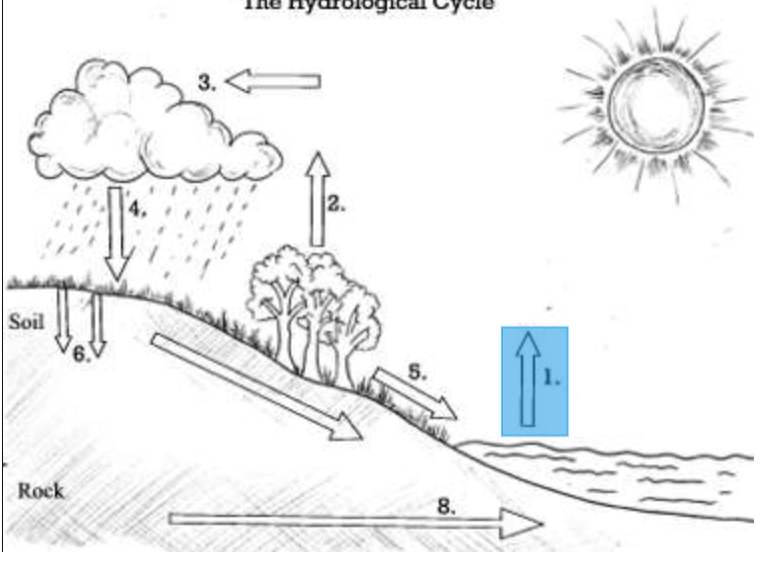
What phase of the water cycle is #4?
Evaporation
condensation
precipitation
runoff

What phase is #6
Evaporation
Precipitation
runoff
infiltration

What phase is #8?
Infiltration
ground water
runoff
evaporation

