
 Worksheets
23-24 Space Science Test Questions - Acc
Total questions: 105
Worksheet time: 17hrs 4mins
How do the inner planets compare to the outer planets? (Select ALL the answers that are correct)
The distances between orbits of the outer planets are much larger.
The distances between orbits of the inner planets are much larger.
The inner planets are larger in size.
The outer planets are larger in size.
Why do scientists use scale models to study the Solar System?
The solar system is too large to visualize without using models
The solar system is too small to visualize without using models
Scientists don't need to use models because we have satellites
The solar system moves too much to visualize without using models.
Why is making a model of the solar system difficult?
Don't have the right materials
The solar system is so big and the objects in it are so small in comparison
There are too many parts in a model
Because the science concepts are too difficult

Which planet in the Solar system orbits the sun in the shortest amount of time?
Mercury
Earth
Jupiter
Neptune

The graph shows the average temperatures of the planets in our solar system. Which planet has the highest average temperature?
Mercury
Venus
Earth
Jupiter

If you were going to make a scale model of the Solar system what planet should be the second largest?
Jupiter
Saturn
Earth
Uranus


What planet is spinning the fastest on its axis?
Mercury
Jupiter
Venus
Earth

What planets year (Period of Revolution) is shorter than its day (Period of Rotation)?
Venus
Jupiter
Earth
Uranus
One similarity between asteroids, comets and meteoroids is that they all:
are made of the same materials
come from the Asteroid Belt
have long tails that follow behind them
orbit the sun
Which is true of the dwarf planets? (Select all that are true.)
have cleared their orbit of other objects
made of ice
orbit the Sun
spherically shaped
Imagine that a new object is found in our solar system. It is small and made of rock and orbits the dwarf planet Eris. How would scientists classify this object?
A moon
A comet
An asteroid
A meteoroid
Which of the following bodies in our solar system orbit the sun? (Select all that are correct)
Meteoroids
Moons
Dwarf Planets
Comets
Asteroids
According to a livescience.com headline from a few years ago, "On Wednesday (Sept. 22, 2021), the fall equinox will bring the Earth about 12 hours of daylight, 12 hours of night, and a renegade space rock measuring about three times the size of the Statue of Liberty."
This object would be classified as a...
comet
asteroid
meteoroid
moon
This list represents the outer planets.
Jupiter, Saturn, Uranus, Neptune
Mercury, Saturn, Earth, Neptune
Mercury, Venus, Earth, Mars
Jupiter, Venus, Uranus, Mars
This list represents the inner planets.
Jupiter, Saturn, Uranus, Neptune
Mercury, Saturn, Earth, Neptune
Mercury, Venus, Earth, Mars
Jupiter, Venus, Uranus, Mars

These planets have shorter revolutions around the Sun.
Inner planets
Outer planets
Terrestrial planets
Gas Giants

These planets have smaller diameters.
Inner planets
Outer planets
Terrestrial planets
Gas giants

In the time it takes for Earth to orbit the sun once, Mercury will orbit the sun approximately (a) times. (Round your answer to the nearest whole number.)
How much closer to the Sun is Venus than the Earth?
41.4 km
41.4 million m
41.4 million km
41.4 billion km
4,140 km
Based on the data table, which of these planets has the greatest mass?
Venus
Saturn
Uranus
Earth

What kind of correlation is shown in this scatter plot?
(a)

What kind of correlation does the scatter plot show?
Positive
Negative
None

What kind of correlation does the scatter plot show?
(a)
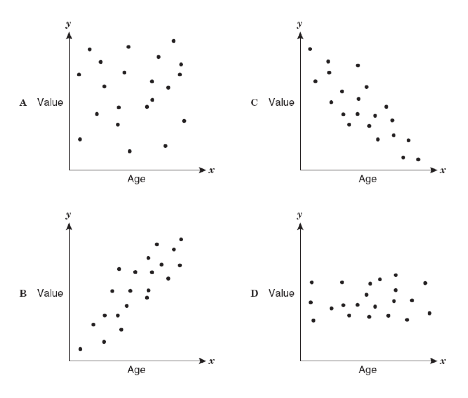


This graph compares the average scores of students in different class periods throughout the school day.
What is the relationship between the variables?
As the period number increases, the average student scores decrease
As the period number increases, the average student scores increase
There is no relationship between the class period and students' averages.

This graph compares data about car accidents with the ages of drivers.
What is the relationship between the variables?
As the driver age increases, the number of accidents decreases
As the driver age increases, the number of accidents increases
There is no relationship between driver age and the number of accidents.

This graph shows data collected from 450 planets within the Milky Way galaxy.
What type of correlation do you see?
(a)
This graph show data collected from 450 planets within the Milky Way galaxy.
What is the relationship between the variables shown?
As the radius of a planet increases, its mass increases.
As the radius of a planet increases, its mass decreases
As the radius of a planet decreases, its mass increases
There is no relationship between a planet's radius and its mass

Is the length of the year on a planet related to its distance from the sun?
Yes, it is positively correlated. As the distance from the sun increases, the length of the year increases
Yes, it is negatively correlated. As the distance from the sun increases, the length of the year decreases
Yes, it is negatively correlated. As the distance from the sun increases, the length of the year increases
No, it is not correlated. As the distance from the sun increases, the length of the year decreases
Yes, it is positively correlated. As the distance from the sun increases, the length of the year decreases

What happens when the hemisphere in which you live tilts away from the sun?
It receives more indirect rays from the sun; it is summer.
It receives more direct rays from the sun; it is summer
It receives more indirect rays from the sun; it is winter.
It receives more direct rays from the sun; it is winter.

Which season is taking place in the Southern Hemisphere in Position 2?

At position 2, which hemisphere would have summer?
Northern hemisphere
Southern hemisphere
Eastern hemisphere
Western hemisphere
What are the reasons for the seasons?
Earth's tilted axis of revolution
Earth's rotation around the sun.
Earth's tilted axis of rotation
Earth's revolution around the sun.

According to the diagram, the southern hemisphere is experiencing summer because
The south pole is tilted toward the sun and the southern hemisphere is receiving more direct rays of sunlight.
The north pole is tilted toward the sun and the northern hemisphere is receiving more direct rays of sunlight.
The south pole is tilted away from the sun and the southern hemisphere is receiving more indirect rays of sunlight.
The north pole is tilted away from the sun and the northern hemisphere is receiving more direct rays of sunlight.
Which season has the fewest number of daylight hours each day?
Spring
Summer
Winter
Autumn
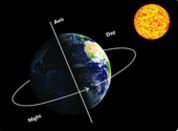
Day & night are caused by the ______________ of Earth on its axis
revolution
orbit
rotation
tilt

A student wants to use a spinning basketball to model the day-and-night cycle on Earth.
What should the student do in order to best model the cause of the day-and-night cycle?
Spin the ball in different directions
Tilt the ball while it is spinning
Paint one half of the ball black and the other half white
Shine a bright light on one side of the ball

In the summer many people enjoy going to the beach. The photograph shows a beach in Argentina, a country in South America, which is in the Southern Hemisphere.
Which diagram shows the position of Earth when it is summer in Argentina?


The model shows Earth in several positions relative to the sun.
In which position is it winter in North America?
Position 1, because North America receives the most direct sun
Position 2, because North America is tilted toward the sun
Position 3, because North America is parallel to the sun
Position 4, because North America is tilted away from the sun

Earth would not have seasons if:
its axis was not tilted
it rotated clockwise on its axis
it took an additional month to orbit the sun
it revolved around the sun in the opposite direction
What is the difference between a gibbous moon and a crescent moon?
The amount of the bright side of the moon that can be seen is greater in a gibbous moon than a crescent moon
The bright side of the moon is on the other side of a gibbous moon than it is on a crescent moon
The amount of the dark side of the moon that can be seen is greater in a gibbous moon than a crescent moon
A gibbous moon is increasing in brightness and a crescent moon is decreasing.

How long does it take for the Moon to make one full revolution around the Earth?
approximately one day
approximately one month
approximately one year
approximately never
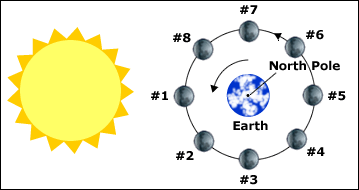
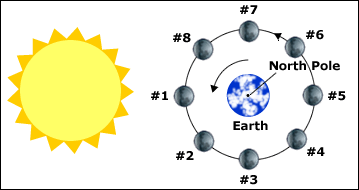
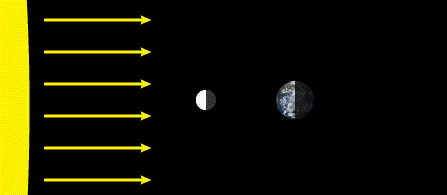
What phase of the moon is shown here?
New Moon
First Quarter
Third Quarter
Full Moon
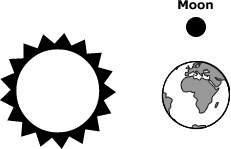
What phase of the moon would this picture represent?
3rd Quarter
1st Quarter
Waxing Crescent
Waning Gibbous
Which relative positions of the Sun, Earth, and Moon would result in a New Moon.


Which relative positions of the Sun, Earth, and Moon would result in a Waxing Crescent moon.
Which image shows a Waxing Gibbous moon?


Which image shows a Waning Gibbous?


Less than half of the visible moon is illuminated
More than half of the visible moon is illuminated
All of visible moon is illuminated
None of visible moon is illuminated

Name the moon phase that would come AFTER the phase shown here.
waning crescent
waxing crescent
waning gibbous
waxing gibbous


What phase is this?
First Quarter Moon
Third Quarter Moon
Waxing Gibbous Moon
Waning Gibbous Moon

If the last full moon was on April 4th, when can you expect to see the next full moon?
April 29th
July 4th
May 3rd
September 12th


Which moon phase is a waning gibbous?
A
B
C
D

This image shows the moon visible from Earth over several nights. From from left to right, does this picture represent a waxing or waning?
waxing, because the light is increasing
waning, because the light is decreasing
waxing, because the light is decreasing
waning, because the light is increasing

Which moon phase would be visible at position 4?

Approximately how much time passes between the new moon and full moon?
1 month
2 weeks
3 days
24 hours

If this image is modeling a SOLAR eclipse, what does the light source in the diagram represent?
What must occur for an solar eclipse to occur?
The Sun, Earth, and Moon align in that order
The Sun, Moon, and Earth align in that order

What is the lighter part of a shadow (light is partially blocked) called?
(a)

If this image is modeling a SOLAR eclipse, what does the ball in the diagram represent?

If this image is modeling a LUNAR eclipse, what does the ball in the diagram represent?

What type of eclipse is shown in the diagram?
total lunar eclipse
partial lunar eclipse
total solar eclipse
partial solar eclipse

What type of eclipse is being shown in the diagram?
total solar eclipse
total lunar eclipse
partial solar eclipse
partial lunar eclipse
When the earth is between the sun and the moon, this can result in...(SELECT 2)
a new moon
a solar eclipse
a lunar eclipse
a full moon

Which moon phase would a lunar eclipse occur in?

When the umbra from the Moon touches the Earth, viewers in that region get a _____
total solar eclipse
total lunar eclipse
partial solar eclipse
partial lunar eclipse

This is a photo of the surface of Earth during a solar eclipse. The dark spot is where the total solar eclipse is visible on Earth. Therefore, the spot you see is the moon's _________.
partial
umbra
penumbra
totality
Because the shadow of the ________ is much larger, a ________ eclipse happens much more frequently.
Earth, Solar
Earth, Lunar
Moon, Solar
Moon, Lunar

What type of eclipse is shown in the diagram?
total lunar eclipse
partial lunar eclipse
total solar eclipse
partial solar eclipse
A total solar eclipse is visible from
all over the Earth.
only within the moon's penumbra.
only within the moon's umbra.
only the dark side of the Earth.

At which position could a lunar eclipse occur?
A
C
E
G
At which position could a solar eclipse occur?
A
C
E
G

Which diagram correctly represents the relative positions of the Sun (S), Earth (E), and the Moon (M) in space during a total solar eclipse? [The diagrams are not drawn to scale.]


Which statement correctly describes the type of eclipse that was occurring and the position on Earth where this eclipse was observed?
A lunar eclipse was observed from position A.
A lunar eclipse was observed from position B.
A solar eclipse was observed from position A.
A solar eclipse was observed from position B.

You are less likely to see a total solar eclipse than a total lunar eclipse because
new moon phases occur less often than full moon phases.
the moon's shadow covers all of Earth during a solar eclipse.
only people on the daytime side of Earth can see a solar eclipse.
the moon's umbra only covers a small area on Earth's surface.
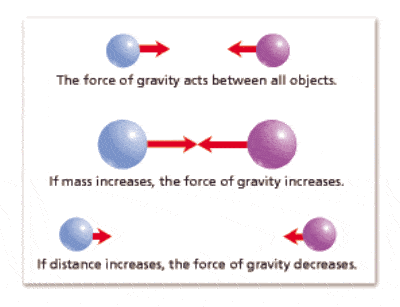
As mass increases, what happens to gravitational force?
It increases.
It decreases.
It stays the same.

In which model would the gravitational pull between the Earth and moon be greatest?
Model A; the distance is decreased
Model B; the distance is increased
Model A; the mass is decreased
Model B; the mass is increased
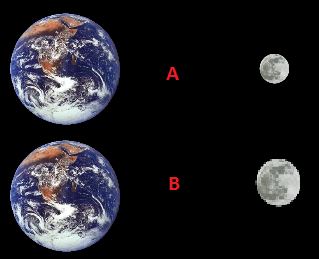
In which model would the gravitational force between the Earth and moon be greatest?
Model A; the mass of the moon is decreased
Model B; the mass of the moon is increased
Model A; the distance between them is increased
Model B; the distance between them is decreased
The TWO factors affecting the magnitude of the force of gravity between 2 objects are...
mass
velocity
distance
weight
You are standing on the Earth. If the Earth's mass was suddenly decreased by 50%, what would happen to your mass?
increase because gravitational force increases
decrease because gravitational force decreases
nothing, mass is not affected by gravitational force
An object's weight is a measure of the force of gravity acting on that object.
If the mass of the earth were to increase, what would happen to your weight.
increase because gravitational force increases
decrease because gravitational force decreases
nothing, weight is not affected by gravitational force
A person would weigh less on the Moon than on the Earth because . . .
Moon has more mass, and therefore more gravity
Moon has less mass, and therefore more gravity
Moon has more mass, and therefore less gravity
Moon has less mass, and therefore less gravity
The gravity on Mars is much lower than it is here on Earth. Because of this, what do you know about Mars?
Mars has less mass than Earth.
Mars has greater mass than the Earth.
Mars is closer to the sun than the Earth
Mars is farther from the Earth than the sun.
Why does the Earth's gravitational force affect the Moon more than the sun's does?
Earth has greater velocity
Earth has less mass
Earth is much closer
Earth is a planet
If Earth's distance from the sun was doubled, what would happen to the gravitational pull it would feel from the sun?
increase
decrease
nothing
Imagine 2 spheres made of iron. Which of the images below would have the greatest gravitational force between them?


__________holds all of the planets in orbit around the sun. Without it, they would all fly off into space.
Velocity
Motion
Weight
Gravity
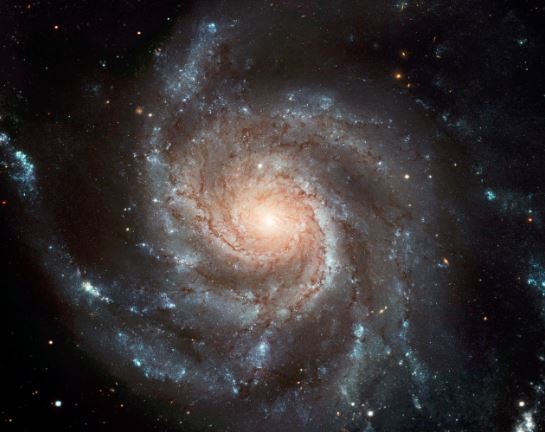
Our solar system is part of the Milky Way galaxy. Our sun and other stars orbit around a supermassive black hole located at the center of this spiral galaxy.
Without gravity, these stars, their planets, and all the other objects in this system universe would _______.
continue to orbit each other
move along curving paths through space
move through space in a straight line
stop moving
Which of the following is required for planets to stay in orbit around the Sun? (choose all that apply)
Gravity
Weight
Friction
Velocity
What prevents orbiting planets from crashing into the Sun?
their Gravity
their Weight
their Friction
their Velocity
As distance between objects increases, what happens to gravitational force?
It increases.
It decreases.
It stays the same.
The Earth is moving through space at a velocity of 29.8 km/s. If it's velocity were cut in half (~15 km/s), what would probably happen?
The Earth would fly off into space.
The Earth would crash into the sun.
The Earth would orbit the moon.
Nothing. Velocity has no effect on orbits.
When will the forces of gravity between two objects be the GREATEST?
when the masses of both objects are small and the objects are far apart
when the masses of both objects are large and the objects are close together
when the masses of both objects are small and the objects are close together
when the masses of both objects are large and the objects are far apart
When will the gravity between two objects be the LEAST?
when the masses of both objects is small and the objects are close together
when the masses of both objects is small and the objects are far apart
when the masses of both objects is large and the objects are close together
when the masses of both objects is large and the objects are far apart
An object's _____ is its curved path around a point/object in space.
orbit
rotation
revolution
spin
A measure of the amount of matter in an object:
volume
weight
density
mass

