
 Worksheets
BIO 1st Sem Exam Part 2 Review
Total questions: 106
Worksheet time: 1hrs 13mins
Which of the following describes cellular respiration?
Occurs in the chloroplast
Occurs in the stroma
Occurs in the thylakoid
Occurs in the mitochondria
Choose all that are PRODUCED during cellular respiration:
ATP
Water
Carbon dioxide
Oxygen
Glucose
Choose all that are PRODUCED during photosynthesis:
ATP
Water
Carbon dioxide
Oxygen
Glucose
Which of the following is NOT true of photosynthesis?
It only occurs in plants & some bacteria.
It occurs in 2 stages.
The mitochondria produced energy needed for it to occur.
It takes place in the chloroplast.
Which process involves the Calvin Cycle?
Photosynthesis
Cellular respiration
Both of these
Neither of these
The name for the stack of membrane-bound sacs inside the chloroplast of a plant cell:
Stroma
Grana
Thylakoid
NADP
The 1st stage of photosynthesis occurs in the inner fluid space of the chloroplast, called the
Stroma
Grana
Thylakoid
Inner membrane
What is the energy source for photosynthesis?
Enzymes
Sunlight
Glucose
Carbohydrates
What are the reactants for photosynthesis?
Carbon Dioxide & Oxygen
Oxygen & Water
Water & Glucose
Carbon Dioxide & Water
What type of sugar molecule is produced by plants during photosynthesis?
Phospholipid
Starch
Glucose
Lipid
Organisms that are able to take inorganic, raw materials and convert them into organic products to use for food are called
Autotrophs
Heterotrophs
Decomposers
Consumers
What green pigment is used to trap light energy from the Sun to be used for photosynthesis?
Chlorophyll
ATP
NADH
Chloroplast
In which organelle inside of plant cells does the process of photosynthesis occur?
Mitochondria
Stroma
Cell Wall
Chloroplasts
What is the formula for photosynthesis?
Carbon dioxide + Water → Glucose + Oxygen
Glucose + Oxygen
→ Carbon dioxide + Water
Carbon dioxide + Glucose
→ Oxygen + Water
Carbon dioxide + Oxygen
→ Glucose + Water
What are the small holes on the underside of plant leaves called?
Guard Cells
Stomata
Stroma
Grana
Which cells are responsible for opening and closing stomata to regulate water loss & gas exchange during photosynthesis?
Guard Cells
Gate Cells
Thylakoids
Stroma
What are the reactants of cellular respiration?
Glucose & oxygen
Glucose & carbon dioxide
Oxygen & water
Water & carbon dioxide
What molecules are produced by cellular respiration?
Water & glucose
Water, carbon dioxide & ATP
Glucose, oxygen & ATP
Oxygen & ATP
Inside of which cell organelle does cellular respiration take place?
Ribosome
Chloroplast
Nucleus
Mitochondria
What is a type of anaerobic respiration that produces carbon dioxide & ethyl alcohol, like during bread making?
Fermentation
Photosynthesis
Glycolysis
Anabolism
Which statement BEST compares aerobic and anaerobic respiration?
More ATP is generated during anaerobic respiration than during aerobic respiration
more water is generated during anaerobic respiration than during aerobic respiration
more oxygen is generated during anaerobic respiration than during aerobic respiration
More lactic acid is generated during anaeobic respiration than during aerobic respiration
Which of the following is TRUE about photosynthesis?
It requires 3 stages to complete, with the goal of producing NADPH.
It requires 2 stages, with the goal of producing glucose.
It begins with breaking down glucose in 3 stages, producing ATP.
It occurs in the mitochondria, drawing in oxygen and releasing carbon dioxide.


What is the name of the genetic material that is inside the nucleus?
ER
ATP
DNA
YOLO
Which organelles are only found in plant cells? 🌿
Nucleus
Chloroplast
Mitochondria
Cell wall

You might think of me as the trash collector, but recycler is maybe more accurate. What am I?
Mitochondria
Lysosome
Vacuole
Ribosome
The gel-like substance inside of cells is called ______
photoplasm
photosynthesis
cytoskeleton
cytoplasm

Where are proteins made?
Golgi body
Mitochondria
Chromosomes
Ribosomes
Centrioles
How does a cell maintain homeostasis?
Regulates what enters and leaves the cell
Flexibility
By utilizing its protective barrier
Converting sunlight to sugars
The cell membrane is selectively permeable, which means...
All materials can enter and leave the cell.
Certain things can enter, while others cannot.
The cell manually sorts through all materials.
Only certain cells can interact with the cell.
All of the following are part of/an example of a prokaryotic cell except
plasma membrane
DNA
endoplasmic reticulum
bacteria

Which of these is NOT a part of the Cell Theory?
All cells work independently.
Cells are the basic unit of living things.
All living things are made up one of or more cells.
Cells come from cells.
Has membrane bound organelles
Prokaryote
Eukaryote
both
neither
Which of the following does NOT describe a hydrophillic substance?
They are attracted to water molecules.
They dissolve well in water.
They have a "fear" of water.
They are polar.
Which of the following is the largest?
atom
organ system
molecule
organ


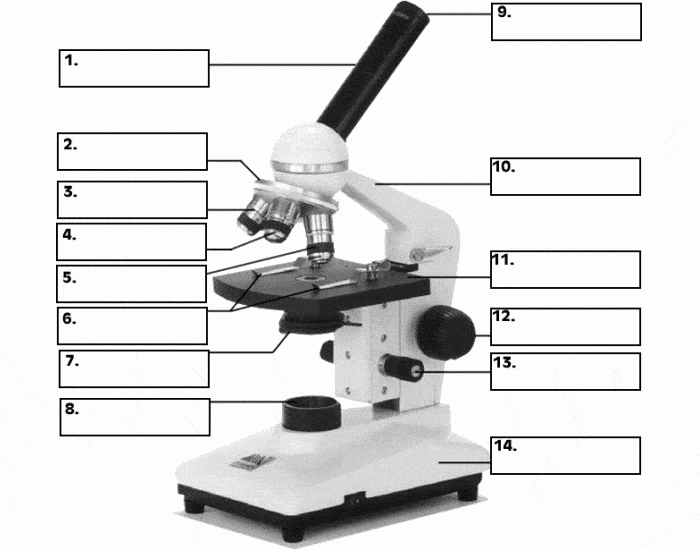


This bring the specimen into sharp focus; used only on high power:
Coarse Adjustment Knob
Fine Adjustment Knob
Eyepiece
Diaphragm
Stage
Part that holds two or more objective magnifying lenses
Stage
Stage Clip
Revolving Nosepiece
Body Tube


Moves stage up and down for focusing; large amounts; first focus knob used
Fine Focus Knob
Diaphragm Knob
Course Focus Knob
Nosepiece
Part 5
Low power (40X)
High power (100X)
Scanning objective (10X)
Diaphragm (100X)
Part 8
Diaphragm
Light source
Objectives
Ocular lens
Parts where you hold the microscope, when transporting/moving.
10 & 14
1 & 10
1 & 14
11 & 13


Which of these is a product of cellular respiration?
ATP
Carbon dioxide
Water
All of these are a product of cellular respiration

In this diagram of photosynthesis, what is used in #1?
Carbon dioxide
Oxygen
Water
Glucose
ATP
In this diagram of photosynthesis, what is #8?
Light dependent reaction
Kreb's Cycle
Calvin Cycle
Electron Transport Chain
In this diagram of photosynthesis, what is #2?
Light dependent reaction
Light independent reaction
Kreb's Cycle
Calvin Cycle
Electron Transport Chain
In this diagram of photosynthesis, what is #3?
ADP
ATP
NADP
NADPH
Glucose
In this diagram of photosynthesis, what is #4?
ADP
ATP
NADP
NADPH
Glucose
In this diagram of photosynthesis, what is #6?
Carbon dioxide
Oxygen
Water
ATP
Glucose
In this diagram of photosynthesis, what is #7?
Carbon dioxide
Oxygen
Water
ATP
Glucose
In this diagram of photosynthesis, what is #5?
Carbon dioxide
Oxygen
Water
ATP
Glucose
In this diagram of photosynthesis, what is #5?
Carbon dioxide
Oxygen
Water
ATP
Glucose

What is this process?
Cellular respiration
Photosynthesis
Mitosis
Meiosis
Not enough information given
What is #5?
Carbon dioxide
Oxygen
Water
ATP
Glucose
What is #4?
Carbon dioxide
Oxygen
Water
ATP
Glucose

What part of the cell is #1 (1st step of cellular respiration)?
Chloroplast
Cytoplasm
Mitochondria
Nucleus
Stroma
What part of the cell is #2 (2nd & 3rd steps of cellular respiration)?
Chloroplast
Cytoplasm
Mitochondria
Nucleus
Stroma
Which stage of the cellular respiration cycle is #3?
Light dependent reaction
Light independent reaction
Electron Transport Chain
Kreb's Cycle
Glycolysis
Which stage of the cellular respiration cycle is #10?
Light dependent reaction
Light independent reaction
Electron Transport Chain
Kreb's Cycle
Glycolysis
Which stage of the cellular respiration cycle is #7?
Light dependent reaction
Light independent reaction
Electron Transport Chain
Kreb's Cycle
Glycolysis
What is #5 indicating that is being produced from stage 1?
Water
Glucose
Carbon dioxide
Oxygen
Pyruvic Acid
Which is being produced in #6?
ATP
Glucose
Electrons
Water
Oxygen
Which is being produced in #8?
ATP
Glucose
Electrons
Water
Oxygen
What is the reactant in #4?
ATP
Glucose
Electrons
Water
Oxygen
What is the final product in #10?
ATP & Glucose
ATP & Water
ATP & Electrons
Electrons & Water
Oxygen & Carbon dioxide


What is the NEXT phase of mitosis after the phase shown?
Prophase
Metaphase
Anaphase
Telophase


if a body cell normally has 24 chromosomes how many will it have at the end of mitosis.
6
12
24
48

