
 Worksheets
CA 7 Review
Total questions: 110
Worksheet time: 2hrs 24mins
Name
Class
Date
1.

Two organisms that are closely related would have
(evolutionary speaking)
(evolutionary speaking)
a)
very similar DNA sequence
b)
exactly the same DNA sequences
c)
no proteins in common
d)
completely different DNA sequence
2.

The gradual development of a species into a new one to survive.
a)
Evolution
b)
Natural Selection
c)
Extinction
d)
Artificial Selection
3.
The goal of every species on earth is...
a)
to survive and reproduce
b)
divide and conquer
c)
survive and conquer
d)
reproduce and die
4.
A process by which individuals that are better adapted to their environment are more likely to survive and reproduce than others.
a)
evolution
b)
diversity
c)
natural selection
d)
noclueitis
5.

Flashy tails on many animals is an example of coloration. Why might flashy tailed animals display their colors to another of the same species?
a)
make friends
b)
help build a nest
c)
attract a mate
d)
scare predators
6.
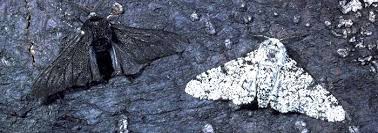
Predict which moth would increase in population
a)
light
b)
dark
c)
gray
7.
Mutations are a change in what?
a)
DNA
b)
tRNA
c)
genotype
d)
phenotype
8.
What is another name for natural selection?
a)
survival of the smartest
b)
survival of the fastest
c)
survival of the biggest
d)
survival of the fittest
9.
What is the study of organisms at the early stages of development?
a)
DNA studies
b)
embryology
c)
extinction
d)
fossil record
10.

Which species’ DNA is most similar to the DNA of the toothed whale?
a)
Hippopotamus
b)
Baleen Whale
c)
Grazing Mammals
d)
Camels
11.

The hypothesis that evolution of a species occurs in periods of rapid change separated by periods of little or no change is called
a)
divergence
b)
gradualism
c)
punctuated equilibrium
d)
isolation
12.

The hypothesis that evolution of a species occurs gradually over time as a slow and constant process is known as
a)
speciation
b)
punctuated equilibrium
c)
gradualism
d)
microevolution
13.

What is an example of?
a)
embryology
b)
fossil record
c)
homologous structures
d)
vestigial structures
14.
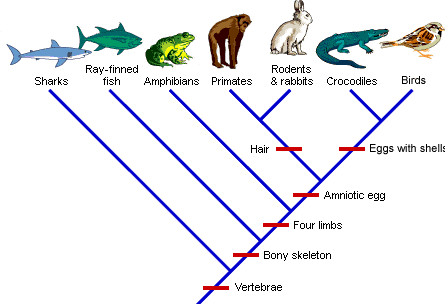
Which two orgainsms have hair?
a)
Sharks & Ray Finned Fish
b)
Primates & Rodents
c)
Birds & Crocodiles
d)
Rabbits & Birds
15.
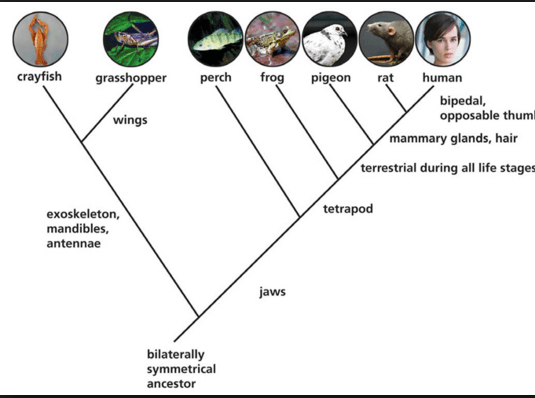
According to the cladogram, which organism is most distantly related to the human?
a)
crayfish
b)
grasshopper
c)
perch
d)
frog
16.

An illustration and a dichotomous key are given. What is the correct classification for this organism?
a)
Class Insecta
b)
Order Amblygygi
c)
Order Araneae
d)
Order Scorpiones
17.

How many animals have an amniotic egg?
a)
2
b)
3
c)
4
d)
5
18.

What genotype is missing from this Punnett Square?
a)
RrYy
b)
RRYY
c)
rryy
d)
RrYY
19.

What genus does Bird Z belong to?
a)
Certhidea
b)
Geospiza
c)
Camarhynchus
d)
Platyspiza
20.
What genus does Bird X belong to?
a)
Certhidea
b)
Geospiza
c)
Camarhynchus
d)
Platyspiza
21.

The 8 levels of classification, most broad to most specific.
a)
Domain, Genus, Family, Order, Class, Phylum, Kingdom, Species
b)
Domain, Species, Kingdom, Genus, Phylum, Family, Class, Order
c)
Domain, Kingdom, Phylum, Class, Order, Family, Genus, Species
d)
Order, Kingdom, Species, Domain, Phylum, Family, Class, Genus
22.
A virus needs a host cell in order to
a)
obtain nutrients
b)
make oxygen
c)
replicate
d)
grow
23.

What does the image represent?
a)
Gene flow
b)
Gene drift
c)
Mutation
d)
Adaptation
24.

What type of natural selection is this?
a)
Disruptive Selection
b)
Directional Selection
c)
Stabilizing Selection
d)
Sexy Selection
25.

What type of selection is depicted in the picture?
a)
stabilizing
b)
directional
c)
disruptive
d)
the answer is not here
26.

An earthquake causes an ocean channel top open and separate an island into two. the species on each section are now in
a)
geographic isoliation
b)
behavioral isolation
c)
disruptive selection
d)
temporal isolation
27.
What do you call all of the genes in a population?
a)
Gene pool
b)
Relative Frequency
c)
Genetic Drift
d)
Allele pool
28.
A random change in a small population's allele frequency is known as
a)
a gene pool
b)
genetic drift
c)
variation
d)
fitness
29.
Genetic Drift is more likely to happen in...
a)
aquatic populations
b)
small populations
c)
terrestrial populations
d)
older populations
30.
Formation of new species.
a)
artificial selection
b)
species
c)
speciation
d)
fossils
31.
Genetic drift, gene flow, mutation, nonrandom mating and natural selection - are known as what?
a)
Examples of evolution
b)
Evidence of evolution
c)
Mechanisms of evolution
32.
Yellow toucan birds seek out one another to make babies together and tend to avoid the green toucan birds.
a)
Genetic Drift
b)
Non-random mating
c)
Gene flow
d)
Mutation
33.
Logan was born with unique abilities for quick healing and awesome claws that stick out of his fingers.
a)
Gene flow
b)
Natural Selection
c)
Mutation
d)
Genetic Drift
34.

What does the image represent?
a)
Founder effect
b)
Bottleneck effect
c)
Natural Selection
d)
Mutations
35.
Term given to describe the 2 name naming system is:
a)
dichotmous key
b)
binomial nomenclature
c)
2 scientific names
d)
binomial key
36.
Cells that do not have a true nucleus are called....
a)
eukaryote
b)
prokaryote
c)
unicellular
d)
multicellular
37.

I am prokaryotic and am found everywhere. What kingdom do I belong to?
a)
Eubacteria
b)
Archaebacteria
c)
Fungi
d)
Protista
38.
What kingdom do unicellular, prokaryotic organisms that live in extreme environments?
a)
Animal
b)
Archaebacteria
c)
Eubacteria
d)
Plant
39.
Tool used by a taxonomist to identify an unknown organism is a:
a)
dichotomous key
b)
binomial nmenclature
c)
scientific name
d)
binomial key
40.
Which kingdom contains members who are prokaryotic?
a)
Archaebacteria and Eubacteria
b)
Archaebacteria and Protista
c)
Eubacteria and Animalia
d)
Eubacteria and Fungi
41.
What do all viruses need to reproduce?
a)
They need host genetic material
b)
They need a host cell
c)
They need bacteria
d)
They need insulin
42.
A(n) _____ is a virus that enters a bacterial cell.
a)
endospore
b)
decomposer
c)
plasmid
d)
bacteriophage
43.
What do viruses have in common with living cells? They both
a)
store genetic information
b)
have chloroplasts
c)
use glucose for cellular respiration
d)
have endoplasmic reticula
44.
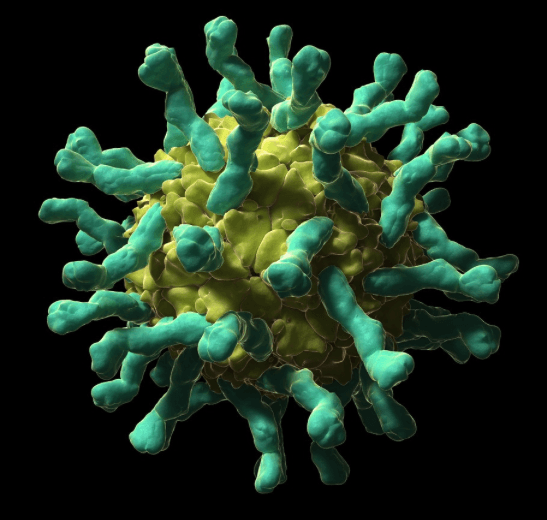
The reason that viruses are considered to be nonliving is because
a)
They are not cellular
b)
They cannot reproduce on their own
c)
They cannot make proteins
d)
all of the above
45.

The genetic material of a virus is in the form of
a)
RNA
b)
DNA
c)
either RNA or DNA
46.
Lysis is
a)
rupture of a cell membrane
b)
replication of a virus
c)
bacterial reproduction
d)
a process that rarely happens
47.
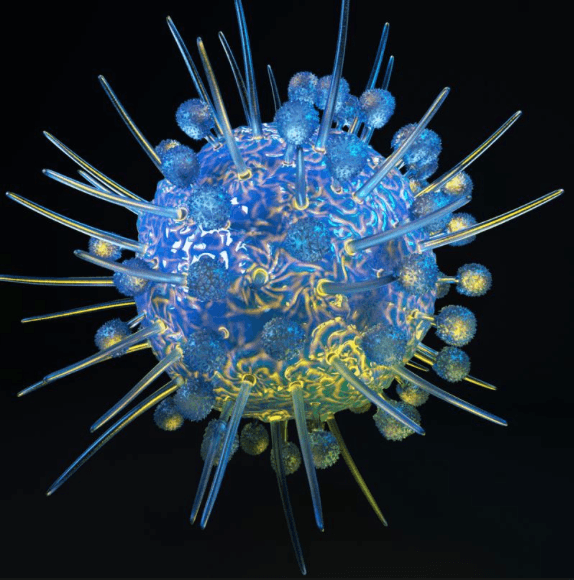
Most viruses do not kill humans. Why not?
a)
Viruses can only kill bacterial cells
b)
Humans have 100 trillion cells; viruses can't infect enough to kill
c)
Our immune cells hunt and kill viruses
d)
We have vaccines for all viruses
48.

A(n) _____ is a virus that enters a bacterial cell.
a)
endospore
b)
decomposer
c)
plasmid
d)
bacteriophage
49.

During an infection, some viruses remain inside cell but do not cause symptoms of disease. The graphic below depicts the...
a)
lytic cycle and the host cell is destroyed by rapidly reproducing viral particles
b)
lytic cycle and the viral nucleic acid inserts into the host cell chromosome
c)
lysogenic cycle and the viral nucleic acid inserts into the host cell chromosome
d)
lysogenic cycle and the viral nucleic acid replicates independently of the host cell chromosome
50.

What is the difference in the function of the glycoprotein structures of an HIV virion and the cilia of an animal cell?
a)
The glycoprotein structures are used for attachment, and the cilia are used to move in fluids surrounding the cell.
b)
The glycoprotein structures are used to obtain nutrition, and the cilia are used to secrete proteins.
c)
The glycoprotein structures are used to provide physical support for the viral envelope, and the cilia strengthen the cell membrane.
d)
The glycoprotein structures are used for defense, and the cilia are used for locomotion.
51.
Biologists have found that a virus is quickly infecting the population of bumblebee catfish in a local stream. Though the virus has not yet been analyzed, the biologists believe that it may be a threat to other organisms in the stream. Which of the following organisms would be most likely to get infected by the virus?
a)
Crawfish
b)
Elodea (aquatic plant)
c)
armored Catfish
d)
Salamander
52.
There are some structures which are unique to viruses and not found in cells.
These include:
I. Protein capsid
II. Nucleic acids
III. Cell wall
These include:
I. Protein capsid
II. Nucleic acids
III. Cell wall
a)
I only
b)
II only
c)
I and II only
d)
II and III only
53.
Which of the following aides in bacterial locomotion (movement)?
a)
Cell wall
b)
Flagellum
c)
Plasmid
d)
Capsid
54.

virus attaches
a)
a
b)
b
c)
c
d)
d
55.

host cell breaks open
a)
a
b)
c
c)
d
d)
e
56.
The term "antibiotic resistance" refers to bacteria that
a)
are resistant to a vaccine.
b)
survive in the presence of an antibiotic.
c)
are weakened and destroyed by antibiotics.
d)
are dead or altered.
57.
Bacteria cells contain structures called _____ , which are chemical factories where proteins are produced.
a)
mitochondria
b)
vacuoles
c)
ribosomes
d)
cells
58.
A solution containing a weakened version of a virus is a _________.
a)
Antibiotic
b)
Vaccine
c)
Window Cleaner
d)
Tap Water
59.

What is C pointing to?
a)
flagella
b)
pili
c)
DNA
d)
ribosome
60.
A virus can be classified by its type of
a)
mitochondria
b)
chromosomes
c)
nucleic acid
d)
carbohydrates
61.

What process is this?
a)
phagocytosis
b)
lytic cycle
c)
lysogenic cycle
d)
formation of antibodies
62.

What is shown here?
a)
Lysogenic Cycle
b)
Lytic Cycle
c)
Binary Fission
d)
Conjugation
63.

Name this bacteria shape
a)
coccus
b)
spirillum
c)
bacillus
64.

Name this bacteria shape
a)
bacillus
b)
coccus
c)
spirillum
65.

Name this bacteria shape
a)
coccus
b)
bacillus
c)
spirillum
66.
Bacteria that help break down dead material in the environment are called
a)
vaccines
b)
decomposers
c)
oats
67.
Live bacteria are found in milk, cheese and yogurt
a)
True
b)
False
68.
Bacteria are unicellular
a)
True
b)
False
69.

Bacteria help you digest food.
a)
True
b)
False
70.

Strep throat is caused by
a)
bacteria
b)
virus
71.

What are these images?
a)
Shapes of viruses
b)
Shapes of bacteria
c)
Shapes of protists
d)
Shapes of fungi
72.
Penicillin kills bacteria by
a)
consuming them
b)
causing holes in cell walls
c)
imprisoning them
d)
depriving them of nutrients
73.
process by which some bacteria convert N2 into ammonia
a)
reverse transcriptase
b)
binary fission
c)
nitrogen fixing
d)
conjugation
74.
Which of the bacteria is the cause of pneumonia?
a)
staphylococci
b)
rikettsia
c)
Treponema pallidum
d)
Streptococcus pnemoniae
75.
In binary fission, all of the following occur
EXCEPT...
EXCEPT...
a)
there is an increase in the number of bacterial cells
b)
pili are used to transfer DNA
c)
the resulting cells are genetically identical to the original cell
d)
only one parent cell was involved at the beginning
76.

What is structure 5?
a)
pilli
b)
cell wall
c)
ribosomes
d)
nucleoid
77.

Which structure aids the bacteria in movement?
a)
A
b)
B
c)
C
d)
D
78.

Based on the figure, which chemical inhibited the growth of the bacteria the most?
a)
A
b)
B
c)
C
d)
D
79.

The illustration shows the amount and types of bacteria found in a sample of patients in a study. Based on what you know about bacteria's effects in the body, which statement is most important for doctors to know about the patients
a)
the patients in the study are exhibiting resistance to antibiotics
b)
the patients in the study will require antibiotic treatment
c)
the patients are suffering from a multi-microbial infection
d)
the patients in the study have a healthy digestive system
80.
An advertisement on TV states that you will be much healthier if you take probiotics. Your research revealed that probiotics were bacteria that you could take as a dietary supplement to help with digestion. Your friend asks if this is true. You tell them...
a)
this is possible because many bacteria live in our digestive system and help with digestion
b)
this is impossible because bacteria cause disease
c)
this is impossible because food and medicine cannot contain bacteria
d)
this is possible because bacteria are a major source of nutrients in our diet
81.
Why are advantageous traits more likely to be passed onto offspring?
a)
Because they are more likely to survive and reproduce.
b)
Because they come from dominant alleles.
c)
Because they come from recessive alleles.
d)
Because the trait is an acquired phenotype.
82.
The theory of evolution by natural selection means that what is changing over time?
a)
The inherited traits of a population.
b)
The acquired traits of a population.
c)
Hair color and eye color
d)
Attractive features.
83.
Brown mice survive and reproduce in their desert environment better than white mice because owls can see and eat the white mice more easily. In this situation, what is doing the selecting?
a)
Owl
b)
Desert Background
c)
Brown Mice
d)
White Mice
84.
Have human beings evolved from apes?
a)
Yes and we evolved through natural selection
b)
Yes and we evolved through survival of the fittest
c)
No but we share a common ancestor
d)
Yes and we evolved through adapting to the environment
85.
Genetic Drift is more likely to happen in...
a)
aquatic populations
b)
small populations
c)
terrestrial populations
d)
older populations
86.
Which of the following is an example of the bottle neck effect?
a)
Bald Eagles are hunted until near extinction, pop recovers
b)
Small group of iguanas floats to an island, starts a new pop
c)
Environ of red fox pop now snowy, gen later pop is all white
d)
farmer chooses seeds from largest apples to plant next gen.
87.
Which of the following is an example of the founder effect?
a)
Bald Eagles are hunted until near extinction, pop recovers
b)
Small group of iguanas floats to an island, starts a new pop
c)
Environ of red fox pop now snowy, gen later pop is all white
d)
farmer chooses seeds from largest apples to plant next gen.
88.
A virus killed most of the seals in the North Sea (e.g. dropped the population from 8000 to 800). In an effort to help preserve the species, scientists caught 20 of the remaining seals and used them to start a new population in the northwest Pacific Ocean. Which of the following statements would accurately describe the new population?
a)
The new seal population is genetically less diverse than the original population
b)
The new seal population is genetically more diverse than the original population
c)
There is equal genetic variety compared to the original population
d)
None of the answers
89.
Which disease is not caused by bacteria?
a)
Strep throat
b)
Pneumonia
c)
Food poisoning
d)
Influenza (the Flu)
90.
Most bacteria are...
a)
Autotrophs
b)
Heterotrophs
91.
Bacteria will reproduce by means of __________________ because they are single-celled and do not contain a nucleus.
a)
Asexual Reproduction
b)
Osmosis
c)
Mitosis
d)
Growing
92.
_____ are uni-cellular organisms that do not contain a nucleus.
a)
Bacteria
b)
Animals
c)
Plants
d)
Virus
93.

The part of the bacteria cell labeled "E" which helps the bacteria move is called a
a)
Pilus
b)
DNA/Chromosome
c)
Ribosome
d)
Flagella
94.
The name streptococcus tells you the bacteria are arranged as ___.
a)
pairs of round cells
b)
long chains of round cells
c)
groups of spirals
d)
chains of rods
95.
Penicillin kills bacteria by
a)
consuming them
b)
causing holes in cell walls
c)
imprisoning them
d)
depriving them of nutrients
96.
Which of the following processes brings about an exchange of genetic information between bacterial cells?
a)
binary fission
b)
mutulaism
c)
conjugation
d)
replication
97.

This picture represents which method of reproduction?
a)
Binary Fission
b)
Conjugation
c)
Sexual reproduction
98.
What is structure 5?
a)
pilli
b)
cell wall
c)
ribosomes
d)
nucleoid
99.
A "resting stage" of bacteria that happens when environmental conditions are unfavorable
a)
peptidoglycan
b)
symbiosis
c)
endospore
d)
capsule
100.
Which of the following is NOT a role of bacteria that live in human bodies?
a)
digesting food
b)
competing for space with disease-causing bacteria
c)
making vitamins
d)
fixing nitrogen
101.
Which of the following structures are always found in bacterial cells?
a)
nuclei
b)
ribosomes
c)
flagella
d)
Coats
102.
A hidden virus
a)
cannot attach to a host cell.
b)
becomes part of the host cell's genetic material.
c)
immediately takes over the cell's functions.
d)
attaches to but does not enter the cell.
103.
When a virus invades a living cell, its _______
takes over the cell's functions.
takes over the cell's functions.
a)
outer coat
b)
genetic material
c)
core
d)
cytoplasm
104.
The shape of the _____ on a virus's coat allows the virus to attach to certain cells.
a)
proteins
b)
vitamins
c)
core
d)
host
105.

Bacteria share similar structures that plants have. What are two of these structures?
a)
Nucleus & Cell Wall
b)
Cell Wall & Tail
c)
Cell Wall & Cell Membrane
d)
Cell Membrane
106.

Bacteria are known to make medicine. What do they make for people who suffer from diabetes?
a)
Insulin
b)
Antibiotics
c)
Vaccines
d)
Advil
107.
What happens in the lytic cyle?
a)
Virus goes in and leaves the host cell
b)
Virus quickly kills the host cell
c)
Virus sleeps inside of the host cell
d)
Virus stay dormant for a long time
108.
What happens in the lysogenic cycle?
a)
Virus goes in and leaves the host cell
b)
Virus quickly kills the host cell
c)
Virus inject the nucleic acid into the host cell, and the nucleic acid integrates into the host cell DNA, and stay dormant for a long time
d)
Bacteria injects DNA into a host cell
109.

What process is this?
a)
phagocytosis
b)
lytic cycle
c)
lysogenic cycle
d)
formation of antibodies
110.
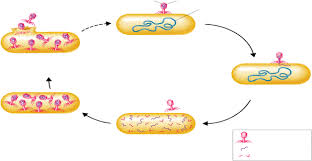
What is shown here?
a)
Lysogenic Cycle
b)
Lytic Cycle
c)
Binary Fission
d)
Conjugation
100 %

