wayground logo

Free Printable Worksheets

Font size

S
M
L
XL
Worksheets

Biology Final Exam Review

Total questions: 109

Worksheet time: 10hrs 43mins

Name
Class
Date
1.
Homozygous is when...
a)
the alleles are the same
b)
the alleles are different
c)
the alleles are absent
d)
the alleles are present
2.
Heterozygous is when...
a)
the alleles are the same
b)
the alleles are different
c)
the alleles are absent
d)
the alleles are present
3.
In a heterozygous genotype, the ___________ allele takes over in the phenotype.
a)
recessive
b)
dominant
c)
lower case letter
d)
both 
4.
T - tall and t = short
In the punnett square below, what belongs in the missing square
a)
tt
b)
Tt
c)
Bb
d)
TT
5.
B = brown fur  b = white fur
In the punnett square, what is the probability for white fur? 
a)
0%
b)
25%
c)
50%
d)
75%
6.
In the punnett square shown, what must the genotype of the missing parent be?
a)
BB
b)
Bb
c)
bb
d)
Tt
7.
In the punnett square shown, what is the genotypes of the two parents?
a)
RW and RR
b)
RW and WW
c)
RR and WW
d)
RW and RR
8.
Which of the following is a phenotype?
a)
Aa
b)
black hair
c)
heterozygous genes
d)
mutated DNA
9.
Dominant or recessive?
tt
a)
Dominant 
b)
Recessive
10.
What is a dominant allele?
a)
A trait that is always shown (capital letter)
b)
A trait that can be hidden (lower case letter)
c)
Alleles that are the same
d)
Alleles that are different
11.
What genotype is missing from this Punnett Square?
a)
RrYy
b)
RRYY
c)
rryy
d)
RrYY
12.
What does heterozygous mean?
a)
An organism that has the same genes for a trait (TT or tt)
b)
An organism that has different genes for a trait (Tt)
c)
When neither gene is fully dominant; offspring is a mixture of both
d)
the different forms of a trait (hair color--> brown, blonde, red
13.
Which of the following genotypes is heterozygous?
a)
Bb
b)
BB
c)
bb
d)
B
14.

Incomplete dominance means that there traits are...

a)

expressed equally

b)

dominant

c)

recessive

d)

blended

15.

Polygenic means that _________ control a characteristic.

a)

many genes

b)

a single gene

c)

3 genes

d)

no genes

16.

Polygenic means that _________ control a characteristic.

a)

many genes

b)

a single gene

c)

3 genes

d)

no genes

17.

An example of polygenic inheritance is...

a)

height

b)

hitch hikers thumb

c)

blood type

d)

tongue curling

18.
What do you call the non-Mendelian inheritance pattern where both traits are dominant and both appear in the organism with heterozygous genotype?
a)
Codominance
b)
Incomplete dominance
c)
Polygenic traits
19.
What pattern of inheritance is shown in this image?
a)
Codominance
b)
Incomplete dominance
c)
Polygenic traits
20.
What pattern of inheritance is shown in this image?
a)
Codominance
b)
Incomplete dominance
c)
Polygenic traits
21.
Which term(s) best describes the inheritance of human blood types? 
a)
incomplete dominance and multiple alleles
b)
codominance and epistasis
c)
codominance and multiple alleles
d)
incomplete dominance and codominance
22.
A breed of chicken shows codominance for feather color. One allele codes for black feathers, another codes for white feathers. The feathers of heterozygous chickens of this breed will be:
a)
all black
b)
all white
c)
all gray
d)
speckled black and white
23.
What is it called when a sperm and egg meet?
a)
meiosis
b)
fertilization
c)
cell division
d)
mitosis
24.
Which process and type of resulting cells are represented?
a)
mitosis, gametes
b)
mitosis, body cells
c)
meiosis, gametes
d)
meiosis, body cells
25.
The chromosomes that pair up during meiosis, are called __________ chromosomes.  
a)
homozygous 
b)
asexual
c)
homologous
d)
genes
26.
A male shark has 40 chromosomes in each of its sex cells. How many would be present in its body cells?
a)
20
b)
40
c)
80
d)
160
27.
Which letter(s) in the diagram correspond to cells that are haploid? 
a)
A
b)
B
c)
C
d)
A and B
28.
Compared to the number of chromosomes contained in a body cell, how many chromosomes would normally be contained in a gamete?
a)
The same number
b)
One-fourth as many
c)
Twice as many
d)
Half as many
29.
What causes genetic variation in meiosis?
a)
chromosomes lining up
b)
crossing over of chromosomes
c)
separation of chromosomes
d)
chromosomes pulling apart
30.
What is one of the advantages, why is it better to reproduce sexually versus asexually?
a)
survival of the fittest
b)
overproduction
c)
genetic variation
d)
cloning
31.
Crossing over helps promote 
a)
male genotype
b)
genetic variation
c)
DNA replication
d)
mitosis
32.
Chromosomes exchange genetic material during 
a)
crossing over
b)
replication
c)
synthesis
d)
translation
33.
A human zygote should have _____ chromosomes inside.
a)
46
b)
23
c)
92
d)
64
34.
Females have ____ and males have _____ chromosomes.
a)
XX, XY
b)
XY, XX
c)
XX, XX
d)
XY, XY
35.
A human being has a somatic cell that has 46 chromosomes.  What is the haploid number found in a gamete?
a)
23
b)
46
c)
69
d)
92
36.
Diploid Cells are represented by
a)
2n
b)
n
c)
4n
d)
1/2 n
37.
This mechanism of evolution occurs when individuals migrate between populations.
a)
Extinction
b)
Gene flow
c)
Genetic drift
d)
Natural Selection
38.
Genetic drift is change in the allele frequency of a population due to...
a)
random chance
b)
natural selection
c)
non-random mating (sexual selection)
d)
artificial selection
39.
Which of the following is an example of the bottle neck effect?
a)
Bald Eagles are hunted until near extinction, population recovers.
b)
Small group of iguanas floats to an island, starts a new population.
c)
Red fox pups are more likely to survive in a snowy environment if they are born white.
d)
Farmer chooses seeds from largest apples to plant next year.  This results in larger apples from year to year.
40.

Which of the following is an example of natural selection?

a)

Bald Eagles are hunted until near extinction, population recovers.

b)

Small group of iguanas floats to an island, starts a new population.

c)

Red fox pups are more likely to survive in a snowy environment if they are born white.

d)

Farmer chooses seeds from largest apples to plant next year. This results in larger apples from year to year.

41.
Five hundred years after the deer had established a flourishing population in the park, a few of them venture back to their original woods and have babies with the deer there.
a)
Genetic Drift
b)
Mutations
c)
Non-random mating
d)
Gene flow
42.
Yellow toucan birds seek out one another to make babies together and tend to avoid the green toucan birds.
a)
Genetic Drift
b)
Non-random mating
c)
Gene flow
d)
Mutation
43.
One day a group of scientists collected a small group of brown anole lizards from a large group of the lizards.  Then they placed this small group of lizards on an island that had no brown anole lizards on it.  What is this an example of?
a)
Bottleneck Effect
b)
Hardy Effect
c)
Founder Effect
d)
None of These
44.

What is this an example of?

a)

natural selection

b)

artificial selection

45.

Which statement is true comparing natural selection and artificial selection?

a)

In natural selection, traits benefit humans and in artificial selection, the traits benefit the species

b)

In natural selection, traits benefit the species and in artificial selection, the traits benefit humans

c)

In natural and artificial selection, the process takes hundreds of years to occur

d)

In natural and artificial selection, nature determines what traits will be passed down to offspring.

46.

What is an example of artificial selection?

a)

Letting dogs choose their own mate

b)

Letting plants pollinate on their own

c)

Crossing a labrador and a poodle to create a labradoodle

47.
During gestation (pregnancy), a developing male pig had a change in his genetic code. The result was that he was able to walk and do karate.
a)
Genetic Drift
b)
Non-random mating
c)
Mutation
d)
Natural Selection
48.
Bats are common in Texas, especially in rocky regions. Bats with longer hang claws have demonstrated higher fitness because of their ability to cling to rock while resting.
a)
Adaptation
b)
Non-random mating
c)
Gene Flow
d)
Mutation
49.
Two track stars fell in love and after marriage had 5 children that became record-setting athletes.
a)
Non-random mating
b)
Gene flow
c)
Genetic drift
d)
Mutation
50.

Which levels of hierarchy form the scientific name?

a)

Class and species

b)

Order and genus

c)

Phylum and species

d)

Genus and species

51.
Term given to describe the 2 name naming system is:
a)
dichotmous key
b)
binomial nomenclature
c)
2 scientific names
d)
binomial key
52.
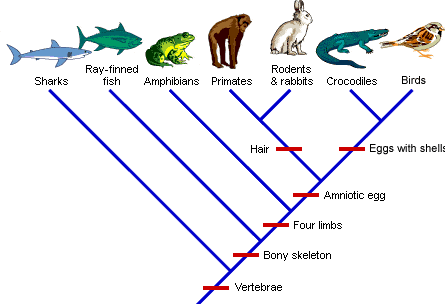
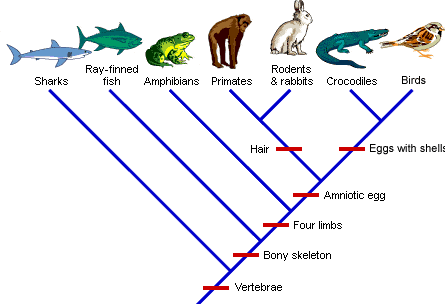
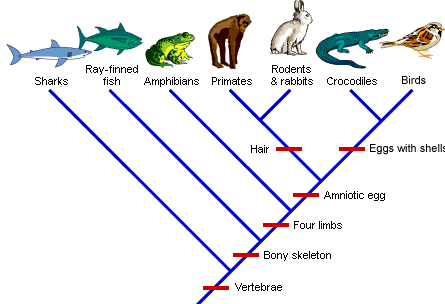
According to this cladogram, sharks are MOST closely related to which organism? 
a)
Amphibians
b)
Ray finned fish
c)
Crocodiles
d)
Birds
53.
Which two orgainsms have hair? 
a)
Sharks & Ray Finned Fish
b)
Primates & Rodents
c)
Birds & Crocodiles
d)
Rabbits & Birds
54.
According to this cladogram, birds are LEAST related to: 
a)
Amphibians
b)
Sharks
c)
Ray Finned Fish
d)
Crocodiles
55.
The 8 levels of classification, most broad to most specific.
a)
Domain, Genus, Family, Order, Class, Phylum, Kingdom, Species
b)
Domain, Species, Kingdom, Genus, Phylum, Family, Class, Order
c)
Domain, Kingdom, Phylum, Class, Order, Family, Genus, Species
d)
Domain, Kingdom, Species, Phylum, Family, Order, Class, Genus
56.

The proper writing of a scientific name includes ___.

a)

Genus Capitalized

b)

Species Lowercase

c)

Underline or Italics

d)

All of the above

57.

What level comes after order?

a)

genus

b)

kingdom

c)

family

d)

species

58.

The 4 eukaryote kingdoms are Animals, Plants, Fungi, and

a)

Bacteria

b)

Archaea

c)

Humans

d)

Protists

59.

Choose the correct way to write the scientific name for humans:

a)

homo sapiens

b)

Homosapiens

c)

Homo sapiens

d)

Homo Sapiens

60.

Some female peacocks prefer males with large, colorful tales while other female peacocks prefer males with no tail at all. Females are now mating only with the tail they prefer. What type of reproductive barrier is this?

a)

behavioral isolation

b)

hybrid sterility

c)

temporal isolation

d)

mechanical isolation

61.
A flash flood carried a raft of Amazon ants away from their original population. There is enough distance between the two groups, that they will never meet in nature again. What type of reproductive barrier is this?
a)
behavioral isolation
b)
temporal isolation 
c)
gametic isolation
d)
geographic isolation 
62.

In the Great Lakes region of North America, gray wolves and coyotes are similar species but do not mate because their breeding periods occur at different times of the year.

a)

Geographic isolation

b)

Behavioral isolation

c)

Temporal isolation

63.

The flashing pattern of the firefly (Lampyridae) is used to attract the opposite sex. Female fireflies only flash back and attract male fireflies who first signal them with a species-specific pattern of light.

a)

Geographic isolation

b)

Behavioral isolation

c)

Temporal isolation

64.

Some female peacocks prefer males with large, colorful tales while other female peacocks prefer males with no tail at all. Females are now mating only with the tail they prefer. What type of reproductive barrier is this?

a)

behavioral isolation

b)

hybrid sterility

c)

temporal isolation

d)

mechanical isolation

65.
Why are advantageous traits more likely to be passed onto offspring?
a)
Because they are more likely to survive and reproduce.
b)
Because they come from dominant alleles.
c)
Because they come from recessive alleles.
d)
Because the trait is an acquired phenotype.
66.
What is the term used to describe all living things in an ecosystem?
a)
Biotic Factors
b)
Abiotic Factors
c)
Environmental Factors
d)
Population
67.
What is the term used to describe all non-living things in an ecosystem?
a)
Biotic Factors
b)
Abiotic Factors
c)
Environmental Factors
d)
Population
68.
These are organisms that creates their own food such as plants and trees.
a)
Population
b)
Community
c)
Producers
d)
Consumers
69.
When a plant is eaten by a grasshopper, the grasshopper is called
a)
Producer
b)
Primary consumer
c)
Secondary consumer
d)
Tertiary consumer
70.
What do you call ALL the living things in the same environment?
a)
population
b)
community
c)
ecosystem
d)
biome
71.
What do you call all of the living things AND all of the non-living things together in the same environment?
a)
Population
b)
Community
c)
Ecosystem
d)
Biome
72.
What do you call it when one species benefits AND the other species benefits?
a)
predation
b)
parasitism
c)
commensalism
d)
mutualism
73.
What do you call it when one species benefits and the other species is not really affected in any way?
a)
Predation
b)
Parasitism
c)
Commensalism
d)
Mutualism
74.
What do you call it when new communities form after a major disturbance like a flood, fire, hurricane, etc.?
a)
First Succession
b)
Secondary Succession
c)
Primary Succession
d)
Ending Succession
75.
What do you call it when communities form in an area that previously had no life?
a)
First Succession
b)
Secondary Succession
c)
Primary Succession
d)
Ending Succession
76.
Where does the carbon come from that plants use?
a)
Animals
b)
Water
c)
Air
d)
Connecticut
77.
Where is carbon stored in the environment?
a)
Fossil fuels
b)
Wood of trees
c)
Calcium carbonate (shells and bones)
d)
All of the above
78.
A particular golf course is using large amounts of nitrogen fertilizer. What process could move this nitrogen into a local stream?
a)
volatilization
b)
nitrogen fixation
c)
runoff
d)
ammonification
79.
What converts nitrogen into a useable form for plants and animals?
a)
bacteria
b)
fungi
c)
rain
80.
Carbon dioxide is added to the atmosphere by
a)
Burning fossil fuels 
b)
Cellular respiration
c)
Decomposing organic matter
d)
All answers are correct
81.

An animal that only feeds on plants is called

a)

Vegetarian

b)

Herbivore

c)

Carnivore

d)

Vegan

82.

How much energy is moved from one trophic level to the next trophic level?

a)

100%

b)

1/2

c)

10%

d)

25%

83.

How many calories will be passed on from 250 to the next trophic level?

a)

2,500

b)

25

c)

2.5

d)

10%

84.

What is an example of a scavenger?

a)

vulture

b)

bear

c)

lion

d)

gorilla

85.

At what population was carrying capacity met?

a)

250

b)

1000

c)

400

d)

720

86.

Logistic population growth can be described as

a)

growth when resources are limited

b)

a s-shaped curve

c)

reaching carrying capacity

d)

all of the above

87.

Density-independent limiting factors to population growth includes

a)

stress from overcrowding

b)

parasitism

c)

competition

d)

natural disasters

88.

As resources become less available the growth of a population

a)

slows or stops

b)

decreases or increases

c)

up or down

d)

in or out

89.

Exponential Growth occurs when-

a)

populations have plenty of food/space

b)

home to keystone species

c)

have few evasive species in a habitat

d)

have little to no competition or predators

90.

Causes of death in a population may be-

a)

density dependent & density independent

b)

dispersion independent

c)

density independent

d)

independent density

91.
If the number of births in a population is the same as the number of deaths in a population, what will happen to the growth of the population?
a)
It will increase.
b)
It will decrease.
c)
It will stay the same.
d)
It will fluctuate.
92.
When a virus invades a living cell, its _______
takes over the cell's functions.
a)
outer coat
b)
genetic material
c)
core
d)
cytoplasm
93.
What part of the phage is the DNA?
a)
A
b)
B
c)
C
d)
D
94.
What is the purpose of surface marker on a virus
a)
As defense.
b)
They provide structural support.
c)
To allow the virus to move.
d)
To attach to the host cell.
95.
All foreign materials that cause a response from the immune system are called _____________________.
a)
Antigens
b)
Active Immunity
c)
Antibodies
d)
Antibiotics
96.
Proteins produced by B cells and designed to mark antigens to be destroyed, specific to the antigen.
a)
Antigens
b)
Active Immunity
c)
Antibodies
d)
Antibiotics
97.
Which of the following is a non-specific response?
a)
Fever
b)
Red, itchy eyes that may be crusted shut
c)
Signs that is related to one antigen
98.
What is the first barrier against disease?
a)
White blood cells
b)
Red blood cells
c)
the skin
d)
leucocytes 
99.

An accurate definition of Sustainability is

a)

meeting population needs

b)

meeting the needs of the present without compromising the ability of future generations to survive

c)

meeting the needs of the future without worrying about todays

d)

meeting the food needs of animals

100.

A resource that can replenish itself is...

a)

Renewable

b)

Non-renewable

101.

Gas, oil and diesel are all examples of...

a)

Renewable resources

b)

Non-renewable resources

102.

Solar, wind and water energy are all...

a)

Non-sustainable resources

b)

Sustainable resources

103.
Biodiversity refers to
a)
extinct species
b)
the variety of species on Earth
c)
nonrenewable resources
d)
the rate of species decline
104.
1. What makes a species invasive?
a)
Moving to a new ecosystem and taking resources from natives 
b)
Not having papers
c)
Species that can't adapt
d)
Plants that take up too much space
105.
If a blue catfish is introduced and eats the large fish who eat the smaller fish, what will happen to the population of the smaller fish?
a)
Increase
b)
Decrease
c)
Stay the same
d)
No affect on smaller fish
106.

Which organism in the food web shown to the right would

contain the highest concentration of chemical pollutants?

a)

Producers

b)

Primary consumers

c)

Secondary consumers

d)

Tertiary consumers

107.

The removal of forests around the world has a negative effect on the global carbon cycle. Which of the following effects to the carbon cycle would be caused by deforestation?

a)

Increased levels of atmospheric CO2

b)

Reduced rates of decomposition by bacteria

c)

A reduction in available solar energy

d)

Increased levels of atmospheric O2

108.

When deforestation occurs, some species become extinct as their habitats are destroyed. What effect does this have on global biodiversity?

a)

the biodiversity of the planet increases

b)

the planet’s biodiversity is not affected

c)

the biodiversity of the planet decreases

d)

the planet’s biodiversity cannot be measured

109.

Which organism in the food web shown to the right would

contain the lowest concentration of chemical pollutants?

a)

Producers

b)

Primary consumers

c)

Secondary consumers

d)

Tertiary consumers